The Grow Awards 2026 🏆
Likes
Comments
Share
@DBoogie
Follow
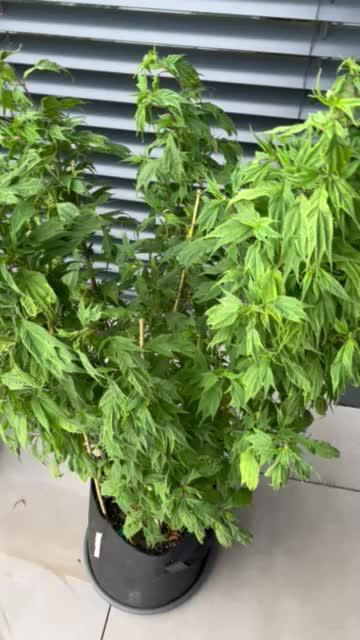
Hey Team! What can I say, my first time grow is coming along smooth. 🍃🍃 🍃 D-Boogie coming along smooth y’all. I think My tangerine dream is getting ready to flower soon. Going to carry out the veg-state as long as I can. I’m not sure how much water to give them but I’m sticking my gallon a week to keep it safe. Looking forward to next week!
Likes
16
Share
@LowzGrowz
Follow
Great Strain will run again No Larf all dense nug Great Fade Frosty Purple tint nugs
Likes
3
Share
Likes
Comments
Share
Starting to Fill The 3 Litre Pot Out Now So Few More Days Be Ready For Her Final Pot, Maybe Thinking A 7 Or 10 Litre For Flowering.
Likes
4
Share
Looking like 3 more weeks until harvest. I’m going to start flushing in about 10-12 days
Likes
11
Share
01.09.25 the three fast flowering strains keep dropping fan leaves and growing flower sites instead. Odor is slowly picking up on the balcony. The mildew from the Sherbets didn't spread and so far looks contained. I keep an eye on this and am ready to spray again if needed. Finally the Sherbets start to show pistils after the month of August is over, in which exotic seeds said the harvest would take place 😂. So kudos to seedsman for their genetics delivering as advertised and shame on exotic seeds for advertising harvest in August when flower starts last week of August.
Processing
Likes
56
Share
Week 3 of flower and plants are settling in nicely. Gave the plants a top feeding of some of my super soil....and will water in a little bit.... half a Dixie cup every other week seems to do the trick... The plant are showing there different pheno traits. The back right plant seems like it's gonna be the burgandy phenom.. love this grow so far can't wait!!!
Likes
42
Share
Thank you. Gave her a cocktail to help with stress. Added 1st net for lateral support, not so much now, but for later. Blue light is absorbed by photoreceptor proteins called phototropins, which trigger a hormonal response that causes cells on the shaded side to elongate, making the plant bend toward the light. Try and fill this side a little. She is quite big already, just needs to find her stride again after the undue torture. 5 apex stems with 20-30 mini cola, let them develop a little, with the apical dominance shattered, all those 20-30 will all compete with each other as soon as that stretch is initiated. Key to a good stretch is making sure the plant is cycling efficiently, with large ATP conversions occurring lights out. For now, I'm keeping light intensity high. A plant will slow its vertical growth in very high light intensities, leading to a more compact form with thicker stems and leaves. This response is a protective mechanism against light stress, which can damage the photosynthetic apparatus and lead to symptoms like leaf scorching, yellowing, and brittleness. Instead of growing taller, the plant invests its energy into creating a more robust, stress-tolerant structure. Providing plants with necessary antioxidants helps protect the photosynthetic apparatus by scavenging reactive oxygen species (ROS) that cause damage from excess light. UV light exposure can impact the xanthophyll cycle by either enhancing its photoprotective role or causing damage, depending on the intensity and type of UV radiation. UV exposure can trigger the synthesis of more xanthophyll cycle pigments to increase the plant's capacity to dissipate excess energy, but it can also cause direct damage, particularly to Photosystem II, and may lead to a decrease in the de-epoxidation state (DEPS ratio) which indicates a reduced capacity to dissipate excess energy. Plants can respond to UV stress by increasing the synthesis of xanthophyll cycle pigments, such as violaxanthin and zeaxanthin, to improve their photoprotective capacity. UV-induced changes in xanthophyll cycle pigments can be linked to a plant's overall tolerance to high radiation stress. The xanthophyll cycle helps protect against photoinhibition, which is especially important when the plant is exposed to high levels of both UV and visible light. High doses of UV radiation can directly damage photosynthetic components, including the proteins, lipids, and pigments in the thylakoid membranes. Exposure to UV radiation can have a mixed effect on the de-epoxidation state (DEPS ratio) of the xanthophyll cycle pigments. In some cases, UV can inhibit the conversion of violaxanthin to zeaxanthin, resulting in a lower DEPS ratio and a reduced capacity for energy dissipation. However, the total pool of xanthophyll cycle pigments may increase, and this enhanced pool size could provide a greater potential for photoprotection despite a lower DEPS ratio. The xanthophyll cycle works alongside other mechanisms, such as the accumulation of flavonoids (UV screens), to protect the plant from UV-induced damage. Blue light repairs 100% UV-induced damage in plants through a process called photoreactivation, which uses a light-dependent enzyme called photolyase. This enzyme uses energy from blue and UV-A light to directly reverse the damaging pyrimidine dimers in the DNA caused by UV-B radiation, a key mechanism for maintaining the plant's genetic integrity. After carbon, light, water, temperature, and nutrients, the limiting factor of a plant's growth is often its own internal factors or the amount of a key ingredient. Chlorophyll concentration is one such factor, as the amount of this pigment limits how much light can be captured for photosynthesis. Other factors include chloroplast number, respiration rate, and the concentration of carbon dioxide in the atmosphere, as plants are often in a CO2-deficient condition. 60x60x18=64800seconds x 700 = 45,360,000moles. 45DLI Exposure to 165 µW/cm² of ultraviolet-B (UV-B) light for 3600 seconds = 1 hour, a extremely high, acute dose triggering stress responses and protective mechanisms. . The plant's photoreceptor protein, UVR8, senses the UV-B radiation. This triggers a signaling cascade that activates specific genes to protect the plant from damage. In response to the UV-B signal, the plant ramps up the biosynthesis of protective compounds like flavonoids, phenolic acids, and anthocyanins. These compounds absorb UV radiation and accumulate in the epidermal layers of leaves to shield inner photosynthetic tissues. The plant may increase leaf thickness or deposit more cuticular wax, creating a physical barrier to the radiation. The plant will produce more enzymatic and non-enzymatic antioxidants to neutralize the reactive oxygen species (ROS) produced by the UV-B radiation. The plant activates enzymes, including photolyases, to repair DNA damage caused by the UV-B. These repair mechanisms are critical for preventing permanent genetic mutations. While protective measures are activated, a high dose delivered over a short period can cause stress that overwhelms the plant's defenses. Photosynthesis is highly sensitive to UV-B. A high dose can inactivate Photosystem II (PSII), damage thylakoid membranes within the chloroplasts, and reduce chlorophyll content, which lowers the plant's overall photosynthetic capacity. Despite repair mechanisms, high UV-B doses can inflict persistent damage on the plant's DNA. The overproduction of reactive oxygen species can cause oxidative stress, leading to the oxidation of lipids and proteins and disrupting cellular function.
Likes
10
Share
@heeelion
Follow
Well sliding into another week, I'm checking the trichomes and waiting for them to go milky, not sure if i can just check leaves for that. That's what i have been doing. I've been told i'm waiting for a portion of at least half of the hairs to go an orange/bronze color. Weird blotches become more prominent on leaves that its visible (they are just in some leaves) less than half id say around 15 - 20% and less than half of those seem pretty bad. I would like to know the cause if its nutrient lockout or a disease etc. Or perhaps its normal for late stage flowering i do not know
Likes
13
Share
@Corwinism
Follow
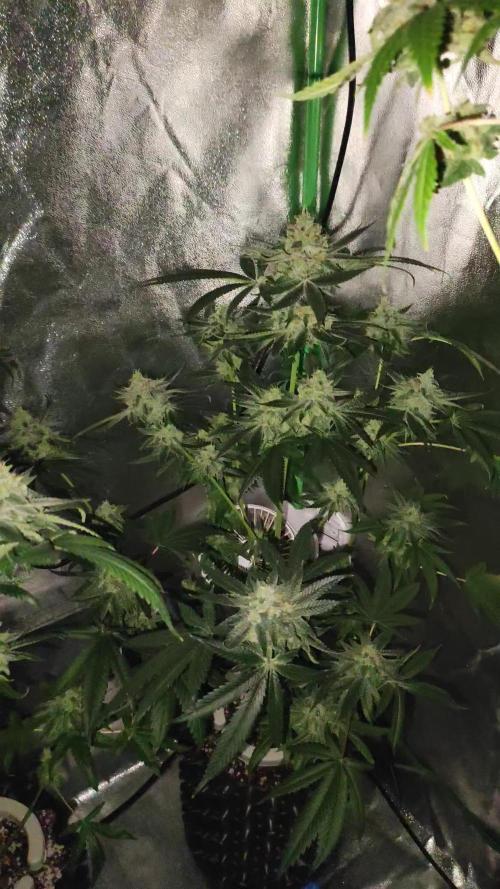
Week 3 of flower and the garden is looking great! I'm living for the aroma that fills my entire apartment each time I unzip the tent. The pre-flower stretch is pretty much over at this point. Maybe a few more days left. Mimosa EVO stretched the most after the 12/12 switch, followed closely by the Glookies. American Pie #1 remained relatively short compared to American Pie #2, and the other 2 cultivars. With that said, the canopy isn't as even across the top as I would like. I can't really complain too much though because there are so many colas. Did a light defoliation in addition to lollipopping. My LST job is looking pretty good. My next grow I should have my technique more zeroed in, with an even canopy across the board. Onto week #4! I'll see you all there. 🙏
Likes
11
Share
Taste like Sweets and Blueberry. 10/10 - Did cut early as well.
Processing
Likes
4
Share
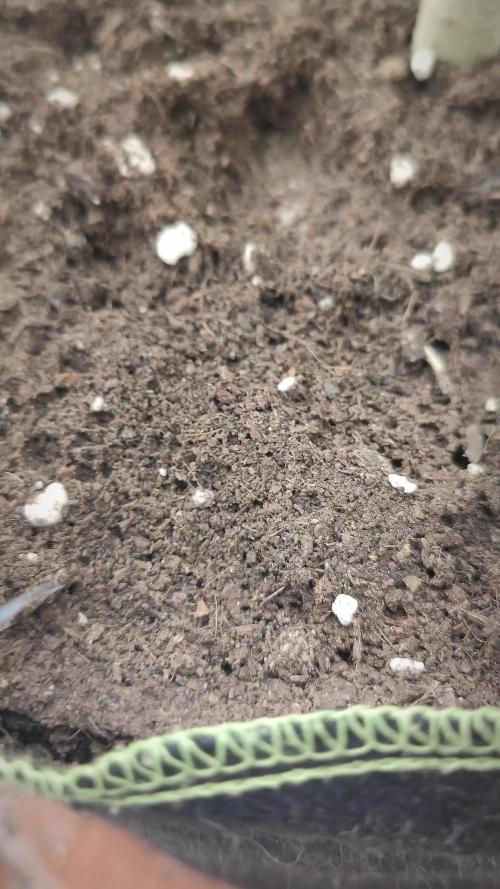
Dropped the seeds in water in the afternoon, the day before yesterday. I just put them in the pots about an hour ago. I am growing 4 in a 4X4. All the seeds were split and showing just a bit of the root. I mixed about a teaspoon of Azos with the soil just where the seeds are, in the center of the pots. I mixed it into a depth of about 3 inches. I am misting with PH (6.4) adjusted water. Will grab some pics when the girls come up. It should just be a couple of days. Update for the week. It's early morning on the 9th, 5 days since planting. All 4 of these Fastberrys were up within 48 hours of going into the ground. They popped within 12 hours of each other. They have now been up for 2 days and are looking good. Still misting with just PH (6.4) adjusted water. I will mist for a couple more days and then start real watering. The first watering will include Mykos WP to help with root growth. So far off to a good start!
Likes
5
Share
Week 13 for Moby Dick by fastbuds, She lost a lot of her foliage during the hot weather this week as i also think she ran out of food a little earlier than i wanted her to. At the start of the week i gave her a fairly heavy feeding & she gaining some colour back, but now im back to plain water as she comes to her finish. Actually glad so much foliage has fallen off going to be a lot of an easier trimming job 😂
Likes
8
Share
@Random80
Follow
Again I did not connect her on autopot but soaked the soil with loads of water and left wet towels all around the bottom of the tent to keep humidity since capacity of my humidifier is just one day. My idea was that she will use all the water in the pot and nicely dry out the root until I am back next time and in the meantime wet towels on the bottom of the tent will keep air humidity for first few days and than I can switch ON my humidifier remotely for last day, if needed (I am using alfred camera app and my old phone inside of the tent to be able to keep an eye on conditions while I am absent however I can only remotely control humidifier). Turns out (AGAIN) that it was too much water and she did not manage to use all of it during this 5 days. I found the top of the soil to be completely dried out while at the bottom of the pot and by the weight I would guess that there was still plenty of water available. I am using guanokalong soil that normally spreads water and humidity very nicely so I was bit surprised about such a difference from top to bottom of the pot. Overwatering signs are visible on young leaves; they became soft and start curling down got darker color. Despite that I have added 0,5 lit water (with orgatrex) just to balance the humidity in the pot. I am here only for day and a half and after that I will be gone for 10 days. Will not be able to dry out the soil before connecting autopot so more problems related with overwatering can be expected next time I am back. Will try to calculate quantity of water needed for 10 day and fill the tank of autopot with just a bit less than that so she can recover from all that water at one point.
Likes
13
Share
Likes
2
Share
I planted 3 seeds to germinate, but only one sprouted. Sad. After it emerged in the coco, the first watering was done with aloe vera juice. The next day, it was irrigated with Azospirillum, a bacteria that promotes plant growth, fixing N. The third watering was done with an aerated tea consisting of mycorrhizae, molasses, and worm castings. The fourth watering was done with fertilizer, with a ppm of 700. I used Plant Prod and Calcium Nitrate. For the fifth watering, I repeated the tea, and finally, another watering with fertilizer, with a slightly lower ppm (541). All waterings maintained a pH between 5.5-5.8.
Likes
67
Share
Day 63: What can i say, its not going bad nor great. Maybe it is just me used to grow better plants lol. Last time i found another reason why it is the way how it is now. This week i also though about having 20hours of light. I have done it before but with other pots, soil and more, it is really rewarding to have 20-24hours of light with autoflowers, but after seeing them so much stretch i should had thought about having less lighthours like 12 to 14, it would had stimulated the flowering better and stopped stretching that much ahaha. That kind of dumb shit happens when you don't have enough time to take care of so many plants.