The Grow Awards 2026 🏆
Likes
Comments
Share
Se han estresado un poco por retrasarme en el trasplante q con el calor q ha hecho no queria estresarlas aun mas. Trasplante hecho recuperación en marcha.
Likes
56
Share
What's in the soil? What's not in the soil would be an easier question to answer. 16-18 DLI @ the minute. +++ as she grows. Probably not recommended, but to get to where it needs to be, I need to start now. Vegetative @1400ppm 0.8–1.2 kPa 80–86°F (26.7–30°C) 65–75%, LST Day 10, Fim'd Day 11 CEC (Cation Exchange Capacity): This is a measure of a soil's ability to hold and exchange positively charged nutrients, like calcium, magnesium, and potassium. Soils with high CEC (more clay and organic matter) have more negative charges that attract and hold these essential nutrients, preventing them from leaching away. Biochar is highly efficient at increasing cation exchange capacity (CEC) compared to many other amendments. Biochar's high CEC potential stems from its negatively charged functional groups, and studies show it can increase CEC by over 90%. Amendments like compost also increase CEC but are often more prone to rapid biodegradation, which can make biochar's effect more long-lasting. biochar acts as a long-lasting Cation Exchange Capacity (CEC) enhancer because its porous, carbon-rich structure provides sites for nutrients to bind to, effectively improving nutrient retention in soil without relying on the short-term benefits of fresh organic matter like compost or manure. Biochar's stability means these benefits last much longer than those from traditional organic amendments, making it a sustainable way to improve soil fertility, water retention, and structure over time. Needs to be charged first, similar to Coco, or it will immobilize cations, but at a much higher ratio. a high cation exchange capacity (CEC) results in a high buffer protection, meaning the soil can better resist changes in pH and nutrient availability. This is because a high CEC soil has more negatively charged sites to hold onto essential positively charged nutrients, like calcium and magnesium, and to buffer against acid ions, such as hydrogen. EC (Electrical Conductivity): This measures the amount of soluble salts in the soil. High EC levels indicate a high concentration of dissolved salts and can be a sign of potential salinity issues that can harm plants. The stored cations associated with a medium's cation exchange capacity (CEC) do not directly contribute to a real-time electrical conductivity (EC) reading. A real-time EC measurement reflects only the concentration of free, dissolved salt ions in the water solution within the medium. 98% of a plants nutrients comes directly from the water solution. 2% come directly from soil particles. CEC is a mediums storage capacity for cations. These stored cations do not contribute to a mediums EC directly. Electrical Conductivity (EC) does not measure salt ions adsorbed (stored) onto a Cation Exchange Capacity (CEC) site, as EC measures the conductivity of ions in solution within a soil or water sample, not those held on soil particles. A medium releases stored cations to water by ion exchange, where a new, more desirable ion from the water solution temporarily displaces the stored cation from the medium's surface, a process also seen in plants absorbing nutrients via mass flow. For example, in water softeners, sodium ions are released from resin beads to bond with the medium's surface, displacing calcium and magnesium ions which then enter the water. This same principle applies when plants take up nutrients from the soil solution: the cations are released from the soil particles into the water in response to a concentration equilibrium, and then moved to the root surface via mass flow. An example of ion exchange within the context of Cation Exchange Capacity (CEC) is a soil particle with a negative charge attracting and holding positively charged nutrient ions, like potassium (K+) or calcium (Ca2+), and then exchanging them for other positive ions present in the soil solution. For instance, a negatively charged clay particle in soil can hold a K+ ion and later release it to a plant's roots when a different cation, such as calcium (Ca2+), is abundant and replaces the potassium. This process of holding and swapping positively charged ions is fundamental to soil fertility, as it provides plants with essential nutrients. Negative charges on soil particles: Soil particles, particularly clay and organic matter, have negatively charged surfaces due to their chemical structure. Attraction of cations: These negative charges attract and hold positively charged ions, or cations, such as: Potassium (K+) Calcium (Ca2+) Magnesium (Mg2+) Sodium (Na+) Ammonium (NH4+) Plant roots excrete hydrogen ions (H+) through the action of proton pumps embedded in the root cell membranes, which use ATP (energy) to actively transport H+ ions from inside the root cell into the surrounding soil. This process lowers the pH of the soil, which helps to make certain mineral nutrients, such as iron, more available for uptake by the plant. Mechanism of H+ Excretion Proton Pumps: Root cells contain specialized proteins called proton pumps (H+-ATPases) in their cell membranes. Active Transport: These proton pumps use energy from ATP to actively move H+ ions from the cytoplasm of the root cell into the soil, against their concentration gradient. Role in pH Regulation: This active excretion of H+ is a major way plants regulate their internal cytoplasmic pH. Nutrient Availability: The resulting decrease in soil pH makes certain essential mineral nutrients, like iron, more soluble and available for the root cells to absorb. Ion Exchange: The H+ ions also displace positively charged mineral cations from the soil particles, making them available for uptake. Iron Uptake: In response to iron deficiency stress, plants enhance H+ excretion and reductant release to lower the pH and convert Fe3+ to the more available form Fe2+. The altered pH can influence the activity and composition of beneficial microbes in the soil. The H+ gradient created by the proton pumps can also be used for other vital cell functions, such as ATP synthesis and the transport of other solutes. The hydrogen ions (H+) excreted during photosynthesis come from the splitting of water molecules. This splitting, called photolysis, occurs in Photosystem II to replace the electrons used in the light-dependent reactions. The released hydrogen ions are then pumped into the thylakoid lumen, creating a proton gradient that drives ATP synthesis. Plants release hydrogen ions (H+) from their roots into the soil, a process that occurs in conjunction with nutrient uptake and photosynthesis. These H+ ions compete with mineral cations for the negatively charged sites on soil particles, a phenomenon known as cation exchange. By displacing beneficial mineral cations, the excreted H+ ions make these nutrients available for the plant to absorb, which can also lower the soil pH and indirectly affect its Cation Exchange Capacity (CEC) by altering the pool of exchangeable cations in the soil solution. Plants use proton (H+) exudation, driven by the H+-ATPase enzyme, to release H+ ions into the soil, creating a more acidic rhizosphere, which enhances nutrient availability and influences nutrient cycling processes. This acidification mobilizes insoluble nutrients like iron (Fe) by breaking them down, while also facilitating the activity of beneficial microbes involved in the nutrient cycle. Therefore, H+ exudation is a critical plant strategy for nutrient acquisition and management, allowing plants to improve their access to essential elements from the soil. A lack of water splitting during photosynthesis can affect iron uptake because the resulting energy imbalance disrupts the plant's ability to produce ATP and NADPH, which are crucial for overall photosynthetic energy conversion and can trigger a deficiency in iron homeostasis pathways. While photosynthesis uses hydrogen ions produced from water splitting for the Calvin cycle, not to create a hydrogen gas deficiency, the overall process is sensitive to nutrient availability, and iron is essential for chloroplast function. In photosynthesis, water is split to provide electrons to replace those lost in Photosystem II, which is triggered by light absorption. These electrons then travel along a transport chain to generate ATP (energy currency) and NADPH (reducing power). Carbon Fixation: The generated ATP and NADPH are then used to convert carbon dioxide into carbohydrates in the Calvin cycle. Impaired water splitting (via water in or out) breaks the chain reaction of photosynthesis. This leads to an imbalance in ATP and NADPH levels, which disrupts the Calvin cycle and overall energy production in the plant. Plants require a sufficient supply of essential mineral elements like iron for photosynthesis. Iron is vital for chlorophyll formation and plays a crucial role in electron transport within the chloroplasts. The complex relationship between nutrient status and photosynthesis is evident when iron deficiency can be reverted by depleting other micronutrients like manganese. This highlights how nutrient homeostasis influences photosynthetic function. A lack of adequate energy and reducing power from photosynthesis, which is directly linked to water splitting, can trigger complex adaptive responses in the plant's iron uptake and distribution systems. Plants possess receptors called transceptors that can directly detect specific nutrient concentrations in the soil or within the plant's tissues. These receptors trigger signaling pathways, sometimes involving calcium influx or changes in protein complex activity, that then influence nutrient uptake by the roots. Plants use this information to make long-term adjustments, such as Increasing root biomass to explore more soil for nutrients. Modifying metabolic pathways to make better use of available resources. Adjusting the rate of nutrient transport into the roots. That's why I keep a high EC. Abundance resonates Abundance.
Processing
Likes
7
Share
J ai augmenté un peut les nutriments j ai des problèmes de surengraisage. Mais sava je gère
Likes
4
Share
@Luxengrow
Follow
Nearing close to the end. Really regret not using the scrog net as they’re struggling to hold themselves up as they go through their final swellings on the buds. Smell has changed and has a candy sweet at the moment starting to come througH
Likes
12
Share
@mowsgrows
Follow
Sweet, Sour, Gassy.. now we talking Der Geruch erinnert mich nun an Vitamin C Bonbons und die Buds legen immer mehr zu. Ich bin zufrieden mit dem Gesamtbild und freue mich über immer mehr frost. Manche Blätter drehen sich vor lauter Trichomen zwischen den Zacken. Überall sieht man Zuckerkristalle bis auf die grossen Fächerbätter hinaus. Es hat sich hier deutlich abgekühlt und für die letzten Wochen finde ich es sogar gut um ein klein wenig Herbst zu imitieren :) Basis Dünger werden nur bei jedem zweiten Giessen verwendet, Booster bei jedem Mal. Ich gebe nun bis zum Schluss Alfa Boost mit hinzu, während ich bei den Mengen von Growzyme und Huminsäure Plus variiere Das Thermometer habe ich nun mal auf Höhe der Blüten gehängt, im Endeffekt waren die Werte bisher alle von der Höhe der Töpfe Edit 5.Sept. : Habe gestern an einer Pflanze Bananen in den Buds entdeckt. Habe Sie gespült, mit Skalpell die Sichtbaren Bananenteile entfernt und wieder etwas niedriger ins Zelt gestellt. Die anderen Beiden bekamen heute nochmal nutrients und werden mit der nächsten Tour auch gespült. Ich brauche die Zwitter Pflanze mindestens zur weiterverarbeitung. :(
Likes
13
Share
Ok heading into Week #5 & nothing but dechlorinated tap water. Yah boi! My 1st venue into high stress topping & training - The Jack's are still undetermined sex, so I figure what the hell -- have some fun & hopefully learn a bit. I don't see anything obvious on the Jack's that are giving me anything definitive in regards to sex. I'll just keep watching. One thing I have noticed with the leaves, is that they are very strong, like a bit rubbery. Overall the are very clean, green & healthy looking. The Green Crack duo is looking nice as well. Same deal with the leaves. Strong & stretchy, but healthy -- I defoliated the giant leaves & cleared off the 1st nodes. No training - YET - Watering is done automatic for both tents. Was bout 1/2 gallon every 2 days, that will change with the the recent defolio ---- well that's about it, .
Likes
8
Share
Semana 6 El buen tiempo al fin se asienta ☀️, con días luminosos y temperaturas suaves que invitan a crecer. La planta, aunque venía de semanas complicadas por la falta de sol, sigue manteniéndose sana, con buena coloración y sin señales de carencias ni estrés. El crecimiento sigue siendo moderado, pero constante, y los nudos se forman con buena estructura. Esta semana se ha realizado el trasplante a su lugar definitivo, con el objetivo de darle más espacio, mejor drenaje y aprovechar al máximo las condiciones favorables. ¡Seguimos creciendo fuerte! 💪
Likes
5
Share
@Ibgrowing
Follow
I think that both of my plants are almost ready for harvest. I don't have a USB microscope so I can't check thoroughly. Luckily I have a few lenses of a microscope and a very good phone camera. I gave them no nutes with the watering because I did the same with the other plant. The following update might just be the harvest 👀, the trichomes are looking good.
Processing
Likes
3
Share
She looks suuper healthy and happy, she's gonna produce some big nice colas, I love the aroma of this strain the 5 phenos I have got the same smell,very sweet and floral,looks like it's gonna be a nice hitting indica.let's see how she performs guys! 😍💚
Likes
68
Share
@Joni2017
Follow
Day 59, she continues the very healthy flowering 🙌 size 65 cm👏🏻👏🏻 temperature 24º C ☀️, humidity 60% 💧 watering 750 ml alternating one day with nutrients and another without nutrients with osmotized water 💦💦 Session 45 min. of binaural sounds for growth and healing 🎼 and music 😉👍
Likes
16
Share
@Rinna
Follow
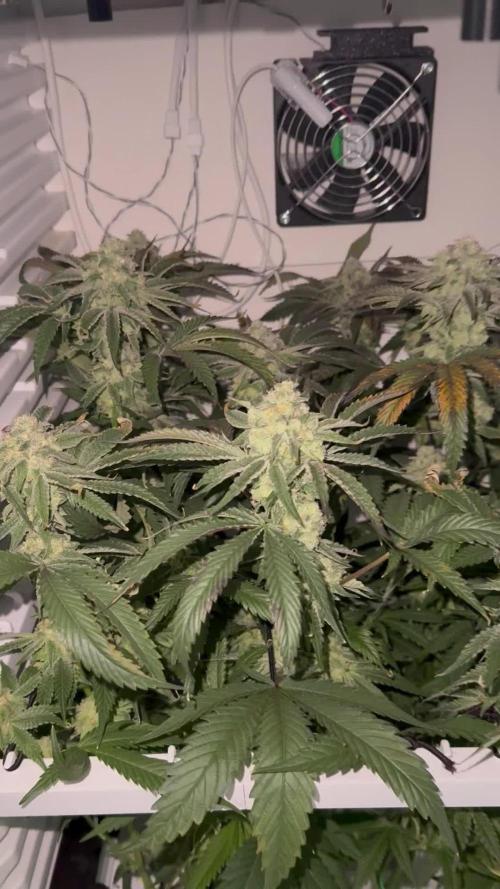
Both are doing amazing, we’re cruising right now as I’ve slowly started dosing down the nutrients. The plants are looking well fed, all leaves are beautiful dark green, more towards a burn than any deficiencies! A nice fade is starting to kick in as well on both. I’ll be leaving on holiday upcoming week, and all the plants should be more than ready to harvest once I return! both pheno’s are incredibly icy, and smell super sweet and fruity. The buds truly look insane and I can’t stop looking at them 😍
Likes
39
Share
Quité la malla porque me costaba un mundo poder regar de manera correcta además de que el tallo central que salió doble de una de las nenas estaba comenzando a doblarse por el peso, por ende tuve que entrar a amarrarlo a un tutor para poder tener la precaución de que no se fuera a caer. El color y olor es maravilloso. Seguimos con este crecimiento ...
Likes
290
Share
@Ferenc
Follow
Day 128... long journey behind...What can I say? Beautiful.... last time removed the injured leaves due to covering but now she is coming back. ;) Weather condition is still right compare to September in London but okay. I hope she will do all the way the flowering and nice smoke comes off.
Likes
6
Share
Watering 2-3 days 2 liters per plant
Likes
5
Share
@Kardo
Follow
Voll mit Zucker und sehr gesunder Farbe bin gespannt wie sie schmeckt
Likes
54
Share
@Fatnastyz
Follow
11-29 Bad news, Banana Purple Punch has been let go. 😭 She was very stunted and tiny, so I made the bold decision to call it. Thought about letting her finish, but she was really small. But Strawberry cheesecake is making up for it!. This thing seems super happy atm! She has jumped to around 12 inches. Stretch is officially on! Triple grape is rockin too, few flimsy leafs, bud branches. One of the branches, kinda twisted itself. Imma look into that one. But both rockin and lovin the EM1. More importantly than the rest! I still haven't over watered or fed. 😁💪 Time will tell, but I'm staying the course! Happy Holidays 😁🤘 12-1 2k water, silica 3ml, cal/mag 3ml, drops balance 1ml and some dust of yucca. 6.2 Stripped GC of anything blocking anything else . Couple blocked bud sites too. Wont touch for at least 3 days. Maybe 4, we will say next water? She may be a bit stressed 😂 Im sure the stripping didnt help. 💪🤘 3x- 11.5 inches tall Scc- 12.5 in tall . .
Processing
Likes
3
Share