




Likes
16
Share


@GRow_M8s
Follow
During week 7(bloom) like corona lock down wasn't enough we had major weather change. Temp dropped significantly and humidity levels increased to 70%(outdoors RH).
As far this goes on it is necessary to use a strong dehumidifier inside tent for half an hour every 2 hours as once the lights are off the humidity climbs 65%+ without it.
Feed remained the same.
GG# 1 looks like most of its pistils are orange so in the end of the week I ll have a look with the microscope and might start flushing it.
Likes
Comments
Share

@WMinerva007
Follow
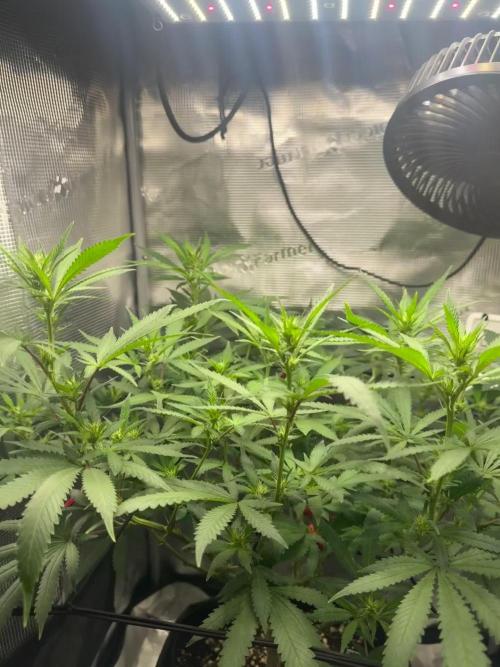
Wow… she stretched really really well and shes gonna start her bulking phase soon.
Shes growing vigorously with lush green color and great node spacing so I’m expecting a really good harvest!

Likes
3
Share


@Cultiv8or
Follow
Brought them inside this week and borrowed a Dehumidifyer. I’ve been able to get RH , 45-55 now and the resin production has already started increasing


Likes
43
Share


@TheBulldozerSicily
Follow
Base 75 lt acqua demineralizzata (ec 80);
Aggiungiamo:
37.5 grow 37.5 micro 37.5 bloom 30 ml tarantula 30 ml voodo juice.
Ottenendo ec 474 ph 6.5
Iniziamo questo nuovo ciclo non partendo da seme come sempre, ma partendo da un ottima talea giá radicata, fatta da un nostro amico agricoltore.
Ci aggiorneremo settimanalmente al solito, vedremo i cambiamenti e aggiornamenti settimana dopo settimana.
Buon anno nuovo a tutti!! E buona coltivazione!!!!
Likes
5
Share


@Hempcules
Follow
WEEK 9 (DAY 64-70)
This week, my plants have significantly increased in volume. The buds are abundant, firm, and smell very sweet. Thanks to mainlining, they've become small and compact, now consisting almost entirely of flowers.
For the past few weeks, I've switched to 24-hour lighting to avoid climate fluctuations and speed up the flowering process. So far, this has proven very effective. The plants are growing at a high speed, and I think I'll be harvesting in two weeks at the latest.
I've set my lights to 700 PPFD. While this gives me a rather high DLI (Daily Light Integral), the plants don't seem to mind so far.
Due to the high temperatures and strong growth, I have to water at least every 24 hours. I'm currently alternating nutrients with Biobizz and Plagron Green Sensation.
Last week, I defoliated the plants again to ensure good air circulation around the buds and to direct all energy towards flower production.
Thanks to the high transpiration rates, I'm managing to keep the room's humidity just under 60%. It's not optimal, but I think it will work out.
With this code, you will receive a 20% discount on your next Zamnesia order:
ZAMMIGROW2024
Likes
23
Share


@MistaOC
Follow
28.01. Day 3
Just relax and get an eye on the vpd!
In my case looking for 0,6.
But temp. Is very cold with 19 degrees
——————————————————————
30.01. Day 5
Same
—————————————————————


Likes
38
Share


@TheCannaProphet
Follow
--------------------------------------------
~DUTCH PASSION OUTLAW AMNESIA~
--------------------------------------------
Outlaw Amnesia is a top quality old-school Amnesia Haze dominant Sativa that will appeal to both beginners and connoisseur growers alike. She is 80/20 Sativa/Indica with around 20% THC and is a cross of our Super Haze with a very special clone of Amnesia. The high is powerful and fast with a clear uplifting sativa high and a strong Haze accent. The taste is fresh, sour, strong and old-school Hazy. Outlaw will stretch more than most, she can triple in height during bloom, and grows well with the SCROG method.
Although she can be harvested as early as 9 weeks, a full 12 week flower period may be required for best taste, yield and high. She grows well in all grow mediums with perhaps the best yields in hydro where yields of up to 500g/m2 are possible, classifying this as a high production variety.
*description credit to Dutch Passion
OUTLAW AMNESIA (DUTCH PASSION) FEMINIZED DATA SHEET
Breeder: Dutch Passion
Genetics: 20% Indica / 80% Sativa
Parents: Super Haze x Amnesia
Flowering Time: 11-12 weeks
THC: 20%
Yield (Indoor): 450-500 gr/m²
Height (Indoor): 50cm
Available as: Feminized seeds
Flowering Type: Photo-period
Sex: Feminized
*Specified by breeder when grown under ideal circumstances
--------------------------------------------------------------------------------------------------------------------------------------------------------------------------------------------------------------------------------------------------------------------------------------------------------------------------------------------------------------------------------------------------------------------------------------------------------------------
THE SETUP:
~Planted into Jiffy Peat Pellets that were hydrated with de-chlorinated water with SuperThrive added then ph'd to 6.0 @ 80℉
~Grown 100% organic in 10g fabric pots with Mother Earth 70/30 Coco/Perlite medium amended with 2tbs/g of Down To Earth 4-4-4 / 2 cups/g of Earthworm Castings / 1tbs/g of Dr. Earth Flower Girl 3-9-4, 1tbs/g of Dr. Earth Bat Guano, 3/4 cup of Down To Earth Azomite and 1 tsp/g Down To Earth Fish Bone Meal.
~24hr light cycle during Germination / 19/5 light cycle for Vegetation and 12/12 for Flower
~Straight water ph'd @ 6.2-6.8 when needed and weekly Compost Tea's.
__________________________________________________________________________________________________________________________________________________________________________________________________________________________________________________________________________________________________________________________________________________________________________________________________________________________________________________
WEEKLY UPDATES:
10/4- Week Eight of flower is here and we're 3-4 weeks from wrapping up with this girl!
Her flowers are continuing to bulk up and are covered in glistening trichomes. She appears to be starting to fade which is exactly what I'm hoping to see, meaning that she's just about used up the nutrients in her medium.
I watered today with 1.5g of de-chlorinated water which was then ph'd to 6.6 @ 72℉ turned her pot and shot a few pictures of her.
And lastly, I have to address the 'elephant in the room'. Yes, it looks like she's got some seeds in her flowers. She's in my 4x8 with seven other ladies and, unbeknownst to me, my Do Si Dos #33 developed some male flowers that were EXTREMELY small and well hidden. As a result, she got fertilized. This happened so late into flower that I decided to go ahead and finish her out. My hopes are that I get some viable seeds which should be an interesting F1 cross between these two.
10/6- Today I watered her with 1.5g of her usual straight de-chlorinated water that's ph'd to 6.5 @ 72℉ and turned her pot.
She's just starting to fade, is still stacking her flowers, bulking up and has an incredible amount of trichomes which I'm beginning to monitor daily.
10/8- The routine of watering every other day continues like clockwork. Yesterday was a 'no water' day and I did a basic check over of the plant, removed a couple of yellowed lower leaves and turned her pot.
Today she got the usual 1.5g of straight de-chlorinated water that's ph'd to 6.5 @ 72℉ and had her pot turned. I've also begun to check her trichome development with a digital USB microscope to try to identify the ideal harvest time which, according to the breeder, will be here in around three weeks +/- but nothing is cut in stone so I'll let the trichomes determine when she's ready...ya never know, could be a lot sooner! 🤪
10/10- Well, Week Eight has come, gone and has been a trial once again of my patience with this 11-12 Week cultivar!
She's so freaking frosty that I've wanted to chop her several times but, I know from experience, good things come to those who wait... then wait a bit more. I anticipate that she's not going to make the 77-84 days in flower 'suggested' by the breeder for best taste/yield and will probably go closer to the 9 weeks +/- which is the minimum recommended flowering period for this strain, but we'll have to see what her trichomes have to say!
I've cut the wattage back on the HLG 650R to 500w at the wall now to simulate the way that sunshine becomes weaker as fall approaches due to the lower angle of the sun in the sky. This helps outdoor plants to know that winters on the way and they need to hurry up and complete their life cycle. Cutting the wattage back creates the same effect on the indoor plants, especially when coupled with lowered temperatures in the tent.
I have also noticed that her water uptake has slowed. After her heavy watering on the 8th, her pot still had some weight to it and she was looking great so I went ahead and skipped watering her today, watering her tomorrow at lights on with her usual.
Next week promises to be exciting so don't forget to check in! Harvest time is right around the corner and I'm getting stoked to see the results! 😎🙏💚
~Thanks for stopping in! This epic run is in the home stretch with harvest fast approaching...Stay lifted and be Blessed! 😎🙏~

Likes
8
Share


@FarmerT
Follow
Week 9 looking good getting ready to chop down both lsd25s the big bud and cherry cola still have time to thicken up for sure
Likes
43
Share


@Hashy
Follow
********************************************
Week 14 Ripen (flower week 8)
********************************************
Light cycle=12/12
Light Power=125w 52%
Extractor controller settings
High temp= Day 26c, Night 20c
Low temp= c
Temp step=0c
High Rh= Day 50%, Night 55%
Low Rh= %
Rh step=0%
Speed max=10
Speed min=2
Smart controller settings (during lights on).
Lights on=9.00am
Top fan on=+22.5c
Top fan off=-22.0c
Dehumidifier on=+50% and -26c
Dehumidifier off=-50% or +26c
Smart controller settings (during lights off).
Lights off=9.00pm
Dehumidifier on=+55% and -20c
Dehumidifier off=-55% or +20c
VPD aim=0.6-1.4
DLI aim=30-45
EC aim=0.2-2.0
PH aim=6.0-6.5
NPK(3.6/24.8/18.4)
💧💧💧💧💧💧💧💧💧💧💧💧💧💧💧💧
Method= Autofeed 6 drippers.
Feed=Ripen Nutes.
Neutralise=0.1ml/L
Dragon force=4ml/L
Boost=1ml/L
Volume=12L
Easy Ph up= 0.166ml/L
Ec=1.42 PH=6.3/6.4
Runs=16
Run times=5min (250ml each)
Gap times=15min×14, 45min×2
Total runtime=80mins (4.0L each)
Total flowrate= 100ml/min (50ml/min each)
Auto start time=10.00am
Auto stop time=4.05pm
💧💧💧💧💧💧💧💧💧💧💧💧💧💧💧💧
********************************************
********************************************
📅18/8/24 Sunday (day 92, day 50 flower)
📋
💧
Method= automatic
Feed=Nutes Ripen
Volume=12L
Easy Ph up= 0.166ml/L
Ec=1.4 PH=6.3/6.4
Volume left=3.3L
Volume used=8.7L (108ml/min)
Volume each=4.35L (54ml/min)
Runoff.
Runoff=1.8L
Ec=3.5 PH=/6.1
@5.15pm manually 0.4L each
Total left=2.5L
Total used=9.5L
Total each=4.75L
Extra runoff=0.4L
Ec=2.8 PH=/6.2
💧
📅19/8/24 Monday (day 93, day 51 flower)
📋 temps should be cooling off for about a week.
📅20/8/24 Tuesday (day 94, day 52 flower)
📋 Rotated pot slightly. Pot is still heavy.
📅21/8/24 Wednesday (day 95, day 53 flower)
📋 Skipped watering.
📅22/8/24 Thursday (day 96, day 54 flower)
📋
💧
Method= automatic
Feed=Nutes Ripen
Volume=7.5L
Easy Ph up= 0.166ml/L
Ec=1.5 PH=6.4/6.4
Volume left=2.5L
Volume used=5L (62ml/min)
Volume each=5L (62ml/min)
Runoff.
Runoff=0.8L
Ec=3.2 PH=/6.2
💧
📅23/8/24 Friday (day 97, day 55 flower)
📋
📅24/8/24 Saturday (day 98, day 56 flower)
📋
********************************************
Weekly roundup.
📋 She is doing fine, I realised I was slightly over watering her so have cut that back a bit. Bulking up at a good speed, may not be the 1st to finish in this grow. I'm unsure if I'm going to go onto just water for the remainder of the grow or just have another week on Ripen.
Take it easy.
Back soon.
********************************************
Likes
15
Share


@Rangaku
Follow
Mimosa is looking the pick of the bunch early on here , a bit of pre flower stank hit me when I was tying her down … verr nice .
Transplanted her into her forever home and tied her down , looking to double size again the coming week
Likes
5
Share


@BudBrewerz
Follow
Thick, smelly dense buds ... They are still drying, some off them allready wet trimmed, some of them still attached to the stem, hanging to dry slower ... So can't come up with any numbers. It's a very nice harvest though 🤠
Likes
4
Share


@CannaIGrow
Follow
Plant is growing well. Transplanted them from a 1 gallon pot into a 3 gallon pot this week.
Likes
24
Share


@Zurban_Poison
Follow
Hi people!
Bruce turned out to be a very disobedient girl)) she stubbornly strives for the top! but at the top there is no more space)) for this) after the first supercropping last week, I had to do 1 more supercropping this week .. hope this will stop her and soon she will start growing wide and not high))) she has a lot of buds and veto! I think she will not give a bad harvest!)) and of course seeds)))
Please watch the video😏
Likes
4
Share


@SamDo
Follow
Hello growers,
This week marks an important step in the development of the Pineapple Upside Down from Humboldt.
The plant has now been moved into the flowering tent. The main reason for this change is simply to give the plant more space and to benefit from better environmental control. The larger tent allows improved airflow and more stable climate management, which should help the plant maintain a healthier rhythm moving forward.
Even though the light fixture changed, the spectrum remains the same. The plant is still running under a 3500K spectrum, so there should be no real shock from a lighting perspective. Light intensity has been kept around 600 PPFD, which means the plant continues growing under conditions that are very similar to what it was used to previously.
Some environmental adjustments were also made this week. The VPD has been increased slightly to around 0.8–0.9 in order to encourage stronger transpiration and improve nutrient uptake.
Last week the plant showed a small slowdown in growth and overall vigor. The leaves were slightly droopy and the plant looked a bit less energetic than usual. After reviewing the parameters, the most likely explanation was a pH drift upward toward 6.2–6.3.
While this range is not catastrophic, it can reduce the plant’s ability to absorb certain nutrients, especially nitrogen, which could explain the temporary slowdown that was observed.
The pH has now been corrected and brought back down to around 5.8, allowing it to naturally fluctuate between 5.5 and 5.9. Since this adjustment is very recent, the plant will need a few days to fully respond to the correction.
Earlier in the week, the EC had been increased to 2.0 to test the possibility of a nutrient deficiency. Toward the end of the nutrient solution cycle, the mixture was slightly diluted with osmosis water in order to rebalance the EC and avoid pushing the plant too hard.
This week was also used to work heavily on the plant’s structure.
A topping combined with a strong defoliation was performed. The canopy was opened up significantly, removing a large amount of leaf mass to improve airflow, light penetration, and overall structure. It was not a light cleanup — the plant was trimmed quite aggressively in order to reset the canopy properly.
The plant originally had four main apexes, and each of those was topped again. This now creates approximately sixteen main growth points.
With sixteen apexes, the plant structure is now approaching the intended final architecture. From this point forward, the main objective is simply to allow the plant to recover from this fairly heavy pruning session, regain strength, and stabilize before any further training.
Over the coming days and weeks, the focus will be on observing how the plant responds to the pH correction, the environmental adjustments, and the recent structural work.
For now, everything appears to be back under control.
We’ll see how she responds over the next week.
Alright growers, take care and see you next week.

Processing
Likes
4
Share


@ganjaman24
Follow
Sorry for the delayed post I honestly forgot I started this one lol...they’re doing great I had some of those biodegradable starter pots that I used n prolly let them stay in too long tbh but now they’re both in their new homes! One is all coco and the other is top-half coco/bottom-half soil..thanks for reading/looking

Likes
13
Share

@Oldwied
Follow
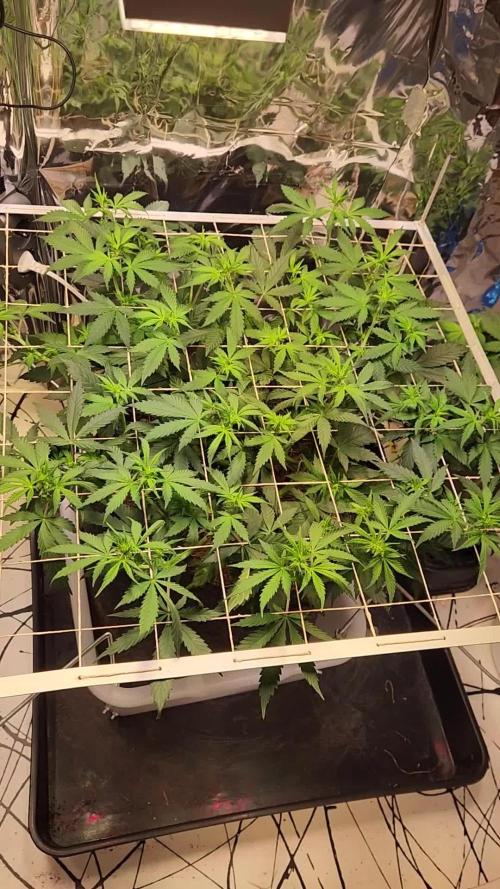
Flower time is scrogging time.
Over the week I increase the light Power slowly
Light Power: 80%
Day 54
Flower #4
Watered with SF nematodes
Day 57
Flower #6
Photoshooting
Tucking
Day 58
Flower #7
Photoshooting

Likes
45
Share


@KrautFabrik
Follow
Day 60: flush 💦
Pictures are taken on day 62 📸
---------------------------------------------
She is doing great 😂i got nothing to say🤷♂️😂
It seems like the nematodes are killing the fungus gnats larvae. Most get killed by the fly paper and no new ones are coming 😁👍
Happy growing 🍌🌱