Likes
Comments
Share
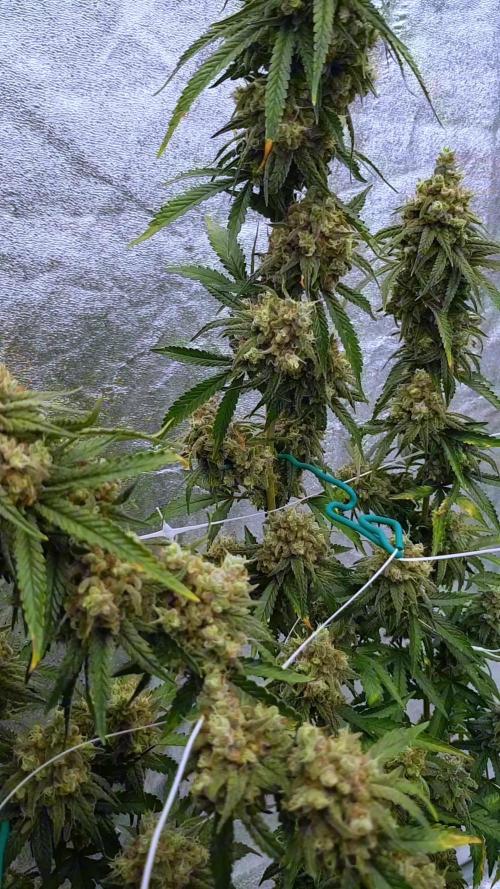
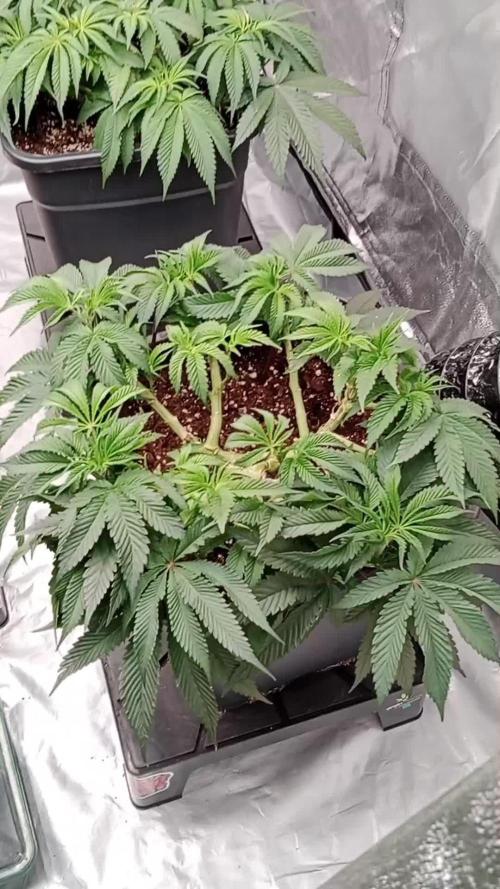
Got in my bloom nutes in and started feeding this week. Stopped with superthrive didn't want to go to hard with the nitrogen. Seem to be growing strong. Good luck to all.
Likes
10
Share
@Bncgrower
Follow
One more week and this is the last one before switching to 12/12h, I decided to clean a few more sheets and I'm sure it will recover very quickly.. Happy growing! ✌️🌱🌿🍁
Likes
17
Share
@Stupenico
Follow
So harvest time finally. Only 2 plants at the end but still I am happy with the result. After cutting them I placed them for 4 days inside the dark tent. I struggle a bit with the humidity as the air was really dry. So now its time for curring. I have placed the bud inside jars. Lets wait for a few weeks to have a first try ! See you for the smoke review.
Processing
Likes
25
Share
Well the pictures speak for themselves, roots must be well established now. Pretty much doubled in size and great structure. The smells are pronounced, should no carbon filtration be used surely the entire house would smell. Only means good things, looking fwd to see what this girl will bring to the table.
Likes
6
Share
@gr3g4l
Follow
Una semana bastante tranquila. Ni bichos ni carencias preocupantes, todo en orden. Así empezaba la semana si, no se veía nada hasta que ..... Y así se termina con todas mis ilusiones , visto lo visto no me arriesgo a perder mucho más y aun faltándoles bien bien 15-20 dias voy a cortar . Prefiero tricomas cristalinos y poca cantidad a tener que deshacerme de la mitad por la botritis.
Likes
3
Share
@Chanardo
Follow
Hola! Apliqué un poco de LST. Voy a seguir haciéndolo cada dos días como otro cultivador me ha dicho aquí. La planta se ve muy bien. Está comenzando a largar un poco más de olor, super agradable. Saludos!
Likes
16
Share
Inicio de su 7ma semana, están muy grandes y bonitas. Actualizando ya casi terminando su 7ma semana se ven muy sana y fuertes. Espero con ansias el resultado de este cultivo.
Likes
93
Share
@GMSgrows
Follow
Final stretch for the Cheese trees twins. Amazing smells inside the grow room. Smells great, but this dank ass smell, lingers in the air. Not sure which is creating this odor, or maybe just a mixture from all the ladies. Straight water for the next week. Once I get them down under the 200 ppm mark, I will be dropping these ladies. The tops of these ladies are super heavy. Light cables are stopping them from bending right over and hitting the floor. These Cheese have been healthy through the entire grow. Haven't lost a single leaf and all remain healthy. One healthy strain and a pleasure to watch grow and bloom. Looks like it will be a breeze to trim up.👍
Likes
6
Share
🌿 Amnesia Skunk Automatic Week 8 From Seed ≈ Week 4 Flower (12/12 From Seed Run) She may be 8 weeks old, but biologically she’s in her fourth week of active flowering — and she’s behaving exactly like a plant that has found her rhythm. After defoliation? She bounced back like nothing happened. No stall. No stress signals. Just structure, stacking, and deep healthy green. That’s not luck. That’s environment + balance. And she’s beautiful. ⸻ Environment — Playing on the Edge (But Controlled) Room Conditions • Canopy Temp: ~28°C • RH: ~70% • CO₂: 1000+ ppm • PPFD: 800 → 1300 µmol/m²/s On paper, 28°C + 70% RH sounds high. But numbers without airflow mean nothing. Massive Airflow We’re running: • Strong horizontal movement • Vertical air displacement • Active air exchange • Under-canopy circulation Airflow changes everything. Stagnant 70% RH is dangerous. Moving 70% RH behaves very differently. ⸻ 🍃 Leaf VPD vs Room VPD Room VPD says one thing. Leaf VPD tells the real story. Under strong light, leaf surface temperature runs slightly above ambient. That increases transpiration. Add 1000+ ppm CO₂: • Stomata don’t need to open as wide • Photosynthesis rate increases • Plants tolerate higher humidity • Metabolism stays high That’s why they’re not just surviving. They’re pushing. ⸻ 💡 Lighting Strategy — Scaled to Structure We are not blasting everything equally. • Larger tops: up to 1300 µmol • Smaller plants: ~800 µmol Light intensity is matched to plant size and leaf mass. No ego lighting. Only usable photons. ⸻ 🔦 Under-Canopy Lighting — Why? This isn’t a gimmick. Purpose: • Illuminate lower bud sites • Reduce larf • Stimulate lower-zone photosynthesis • Improve uniformity • Keep lower canopy metabolically active We’re not replacing top light. We’re filling in where dense canopy blocks energy. Active lower buds stay healthier. Healthier lowers improve airflow. Better airflow stabilizes microclimate. Everything connects. ⸻ 🔴 End-of-Day Red (15 Minutes After Lights Off) We run a 15-minute red pulse at lights-off. This is phytochrome management. Plants operate with two main phytochrome states: • Pr (red-absorbing) • Pfr (far-red absorbing) Red light pushes phytochrome into the active Pfr state. In darkness, Pfr slowly converts back to Pr. By giving a short red signal: • We influence phytochrome equilibrium • Support flowering signaling • Encourage structural consistency • Potentially stabilize transition timing It does not extend photoperiod. It manipulates light signaling — not day length. And as always: We experiment. We observe. We document. No magic claims. ⸻ 🌱 Feeding & EC — They’re Hungry • Soil EC: 0.9 • Feed EC: 2.4 This tells us something important. They’re eating aggressively. As long as runoff EC stays stable and does not climb: We maintain strength. High metabolic demand requires high input. If soil EC rises? We adapt immediately. No rigid formulas. Only feedback-based decisions. ⸻ 📸 Visual Observations From the traditional full-plant shots to the macro work: • Tight stacking beginning • Strong pistil development • Leaves praying under high PPFD • No signs of stress after defoliation • Structure clean and symmetrical She is balanced. And balance is power. Oh that topping was an accident wen moving her 🙏 📡 DELETED @ 1K Please stay tuned.we never quit https://www.youtube.com/@DOGDOGTHEDOCTOR NEW 🙏 Thank you for your patience and continued support. FOR DISCOUNT CODES AND MORE JUST FOLLOW THE LINK https://website.beacons.ai/dogdoctorofficial 📲 Don’t forget to Subscribe and follow me on Instagram and YouTube @DogDoctorOfficial for exclusive content, real-time updates, and behind-the-scenes magic. We’ve got so much more coming, including transplanting and all the amazing techniques that go along with it. You won’t want to miss it. GrowDiaries Journal: https://growdiaries.com/grower/dogdoctorofficial Instagram: https://www.instagram.com/dogdoctorofficial/ YouTube: https://www.youtube.com/@dogdoctorofficial Deleted by Youtube Vimeo : https://vimeo.com/dogdoctorofficial Under construction stay tuned ⸻ Explore the Gear that Powers My Grow If you’re curious about the tech I’m using, check out these links: 🔆 Lighting & Environmental Control • Future of Grow — Advanced LED lighting technology https://www.futureofgrow.com/ DISCOUNT CODE: DOG20 • Lumiflora — Under-canopy LED lighting https://lumiflorade.com/ • TrollMaster — Environmental controllers and automation gear (past collaboration) ⸻ Genetics • Zamnesia Seeds — Genetics used in this project https://www.zamnesia.com/ ⸻ 🌱 Soil, Substrates, Boosters & Root Support • Plagron — Substrates, bio mixes, and supportive products https://plagron.com/en/ ⸻ 🎒 Storage, Curing & Preservation • Grove Bags — Curing and storage solutions https://grovebags.com/ ⸻ 📸 Photography Equipment & Tools (Not sponsors, but part of my creative toolkit) • Sony A6700 • Sony full-frame macro lens + few more • Stacking photography workflow - learning • iPhone (for behind-the-scenes shots) We’ve got much more coming as we move through the grow cycles. Trust me, you won’t want to miss the next steps, let’s push the boundaries of indoor horticulture together! As always, this is shared for educational purposes, aiming to spread understanding and appreciation for this plant. Let’s celebrate it responsibly and continue to learn and grow together. With true love comes happiness. Always believe in yourself, and always do things expecting nothing and with an open heart. Be a giver, and the universe will give back in ways you could never imagine. 💚 Growers love to all 💚 📸 P.S. – The Eye Behind the Lens All photos in this diary (for now — except for the ones showing the camera, which I took with an iPhone) are taken with a Sony A6700 paired with a Sony full-frame macro lens and a few more. Photography is part of the story — it’s how we share the fine textures, the glow, and the quiet details that words can’t always capture. I’ve also started experimenting with photo stacking — a technique where multiple images, each taken at a slightly different focus point, are layered together to create one perfectly sharp image from front to back. It’s not digital enhancement or AI; it’s pure photography — a way to reveal the plant’s beauty in microscopic depth, from trichome to petal. You’ll even see a few shots of "ghost me" capturing the shots — camera, lens, setup — because every grow deserves not just to be cultivated, but documented like art. FOR DISCOUNT CODES AND MORE JUST FOLLOW THE LINK https://website.beacons.ai/dogdoctorofficial NEW DISCORD - Official Server Invite Link : https://discord.gg/ksjAkA5T74
Likes
7
Share
Day 50, The deficiency on the smaller pheno seems to be under control. It hasn't spread any that I've noticed. Everybody else seems to be pretty happy. Light intensity is set to 9 at 18in from the canopy and each plant is getting about 650-750 ppfd depending on how close to the center. Leaves are praying slightly and tips have a very small amount of burn. I think the light and nutrients are at the max these girls can handle. So now its time to bulk up!! Hopefully the Terps ramp up too because right now its not much, smells like green onions and breakfast sausage lol. Stay frosty, Gromies. See you next week.
Likes
27
Share
Buds a still forming and looking good. I've cut the co2 going forward and will go wihout for the rest of the grow so the buds can rippen. Buds have a lot of frost so far so that's a great sign for the THC. Plants in the tents out of nowhere have spider mites but this plant didn't have much compared to others. Hopefully the last 3 weeks go by fast
Processing
Likes
10
Share
@yaron
Follow
starting week 6,the wedding cheesecakes are in flower for a couple of days now and the gg are starting to flower. alot of wind and clouds and rain these past two weeks but the girls are looking good in my opinion. update:after 4 or 5 days of rain and low temperatures finally the re is sunlight so the girls have to recover a bit. but things are looking better wheatherwise. cheers!
Processing
Likes
58
Share
She's coming on nicely buds coming all the way up the branches she's gonna be short an stocky still no frost but loads of nodes closely stacking with buds not much else to report just bud watching thanks for reading happy growing
Likes
128
Share
💩Holy Crap We Are Back At It And Loving It💩 Growmies we are at DAY 14 and she's just killing💀it👌 So I'm starting to see she needs watering every single day and now need nutrients 🙃 Lights being readjusted and chart updated .........👍rain water to be used entire growth👈 👉I used NutriNPK for nutrients for my grows and welcome anyone to give them a try .👈 👉 www.nutrinpk.com 👈 NutriNPK Cal MAG 14-0-14 NutriNPK Grow 28-14-14 NutriNPK Bloom 8-20-30 NutriNPK Bloom Booster 0-52-34 I GOT MULTIPLE DIARIES ON THE GO 😱 please check them out 😎 👉THANKS FOR TAKING THE TIME TO GO OVER MY DIARIES 👈
Processing
Likes
22
Share
@B4niTa
Follow
Week 4 begin! Day24 girls are 30cm tall! Im feel a strong genetic! We will see after few weeks!
Likes
7
Share
@Reaper
Follow
The flowers start to get purple ( the nutrients described this week were givin at half strength)
Likes
20
Share
Servus Moin! Die Bluzcotti Vaders Cut riecht wieder extrem BlueSherb-Soapy, Citrus, Gassy... einfach genial. Die Buds werden langsam auch deutlich härter und fangen an Richtung Ausreifung zu gehen. Man sieht sogar wie sie langsam grau-bläulich werden. Sie wurde das letzte mal jetzt entlaubt und ist bereit für die letzten 3-4 Wochen.
Likes
2
Share
18 hours in seconds, 60x60x18 = 64,800 seconds, now multiply by the 833μMol/s reading off the PAR metre. μMol/s (micromol) is the unit in which P.A.R. is expressed. 64,800x833=53,784,000μMol 53,784,000μMol = 54 Mol 54 DLI @ 800ppm, powerful combination. Pushing photosynthesis to peak capacity, accelerated growth and increased biomass. Applied net, stretching her around for a week. Maintaining a minimum air velocity of 0.3m/s within the inner canopy. E=MC2 looks like a simple multiplication problem; it describes a fundamental physical truth: mass and energy are the same thing. The equation doesn't just calculate a value; it reveals that mass is effectively "congealed" energy. Energy is just numbers. Energy isn't a physical "substance" you can hold or touch. It is essentially an abstract, calculated number that we assign to a system to predict how it will change, interact, or move. A numerical label we attach to matter to track how it behaves. Because the universe runs on laws of symmetry (specifically, that the laws of physics don't change over time), a single global number must be conserved. We call that number "energy". How well a seedling grows is down to how much knowledge one can acquire to increase the level of conversion to occur. Applying knowledge effectively requires intuition, which comes from hands-on experience. A seasoned stoner learns to read subtle signs—like a slight change in leaf turgor (stiffness), subtle color shifts, or the specific texture of the soil—before a textbook diagnosis can be made. Ultimately, growing is the application of botanical science blended with active observation. Knowledge dictates your potential, but adaptability and attentiveness to the plant's immediate environment determine your results. The human eye is capable of distinguishing more shades of green than any other color in the visible spectrum. 1.618 Nature mathematically optimizes quantum energy transfer and light absorption efficiency within the photosynthetic machinery, as it naturally dictates energy scaling hierarchies and resonance dynamics. External vibration or electromagnetic wave that perfectly matches a plant's natural frequency directly influences plant growth. Low-frequency sound waves and targeted electromagnetic fields stimulate cellular processes and boost photosynthetic efficiency. An angular frequency aligned with the Golden Ratio is often used in wave mechanics and quantum physics to optimize energy transfer. Does it produce better yields? All I know is the IVM loves being aligned with it. Here is how I "think" of it to simplify it for myself when I give it thought. Quantum is the firmware, DNA is the software read/write expression. Alignment with that of which already exists. Law of nature, not my opinion: Constructive interference occurs when two or more overlapping waves meet in phase, meaning their crests and troughs perfectly align. Their amplitudes add together, creating a new, amplified wave with greater intensity than the individual components. Constructive interference is the foundational mechanism that establishes a resonance hierarchy across physical, structural, and acoustic systems. "Frequencies utilizing this ratio naturally minimize resistance (or impedance) and allow for highly efficient resonance, which can facilitate an increase in Electron Transfer Reactions (ETR) or energy pathways in molecular structures." Quantum coherence in photosynthesis occurs when a photon of sunlight strikes a leaf; the energy it carries must travel to a reaction center to be converted into chemical energy. This process operates at nearly 100% efficiency. If the energy moved in a traditional "bunching" or random hopping manner, a large portion of it would be lost as heat. Instead, plants utilize quantum superposition. The energy particle (exciton) doesn't just take one path; it exists in a wave state and explores multiple pathways simultaneously. It essentially "chooses" the most efficient route to the reaction center simultaneously. Research shows that molecular vibrations and the specific network arrangements of chlorophyll molecules (like the naturally evolved Chlorophyll A & B ratios) actively protect against energy overflow, optimizing light capture across different light intensities. Enzymes are the biological catalysts that speed up chemical reactions within a plant's cells, allowing them to grow, metabolize, and repair. Rather than relying solely on the classical kinetic energy of molecules colliding, plants use quantum tunneling. Subatomic particles like electrons and protons (hydrogen ions) can literally "teleport" through energy barriers that they normally wouldn’t have the energy to climb over. This makes vital metabolic reactions happen far faster than classical physics could ever explain! Chloryphyll b has peak absorption at 460nm (Blue) and at 647nm(Red). If we take the blue peak wavelength 460nm and a UV-B, UVR8 peak absorption wavelength 285nm, Tryptophan-285 (W285) Sensing protein. 460/285=1.618 Φ If we take chlorypyhll b's Red absorption peak 647nm and a UV-A of 400nm, we get 647/400=1.618 Φ. "Structure of light". The cryptochrome photoreceptor (CRY) is a UV-A/blue light receptor that shares this dual sensitivity with several other biological structures and functions, including significant sequence similarity and a common evolutionary ancestor with DNA photolyase enzymes. These are light-activated enzymes that use blue/UV-A light to repair DNA damage caused by UV-B radiation in plants. Synergistic. Effective quantum efficiency of photosystem II, often denoted as ΦPSII, represents the proportion of light absorbed by Photosystem II (ΦPSII) that is actually used in photosynthetic electron transport. It is a key indicator of how efficiently a plant is using light for photosynthesis, as opposed to losing it as heat or fluorescence. ΦPSII (effective quantum yield of photosystem II) functions primarily as a "multiplier" (a coefficient of efficiency) rather than an additive factor when estimating the overall photosynthetic electron transport rate (ETR). Multipliers are considered far more beneficial than additions because they generate exponential growth, leverage existing resources to their full potential, and create sustainable, self-multiplying capacity, rather than just incremental, linear increases. This fascinating observation is rooted in the intersection of subatomic geometry, fractal scaling, and quantum dynamics. In specific molecular arrangements—such as in conjugated polymer networks or biomolecular architectures—the Golden Ratio (PHI) naturally dictates energy scaling hierarchies and resonance dynamics. Mathematically tied to the fine-structure constant, which defines the strength of the electromagnetic interaction. The Golden Ratio can be mapped geometrically as the Golden Angle (137.5 degrees) in atomic structures, linking the charge of the electron to fundamental quantum constants like Planck's constant. An electromagnetic wave is neither electric nor magnetic, but a combination of both. 137.5 The Golden Angle (137.5) This angle is derived from the Golden Ratio (1.618). It is the smaller of two angles created when a circle is divided such that the ratio of the arcs equals the Golden Ratio. An electromagnetic wave (like light or radio waves) is not a static electric field or a static magnetic field, it is a self-propagating combination of both. An oscillating electric field creates an oscillating magnetic field, which then regenerates the electric field. They feed off each other and travel together through space at the speed of light, carrying energy without needing a material medium. The Fine-Structure Constant Alpha (Α/α): In quantum physics, is the approximate denominator of the fine-structure constant (often represented by the Greek letter Alpha (Α/α). It is a fundamental, dimensionless number that dictates how strongly charged particles (like electrons) interact with the electromagnetic field. Its value has puzzled physicists for over a century, as it bridges quantum mechanics, electromagnetism, and relativity. In quantum mechanics, Omega (Ω/ω) usually represents angular frequency. When applied to "quantum coherence"—the ability of particles to exist in overlapping states without immediately degrading—is key to calculating how long these states last. The Golden Angle, the value 137.5° is the geometric Golden Angle. It is derived from the Golden Ratio (1.618) and is famously responsible for the beautiful, mathematically optimized spiral patterns found in nature (such as sunflower seeds, pinecones, and leaf arrangements). Because of this, theoretical physicists and mathematicians have long speculated about why nature relies so heavily on the number 137 and the golden angle to govern everything from subatomic light interactions to the macroscopic geometry of the universe. Quantum coherence allows particles to maintain superposition and entanglement. In realistic, open environments, interactions with a noisy background typically cause decoherence, destroying the system's quantum information. A major challenge in quantum physics and quantum computing is preventing this decoherence at large scales. In quantum optics and driven systems, the Greek letter Omega (Ω/ω) often represents the Rabi frequency, which dictates the strength of the coherent driving laser or electromagnetic field interacting with the quantum system. The interaction of light and water generates specific Coherent Domains. Trapped electromagnetic fields cause water molecules to vibrate in unison at a coherent frequency, separating the liquid into structured quantum areas and an unstructured phase. When water interacts with hydrophilic (water-attracting) surfaces, the energy from UV and Infrared light can drive the formation of larger, structured layers known as Exclusion Zone (EZ) water. Exclusion Zone (EZ) water represents a structured, negatively charged phase of water critical to cellular biology. Driven by light energy and hydrophilic surfaces, this ordered state acts as a natural biological battery, with far-reaching implications for cell function and human health. In this domain, water molecules arrange themselves into a highly ordered, negatively charged lattice that excludes solutes and particles. At higher energy levels, UV light acts as a catalyst for photochemical reactions. Photons can provide enough energy to break the hydrogen and oxygen bonds in molecules, resulting in free radicals and a plasma of quasi-free electrons. This transfer of electrons forms the fundamental basis for redox reactions and energy metabolism in ALL biological systems. Input: The energy, time, and focus you dedicate. Process: Continuous growing, refining, and learning. Output: A superior, highly polished final product.
Likes
15
Share
Place these seeds in the paper towel literally 24hrs later the tap roots were nice and long. I then placed them in jiffy pods and within 24 hours this is how they looked. So far amazing from what I see. Shout out to fast buds!!! This will be ram in the growace Aircube system.