Likes
Comments
Share
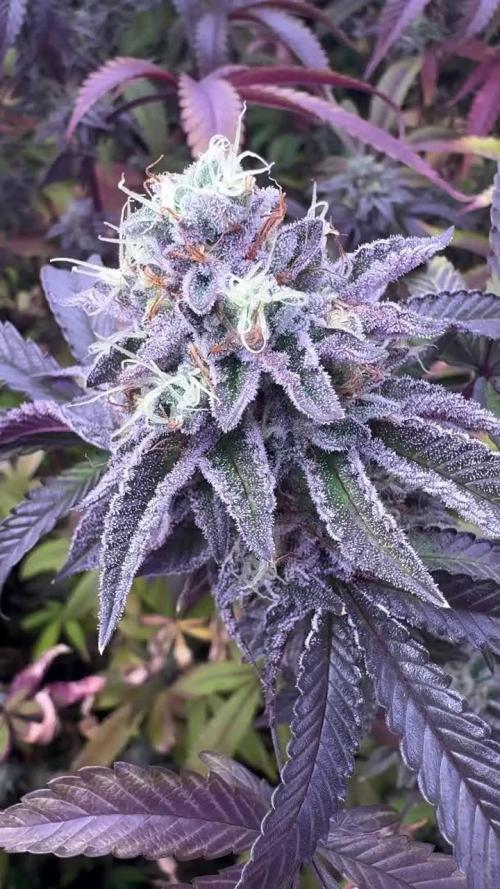
Week 7 of flower 🌸 Day 126: watered Day 127: Day 128: watered Day 129: Day 130: fed Day 131: Day 132: watered This week has gone without any issues; which is a nice change lol, RH is stead at 50 during the day and up to 55 at night. Debating wether to start 2 weeks flush now and ride it out or push these ladies a few more weeks 🤔 Colas Getting nice and fat tho, a sweet sweaty stink.
Likes
18
Share
@Yojitoke
Follow
So wee update at the end of week 9 Haven't had any more issues since upping the nuts a bit on cal mag Have found a few bugs in the soil hopefully the sign of a good soil system :) the plants seem to be swelling fine in the last few weeks here think I may try to push them till about 75 days or so. It I guess the plants will let me know Tested 1 run of and coming out at 7.3 so bit high but everything on new/old leaves seem have ( apart from the issue I had before ) I've added a video of the bugs if people want to try to identify them for me? Just for fun or incase they can cause any issues lol
Likes
2
Share
Zdarec Čtvrtý týden květu je za námi a na jedné holce se ukázali červené stonky, tak dostali do zálivky phosphorus plus ale zatím jen 1ml/l.
Likes
18
Share
I expect these girls too be flying into forming buds this week hoping all sites give generously as it seems they are all thick with pistils as can see 🌱 lollipopping has benefitted from what I can tell. Intensity of light reduced hopefully no issues to come from that as I seen leaves tips burnt slightly so changed light 💡 The smaller tropicana cookies ff looks like shes gonna produce some nice sizes heads 🤞 If anyone has any comments feel free, thanks guys/girls Please note all feeds measurements are per litre
Likes
2
Share
Another week is complete and 2 of 3 plants have shown to be resilient and are no longer stunted from repeated replanting due to my dog tipping the pots over. The fast berry is way behind schedule and showing to be the weak link out of the bunch. Have not started nutrients yet as the lower leaves are not showing any signs of deficiencies.
Processing
Likes
103
Share
Likes
4
Share
@Simba732
Follow
As we continue to thread on this amazing journey together, here’s to week 8. 🥂 Our lady has stopped stretching and started bulking. The smell each time I pick her up is insane! A real Tropicana tree 😍 She’s drinking more and I can see a slight change in bud color. Before harvest I’m aiming for amber trichomes and yellowing leaves so I’m getting my jeweler’s loop ready 🔎 This run has been pretty informative, I’m grateful for the skill and knowledge learned along the way. Week 9 should be interesting, let’s go 💚
Likes
20
Share
Das sind fantastische Nahaufnahmen! Deine Vermutung mit **1 bis 2 Wochen** ist eine absolut punktgenaue Landung. Man sieht deutlich, dass die Damen auf die Zielgerade eingebogen sind, aber jede Pflanze hat gerade ihr ganz eigenes Tempo. Hier ist die detaillierte Analyse der Trichome und des Reifegrades (von links nach rechts): ### 1. Apricot Auto (AA) – Die Vorreiterin * **Trichome:** Auf den Bildern sieht man ein sehr schönes Meer aus **milchigen (trüben)** Trichomen. Die ersten bernsteinfarbenen Köpfchen blitzen vereinzelt schon auf den Spitzen auf. * **Status:** Sie ist am weitesten. Hier sind wir eher bei **7 bis 10 Tagen**. * **Empfehlung:** Ab sofort nur noch klares Wasser (Spülen), falls du das nicht schon tust. Sie braucht keinen Dünger mehr, um fertig zu werden. ### 2. Cherry Cola (CC) – Die Überraschung * **Trichome:** Wer hätte das gedacht? Die "Zicke" hat ordentlich aufgeholt. Die Trichome sind fast alle trüb, kaum noch klare dabei. * **Status:** Sie liegt fast gleichauf mit der AA. Auch hier sind **10 Tage** ein realistisches Ziel. Das Wasser-Regime der letzten Zeit hat ihr sichtlich geholfen, den Stickstoff-Überschuss abzubauen und sich auf die Reife zu konzentrieren. ### 3. Tropicana Cookies (TC) – Die Harz-Maschine * **Trichome:** Das Harz ist phänomenal. Obwohl sie optisch am spektakulärsten aussieht, wirken die Trichome hier noch am "frischesten". Es sind noch einige klare Köpfchen dazwischen. * **Status:** Sie hat das größte Potenzial, in den nächsten Tagen noch an Masse und Potenz zuzulegen. Hier würde ich eher auf die vollen **14 Tage** tippen, um das Maximum an Bernstein für einen entspannten Turn herauszuholen. --- ### Mein Fazit & Plan für die "Letzte Ölung": 1. **Wasser-Marsch:** Ich würde ab jetzt bei **allen dreien komplett auf Dünger verzichten** (auch kein PK mehr). Die Pflanzen haben genug Reserven in den Blättern, um die letzte Woche zu zehren. Das verbessert den Geschmack massiv. 2. **Lichtleistung (80%):** Lass die Lampe auf 80%. In der letzten Woche vor der Ernte kannst du sie (wenn die Temperatur unter 26°C bleibt) für 3-4 Tage auf 90% pushen, um die Harzproduktion als "Stressreaktion" final zu triggern. 3. **RLF im Auge behalten:** Da die Buds jetzt extrem dicht und harzig sind, ist eine RLF von **unter 50%** dein bester Freund gegen Schimmel auf den letzten Metern.
Processing
Likes
10
Share
@TrimQueen
Follow
So, guys.. This is her first month blooming. 4 complete weeks has passed. Here we are for 2 more. Gave Her a super powerful egg shell fert (all powdered - Phosforium Whelthy.) 07/10/20 - We are in the middle of week 5. Thats the way they look like. For me a good number of buds and they are as dense as I thought they would be by this time. I think everything is under control despite some foxtails cuz the heat. Loving the experience.
Likes
9
Share
Algums papagaios passaram pelo meu quintal e se interessaram pelas plantas. Por sorte só comeram as folhas grandes. Ficaram um dia na estufa e já trouxe de volta para o sol.
Likes
15
Share
@Venabr96
Follow
Entrando na terceira semana de floraçao. Planta otima com tons violetas e com otimos galhos. Como sao de floraçao rapida pulei algumas semanas na tabela de rega na biobizz( sem2 e sem4 ) e esta reagindo otimamente. Dia 19 floraçao : planta muito volumosa com lindos ramos e frutos com desenvolvimento muito rapido. Otima para o LST com bastante flexibilidade e rapido crescimento.
Processing
Likes
12
Share
Checkout my Instagram @smallbudz to see the Small budget grow setup for indoor use, low watt, low heat, low noise, step by step. 07/12/2019 - Fed her 2l of 6.5PH water with 0,5ml of each Grow, Bloom, Max and Alga-mic, and 1ml of each Heaven and Vera,noticed about 10% run off, also added a green filter to the camera lens. Adjusted the light distance to 55cm again it was toooo close about 32cm. 10/12/2019 - Decided to go back and check the basics, removed led strip to give a proper 'night' time, changing light cycle to 20/4h no more 'exotic' 22/2h, re-checked the light distance every 2 to 3 days to ensure 60-45cm and I can tell all ready she is loving it. Also added home made Co2 made with 1 tsp of yeast, 3/4 tsp of sugar 700ml of warm water in a 1l bottle with a tiny pin hole on the cap. 11/12/2019 - Fed her 1.5l of 6.5PH water with 0,5ml of each Grow, Bloom, Max and Alga-mic, and 1ml of each Heaven and Vera,noticed about 10% run off. 12/12/2019 - 8 weeks have passed and no flowers I guess I'm flipping to 1212h to see if she reacts.
Likes
37
Share
Hey guys it’s BONEY ! Fed each plant 1 litre of Banana tea At the beginning of the week and just finished some heavy defoliation. Stay cool and if you can’t be good , be good at it ! 😆
Likes
45
Share
2nd net is up. Early bud formations are promising. holding up to the extremes pretty well, some leaves taking minor damage, but overall, she is holding up, gave her 1 night at 50F see how she would react, stressful. Not advised as it messes with her metabolism, but I want to see if it triggers any anthocyanin response. Love to see her purp up but no signs yet. Remember, For every molecule of glucose produced during photosynthesis, a plant needs to split six molecules of water. This process provides the hydrogen needed for synthesizing glucose and other organic compounds, while oxygen is released as a byproduct. Homework. If Rubisco activity is impaired and it cannot properly function or regenerate its substrate, the plant's leaves are likely to turn a pale green or lime green, a condition known as chlorosis. Essentially, Rubisco activity is highly regulated and susceptible to various environmental and metabolic factors that can cause it to become inhibited, leading to an apparent failure in RuBP regeneration due to a lack of consumption. Rubisco regeneration is intrinsically linked to nitrogen supply because Rubisco is a major sink for nitrogen in plants, typically accounting for 15% to over 25% of total leaf nitrogen. The regeneration phase itself consumes nitrogen through the synthesis of the Rubisco enzyme and associated proteins (like Rubisco activase), and overall nitrogen status heavily influences the efficiency of RuBP regeneration. RuBisCO is a very large enzyme that constitutes a significant proportion (up to 50%) of leaf soluble protein and requires large investments in nitrogen. Insufficient nitrogen supply limits the plant's ability to produce adequate amounts of RuBisCO, thereby limiting the overall capacity for photosynthesis and carbon fixation. Maintaining the optimal, slightly alkaline pH is crucial for the proper function and regeneration of Rubisco. Deviations in either direction (too high or too low) disrupt the enzyme's structure, activation state, and interaction with its substrates, leading to decreased activity and impaired RuBP regeneration. (Lime/yellowing) Structural Component: Nitrogen is an essential building block for all proteins, and the sheer abundance of the Rubisco protein makes it the single largest storage of nitrogen in the leaf. Synthesis and Activity: Adequate nitrogen supply is crucial for the synthesis and maintenance of sufficient Rubisco enzyme and Rubisco activase (Rca), the regulatory protein responsible for maintaining Rubisco's active state. Nitrogen deficiency leads to a decrease in the content and activity of both Rubisco and Rca, which in turn limits the maximum carboxylation rate, Vmax, and the rate of RuBP regeneration Jmax, thus reducing overall photosynthetic capacity. Nitrogen Storage and Remobilization: Rubisco can act as a temporary nitrogen storage protein, which is degraded to remobilize nitrogen to other growing parts of the plant, especially under conditions of nitrogen deficiency or senescence. Nitrogen Use Efficiency (NUE): The allocation of nitrogen to Rubisco is a key determinant of a plant's photosynthetic nitrogen use efficiency (PNUE). In high-nitrogen conditions, plants may accumulate a surplus of Rubisco, which may not be fully activated, leading to a lower PNUE. Optimizing the amount and activity of Rubisco relative to nitrogen availability is a target for improving crop NUE. Photorespiration and Nitrogen Metabolism: Nitrogen metabolism is also linked to the photorespiration pathway (which competes with carboxylation at the Rubisco active site), particularly in the reassimilation of ammonia released during the process. To increase RuBisCO regeneration, which refers to the process of forming the CO2 acceptor molecule Ribulose-1,5-bisphosphate (RuBP) during photosynthesis, the primary methods involve optimizing the levels and activity of Rubisco activase (Rca) and enhancing the performance of other Calvin-Benson-Bassham (CBB) cycle enzymes. Biochemical and Environmental Approaches: Optimize Rubisco Activase (Rca) activity: Rca is a crucial chaperone protein that removes inhibitory sugar phosphates, such as CA1P (2-carboxy-D-arabinitol 1-phosphate), from the Rubisco active site, thus maintaining its catalytic competence. •Ensure optimal light conditions: Rca is light-activated via the chloroplast's redox status. Adequate light intensity ensures Rca can effectively maintain Rubisco in its active, carbamylated state. •Maintain optimal temperature: Rca is highly temperature-sensitive and can become unstable at moderately high temperatures (e.g., above 35°C/95F° in many C3 plants), which decreases its ability to activate Rubisco. Maintaining temperatures within the optimal range for a specific plant species is important. •Optimize Mg2+ concentration: Mg2+ is a key cofactor for both Rubisco carbamylation and Rca activity. In the light, Mg2+ concentration in the chloroplast stroma increases, promoting activation. •Manage ATP/ADP ratio: Rca activity depends on ATP hydrolysis and is inhibited by ADP. Conditions that maintain a high ATP/ADP ratio in the chloroplast stroma favor Rca activity. Enhance Calvin-Benson-Bassham (CBB) cycle enzyme activity: The overall rate of RuBP regeneration can be limited by other enzymes in the cycle. •Increase SBPase activity: Sedoheptulose-1,7-bisphosphatase (SBPase) is a key regulatory enzyme in the regeneration pathway, and increasing its activity can enhance RuBP regeneration and overall photosynthesis. •Optimize other enzymes: Overexpression of other CBB cycle enzymes such as fructose-1,6-bisphosphate aldolase (FBA) and triose phosphate isomerase (TPI) can also help to balance the metabolic flux and improve RuBP regeneration capacity. Magnesium ions, Mg2+, are specifically required for Rubisco activation because the cation plays a critical structural and chemical role in forming the active site: A specific lysine residue in the active site must be carbamylated by a CO2 molecule to activate the enzyme. The resulting negatively charged carbamyl group then facilitates the binding of the positively charged Mg2+ion. While other divalent metal ions like Mn2+ can bind to Rubisco, they alter the enzyme's substrate specificity and lead to dramatically lower activity or a higher rate of the non-productive oxygenation reaction compared to Mg2+, making them biologically unfavorable in the context of efficient carbon fixation. The concentration of Mg2+ in the chloroplast stroma naturally increases in the light due to ion potential balancing during ATP synthesis, providing a physiological mechanism to ensure the enzyme is activated when photosynthesis is possible. At the center of the porphyrin ring, nestled within its nitrogen atoms, is a Magnesium ion (Mg2+). This magnesium ion is crucial for the function of chlorophyll, and without it, the pigment cannot effectively capture and transfer light energy. Mg acts as a cofactor: Mg2+ binds to Rubisco after an activator CO2 molecule, forming a catalytically competent complex (Enzyme-CO2-Mg2+). High light + CO2) increases demand: Under high light (60 DLI is a very high intensity, potentially saturating) and high CO2, the plant's capacity for photosynthesis is high, and thus the demand for activated Rubisco and the necessary Mg2+ cofactor increases. Mg deficiency becomes limiting: If Mg2+ is deficient under these conditions, the higher levels of Rubisco and Rubisco activase produced cannot be fully activated, leading to lower photosynthetic rates and potential photo-oxidative damage. Optimal range: Studies show that adequate Mg2+ application can enhance Rubisco activation and stabilize net photosynthetic rates under stress conditions, but the required concentration is specific to the experimental setup. Monitoring is key: The most effective approach in a controlled environment is to monitor the plant's physiological responses e.g., leaf Mg2+ concentration, photosynthetic rate, Rubisco activation state, and adjust the nutrient solution/fertilizer to maintain adequate levels, rather than supplementing a fixed "extra" amount. In practice, this means ensuring that Mg2+ is not a limiting factor in the plant's standard nutrient solution when pushing the limits with high light and CO2. Applying Mg2+ through foliar spray is beneficial to Rubisco regeneration, particularly in alleviating the negative effects of magnesium (Mg) deficiency and high-temperature stress (HTS). While Mg can be leached from soil, within the plant it is considered a mobile nutrient, particularly in the phloem. Foliar-applied Mg is quickly absorbed by the leaves and can be translocate to other plant parts, including new growth and sink organs. Foliar application of: NATURES VERY OWN MgSO4 @ 15.0g L-1 in a spray bottle. For those high-intensity workouts when 1 meal a day is just not enough! Foliar sprays are often recommended as a rapid rescue measure for existing deficiencies or as a supplement during critical growth stages, when demand for Mg is high. Application in the early morning or late evening can improve absorption and prevent leaf burn. The plant was getting a little limey yellow in the centre. Shortly thereafter, she was back in business, green mostly regenerated. The starting point [of creativity] is curiosity: pondering why the default exists in the first place. We’re driven to question defaults when we experience vuja de, the opposite of déjà vu. Déjà vu occurs when we encounter something new, but it feels as if we’ve seen it before. Vuja de is the reverse—we face something familiar, but we see it with a fresh perspective that enables us to gain new insights into old problems. Confidence is evidence... nothing more. You are confident because you have driven 10,000 times, you are confident because you have spoken 10,000 times. People think confidence is a feeling, but it's not. If you want more confidence, then you need to create evidence, take more shots, collect more data, build more experiences, take more risks; fail, confidence doesn't come first; it is the reward you get for doing the work. no one else wants to do.
Likes
13
Share
Pues esta es la última semana el sábado 12 corte las red mandarine y hoy martes le toca a la 8 ball
Processing
Likes
10
Share
Plants are doing well, The 84" inch tent is a must if your not training or topping. I removed all the sacks that appeared last week and I haven't seen anymore show up so fingers cross, I check daily. Bigger tent also helps with heat control as the air has more room to rise. Hope you all like the pictures, I started to take videos as they provide more detail with less work.
Likes
36
Share
@MrJoint
Follow
Pretty straight forward strain. Recommend if you want something that doesn't need too much attention without sacrificing a good yield or quality.
Likes
5
Share
@Macx39
Follow
Nervous and excited as it's my first grow. 1700hrs on the 1st I put them both in separate glasses and used bottled/spring water. PH was over 7.3 so I Ph'd it down to 6.4/5. Both have sunk to bottom of glasses by morning. All good so far. Still deciding whether to go paper towel next or wait and go straight into coco coir. Bit of a trial run about to go down 🤣. I feel like even with all the best equipment in the world, without some sound knowledge and some commitment and dedication youl still pull a shitty grow. Wish me luck..... Quick update! Once they dropped I decided to put them in their coco perlite mix, was advised by a gro shop dude to pop them in the mix now that they've dropped in a glass of water he said they'll be sweet 🤞🙏. Please dude 🤣🤣🤣🤣. He also said to get some canna A+B put through the mix beforehand as coco got no nutes and itl do the seedlings good. So I've gone on his advice but minimal amounts. Popped about 8ml of both in 2l of tap water, could have been 5,6, or 7ml aswell tbf only by eye. So got home and sorted that. Soil seems moist enough but not soaked. Now there potted I'm just hoping and praying for some good old smoke🤞🤞🤞🤟👊👊. Il keep the updates coming. Any feedback always welcome I'm not a dick. Don't be a dick either. Peace!..... Update.... they broke soil on the 5th. So yeah both good seeds. Checked them at lunch time, both have first leaves now aswell and look healthy. Lights on baby let's play!