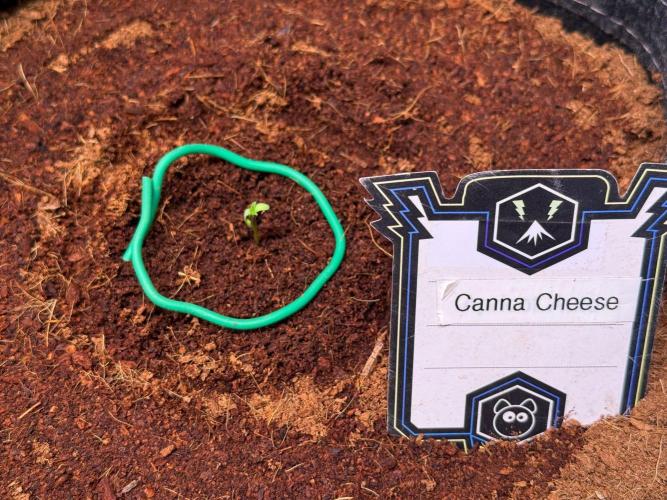
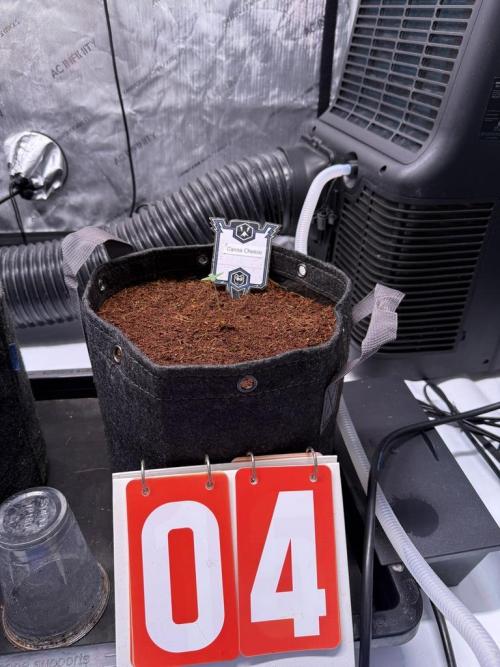
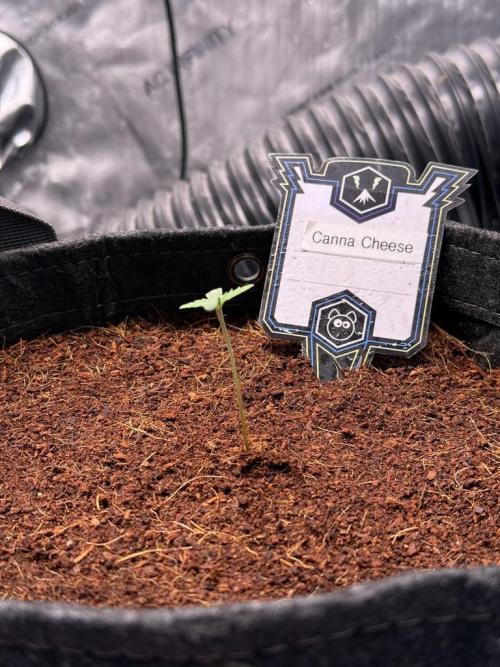
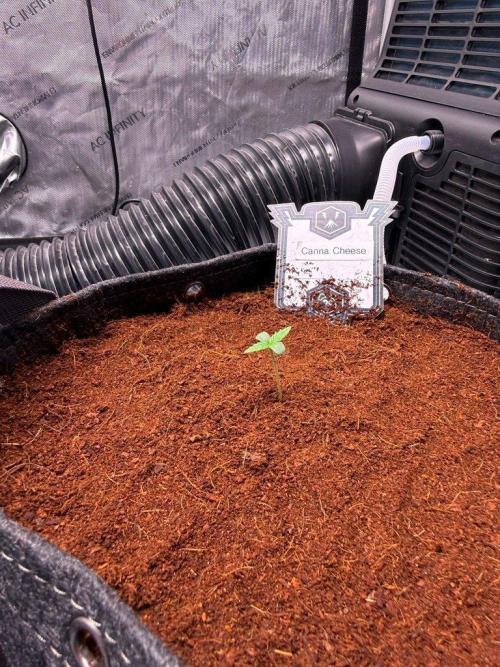
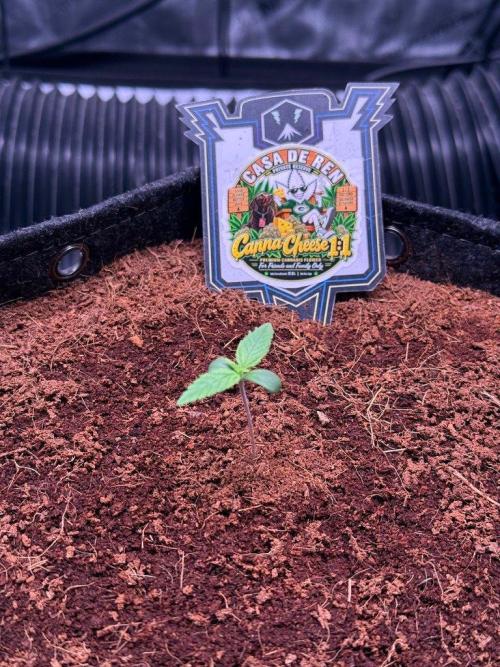
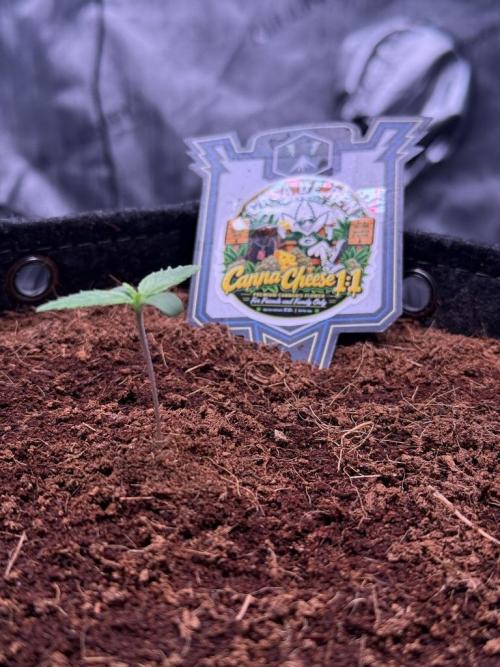
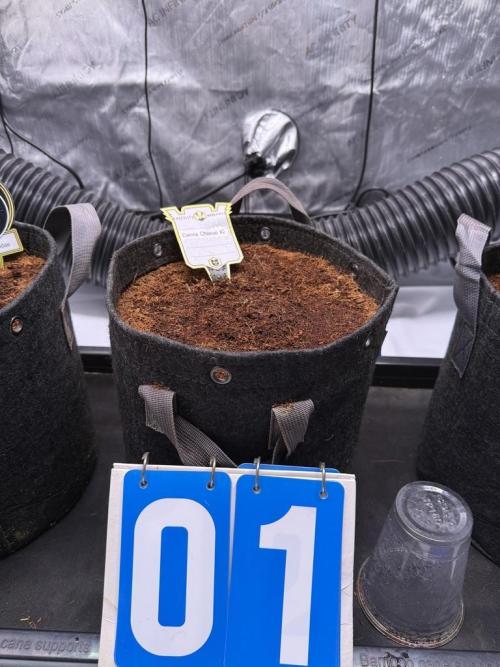
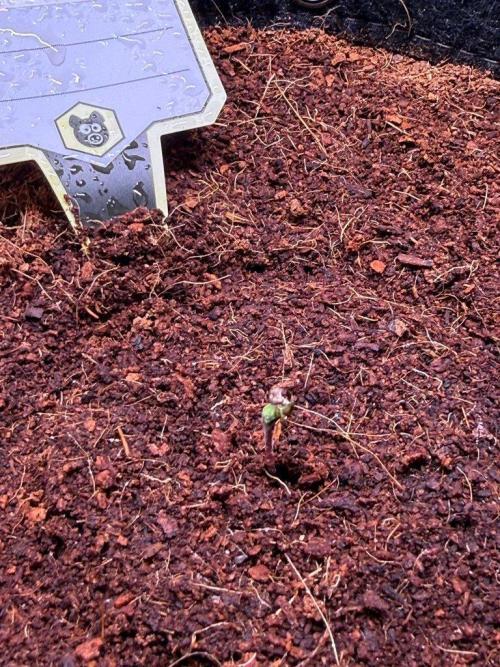
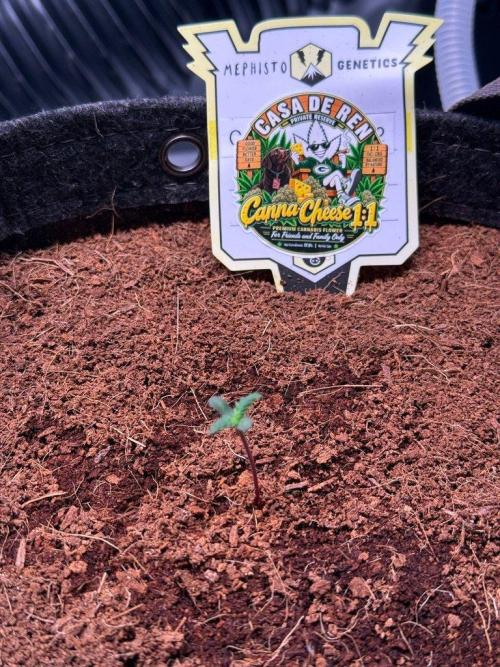
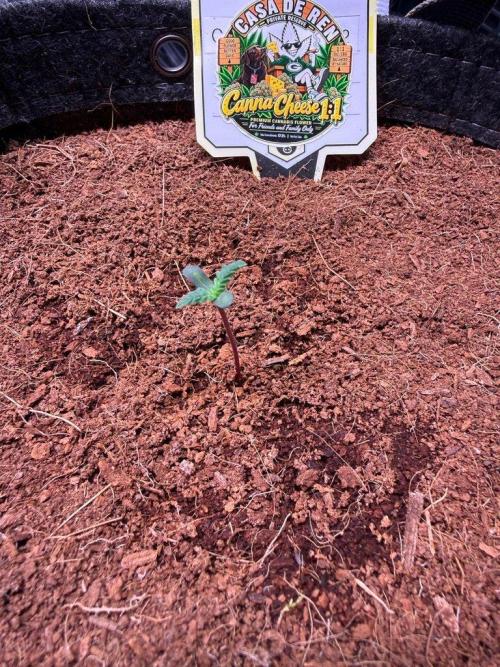
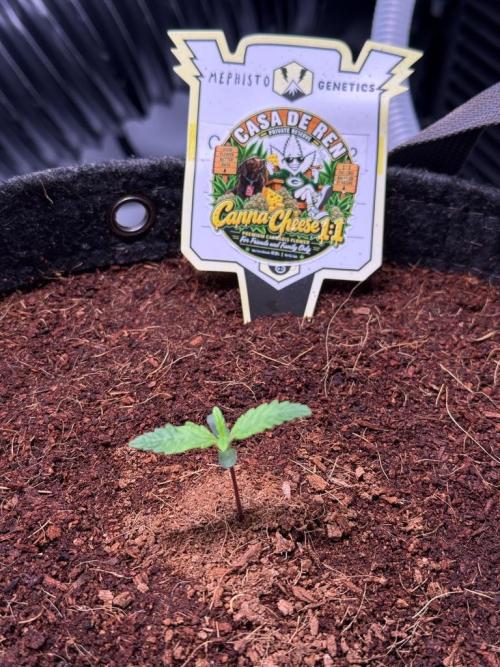
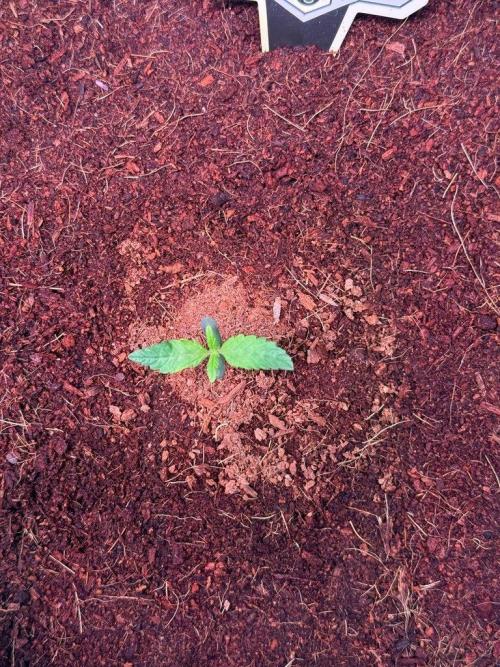
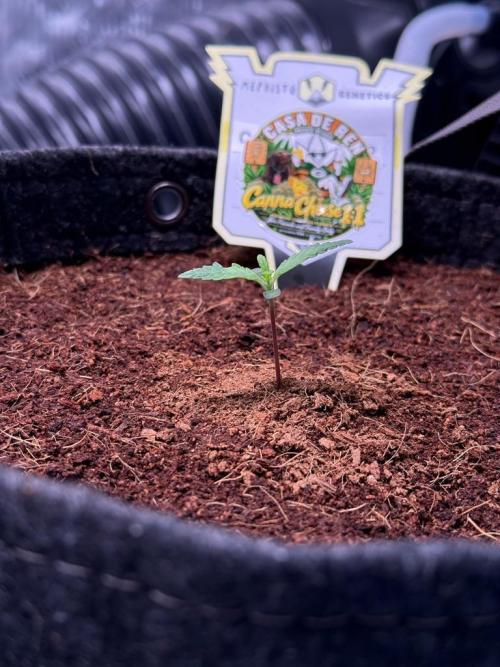
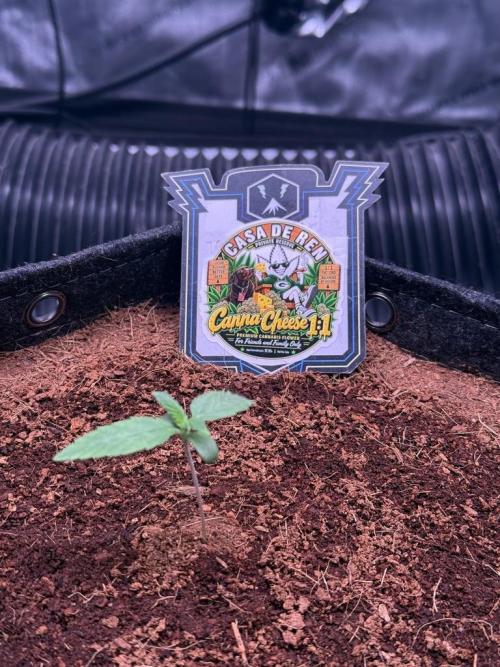
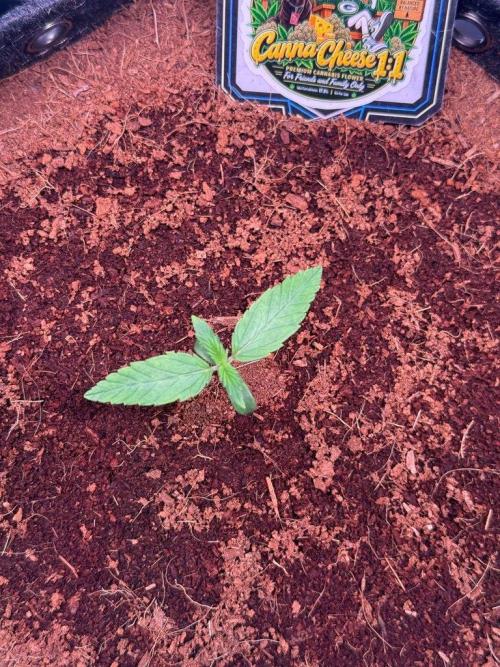
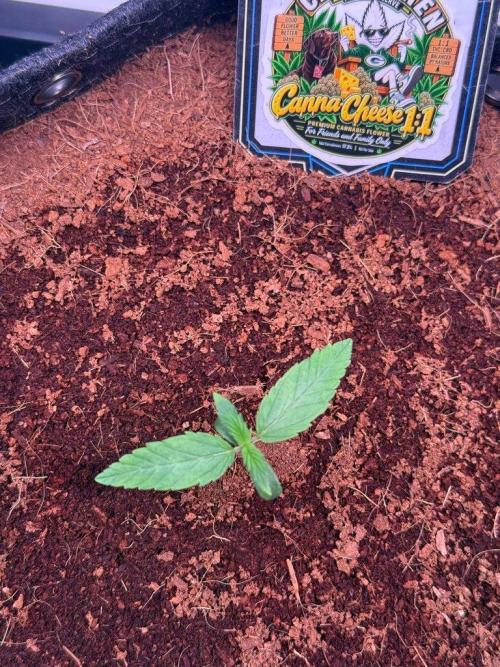
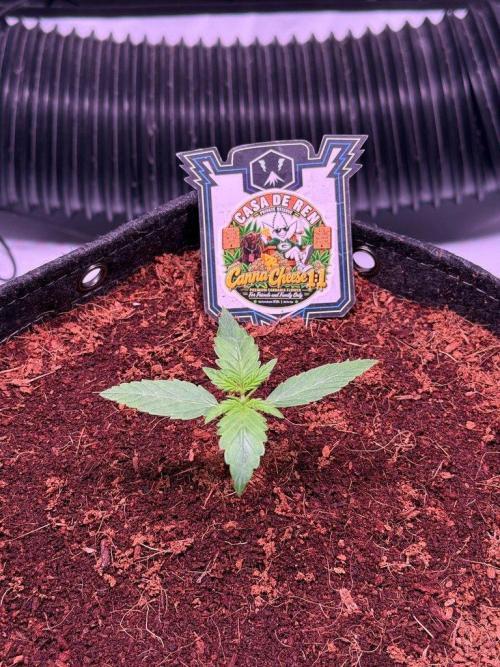
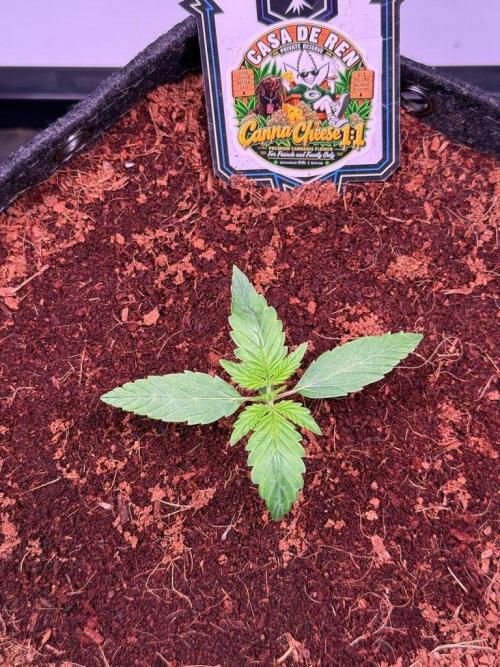
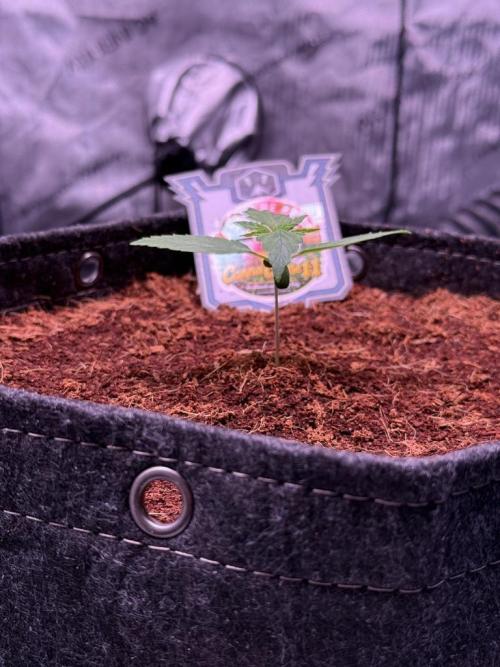
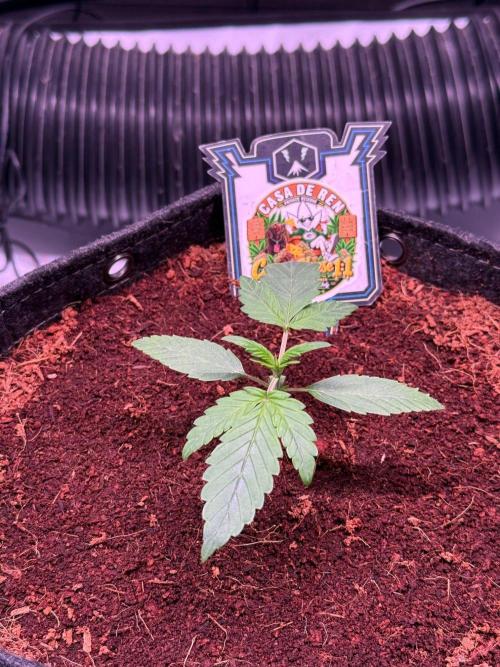
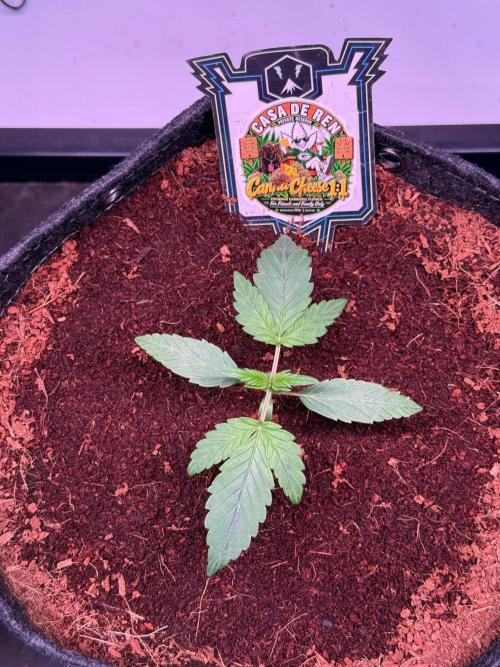
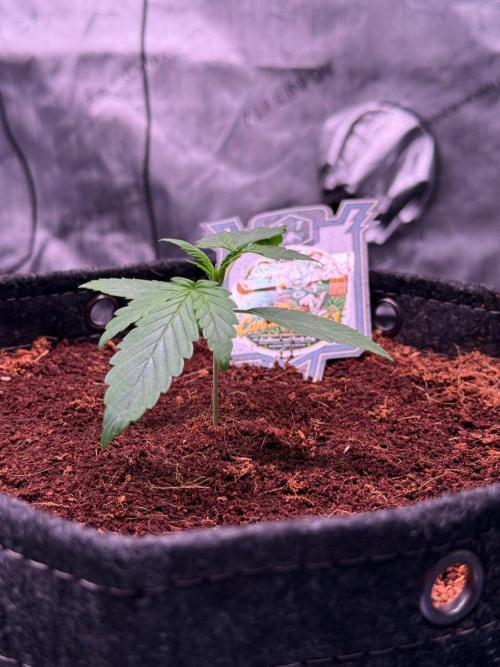
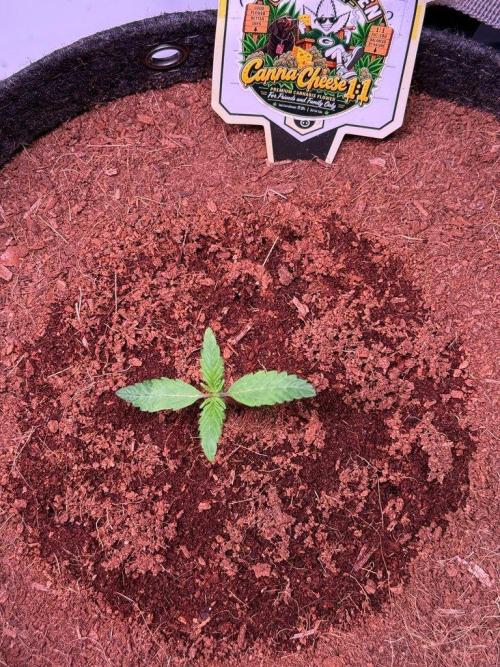
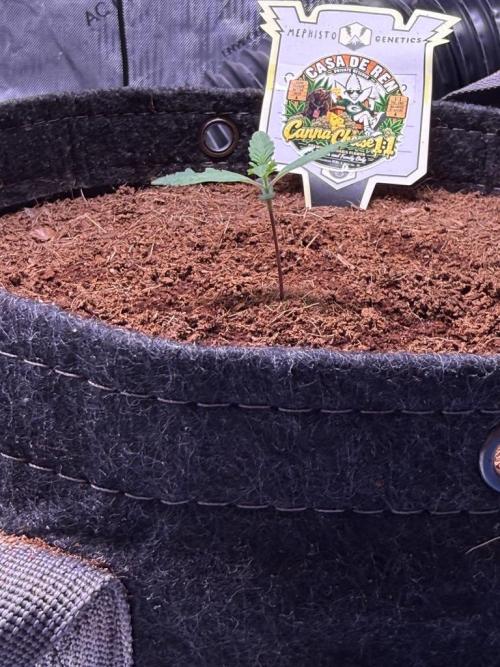
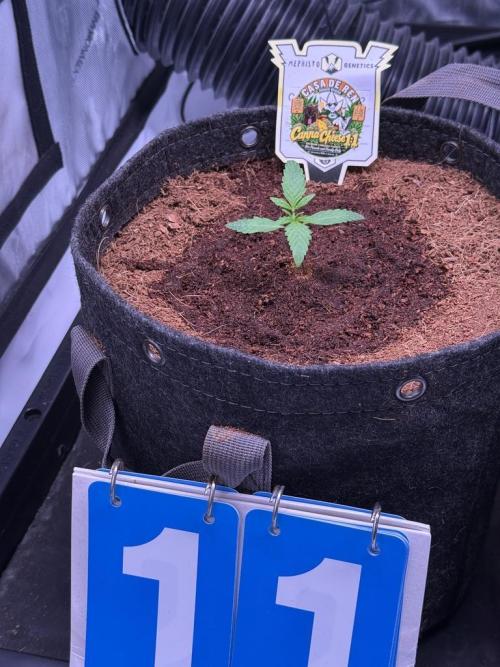
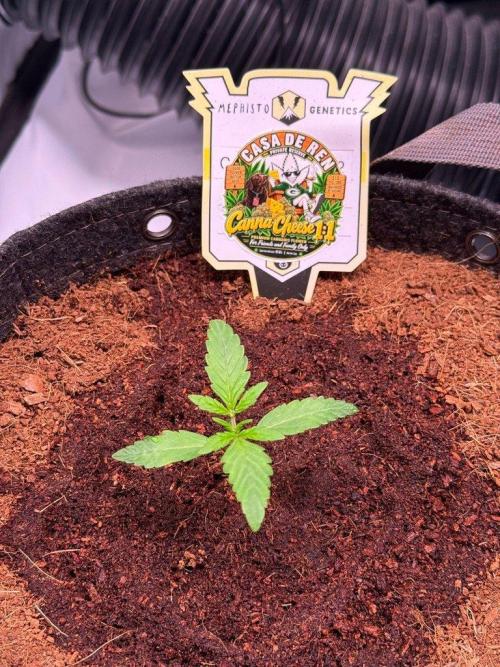
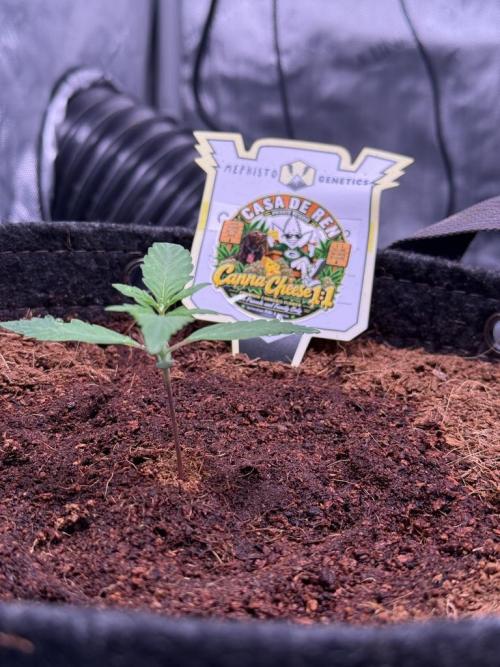
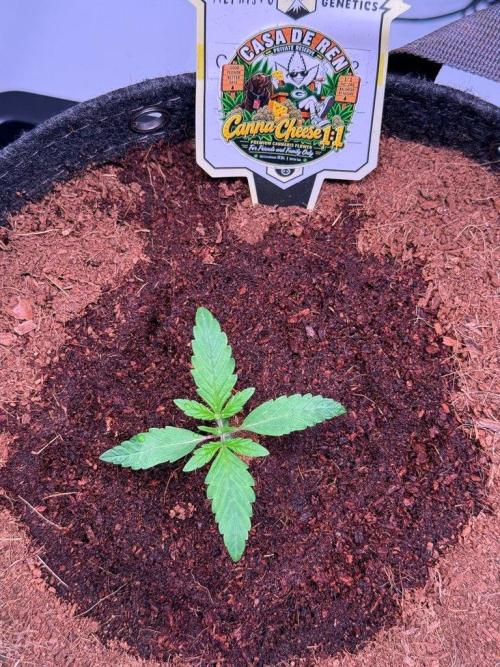
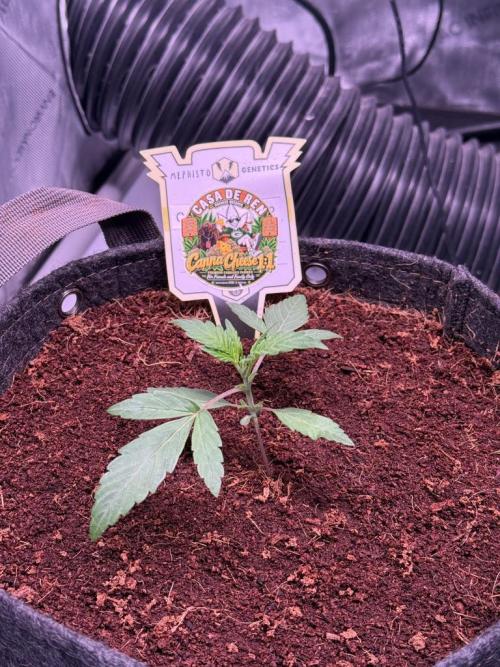
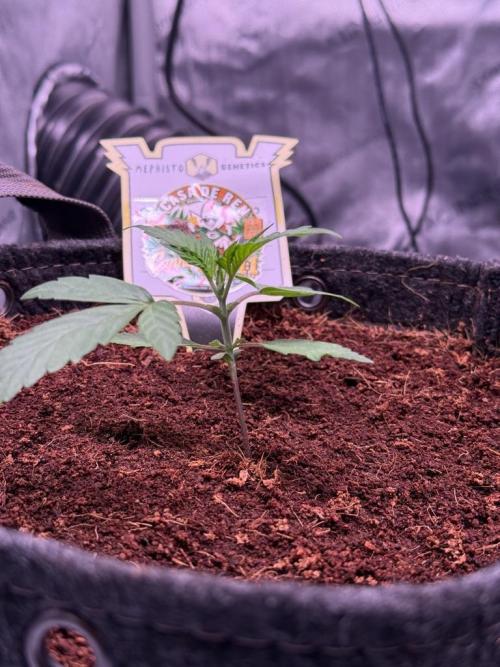
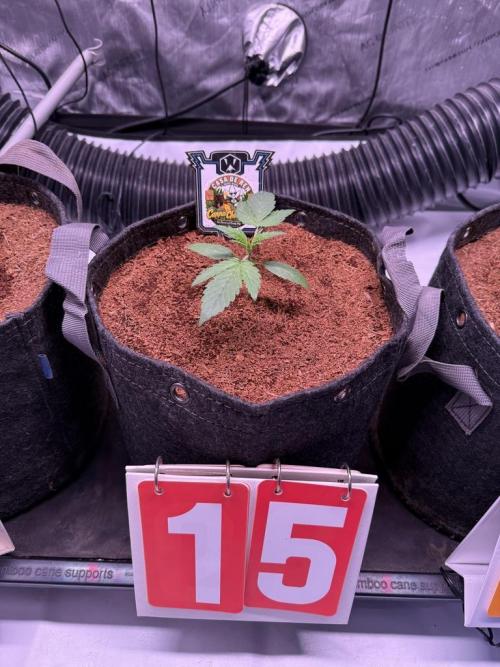
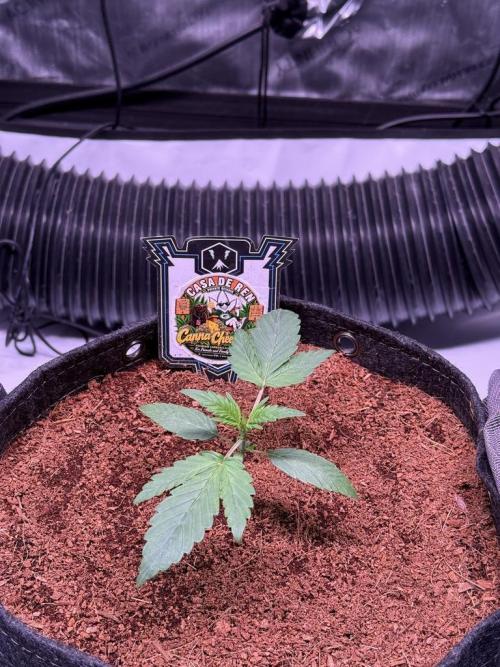
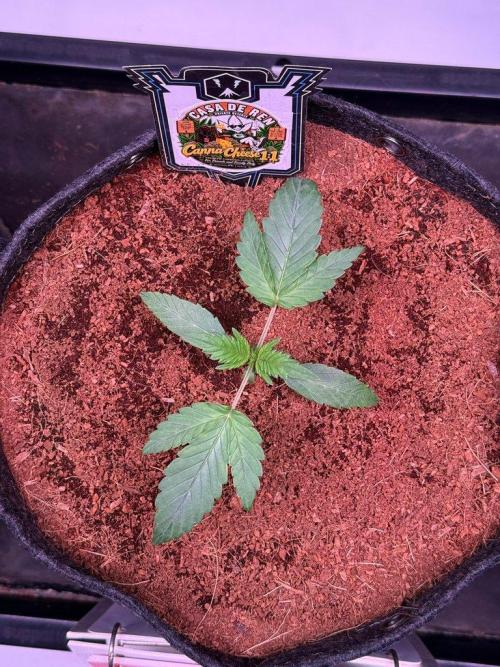
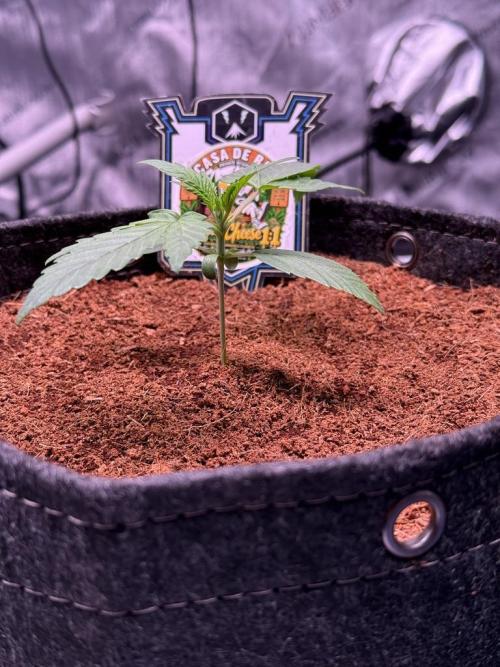
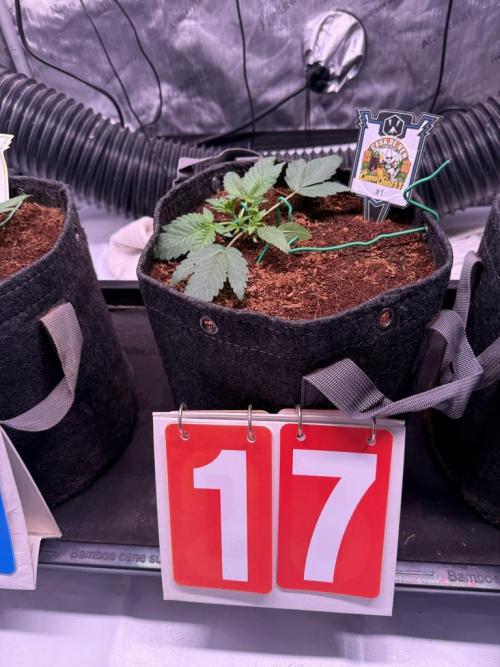
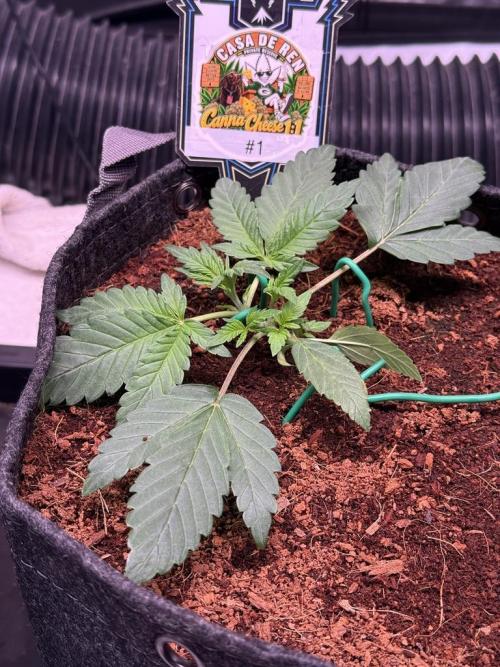
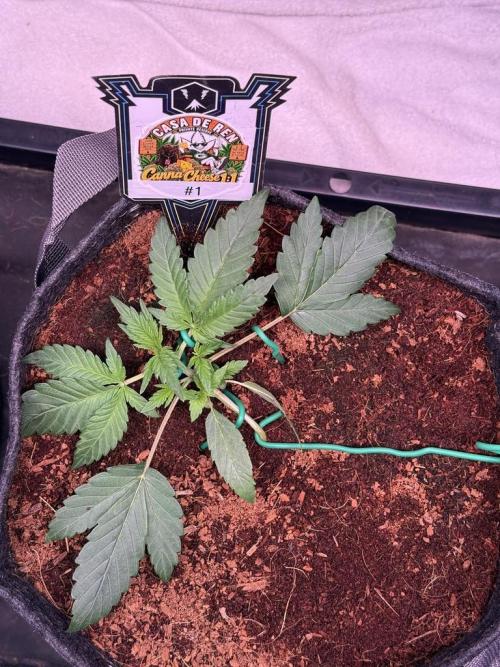
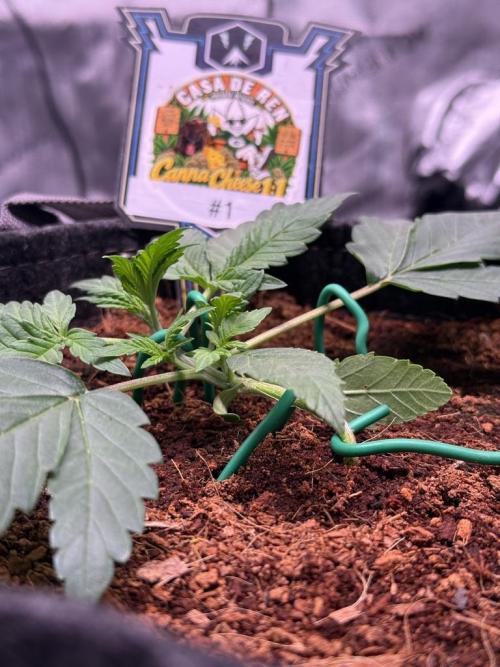
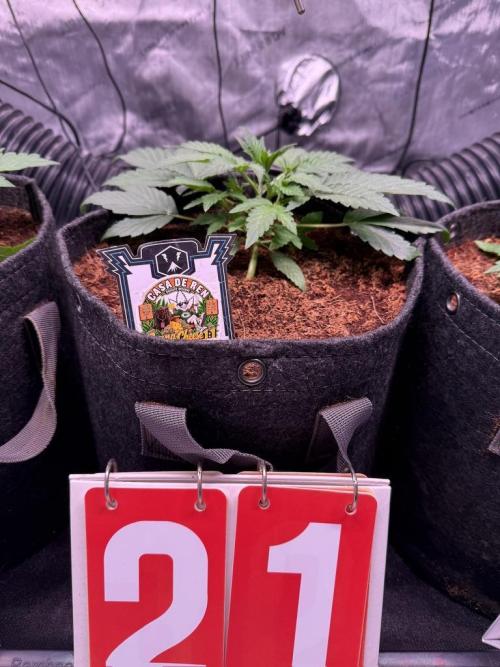
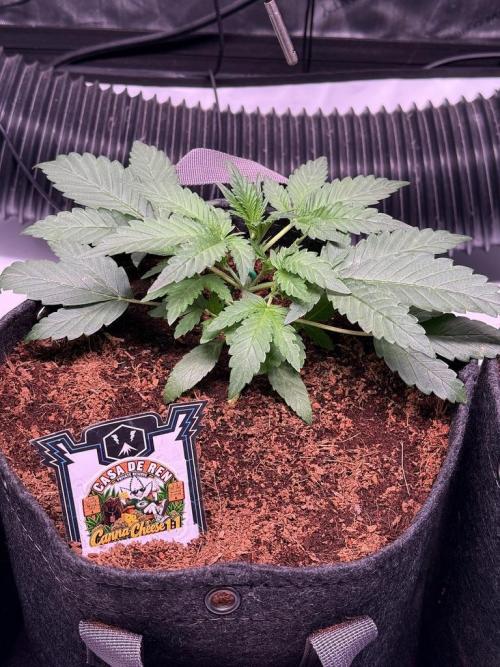
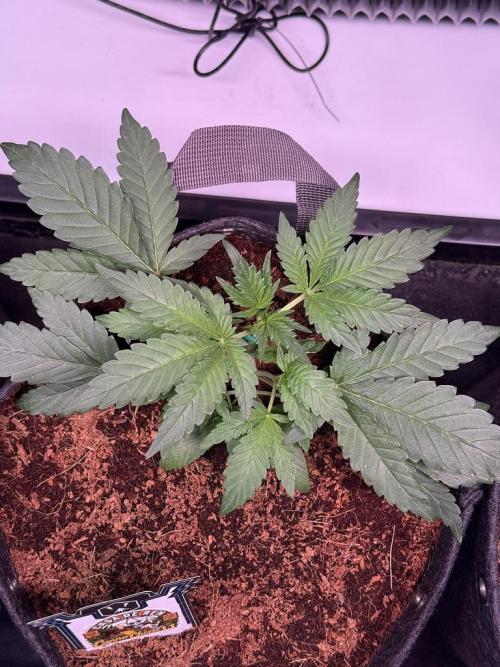
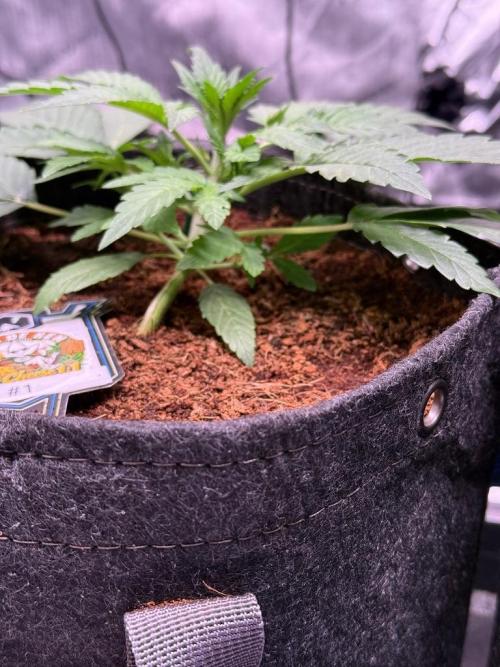
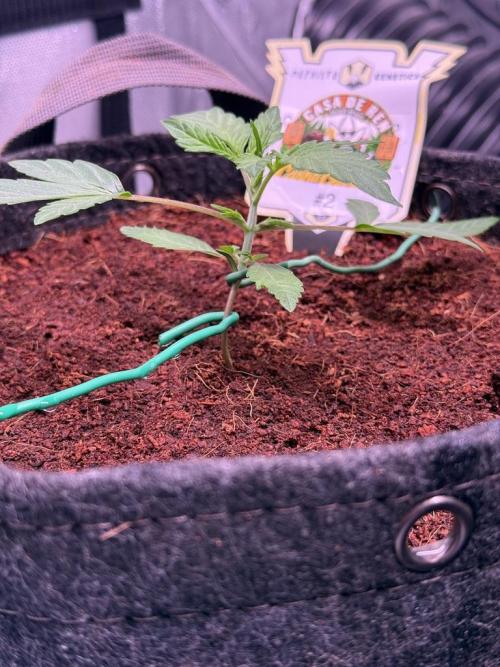
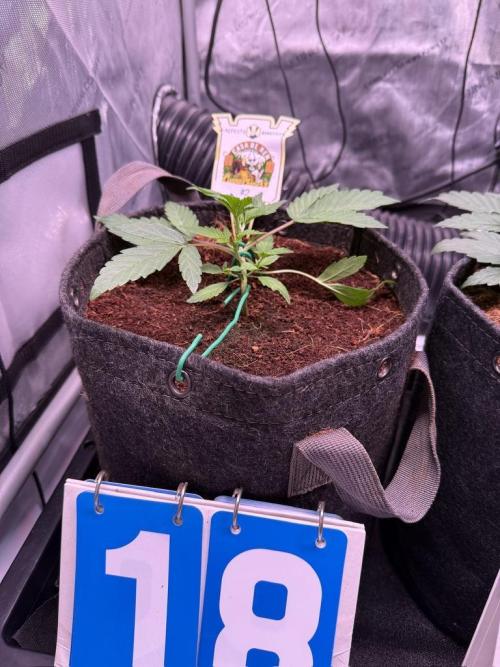
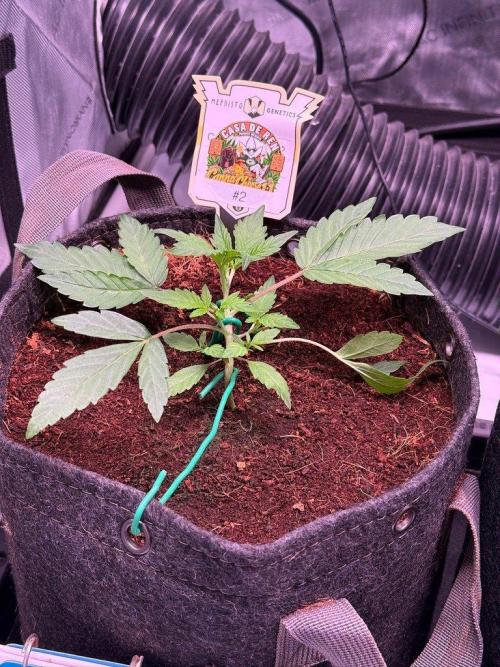
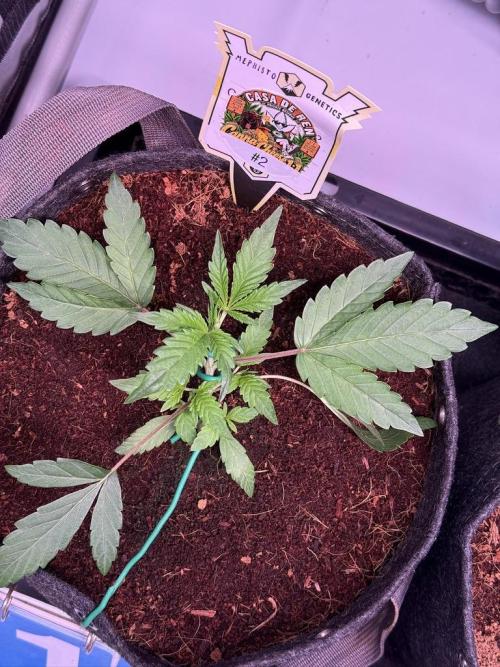
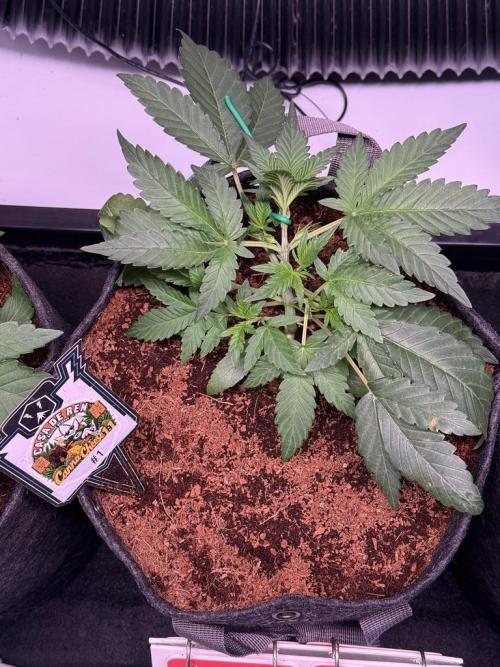
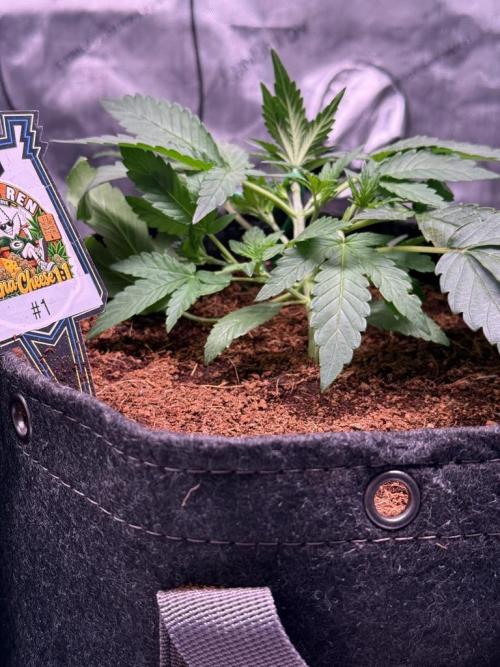
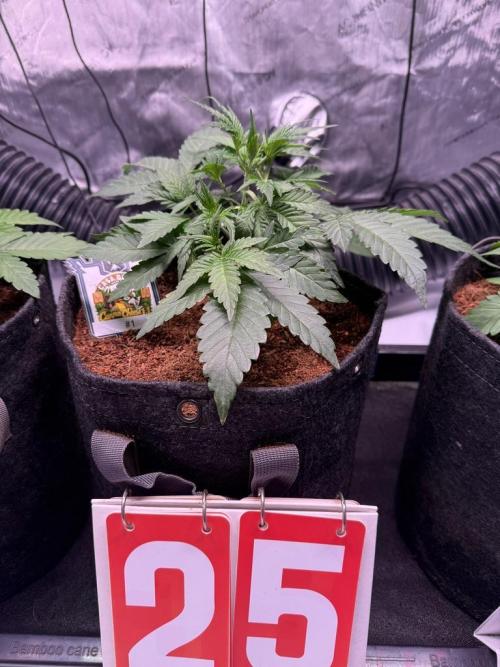
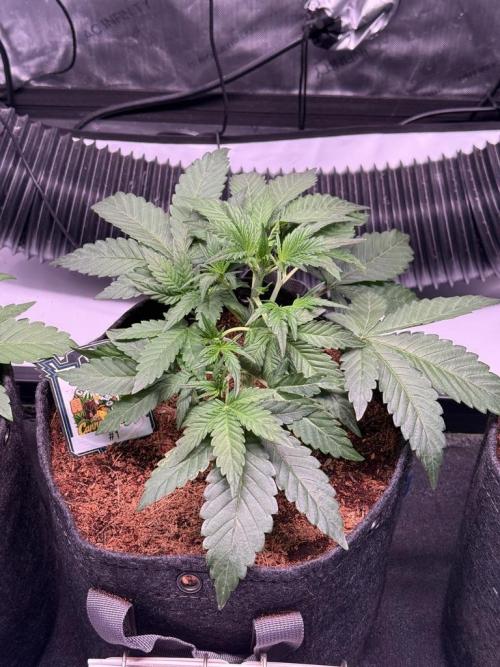
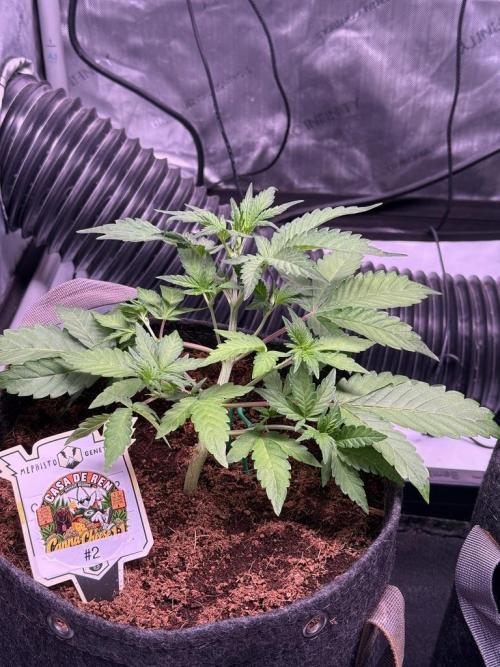
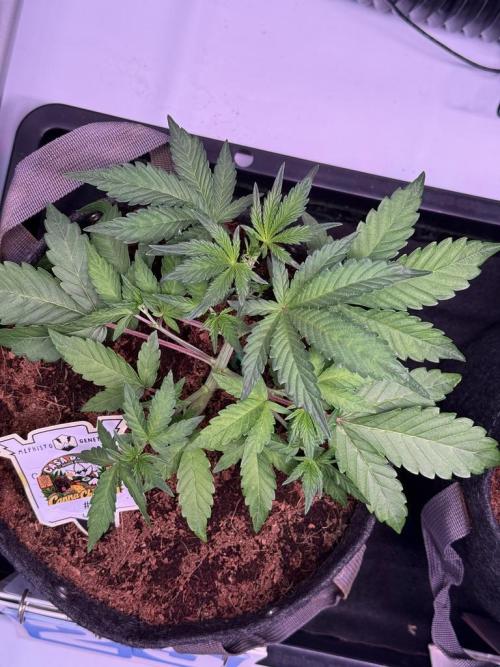
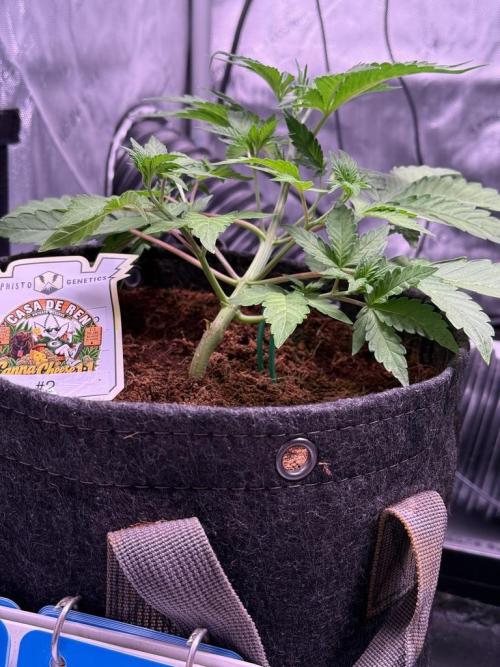
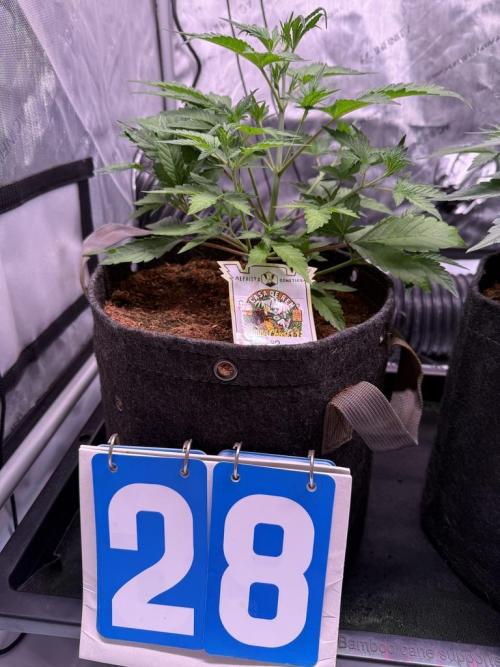
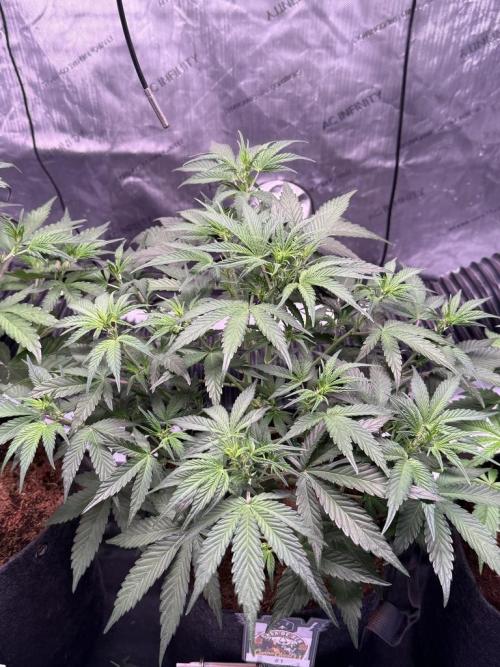
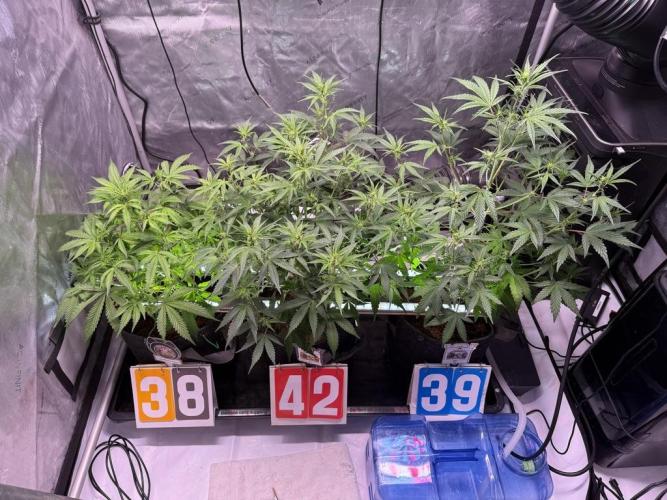
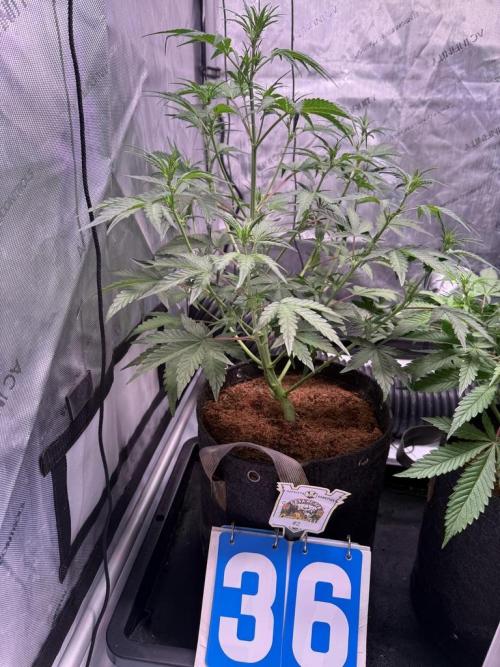
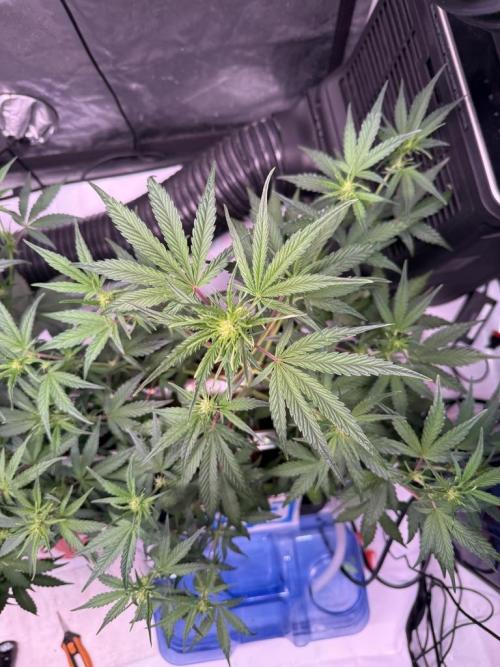
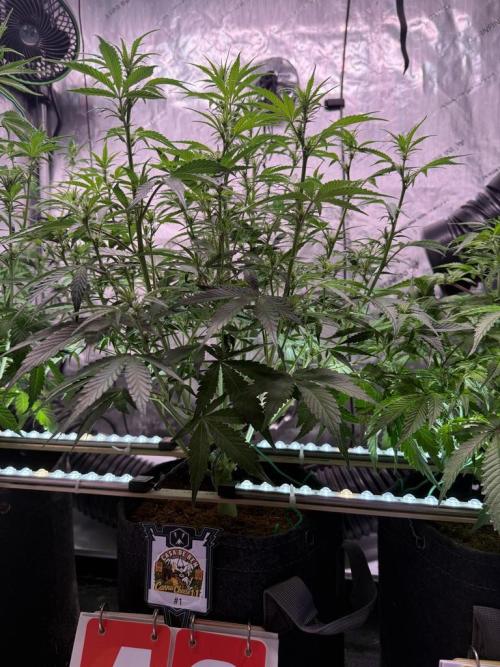
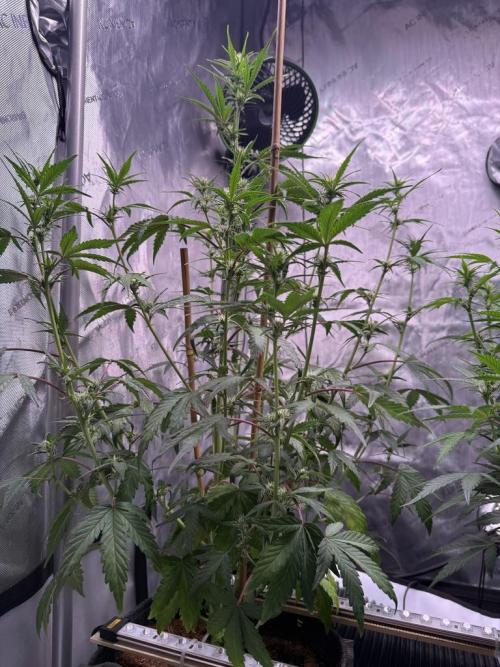
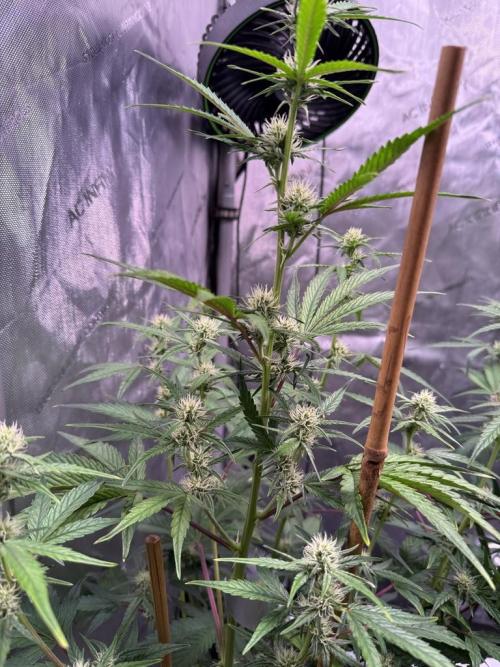
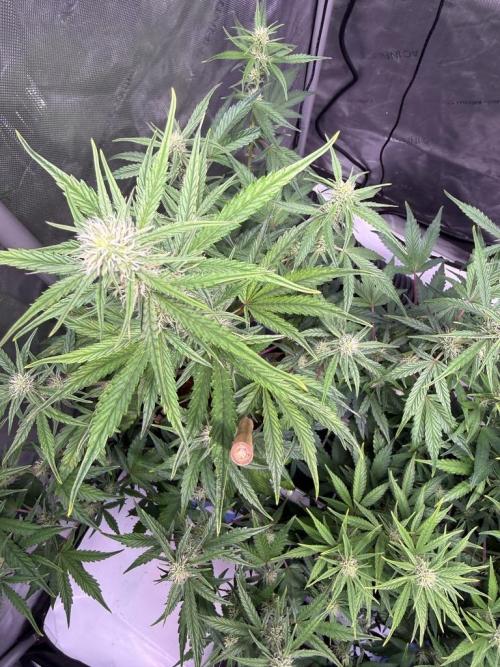
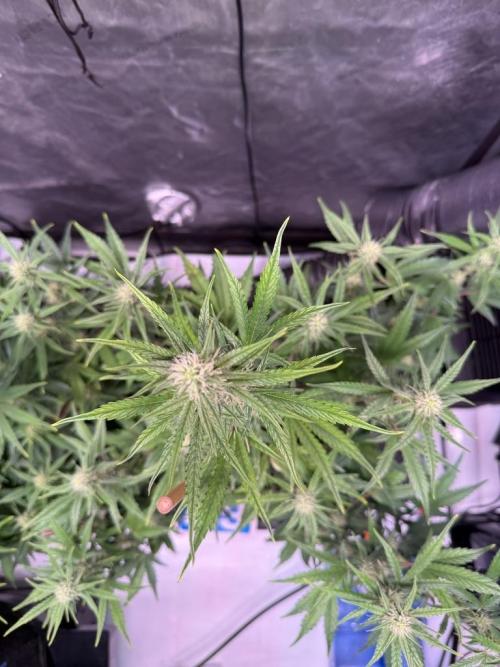
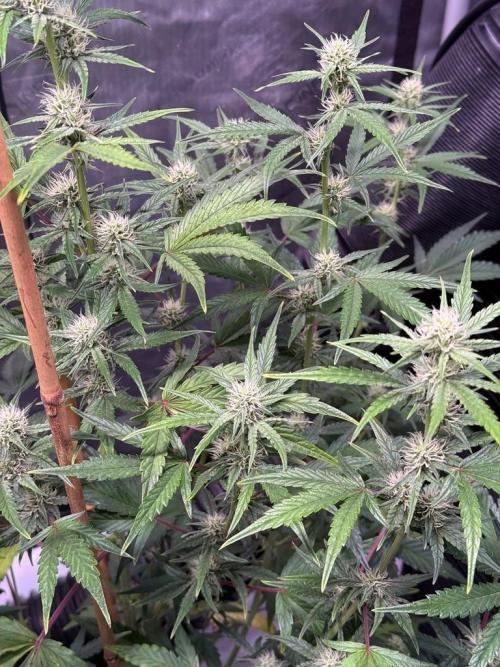
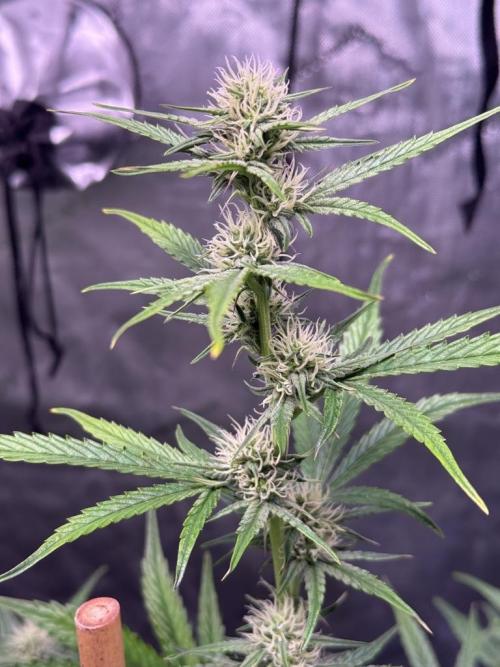
GrislyOldVet 8/28-Into the water.
8/31-Into coco coir
2 likes
comments
Share
Used method
Glass Of Water
Germination Method
1
Week 1. Vegetation
1mo ago
1/15
19 hrs
Light Schedule
26 °C
Day Air Temp
5.8
pH
300 PPM
TDS
70 %
Air Humidity
11.36 liters
Pot Size
0.95 liters
Watering Volume
91.44 cm
Lamp Distance
Nutrients 4
CANNA Coco A
0.528 mll
CANNA Coco B
0.528 mll
CANNA RHIZOTONIC
0.793 mll
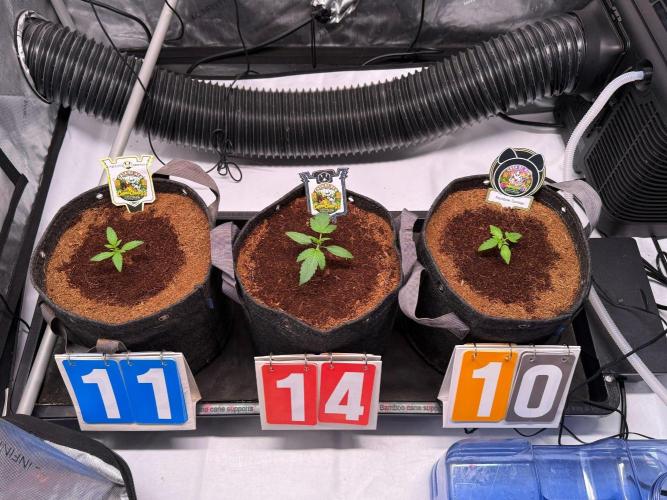
GrislyOldVet Casa de Ren — Canna-Cheese 1:1 #1
Week 1 | Days 1–7 | Sept. 1–7, 2026
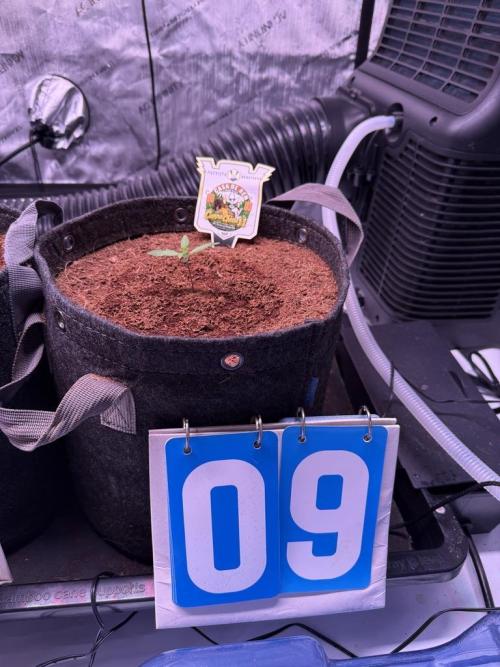
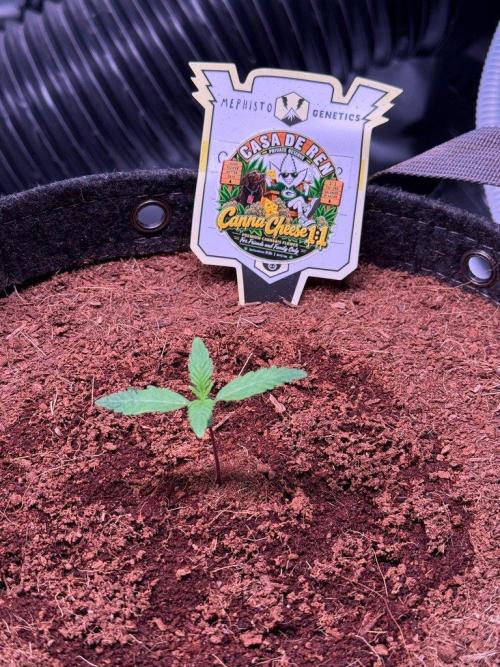
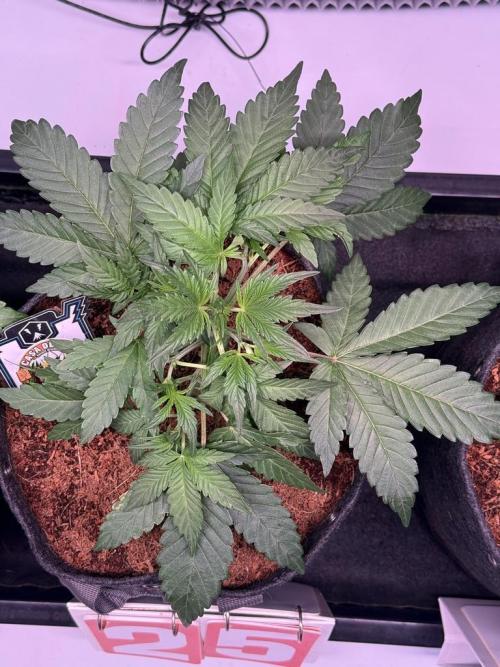
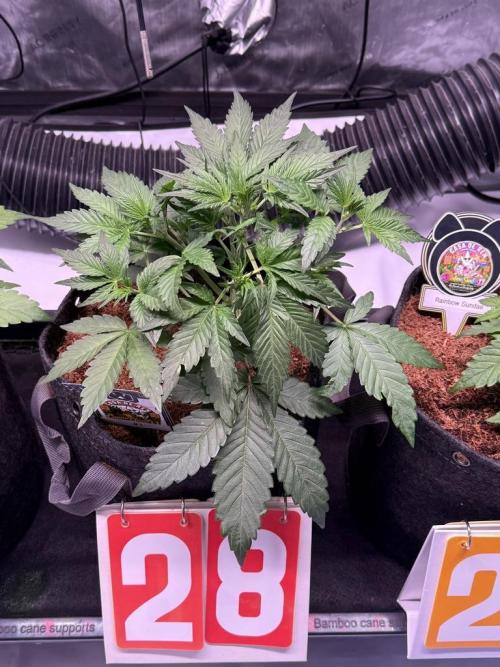
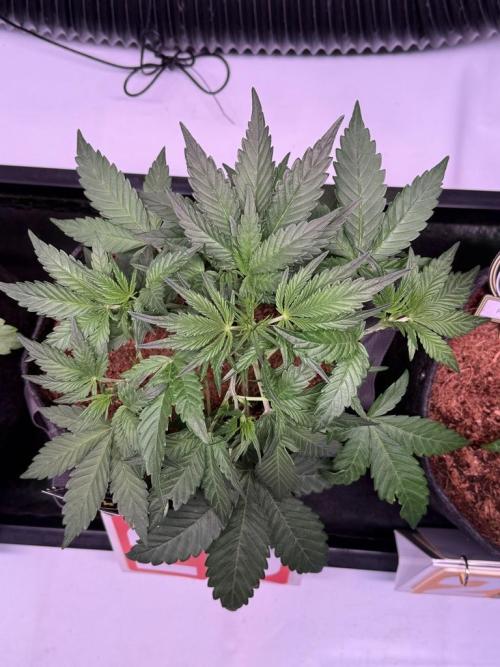
Overall: Healthy first week. Seed soak began Aug. 28, seed went into fresh CANNA Coco Professional Plus Aug. 31, and sprouted Sept. 1. The plant finished Day 7 actively growing with its first true leaves established and new center growth emerging.
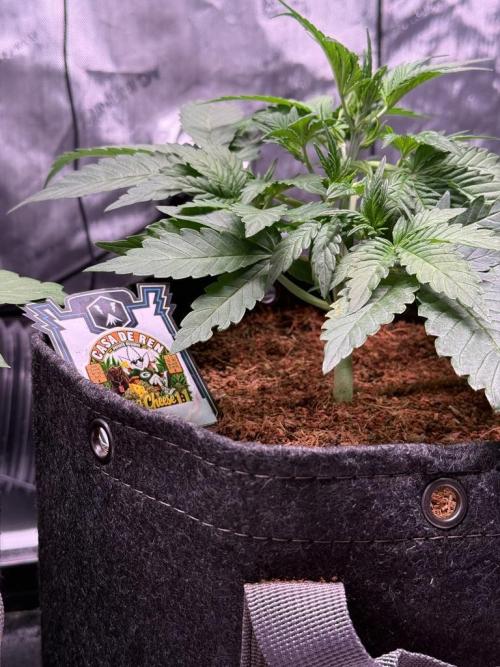
Growth/appearance: The main quirk was early stem elongation. Extra coco was added around the stem for support. Despite remaining somewhat lanky, the stem stayed upright and responded well to gentle airflow. Leaf color became slightly lime/yellow-green near the end of the week but improved without intervention.
Lighting: Started around 150 PPFD, progressed through roughly 200–225, and reached about 275–280 PPFD. On Day 7 intensity was backed down to approximately 250 PPFD because of the lighter foliage color. 19/5 photoperiod.
Feed/watering: Initial solution was RO + Cal-Mag at approximately EC 0.60 / pH 5.8, followed by light CANNA Coco A+B and RHIZOTONIC as growth established. Watering remained localized around the young root zone rather than saturating the entire pot, with the watering ring gradually expanded as the plant grew.
Environment: Representative conditions approximately 75.5°F / 69% RH / 0.75 kPa VPD, with steady gentle airflow.
Interventions/unusual observations: Early stretch prompted additional coco around the stem and gradual lighting adjustments. Interestingly, Canna-Cheese #2 subsequently showed similar elongation while Rainbow Sundae 11 remained considerably more compact in the same tent, suggesting the Canna-Cheese stretch may have a genetic component rather than being purely light-related.
Week 1 takeaway: A strong establishment week with no significant problems. The best decision may have been not reacting immediately when the foliage looked slightly pale—the color improved by the following morning.
Week 2 plan: Hold around 250 PPFD and let the plant show us what it wants. Watch the spacing of the new nodes, continue expanding the watering footprint with root development, and increase feed or light progressively based on plant response rather than the calendar.
---------------------------------------------------------------------------------------
CASA DE REN — FALL GROW 2026
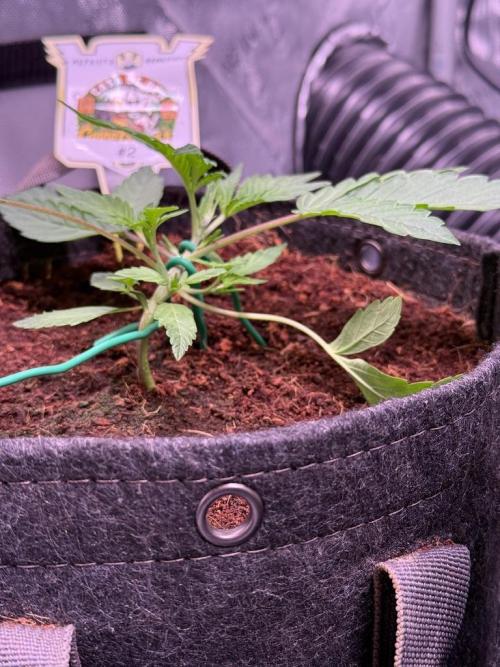
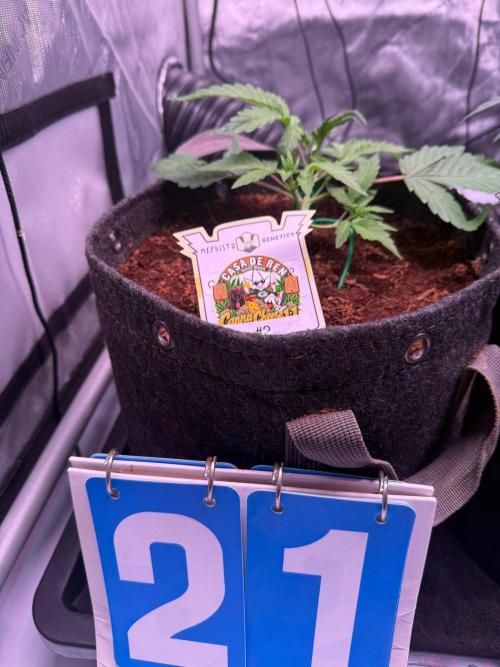
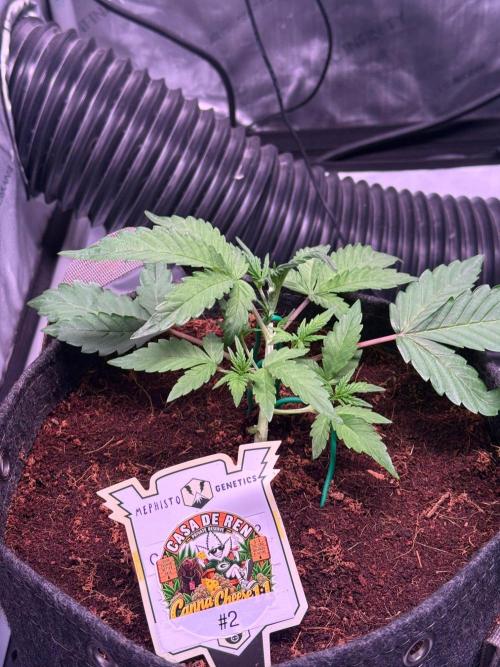
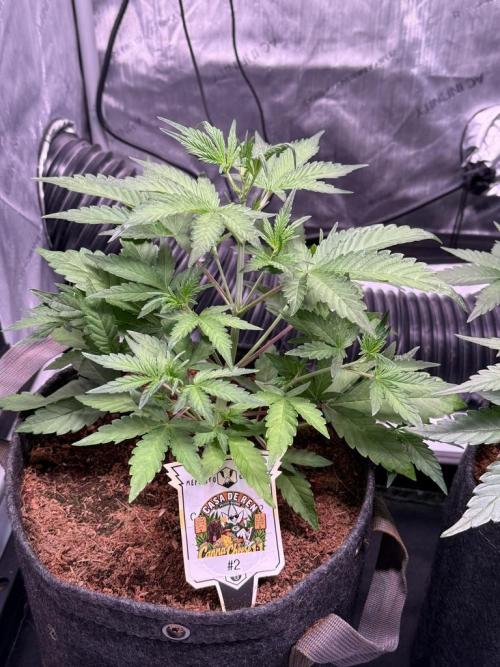
Canna-Cheese 1:1 #2 — Week 1 Report
Week 1 | Days 1–7 | Sept. 3–9 2026
Overall status
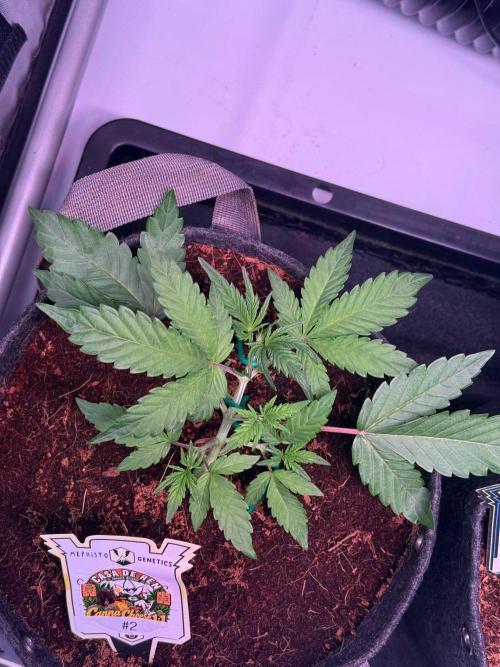
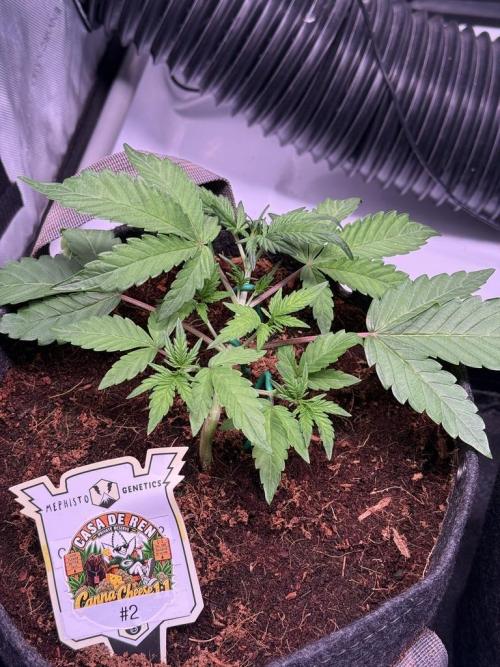
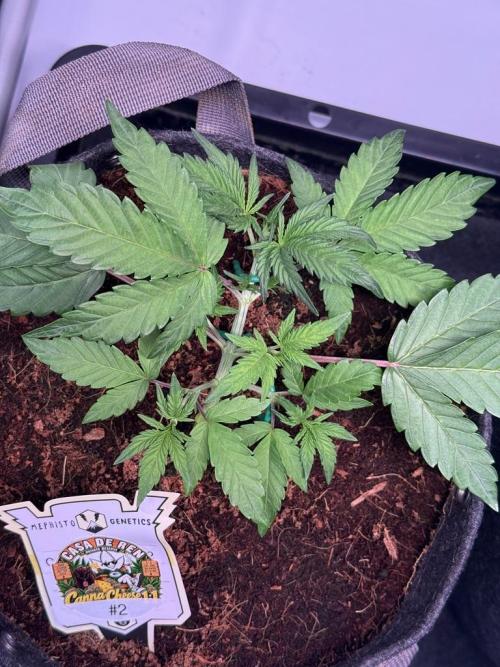
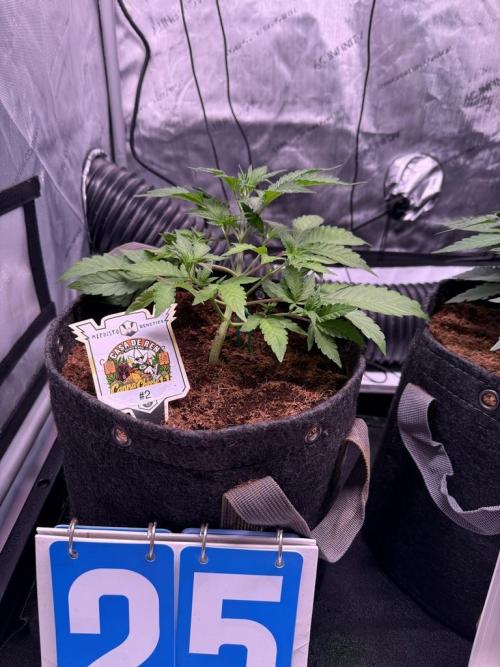
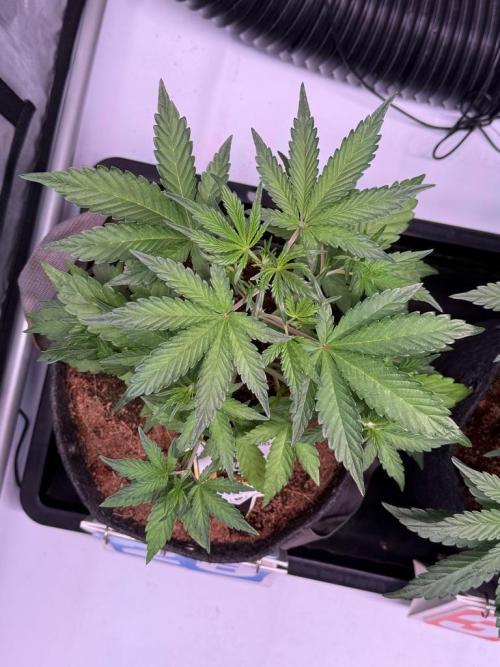
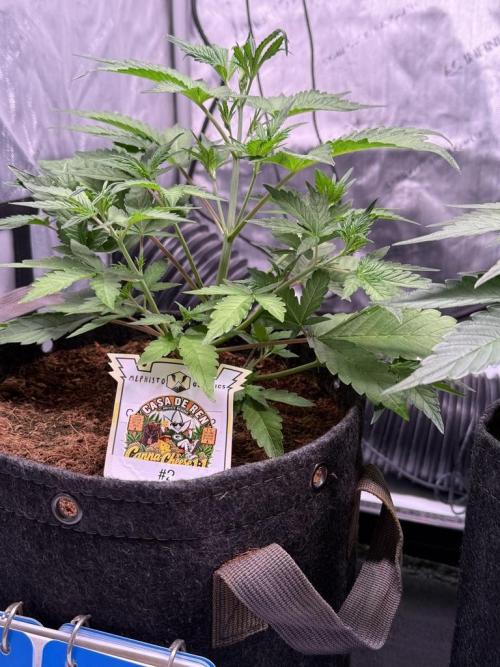
Healthy and recovering strongly. The early “helmet head” issue is now essentially behind the plant. By Day 7 the first true leaves are fully expanded, center growth is developing cleanly, and the plant has settled into a compact, balanced seedling structure.
Growth
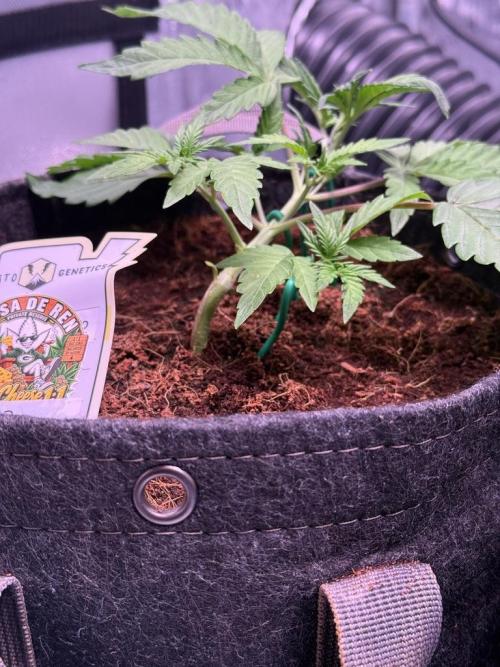
Canna-Cheese #2 is not quite as large as Canna-Cheese #1 was at the comparable point, but its trajectory is good. It is noticeably less leggy than #1. The first true leaves have opened well and the next set of leaves is expanding from the center. From above, growth is symmetrical with no obvious twisting or distortion in the new growth.
Lighting / PPFD
No aggressive lighting push was used during the first week. The plant’s compact posture, healthy color, and continued expansion provide no indication that more light is needed simply to accelerate the schedule.
Feed / root zone
Nutrient solution EC remained mild at approximately 0.6–0.7 throughout this period. There has been no need to increase EC. Healthy color and continued growth support keeping the current approach rather than raising feed strength on a calendar-based schedule.
Environment
The seedling is establishing normally in its final container. No environmental stress symptoms are apparent in the Day 7 photographs.
Interventions
The notable Week 1 event was the helmet-head emergence issue. The seedling emerged with the shell/membrane still constraining the cotyledons, then recovered as the leaves opened. By Day 7 there was no evidence of lasting damage. Minor unevenness or wrinkling in the first true leaves is consistent with the rough emergence and is not concerning while the new center growth continues to develop normally.
What the plant indicated this week
The plant responded well to a restrained start: mild feed, no unnecessary push, and time to recover from emergence. The strongest signal is the quality of the new growth—healthy lime-to-deeper-lime color, clean center development, and a compact structure.
Plan going into Week 2
Stay the course. Continue watching new growth, color, leaf expansion, stem development, and water use. Do not raise EC merely because Week 1 is complete; increase inputs progressively only if plant response indicates a need.
Week 1 takeaway
Recovered, compact, and growing well — the mild start is working, so there is no reason to push.
5 likes
comments
Share
2
Week 2. Vegetation
1mo ago
1/25
7.62 cm
Height
19 hrs
Light Schedule
26 °C
Day Air Temp
5.8
pH
600 PPM
TDS
68 %
Air Humidity
11.36 liters
Pot Size
0.95 liters
Watering Volume
91.44 cm
Lamp Distance
Nutrients 5
CANNA Coco A
0.528 mll
CANNA Coco B
0.528 mll
CANNA RHIZOTONIC
0.528 mll
GrislyOldVet CASA DE REN • FALL GROW 2026
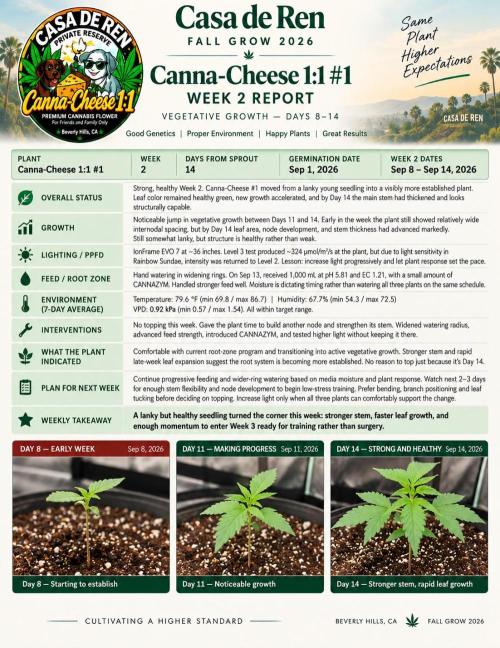
CANNA-CHEESE 1:1 #1 — WEEK 2
Days 8–14 | September 8–14, 2026
Overall Status
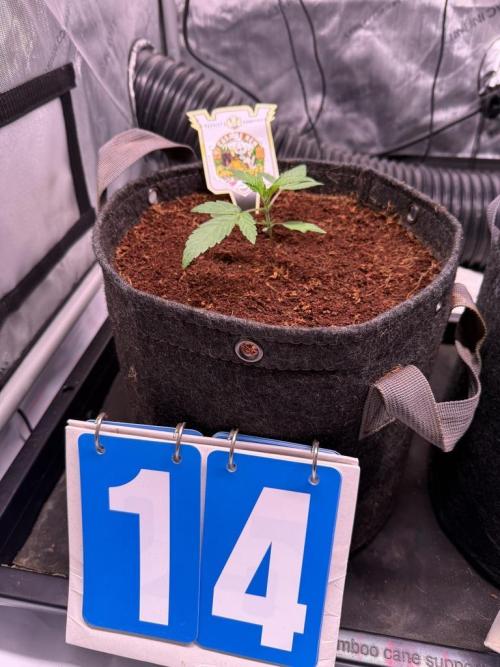
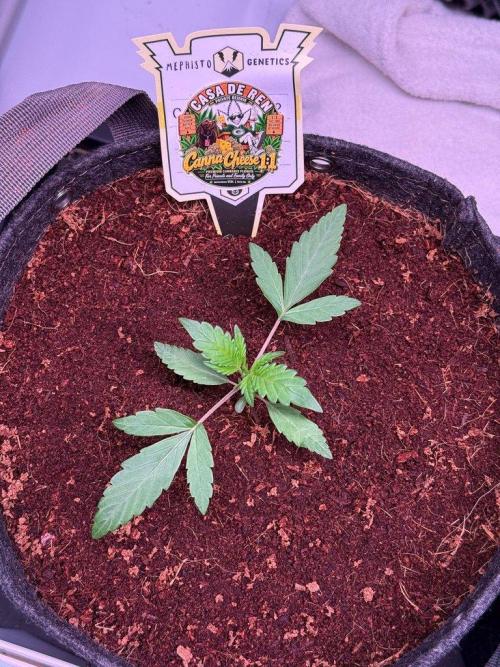
Strong, healthy Week 2. Canna-Cheese #1 moved from a lanky young seedling into a visibly more established plant. Leaf color remained healthy green, new growth accelerated, and by Day 14 the main stem had thickened enough to look substantially more permanent and structurally capable.
Growth
The most obvious change this week was the jump in vegetative growth between Days 11 and 14. Early in the week the plant still showed relatively wide internodal spacing and little separation at the next node, making the usual Day-14 topping decision premature. By Day 14, leaf area, node development and stem thickness had all advanced markedly. The plant remains somewhat lanky, but the structure is healthy rather than weak.
Lighting / PPFD
The IonFrame EVO 7 remained at approximately 36 inches above the plants. A Level-3 test produced about 324 µmol/m²/s at the Canna-Cheese #1 position. Because Rainbow Sundae showed some light sensitivity elsewhere in the tray, intensity was returned to Level 2. The Week 2 lesson was to keep light increases progressive and let plant response—not a fixed calendar—set the pace.
Feed / Root Zone
Hand watering continued in widening rings to encourage roots to move outward through the grow bag. On September 13, Canna-Cheese #1 received 1,000 mL distributed in a broad ring at pH 5.81 and EC 1.21, with a small amount of CANNAZYM added. The plant handled the stronger feeding well, with no visible nutrient stress. Moisture was allowed to dictate timing rather than watering all three plants on the same schedule.
Environment
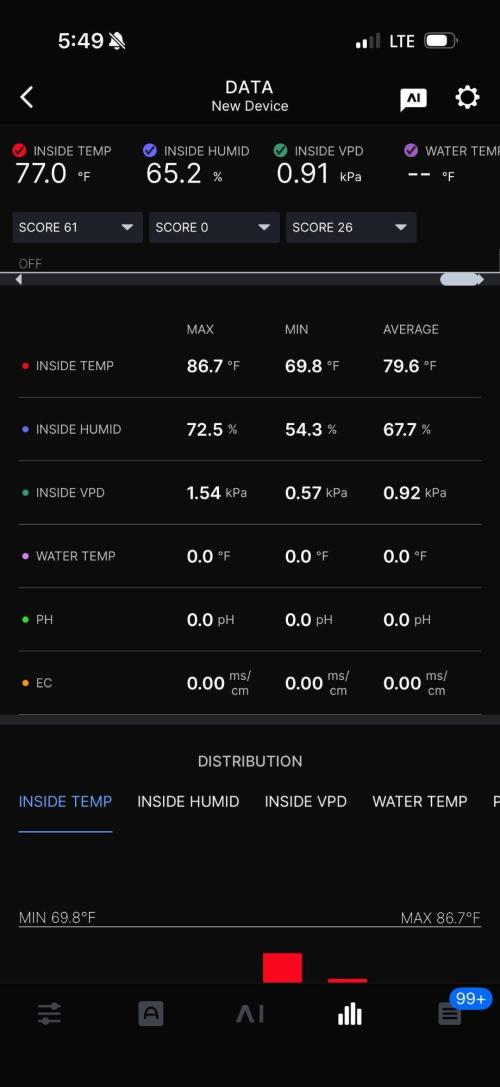
Seven-day averages were 79.6 °F, 67.7% RH and 0.92 kPa VPD.
Interventions
Watering radius was widened, feed strength was advanced cautiously, CANNAZYM was introduced, and lighting was tested without forcing the plant to remain at the higher setting.
What the Plant Told Us
Canna-Cheese #1 appears comfortable with the current root-zone program and is beginning to transition from seedling establishment into active vegetative growth. The stronger stem and rapid late-week leaf expansion suggest the root system is becoming more established.
Plan Going Into Week 3
Continue progressive feeding and wider-ring watering based on media moisture and plant response. Watch the next two to three days for enough stem flexibility and node development to begin low-stress training. The current preference is to try bending, branch positioning and leaf tucking before deciding whether topping is necessary. Increase light only when all three plants can comfortably support the change.
WEEKLY TAKEAWAY
A lanky but healthy seedling turned the corner this week: stronger stem, faster leaf growth, and enough momentum to enter Week 3 ready for training rather than surgery.
Casa de Ren Private Reserve • Fall Grow 2026
______________________________________________________________________________
CASA DE REN • FALL GROW 2026
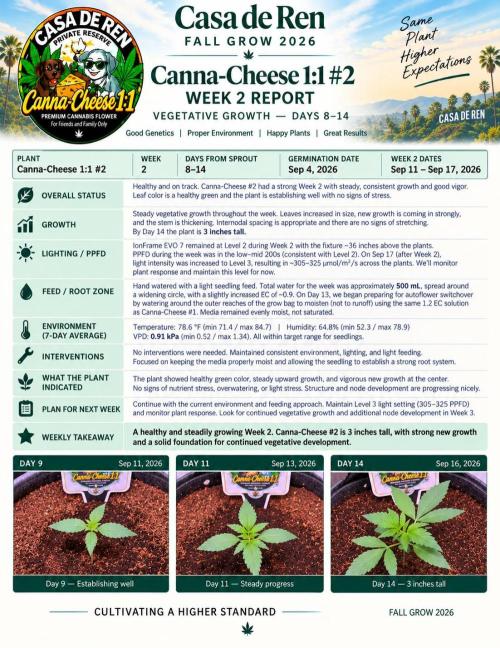
CANNA-CHEESE 1:1 #2 — WEEK 2
Days 8–14 | September 11–17, 2022
Overall Status
Healthy and on track. Canna-Cheese #2 had a strong Week 2 with steady, consistent growth and good vigor.
Leaf color is a healthy green and the plant is establishing well with no signs of stress.
Growth
Steady vegetative growth throughout the week. Leaves increased in size, new growth is coming in strongly, and the stem is thickening. Internodal spacing is appropriate and there are no signs of stretching.
By Day 14 the plant is 3 inches tall.
Lighting / PPFD
lonFrame EVO 7 remained at Level 2 during Week 2 with the fixture ~36 inches above the plants.
PPFD during the week was in the low-mid 200s (consistent with Level 2). On Sep 17 (after Week 2), light intensity was increased to Level 3, resulting in ~305-325 umol/m?/s across the plants. We'll monitor plant response and maintain this level for now.
Feed / Root Zone
Hand watered with a light seedling feed. Total water for the week was approximately 500mL, spread around a widening circle, with a slightly increased EC of ~0.9. On Day 13, we began preparing for autoflower switchover by watering around the outer reaches of the grow bag to moisten (not to runoff) using the same 1.2 EC solution as Canna-Cheese #1. Media remained evenly moist, not saturated.
Environment
Temperature: 78.6 °F (min 71.4 / max 84.7) | Humidity: 64.8% (min 52.3 / max 78.9)
VPD: 0.91 kPa (min 0.52 / max 1.34). All within target range for seedlings.
Interventions
No interventions were needed. Maintained consistent environment, lighting, and light feeding.
Focused on keeping the media properly moist and allowing the seedling to establish a strong root system.
What the Plant Told Us
The plant showed healthy green color, steady upward growth, and vigorous new growth at the center.
No signs of nutrient stress, overwatering, or light stress. Structure and node development are progressing nicely.
Plan Going Into Week 3
Continue with the current environment and feeding approach. Maintain Level 3 light setting (305-325 PPFD) and monitor plant response. Look for continued vegetative growth and additional node development in Week 3.
WEEKLY TAKEAWAY
A healthy and steadily growing Week 2. Canna-Cheese #2 is 3 inches tall, with strong new growth and a solid foundation for continued vegetative
5 likes
1 comment
Share
3
Week 3. Vegetation
1mo ago
1/27
10.16 cm
Height
20 hrs
Light Schedule
25 °C
Day Air Temp
5.8
pH
600 PPM
TDS
63 %
Air Humidity
11.36 liters
Pot Size
0.95 liters
Watering Volume
91.44 cm
Lamp Distance
Nutrients 5
CANNA Coco A
1.585 mll
CANNA Coco B
1.585 mll
CANNA RHIZOTONIC
1.057 mll
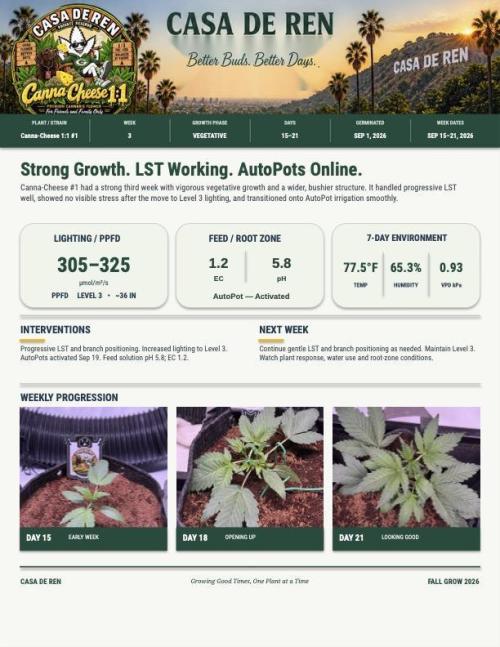
GrislyOldVet CASA DE REN - FALL GROW 2026
Canna-Cheese 1:1 #1 - Week 3 Weekly Grow Log
Sep 15-21, 2026 | Days 15-21 | Germinated Sep 1, 2026 | Vegetative
Overall Status
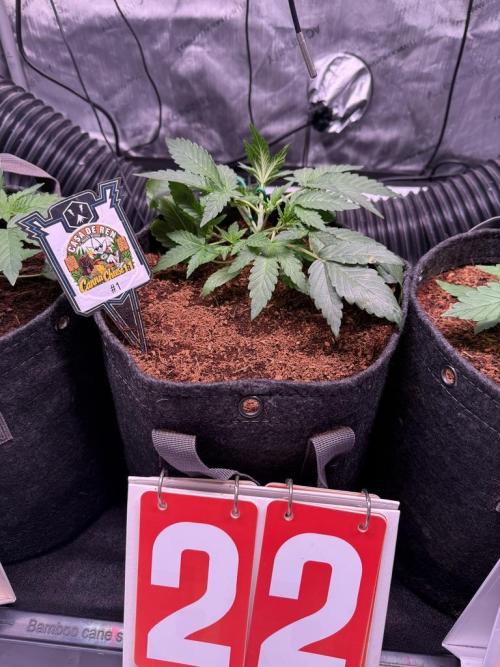
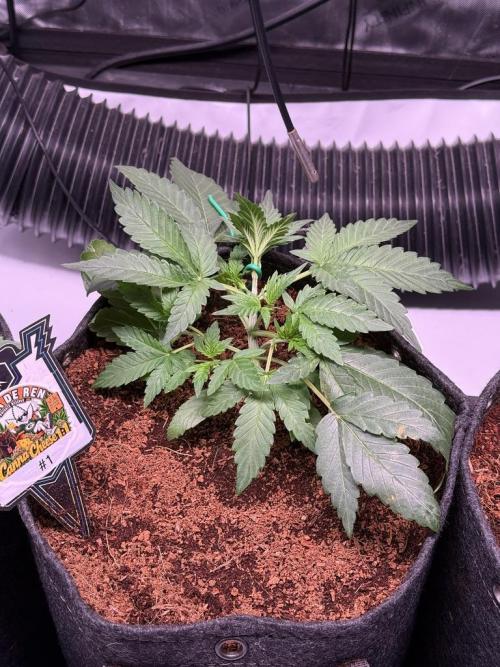
Canna-Cheese #1 had a strong third week with vigorous vegetative growth and a wider, bushier structure. It handled progressive low-stress training well, showed no visible stress after the move to Level 3 lighting, and transitioned onto AutoPot irrigation smoothly.
Growth
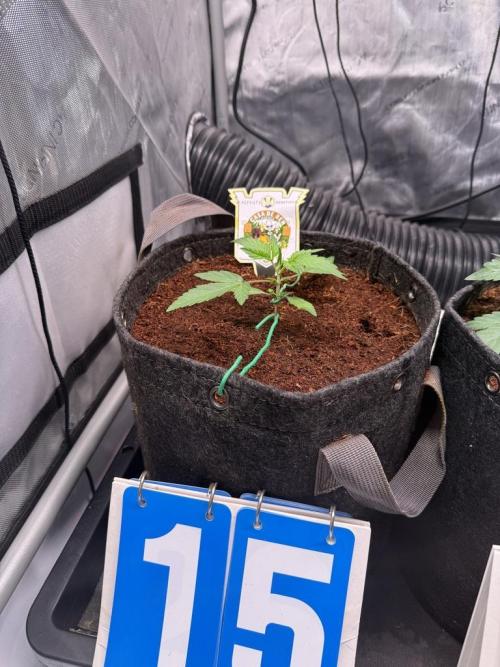
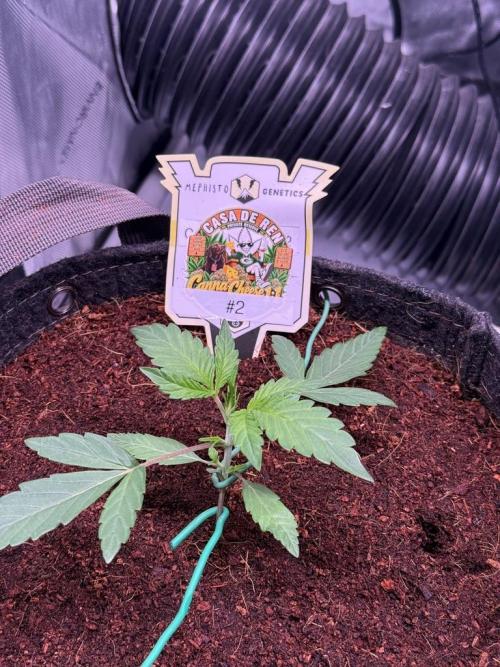
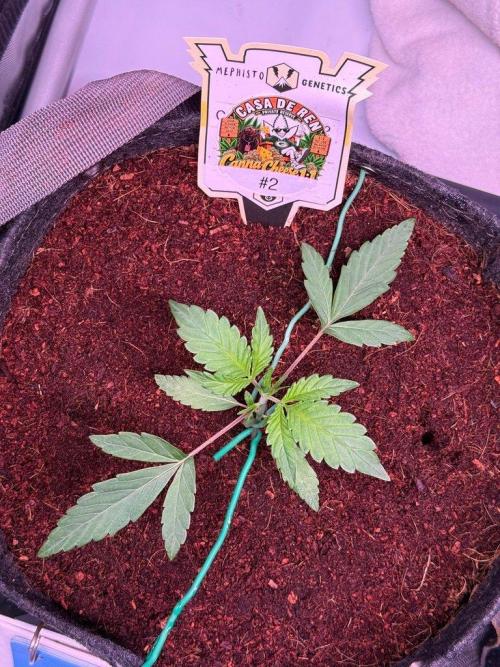
Growth remained vigorous through Week 3. Progressive LST gradually moved the main stem toward horizontal and opened the plant into a wider, bushier structure with multiple growing tips. No topping was performed. Branch positioning remained the preferred training method.
Lighting / PPFD
The IonFrame EVO 7 remained approximately 36 inches above the plants. Lighting was increased to Level 3 for all three plants. Measured PPFD across the plants was approximately 305-325 micromoles/m2/s. Canna-Cheese #1 showed no visible adverse response or light stress after the increase.
Feed / Root Zone
Before AutoPot activation, watering was used to wet the whole pot rather than watering to runoff. AutoPot irrigation was activated September 19. The reservoir started at 5.4 gallons with feed solution at pH 5.8 and EC approximately 1.15-1.20 mS/cm. About 2.7 gallons were delivered from the shared reservoir during the first 24 hours across all three plants, so no plant-specific weekly water-consumption figure is assigned to Canna-Cheese #1.
Environment / 7-Day Average
Seven-day tent averages were 77.5 F temperature, 65.3% relative humidity, and 0.93 kPa VPD. Recorded ranges were 72.1-85.0 F, 45.7-87.4% RH, and 0.25-1.69 kPa VPD. Water-temperature, reservoir pH-sensor, and EC-sensor averages are intentionally omitted because those sensor readings were not considered reliable for this report.
Interventions
Progressive LST and branch positioning continued through the week. Lighting was increased to Level 3. AutoPot irrigation was activated September 19. Feed solution at activation was pH 5.8 with EC 1.15-1.20 mS/cm.
What the Plant Indicated
The plant continued to look healthy and vigorous while responding well to training. It widened and developed multiple growing tips without visible stress from the lighting increase. Near Day 21, the outside fabric of this pot appeared drier than the other two grow bags, while a moisture reading near the bottom of the root zone was approximately 50%. Because the plant remained healthy, no corrective action was taken solely on the basis of the exterior fabric appearance.
Plan for Next Week
Continue gentle LST and branch positioning as needed. Maintain Level 3 lighting and watch plant response before making further increases. Continue monitoring AutoPot operation, water use, plant appearance, and root-zone conditions rather than reacting to the appearance of the outside fabric alone.
Weekly Takeaway
Strong Week 3: vigorous growth, successful LST, no visible stress at Level 3 lighting, and a smooth transition onto AutoPot irrigation.
__________________________________________________________________________________________________________________
CASA DE REN — FALL GROW 2026
Canna-Cheese 1:1 #2 — Week 3 Weekly Grow Log
Overall Status
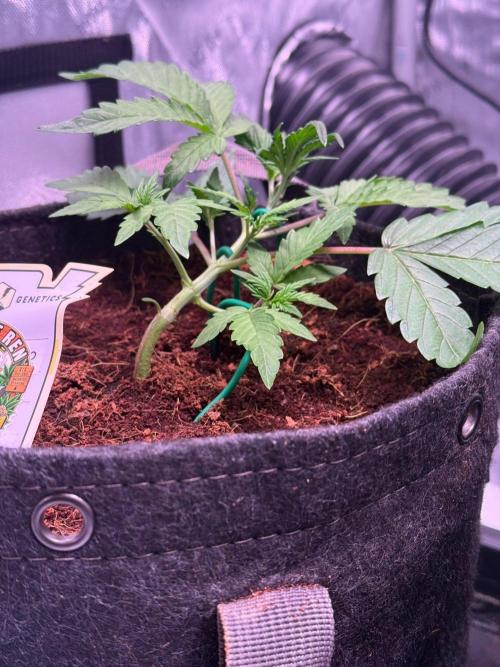
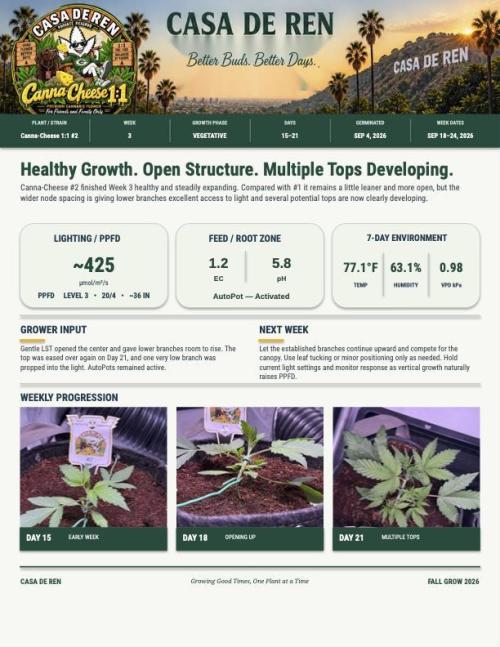
Healthy and steadily progressing through Week 3. Canna-Cheese #2 remains a little leaner and less beefy than Canna-Cheese #1, but the plant has good color, healthy leaf structure and a more open architecture. By Day 21 the wider node spacing was clearly translating into multiple developing tops with good access to light.
Growth
The plant entered the week with a more open, slightly lankier structure than #1. Gentle training exposed the lower branches and allowed them to begin catching up. By Day 20 the plant measured about 4 inches tall. On Day 21, the terminal growth remained active while several lower shoots were visibly rising and beginning to establish their own canopy positions. The more spacious node spacing is proving useful rather than problematic.
Lighting / PPFD
IonFrame EVO 7 remained at Level 3 on a 20-hour light / 4-hour dark schedule. Fixture height remained about 36 inches from the original canopy reference, less the reduction in distance caused by vertical plant growth. Actual PPFD at Canna-Cheese #2 was approximately 425 µmol/m²/s by the end of the week. The plant showed no visible light stress, so no light adjustment was required.
Feed / Root Zone
AutoPot irrigation was activated during Week 3. Reservoir solution was approximately EC 1.2 and pH 5.8. The plant transitioned from hand watering to the AutoPot without visible stress. Shared three-plant reservoir use was approximately 0.8 gallon over one 24-hour period earlier in the week and approximately 0.6 gallon during the most recent 24-hour period. These figures are whole-system consumption, not per-plant uptake.
Environment / 7-Day Average
Shared tent 7-day averages: temperature 77.1°F, relative humidity 63.1%, and VPD 0.98 kPa. Current environmental control targets were tightened to approximately 75–78°F and 58–65% RH. The plant continued growing normally under these conditions.
Grower Input
Gentle LST was used to open the center and expose lower growth. By Day 18 the lower branches were beginning to respond to the additional light. The top was later allowed more vertical freedom, then eased over slightly again on Day 21 to preserve light access for the more widely spaced lower branches. One very low right-side branch that had been resting near the media was propped upward; it responded quickly once exposed to stronger light. No topping was performed.
What the Plant Indicated
Canna-Cheese #2 appears comfortable with the current environment, feed strength, AutoPot transition and lighting. Healthy color, continued new growth and the rapid response of exposed lower branches all support staying the course. Its architecture is different from #1—more open and slightly lankier—but there is no reason to force the two plants into the same shape.
Plan for Next Week
Allow the established branches to continue moving upward and competing for canopy space. Use leaf tucking and only minor branch positioning when useful rather than continuing aggressive restraint. Hold the current light setting and fixture position for now; vertical growth will naturally increase PPFD, so continue monitoring plant response before making any intensity change. Continue watching plant appearance, water use and root-zone conditions.
Weekly Takeaway
A steady, successful Week 3: Canna-Cheese #2 used its more open structure to develop multiple potential tops, responded well to light LST and branch positioning, transitioned smoothly to AutoPots, and finished the week healthy with no corrective action required.
4 likes
comments
Share
4
Week 4. Vegetation
25d ago
1/27
27.94 cm
Height
20 hrs
Light Schedule
25 °C
Day Air Temp
6.0
pH
730 PPM
TDS
60 %
Air Humidity
11.36 liters
Pot Size
0.95 liters
Watering Volume
91.44 cm
Lamp Distance
Nutrients 6
CANNA Coco A
1.849 mll
CANNA Coco B
1.849 mll
CANNA RHIZOTONIC
1.057 mll
GrislyOldVet CASA DE REN - FALL GROW 2026
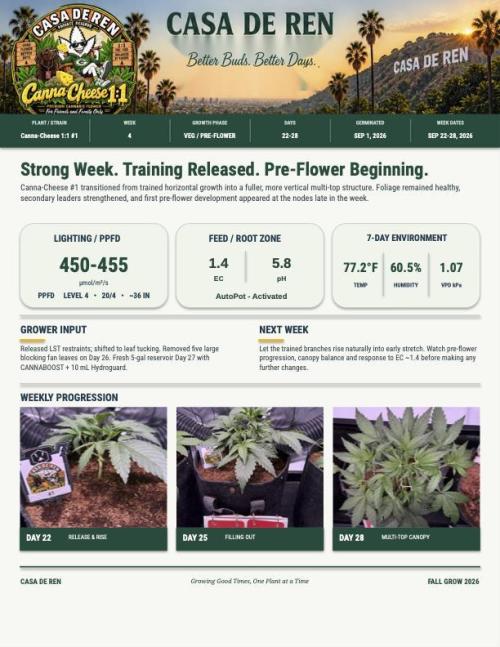
Canna-Cheese 1:1 #1 - Week 4 Weekly Grow Log
Week 4 | Days from Sprout: 22-28 | Germinated: Sep 1, 2026
Week Dates: Sep 22-28, 2026 | Growth Phase: Late Vegetative / Pre-Flower
Overall Status
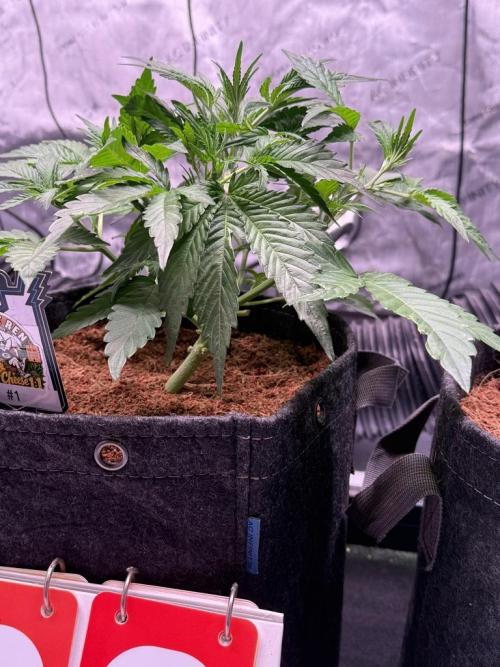
Canna-Cheese #1 completed Week 4 in strong condition. The plant moved from the low, trained structure established during early LST into a fuller and increasingly vertical multi-top canopy. Color and leaf condition remained healthy, the main stem and secondary branches strengthened, and the plant reached approximately 8.5 inches by Day 27. On Day 27, the first visible pre-flower development was observed at multiple nodes; clear pistils were not yet photographically confirmed.
Growth
Day 22 began with the LST range loosened so the plant could gain more vertical growth. Large, pliable fan leaves increasingly allowed leaf tucking instead of continued pulling. By Day 23 all training restraints had been removed, and the plant responded with strong overnight upward growth from a stout main stem and multiple secondary shoots.
During the second half of the week the trained branches continued rising into separate lanes. By Day 28 the plant was visibly filling out while retaining the broad architecture created by LST. The primary leader remained somewhat ahead, but multiple secondary leaders were positioned to compete through the early stretch.
Lighting / PPFD
The IonFrame EVO 7 moved from Level 3 to Level 4 at approximately 8:00 p.m. September 22. Photoperiod remained 20/4. Day 23 measurements were approximately 450-455 µmol/m²/s at Canna-Cheese #1, a DLI of roughly 32.4-32.8 mol/m²/day. The fixture was about 36 inches above the earlier canopy reference; effective distance has decreased as the plants have grown upward. No obvious light-stress response was observed.
Feed / Root Zone
AutoPot irrigation remained active. Shared tent reservoir draw was approximately 0.5 gallon over one 24-hour period, 0.6 gallon the following day, and approximately 1.0 gallon by Day 27; the last figure was treated as approximate because of visual-reading uncertainty and possible correction from the prior reading.
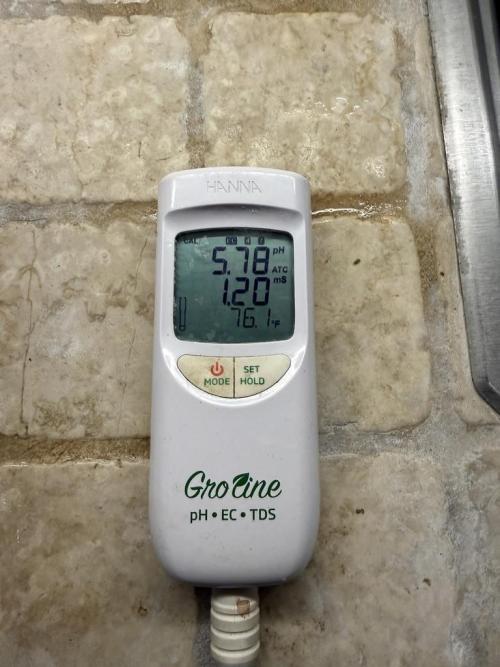
Reservoir EC rose during the week and was confirmed with both the Hanna handheld and AC Infinity sensor. The old reservoir was temporarily diluted with RO water, then replaced on Day 27 with a fresh 5-gallon CANNA reservoir. CANNABOOST was added according to the CANNA recipe. Starting measurements were pH 5.8 and EC 1.42 mS/cm. After the reservoir and tubing were thoroughly cleaned, 10 mL Botanicare Hydroguard was added.
The pH automation used separate AC Infinity peristaltic pumps for pH Up and pH Down. Solutions were diluted 10:1; pump output was set to minimum, dose duration four seconds, with 15-minute check/correction intervals. This generally held pH tightly around 5.8. Near the week close an inaccurate pH sensor indication caused inappropriate automated dosing. The sensor was recalibrated and the reservoir restored to approximately pH 5.8 and EC ~1.40 mS/cm. System lesson: trust the automation, but verify the instruments.
One tray/root-zone solution sample measured approximately pH 6.63 and EC 1.41 mS/cm while the reservoir was lower. It was treated as an observational point rather than a reason for direct tray correction. A small amount of green surface growth/biofilm was also observed on persistently damp, light-exposed media; no associated plant-health problem was visible.
Environment / 7-Day Average
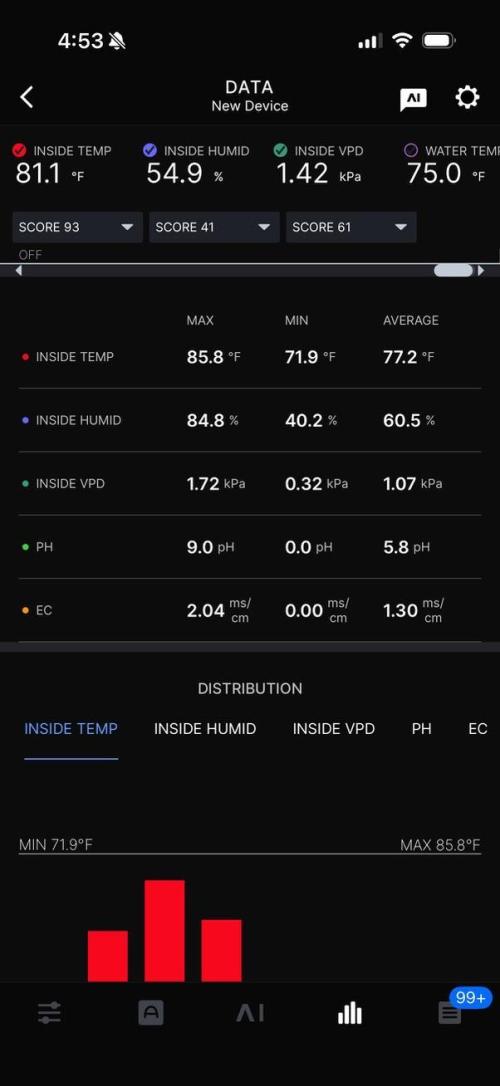
Week-close averages were 77.2°F, 60.5% RH and 1.07 kPa VPD. Seven-day ranges were 71.9-85.8°F, 40.2-84.8% RH and 0.32-1.72 kPa VPD. The Day 28 snapshot was 81.1°F, 54.9% RH and 1.42 kPa VPD, with reservoir water temperature at 75.0°F. Sensor-derived pH/EC weekly statistics were not treated as authoritative because of the calibration event.
Grower Input
Training pressure was deliberately reduced. Restraints were loosened and then fully removed, with leaf tucking used to preserve light access. Around Day 26, five large fan leaves that had been tucked below the canopy and were beginning to block useful undergrowth were selectively removed. The plant remained full afterward while interior branches gained more room to grow outward and upward. No topping was performed.
What the Plant Indicated
The early LST had accomplished its purpose. Once released, the plant shifted upward without collapsing into a single dominant Christmas-tree structure. Secondary shoots remained vigorous, foliage stayed healthy after selective defoliation, and the plant tolerated Level 4 lighting and the higher ~1.4 EC reservoir without an obvious adverse visual response. First pre-flower development at multiple nodes on Day 27 marked the beginning of the next phase.
Plan for Next Week
Allow the trained branches to rise naturally through the early stretch rather than resuming aggressive LST. Continue opportunistic leaf tucking and avoid further defoliation unless a leaf is clearly blocking a useful growth site or airflow. Watch for clear pistil confirmation, track canopy balance and vertical stretch, re-check PPFD as the plant approaches the fixture, and monitor the fresh CANNABOOST/Hydroguard reservoir around EC 1.4 and pH 5.8. Cross-check automated pH/EC instrumentation against the calibrated Hanna meter whenever readings do not make sense.
Weekly Takeaway
Week 4 was the handoff from training to natural growth: the restraints came off, the canopy rose, multiple tops remained in play, and the first pre-flower signals appeared. The plant finished the week healthy, broad and well positioned for the early stretch.
__________________________________________________________________________________
CASA DE REN - FALL GROW 2026
Canna-Cheese 1:1 #2 - Week 4 Weekly Grow Log
Week 4 | Days from Sprout: 22-28 | Germinated: Sep 4, 2026
Week Dates: Sep 25-Oct 1, 2026 | Growth Phase: Vegetative
Overall Status
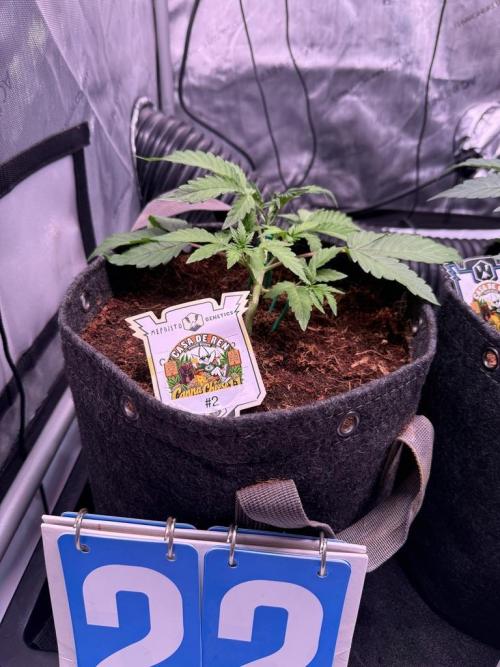
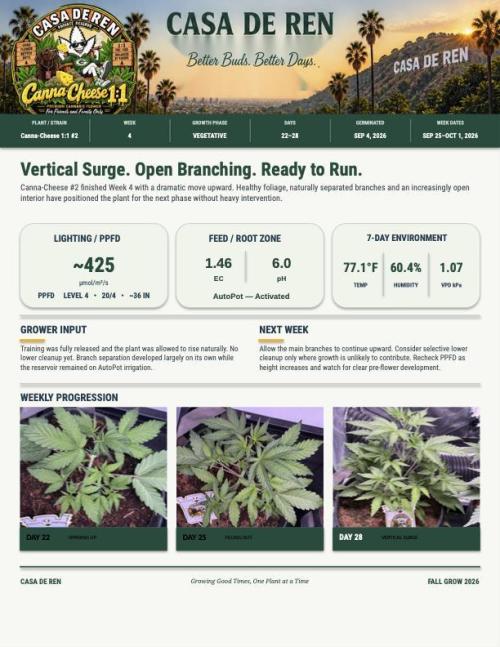
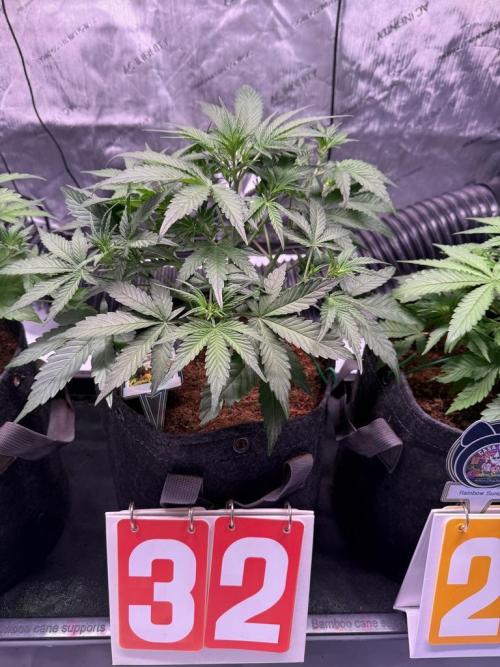
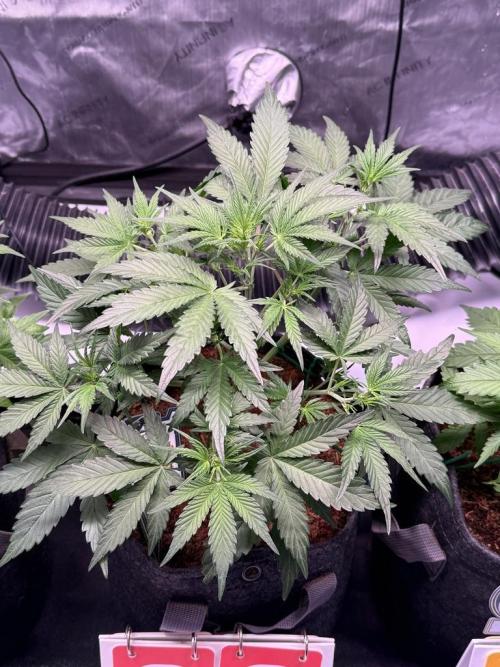
Canna-Cheese #2 completed Week 4 in strong condition and ended the week at approximately 10 inches tall. The defining change was a sudden vertical surge late in the week: a plant that had been relatively open and somewhat lanky quickly became taller and more assertive, while retaining useful spacing between its main branches. Foliage remained healthy and the plant finished Day 28 looking vigorous and ready to continue upward.
Growth
Earlier training had created a broad, open framework. Once the final restraint was removed, the plant responded quickly with vertical growth. By Day 26 it measured about 7.5 inches; by Day 28 it had reached about 10 inches. The main stem and side branches gained height without collapsing into a crowded canopy, and several developing tips were clearly positioned to become major tops.
Unlike Canna-Cheese #1, #2 remained naturally airier through the week. The branch spacing now provides good interior light penetration with relatively little intervention. The plant's architecture is increasingly distinct: taller and more open than #1, but healthy and well balanced in its own way.
Lighting / PPFD
The IonFrame EVO 7 remained at Level 4 on a 20-hour light / 4-hour dark schedule. The most recent measured PPFD for Canna-Cheese #2 during this phase was approximately 425 µmol/m²/s, with the fixture about 36 inches above the earlier canopy reference. No obvious light-stress response was observed. Because the plant has now gained significant height, PPFD should be rechecked rather than assuming the earlier measurement still represents the current canopy.
Feed / Root Zone
AutoPot irrigation remained active. The reservoir was managed around the confirmed pH operating range of 5.8-6.0. At the Week 4 checkpoint the reservoir measured approximately pH 6.0 and EC 1.46 mS/cm, and readings had been largely steady for about two days.
During the week, unusual pH/EC readings led to a useful verification rule: before making chemical corrections, reposition the reservoir probes and confirm suspicious readings with the calibrated Hanna handheld meter. A small low-power submersible pump was added to provide gentle reservoir circulation, replacing the air stones. The pump is being evaluated as a simple way to keep solution moving without adding meaningful heat or aggressive aeration.
Environment / 7-Day Average
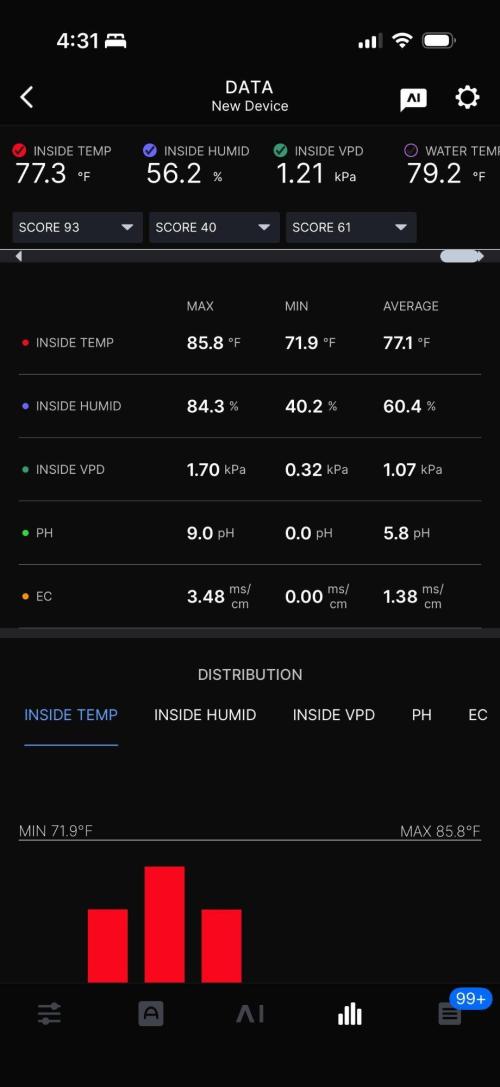
Week 4 averages were 77.1°F, 60.4% RH and 1.07 kPa VPD. Seven-day ranges were 71.9-85.8°F, 40.2-84.3% RH and 0.32-1.70 kPa VPD. Sensor-derived weekly pH/EC extrema were not treated as authoritative because the troubleshooting period included erroneous or stale readings.
Grower Input
Training pressure continued to decrease. The final restraint was removed before the end of the week and the plant was allowed to rise naturally. No lower-canopy cleanup or defoliation had been performed on Canna-Cheese #2 by Day 28. The grower deliberately chose to let the plant gain more density and height before deciding what lower growth, if any, should be removed.
The current intent is to preserve the naturally separated main branches while selectively cleaning only low growth that is unlikely to contribute meaningfully. The goal is not to force #2 into the same structure as #1, but to guide the architecture the plant is already producing.
What the Plant Indicated
Canna-Cheese #2 responded strongly once restraint was removed. The rapid upward movement, healthy leaves, fresh growing tips and naturally open branch spacing indicate that the plant is comfortable with the current environment and is ready to continue its transition toward the next phase. As the grower put it, this plant now looks like she is 'ready to run.'
Plan for Next Week
Allow the main branches to continue gaining height and separation. Consider selective cleanup of low or interior growth only where it is unlikely to contribute to the upper canopy; avoid stripping the plant simply to match the more cleaned-up structure of Canna-Cheese #1. Continue watching for clear pre-flower development, monitor canopy balance, and recheck PPFD as the plant grows closer to the fixture.
Maintain reservoir pH within the confirmed 5.8-6.0 range and continue monitoring EC around the current mid-1.4 range. Keep using the probe-reposition/Hanna cross-check before reacting to any surprising automated reading, and continue evaluating the small circulation pump for stability and reservoir temperature.
Weekly Takeaway
Week 4 was the week Canna-Cheese #2 stood up and announced herself: a dramatic vertical surge, naturally separated branches, healthy foliage and good interior light access, all with very little intervention. The plant finished Day 28 at 10 inches tall, open, vigorous and ready for the next stage.
1 like
comments
Share
5
Week 5. Vegetation
18d ago
1/28
33.02 cm
Height
20 hrs
Light Schedule
24 °C
Day Air Temp
5.9
pH
Normal
Smell
720 PPM
TDS
58 %
Air Humidity
11.36 liters
Pot Size
1.25 liters
Watering Volume
91.44 cm
Lamp Distance
Nutrients 6
CANNA Coco A
1.849 mll
CANNA Coco B
1.849 mll
CANNA RHIZOTONIC
1.057 mll
GrislyOldVet CASA DE REN - FALL GROW 2026
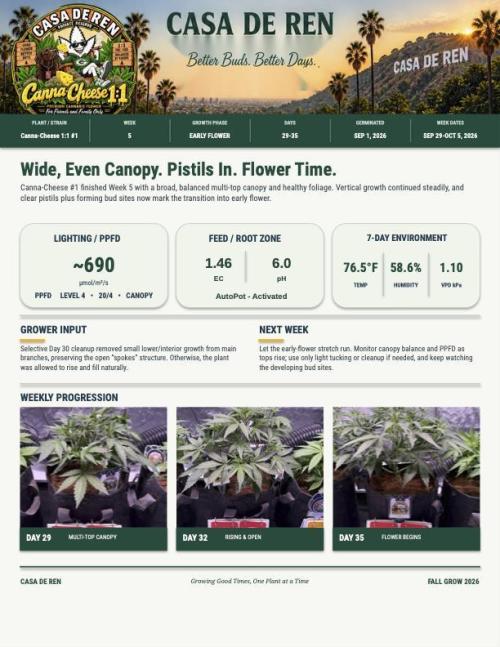
Canna-Cheese 1:1 #1 - Week 5 Weekly Grow Log
Week 5 | Days from Sprout: 29-35 | Germinated: Sep 1, 2026
Week Dates: Sep 29-Oct 5, 2026 | Growth Phase: Pre-Flower / Early Flower
Overall Status
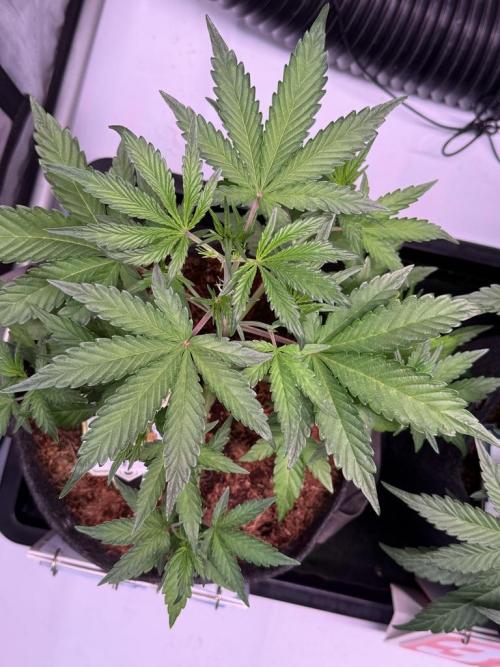
Canna-Cheese #1 completed Week 5 in strong condition and is now showing clear signs of the flowering transition. The broad architecture established through early LST remained intact as the plant rose from approximately 9 inches on Day 29 to about 12.5-13 inches on Day 35. By the week close, pistils were visible at multiple nodes and the first bud sites were beginning to form with definition. Foliage remained healthy and the canopy stayed wide, open and comparatively even.
Growth
Day 29 began with an approximately 9-inch plant and an even-ish multi-top canopy. The early LST work was paying off: the dominant leader was only slightly ahead of the surrounding tops, branch separation was improving light penetration, and the plant was growing vigorously without a need for intervention.
On Day 30, small lower and interior growth was selectively removed from the main branches. The goal was not a full lollipop, but a cleaner lower third and open middle so the principal branches could concentrate growth toward their tops. The resulting structure clearly showed the desired “spokes on the wheel” architecture with roughly seven to eight prominent branches.
By Day 31 the plant was about 11 inches tall, and by Day 33 approximately 11.5 inches. Branches remained separated and pliable, with one semi-dominant leader and several nearby tops. At Day 35 the plant reached approximately 12.5-13 inches. The outer tops remained in the same general height band, producing the wide, balanced canopy targeted from the beginning of training.
Lighting / PPFD
The IonFrame EVO 7 remained at Level 4 on a 20/4 photoperiod. As the plants grew naturally toward the fixture, canopy PPFD increased without another light-level adjustment. By Day 35, Canna-Cheese #1 - positioned in the highest-intensity area of the tent - measured approximately 690 µmol/m²/s at the top of the canopy.
No obvious light-stress response was observed in the Week 5 photographs. The working strategy is therefore to leave the fixture setting unchanged and allow the plants to acclimate as they grow into the higher intensity, while continuing to monitor canopy PPFD so stretch does not carry the tops beyond a comfortable range.
Feed / Root Zone
AutoPot irrigation remained active. During the week the reservoir settled into a much more stable operating pattern. On Day 31 the confirmed reservoir reading was approximately pH 6.0 and EC 1.46 mS/cm, with the intended pH operating range confirmed at roughly 5.8-6.0.
Reservoir mixing was improved with a small submersible circulation pump. By later in the week the known-good circulation routine was the mini-pump running approximately 5 minutes ON / 55 minutes OFF, with a low airstone approximately 10 minutes ON / 10 minutes OFF. Automated peristaltic pH correction remained active, and pH/EC were described as remarkably stable for several days.
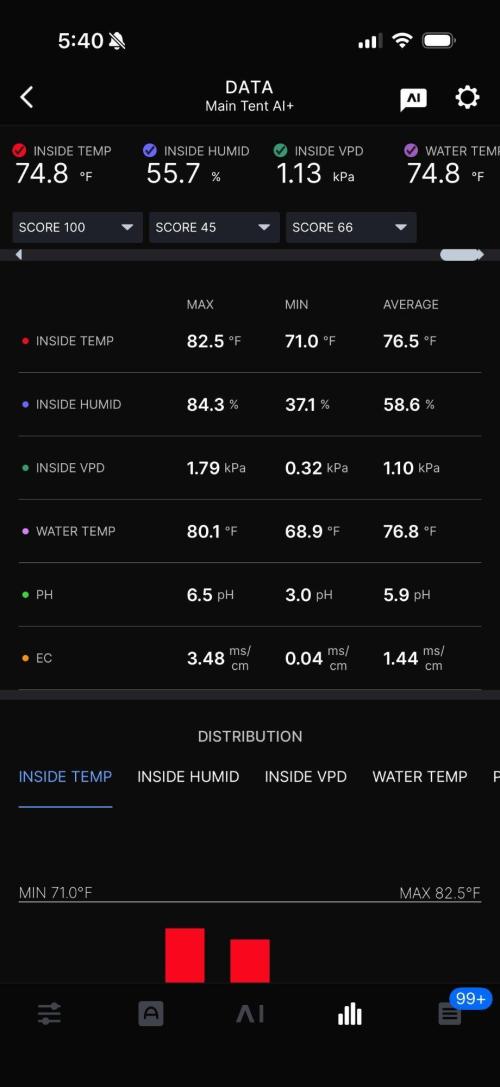
The controller’s seven-day statistics displayed average pH 5.9 and EC 1.44 mS/cm, but the recorded extremes included known erroneous or stale sensor readings. Those extrema are not treated as actual reservoir chemistry. The standing troubleshooting rule remains: reposition the probes first, allow the reading to stabilize, and use the calibrated Hanna handheld meter as an independent second opinion before making chemical adjustments.
Environment / 7-Day Average
The seven-day tent averages at the Week 5 close were 76.5°F, 58.6% RH and 1.10 kPa VPD. Recorded ranges were 71.0-82.5°F for temperature, 37.1-84.3% RH and 0.32-1.79 kPa VPD. Average reservoir water temperature was 76.8°F, with a recorded range of 68.9-80.1°F.
The Day 35 snapshot shown on the controller was 74.8°F, 55.7% RH and 1.13 kPa VPD. The weekly averages remain the preferred one-sheet environmental numbers because they better represent the full light/dark cycle than a single momentary reading.
Grower Input
The main intervention this week was the selective Day 30 cleanup of small growth along the principal branches and lower/interior area. This continued the grower’s preference for a clean lower third without stripping the plant bare. No topping was performed and no major retraining was introduced. After the cleanup, the plant was largely allowed to rise naturally, with only observation and light guidance as needed.
What the Plant Indicated
The plant indicated that the early structural work had accomplished its purpose. It continued upward without losing the broad, multi-top form, branch spacing remained useful, and foliage stayed healthy as PPFD increased naturally with height. The most important biological change was the appearance of clear pistils at multiple nodes by Day 35, along with the first developing bud sites - stronger evidence that Canna-Cheese #1 is now entering early flower rather than simply approaching pre-flower.
Plan for Next Week
Let the early-flower stretch continue with minimal interference. Preserve the wide canopy and allow the existing tops to develop rather than creating new training objectives. Use leaf tucking or very selective cleanup only if a leaf or weak lower growth is clearly blocking useful light or airflow. Continue measuring canopy PPFD as height increases, watch the developing bud sites and pistils, and keep the reservoir operating near the established pH/EC range while verifying any suspicious sensor reading before allowing it to drive a correction.
Weekly Takeaway
Week 5 was the transition from structure-building to flower-building: Canna-Cheese #1 stretched steadily, held the wide and even canopy created by LST, reached roughly 12.5-13 inches, and finished the week with clear pistils and multiple developing bud sites. The setup is now where it was intended to be - open, balanced and ready to let the plant run.
____________________________________________________________________________________
CASA DE REN — FALL GROW 2026
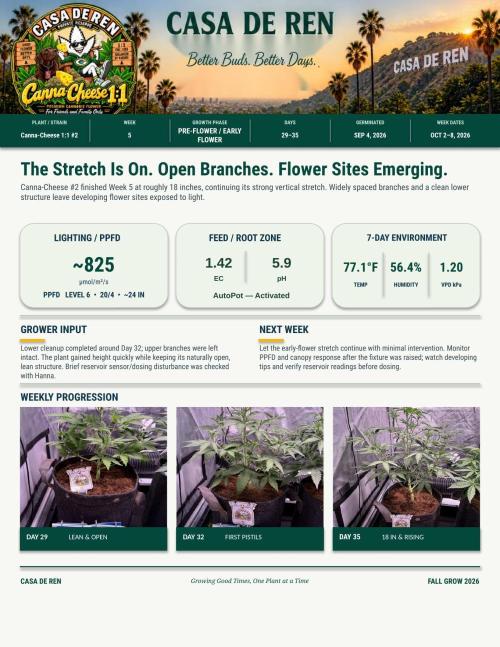
Canna-Cheese 1:1 #2 — Week 5 Weekly Grow Log
Week 5 | Days from Sprout: 29–35 | Germinated: Sep 4, 2026
Week Dates: Oct 2–8, 2026 | Growth Phase: Pre-Flower / Early Flower
Overall Status
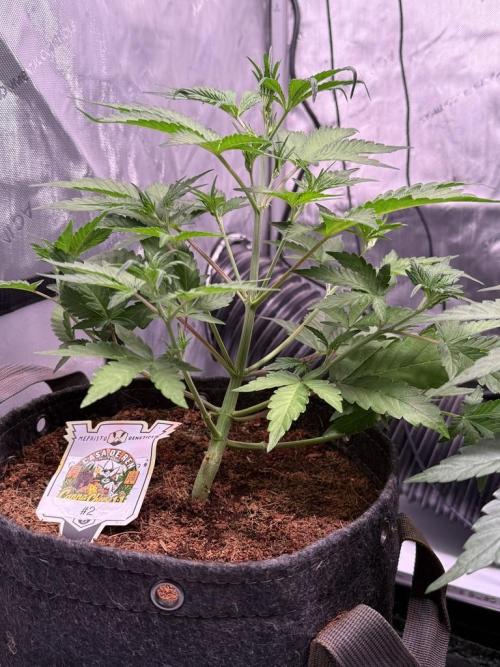
Canna-Cheese #2 completed Week 5 in strong condition, continuing the distinctive lean, upright architecture seen since the first weeks. Height reached approximately 18 inches by Day 35. Long internodal spacing, well-separated outward branches, and a comparatively small number of upper flowering sites distinguish this plant from Canna-Cheese #1. The outcome in yield or quality remains unknown; both plants are developing well in their own ways.
Growth
Day 29: The plant was nearly as tall as Canna-Cheese #1, with larger gaps between nodes, fewer side offshoots, healthy foliage, and an open canopy. The grower noted this as a different expression of the same strain, not inherently an advantage or disadvantage.
Day 30: Height approximately 12.5 inches, temporarily the tallest plant. Rapid development was evident in the upper two-thirds, with early flower preparation visible. No intervention was reported.
Day 32: Height approximately 14.5 inches. Stems were becoming stronger, developing sites were more apparent, and the first pistils were observed. The lower structure had been cleaned up while the productive upper branches were retained.
Day 33: Height approximately 15.5 inches. The lower plant remained clean, with long open internodes and exposed growing tips. No additional intervention was reported.
Day 35: Height approximately 18 inches. Stretch continued along branches extending away from the center. The top nodes showed the beginnings of potential flower clusters. The grower noted fewer potential bud sites than on Canna-Cheese #1 but healthy, vigorous growth overall.
Lighting / PPFD
The IonFrame EVO7 remained on a 20/4 photoperiod. As the plant grew closer to the fixture, canopy PPFD rose naturally: approximately 650 µmol/m²/s on Day 32 and approximately 850 at the top on Day 35 before the lighting adjustment. The fixture was subsequently raised by about a foot to roughly 24 inches above Canna-Cheese #2 and increased to Level 6. The resulting canopy reading was approximately 820–825 PPFD on both Canna-Cheese plants, with Rainbow Sundae at roughly 700. This change was intended to distribute light more evenly rather than keep increasing the highest readings. No obvious light injury was reported. Monitor plant response and remeasure as the tops continue to stretch.
Feed / Root Zone
AutoPot irrigation remained active. The controller's seven-day displayed averages were pH 5.9 and EC 1.42 mS/cm; these averages were considered representative of the week. The displayed extremes (pH 4.3–6.5 and EC 0.02–1.78 mS/cm) included a brief roughly 1.5–2-hour episode of erratic readings and automated correction and must not be interpreted as sustained reservoir conditions. The grower repositioned the reservoir probes, checked the readings independently with a Hanna handheld meter, and restored the reservoir to the desired operating range without discarding the batch. A prior sustained period of stable chemistry did not eliminate the need to monitor automation. The one-way AutoPot reservoir-to-tray system means reservoir EC movement alone cannot be used to infer plant nutrient uptake.
Environment / 7-Day Average
The controller displayed seven-day averages of 77.1°F air temperature and 1.20 kPa VPD. The seven-day average relative humidity was 56.4%, with a recorded high of 81.8% and low of 37.1%. The 55.4% RH shown on the controller was a current snapshot, not the weekly average. Average reservoir water temperature was 77.4°F. Recorded air temperature range: 71.0–86.0°F; VPD range: 0.41–1.79 kPa; water temperature range: 68.9–80.2°F. The brief pH/EC sensor/dosing event affected the recorded chemical extrema, not the overall interpretation of a healthy week.
Grower Input
Lower-growth cleanup was completed around Day 32, leaving a clean lower section and preserving the widely spaced productive upper branches. The plant was otherwise allowed to stretch and express its natural form. The grower also rotated the plant positions within the tent, moving Rainbow Sundae to the middle to improve its light access. The light fixture was raised and intensity adjusted to improve coverage across all three plants. Reservoir probes were repositioned and Hanna verification was used during a short pH/EC control anomaly.
What the Plant Indicated
Canna-Cheese #2 responded with rapid vertical growth, healthy leaves, strengthening stems, and early pistils. Its open architecture provides visible access to upper developing sites. Fewer apparent sites than Canna-Cheese #1 do not yet establish any difference in eventual flower mass, quality, or yield.
Plan for Next Week
Let the early-flower stretch continue without aggressive retraining or defoliation. Watch whether the outer branches hold their spacing and whether the upper flower sites develop evenly. Recheck PPFD at the canopy after any meaningful height increase and observe response to the raised Level 6 fixture. Continue to monitor reservoir pH and EC, reposition probes when readings are suspicious, and verify independently with the Hanna meter before making chemical corrections.
Weekly Takeaway
Week 5 was Canna-Cheese #2's stretch-and-transition week: roughly 12.5 inches on Day 30 to 18 inches by Day 35, a naturally airy branch pattern, first observed pistils, and early flower sites. The plant looks healthy; the comparison with its denser sibling remains an open question until harvest and testing.
likes
comments
Share
6
Week 6. Flowering
11d ago
1/31
66.04 cm
Height
20 hrs
Light Schedule
25 °C
Day Air Temp
5.9
pH
Normal
Smell
700 PPM
TDS
53 %
Air Humidity
24 °C
Solution Temp
11.36 liters
Pot Size
1.25 liters
Watering Volume
60.96 cm
Lamp Distance
Nutrients 6
CANNA Coco A
1.849 mll
CANNA Coco B
1.849 mll
CANNA RHIZOTONIC
1.057 mll
GrislyOldVet CASA DE REN - FALL GROW 2026
Canna-Cheese 1:1 #1 - Week 6 Weekly Grow Log
Week 6 | Days from Sprout: 36-42 | Germinated: Sep 1, 2026
Week Dates: Oct 6-12, 2026 | Growth Phase: Early Flower
Overall Status
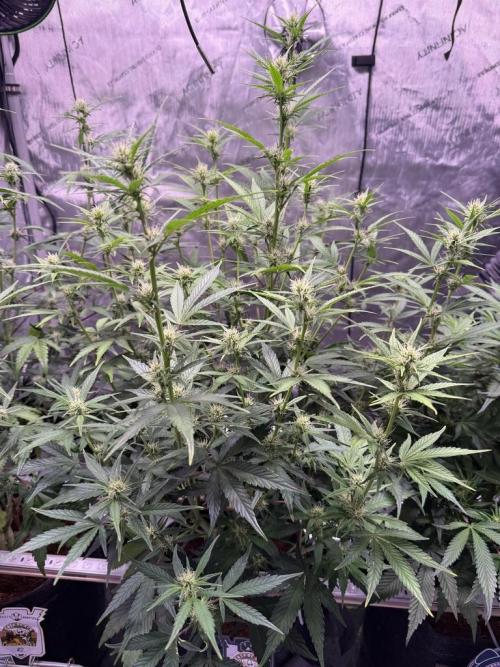
Canna-Cheese #1 completed Week 6 in strong visible condition. At Day 42, she stood approximately 22 inches tall, with a broad, notably even canopy and many developing flower sites extending down to roughly the middle of the plant. The grower described all three plants as progressing smoothly and the overall grow as unusually consistent.
Growth
The plant continued the early-flower stretch and developed a substantial number of flowering tops. The broad, trained structure from earlier weeks has become a fairly level canopy, with many potential bud sites exposed across the top and middle. Day 42 height was approximately 22 inches.
The Day 42 overhead and side photographs show distinct branches, multiple emerging clusters of pistils, and useful space around the tops. Flower development is visible but final flower density and yield cannot yet be determined.
The under-canopy zone remains relatively open after prior selective removal of excess interior and lower growth. This structure now allows supplemental light to reach the middle and lower flowering sites.
Lighting / PPFD
The IonFrame EVO7 was raised roughly one foot to improve light uniformity as the three plants gained height. At Level 6 on the 20/4 photoperiod, measured canopy PPFD was approximately 820-825 µmol/m²/s over both Canna-Cheese plants and about 700 over Rainbow Sundae. The main fixture was approximately 24 inches above the tallest Canna-Cheese canopy when checked.
Under-canopy lighting was introduced as a routine practice the grower has used before, not a new experiment. Two AC Infinity IonBeam bars were zip-tied to a thin 36-inch wooden ruler for easier mounting; by Day 42 a second pair/track had been added on the opposite side. The aim is to supplement middle and lower flower sites. Its effect on final density remains to be evaluated.
Feed / Root Zone
AutoPot bottom-feed irrigation remained in service. The seven-day controller averages displayed EC 1.40 mS/cm and pH 5.9. The controller also recorded implausible brief lows (EC 0.01 and pH 0.0) and a high pH of 9.5, so those extremes should not be interpreted as sustained reservoir conditions.
The known sensor history supports verifying any unusual pH/EC reading by repositioning the probes and comparing with the independent Hanna handheld meters before making dosing decisions. No new nutrient-mix change or independently confirmed root-zone measurement was provided for this week.
The seven-day averages are reported as the broad weekly picture; isolated short-duration excursions should not be treated as representative conditions.
Environment / 7-Day Average
The Week 6 seven-day averages were 77.1°F inside temperature, 55.4% relative humidity, and 1.23 kPa VPD. The recorded extremes were 72.2-86.0°F, 37.8-80.5% RH, and 0.45-1.75 kPa VPD. Average water temperature was 77.2°F (69.8-80.2°F recorded range).
The current Day 42 controller snapshot read 77.7°F, 55.5% RH and 1.25 kPa VPD. The averages, rather than the brief excursions, are used in the one-sheet dashboard.
Grower Input
The major operational addition was under-canopy IonBeam lighting, mounted in pairs to slim 36-inch wooden rulers with zip ties. The first pair was placed by Day 41; the second track was present by Day 42. This is the grower’s established procedure, with a simpler, more repeatable mounting method.
What the Plant Indicated
The plant maintained a healthy overall appearance while flowering sites became more numerous and more clearly defined. The comparatively level top growth suggests that earlier training succeeded in distributing canopy exposure rather than leaving one dominant central cola.
Plan for Next Week
Continue monitoring the transition from stretch into flower development. Recheck PPFD and fixture clearance as the canopy changes, observe the response to the supplemental IonBeam bars, and avoid unnecessary pruning or abrupt feed changes while growth remains steady.
Weekly Takeaway
Week 6 brought a broad, even flowering canopy, about 22 inches of height, and the addition of the grower’s standard under-canopy lighting setup. The plant looks promising; actual bud density and harvest weight will be judged later.
------------------------------------------------------------------------------------------------------------------------------------------
CASA DE REN — FALL GROW 2026
Canna-Cheese 1:1 #2 — Week 6 Weekly Grow Log
Week 6 | Days from Sprout: 36–42 | Germinated: Sep 4, 2026
Week Dates: Oct 9–15, 2026 | Growth Phase: Early Flower
Overall Status
Canna-Cheese #2 completed its sixth week looking healthy, with continuing vertical stretch and progressively defined flowering sites. At Day 42 the grower measured approximately 25–26 inches. The plant retained its characteristic tall, open, relatively sparse foliage compared with Canna-Cheese #1. No major visible health concerns were reported.
Growth
Day 36: Week 6 opened with the plant continuing its established vertical-stretch pattern. A Day 36 documentary photograph was not available for verification at report preparation.
Day 39: The long, relatively thin branches showed clearly emerging flower sites along their length. The plant maintained an airy architecture with broad internode spacing and visible light access between stems.
Day 42: Height reached approximately 25–26 inches. Stretch remained active, with additional mass developing at the flower sites along tall branches. The grower described healthy foliage, consistent growth, and no obvious problems.
Across Week 6: The most notable progression was continued height gain and the transition from isolated pistil clusters toward more readily recognizable early buds. This phenotype remained markedly different from the denser, more radial Canna-Cheese #1.
Comparison: Canna-Cheese #2 remained the tallest plant, while the smaller Rainbow Sundae and denser Canna-Cheese #1 showed their own distinct growth patterns.
Lighting / PPFD
The AC Infinity IonFrame EVO7 continued on the established 20/4 schedule. The most recent previously reported canopy measurement was approximately 820–825 µmol/m²/s after the fixture was raised and set to Level 6; this is a prior measurement, not a newly verified Day 42 reading. Under-canopy IonBeam rails remained part of the tent setup. With ongoing stretch, fresh canopy PPFD measurements are preferable to assuming the previous reading remains unchanged.
Feed / Root Zone
AutoPot irrigation remained active. The controller seven-day displayed averages were EC 1.44 mS/cm and pH 5.9. The user also reported modest upward movement in daily EC and pH readings after reservoir adjustment, with no obvious adverse plant response. Brief zero and extreme controller readings are known probe/sensor anomalies, not evidence of actual nutrient chemistry swings. In this one-way AutoPot system, reservoir EC trends cannot be interpreted as direct nutrient uptake; use plant condition, water use, and verified root-zone readings.
Environment / 7-Day Average
The AC Infinity seven-day displayed averages were air temperature 76.7°F, relative humidity 53.3%, VPD 1.28 kPa, and water temperature 75.6°F. The current humidity target was tightened late in the preceding week from 50–60% to 50–55%. Screenshot momentary values and isolated extremes should not be confused with the weekly averages; known brief sensor glitches affected pH/EC minima.
Grower Input
The grower deliberately avoided aggressive manipulation, choosing to let the long, naturally open branches continue their stretch. Supplemental IonBeam light rails were present under the canopy, with positioning adjusted tent-wide to avoid excessive exposure of lower growth on Rainbow Sundae. A replacement reservoir was introduced with slightly higher EC and pH allowed near 6.0. Equipment was reported operating reliably after prior probe and dosing troubleshooting.
What the Plant Indicated
The plant continued to add height and visible flower tissue while maintaining acceptable leaf color and an open canopy. These observations are consistent with ongoing early flowering and do not by themselves establish eventual bud density or yield. Its different architecture is a phenotype observation, not evidence that it is underperforming.
Plan for Next Week
Continue monitoring flower development and the point at which stretch slows. Re-measure PPFD at the tallest tops and check that supplemental light bars have safe clearance from foliage. Maintain stable reservoir conditions; confirm unexpected sensor values by repositioning probes and using the independent Hanna meter before any dosing response. Avoid unnecessary pruning unless airflow or branch access warrants it.
Weekly Takeaway
Week 6: Approximately 25–26 inches by Day 42, persistent open and lanky architecture, and more defined buds forming along multiple branches. Healthy development, minimal intervention, and a clear contrast with Canna-Cheese #1.
6 likes
comments
Share
7
Week 7. Flowering
4d ago
1/33
82.55 cm
Height
20 hrs
Light Schedule
25 °C
Day Air Temp
6.1
pH
Normal
Smell
740 PPM
TDS
53 %
Air Humidity
24 °C
Solution Temp
11.36 liters
Pot Size
1.89 liters
Watering Volume
60.96 cm
Lamp Distance
Nutrients 6
CANNA Coco A
2.113 mll
CANNA Coco B
2.113 mll
CANNA RHIZOTONIC
0.528 mll
GrislyOldVet CASA DE REN - FALL GROW 2026
Canna-Cheese 1:1 #1 - Week 7 Weekly Grow Log
Week 7 | Days from Sprout: 43-49 | Germinated: Sep 1, 2026
Week Dates: Oct 13-19, 2026 | Growth Phase: Flowering
Overall Status
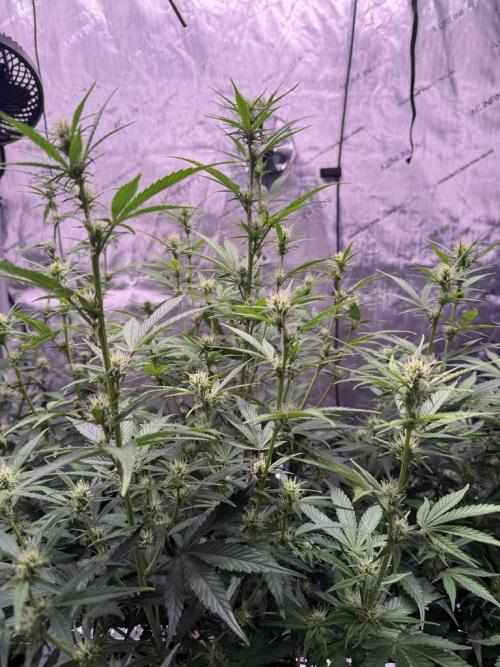
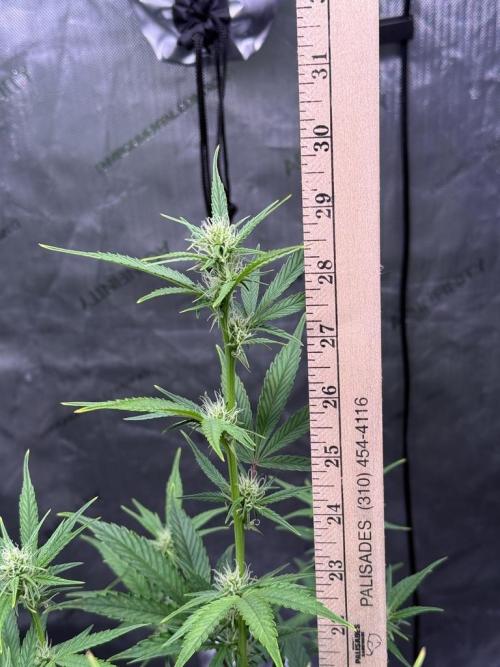
Canna-Cheese #1 completed Week 7 in strong visible condition. At Day 49 she measured approximately 29-29.5 inches tall. The canopy is broad and relatively even, with several taller branches and a remarkable number of developing flower sites. White pistils and emerging flower clusters are distributed from the top through roughly the upper two-thirds of the plant. The lower zone remains relatively clean.
Growth
Stretch continued during Week 7, with Day 49 height near 29-29.5 inches. The grower noted that recent vertical gain seemed less pronounced than for the other plants, suggesting—but not confirming—that stretch may be slowing. Multiple branches continue to develop near the upper canopy, and many secondary flowering sites are now clearly established.
The Day 43, Day 46, and Day 49 photo records show an increasingly flower-filled, open multi-top structure. Earlier low-stress training (LST), without topping, appears to have helped distribute flowering branches across the canopy. These are observations of structure and flower initiation, not yet a yield prediction.
Flowering sites extend well down the stems, while the lower portion of the plant remains relatively clean. The canopy has retained access to light and airflow without major new structural intervention.
Lighting / PPFD
The main AC Infinity IonFrame EVO7 remained on a 20/4 photoperiod. The latest direct measurement at the top of the tallest Canna-Cheese #1 bud was 822 µmol/m²/s PPFD. This is a point measurement, not a canopy-wide average. The fixture had been raised as the plants stretched; actual canopy readings continue to guide observation.
The existing IonBeam under-canopy lighting was temporarily left off. The grower planned to observe the plants for several days before considering intermittent operation. No causal conclusion about its effect on color or flower growth can be drawn from the short interval.
Feed / Root Zone
AutoPot bottom-feed irrigation remained in service. The latest seven-day controller screenshot displayed average EC 1.51 mS/cm and pH 6.0. A modest amount of Cal-Mag was added after the grower noticed some leaf yellowing, particularly on Canna-Cheese #2; water was also added, and the overall measured EC remained around 1.50. A light Cal-Mag foliar spray was also reported.
Subsequent foliage appeared greener to the grower, but the change cannot be attributed with confidence to Cal-Mag alone; lighting changes and photo conditions are possible contributors. Continue verifying suspicious pH/EC readings by repositioning probes and comparing against independent Hanna handheld meters before acting.
The controller recorded isolated implausible pH and EC minima; these should not be treated as representative reservoir chemistry without independent confirmation. Reservoir EC changes in this non-recirculating AutoPot system are not a measure of plant nutrient uptake.
Environment / 7-Day Average
The latest seven-day controller averages were 77.1°F air temperature, 51.0% relative humidity, and 1.37 kPa VPD. Water temperature averaged 75.5°F. The recorded ranges included 66.1-86.1°F air temperature, 29.7-84.3% RH, and 0.33-2.73 kPa VPD; these are extremes rather than sustained conditions.
The screenshot current readings were 77.4°F, 49.0% RH, and 1.44 kPa VPD. The one-sheet uses seven-day averages, not this instantaneous snapshot.
Grower Input
The grower noted slight leaf yellowing, more pronounced on Canna-Cheese #2 but present to a lesser degree on #1, and made a deliberately small Cal-Mag adjustment rather than a broad feed increase. A gentle Cal-Mag foliar spray was also applied. Lower IonBeam lights were left off during observation. At Week 7 close, the grower reported visibly greener foliage and expanding flowering sites across the plant.
What the Plant Indicated
The plant maintained vigorous flowering development with numerous white-pistil clusters across the trained canopy. Day 49 photos show a largely healthy green appearance, with minor leaf-color variation. The change after Cal-Mag is encouraging but not diagnostic. The strongest supported finding is substantial flower-site development with a well-distributed canopy.
Plan for Next Week
Watch whether vertical stretch slows and flower clusters begin stacking more tightly. Measure top PPFD and fixture clearance as needed; monitor leaf color over several days without introducing multiple simultaneous changes. Keep the lower canopy open, evaluate any return of under-canopy lighting, and avoid drawing yield or potency conclusions before harvest and testing.
Weekly Takeaway
Week 7: roughly 29-29.5 inches tall, 822 PPFD at the tallest bud, and a remarkably broad collection of developing flower sites. Early LST continues to pay dividends; the next chapter is flower fill and density.
____________________________________________________________________________________________________________
CASA DE REN — FALL GROW 2026
Canna-Cheese 1:1 #2 — Week 7 Weekly Grow Log
Week 7 | Days from Sprout: 43–49 | Germinated: Sep 4, 2026
Week Dates: Oct 16–22, 2026 | Growth Phase: Flower Development
Overall Status
Canna-Cheese #2 completed Week 7 as the tallest plant in the tent, reaching 32.5 inches on Day 49. The tall, open structure continues to carry numerous developing flower clusters along long branches. Yellowing remains visible on some leaves, but the grower judges the issue to be stabilizing. Bud formation is becoming more substantial, especially along previously sparse-looking internodes.
Growth
Day 43: Height approximately 28 inches. Tall, widely spaced branches and early white-pistil clusters remained characteristic of this plant. The previous comparison with Canna-Cheese #1 showed only a small height gap this grow, despite pronounced differences in architecture.
Day 46: Photographs document the same open, elongated structure with flowering sites becoming more numerous and pronounced along the branches. The plant continued transitioning from stretch toward building floral mass.
Day 49: Height measured 32.5 inches. This is a 4.5-inch gain from Day 43, confirming ongoing stretch. Close-ups show white-pistil flower clusters at multiple nodes on tall stems, with the beginnings of visually continuous bud development (potential stacking).
Across Week 7: The grower noted that substantial flowering growth has appeared along long, slender branches that earlier looked relatively empty. The buds are not yet mature or fully joined; stacking remains a developing possibility, not an established outcome.
Comparison: Canna-Cheese #2 is roughly 2 inches taller than Canna-Cheese #1 (32.5 versus 30.5 inches, latest reported measurements), but #1 has a denser interior and more flowering sites. The grower perceives #2 as slightly ahead in individual bud development despite being three days younger.
Lighting / PPFD
The AC Infinity IonFrame EVO7 was raised to the highest available tent position and increased to Level 7 during the tent reconfiguration. The grower measured approximately 750–775 µmol/m²/s across the three flowering plants following the change. The established 20/4 schedule continues. This is a canopy measurement after reconfiguration, not a seven-day PPFD average. Two supplemental under-canopy IonBeam tracks remain part of the grow setup.
Feed / Root Zone
AutoPot irrigation continues from the shared reservoir. A new five-gallon batch included 20 mL Botanicare Cal-Mag (4 mL/gallon), compared with 10 mL in the prior mix. The grower reported 40 mL per five gallons for the CANNA Coco A/B addition, without a separate amount specified for each part; CannaZym and CANNA Boost were withheld. The reservoir EC was approximately 1.5 mS/cm after mixing. The supplied controller screenshot displayed seven-day averages of EC 1.48 mS/cm and pH 6.1. Those are reservoir readings, not a direct measure of nutrient uptake. Continue verifying suspect sensor readings against Hanna handheld instruments.
Environment / 7-Day Average
Seven-day controller averages supplied by the grower: air temperature 77.0°F, relative humidity 53.5%, VPD 1.29 kPa, water temperature 75.6°F, reservoir pH 6.1, and reservoir EC 1.48 mS/cm. Recorded ranges: air 74.1–79.3°F; RH 45.4–60.8%; VPD 1.04–1.64 kPa. These are tent/controller measurements, not leaf-surface or root-zone measurements.
Grower Input
The grower reorganized the tent to accommodate a fourth plant, repositioned the flowering plants relative to the center of the light, and raised the EVO7 while adjusting its power. Two circulation fans remained in operation. The reservoir recipe was simplified while Cal-Mag was increased to assess whether the previously observed leaf yellowing stabilizes. The grower intentionally avoided aggressive training on the long, naturally open branches.
What the Plant Indicated
Flower development is progressing along many previously open-looking stems. Strong ongoing height gain indicates that stretch may not yet be complete. Leaf color is not entirely uniform; some older or middle leaves retain yellowing, but the images do not show a clear, widespread new collapse. Visual evidence alone cannot establish whether the added Cal-Mag caused any improvement, nor can it establish final bud density or yield.
Plan for Next Week
Monitor whether the top height continues to increase beyond 32.5 inches, and reassess clearance and PPFD as needed. Photograph leaves under neutral light to compare the yellowing without LED color distortion. Observe whether adjacent flower clusters begin to connect along the stems. Keep reservoir conditions stable and confirm unusual controller readings with the independent Hanna meter before changing chemistry.
Weekly Takeaway
Week 7: 32.5 inches by Day 49 (+4.5 inches since Day 43), vigorous stretch, increasingly defined flowering clusters along open branches, and apparently stabilized—but not resolved—leaf yellowing. The tall sister is beginning to show the potential for bud stacking.