


Beachneiden

00110001001001111Oanswered grow question 8mo ago
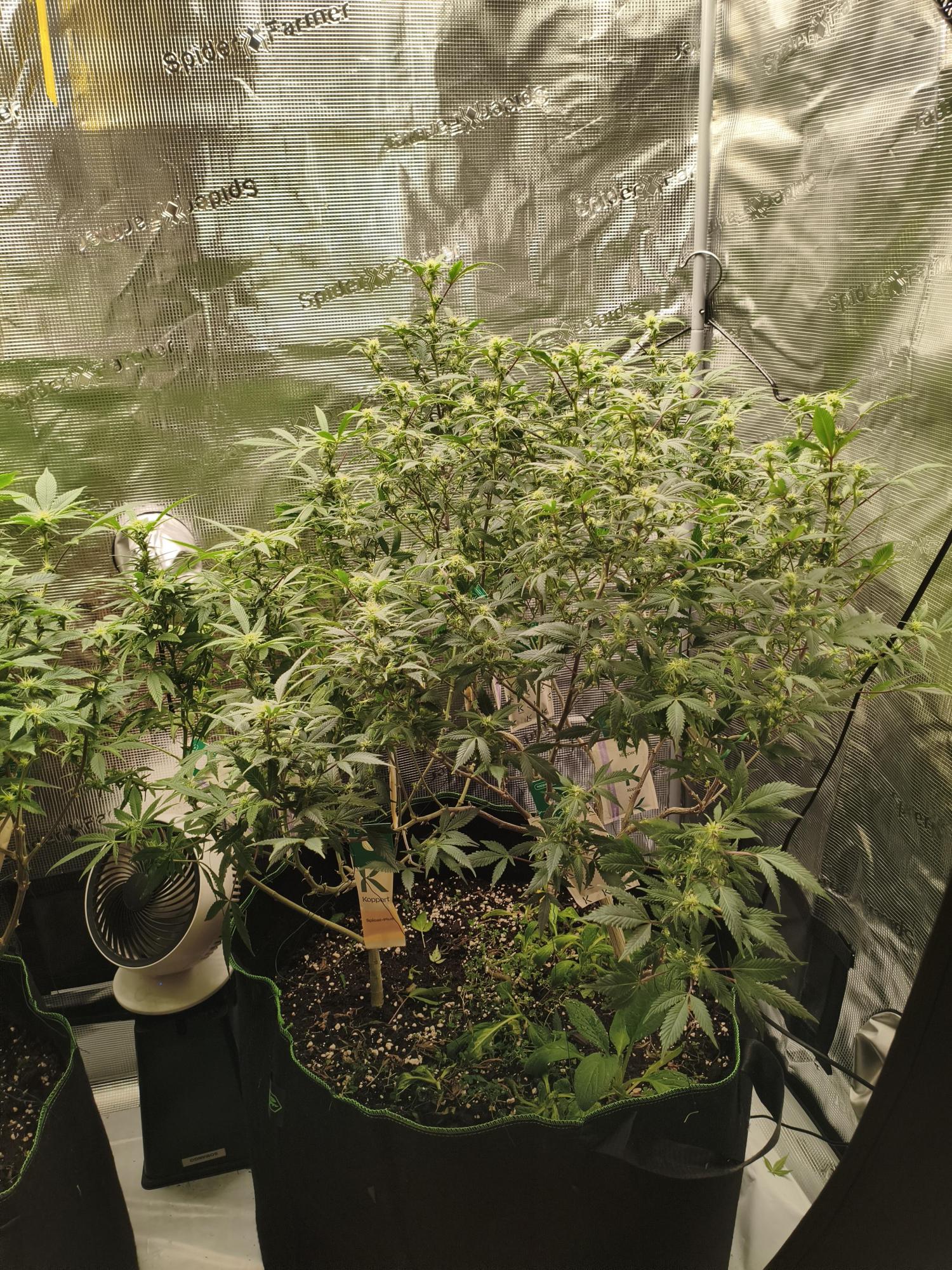
i see a bunch of small-ish, young leaves. Don't defoliate in future.
Selectively prune leaves for which you have a very good reason to remove. For example, avoiding consistent condensation caused from physical touching is a good reason. Do not whimsially remove large portions of leaves, because bro-science says it improves results while never providing 1 mL of supporting evidence.
Leave perform numerous necessary and important roles beyond absorbing light. They store nutrients, which gives you room for error. They transpire and take in CO2, which is a limiting factor of growth. The cost of removing a bunch of leaves is nearly impossible to overcome. Light absorption and CO2 intake are the two most important variables. There's no net-positive when you hinder these 2 things, typically.
Small immature leaves are not as effective as mature leaves. Older leaves do lose effectiveness, but by that time they are well-shielded and still store nutrients and still transpire (co2 intake). Keep leaves. Leaves are your friend.
The burden of proof is on the 'technique' to show it adds some measurable value compared to simply growing the plant without stripping it of leaves... removing a shit ton of leaves has never been proven to do anything positive that i have ever seen - not that i am aware of 100% of all research, but fairly confident about this. The plant will shed leaves if it has too many relative to variables -- a healthier plant can support more leaves, all other factors the same, obviously. This is definitely a case where the plant "knows" better than our limited humans senses can resolve.

Green_Clawsanswered grow question 8mo ago
While generally true that more leaves increase a plant's capacity for photosynthesis,
The formula....."maximum leaves = maximum energy = maximum growth" is not scientifically accurate.
Plant growth is limited by an "optimum" number of leaves, not a maximum. Beyond a certain point, extra leaves become a liability, consuming more energy through respiration than they produce.
Here is a breakdown of why this relationship breaks down:
1. The "Diminishing Returns" Law
Self-Shading: In a dense canopy, upper leaves shade lower ones. The shaded leaves receive insufficient light for photosynthesis but still consume energy for maintenance, reducing the plant’s net energy gain.
Respiratory Costs: Every leaf produced requires energy to construct and maintain. If a leaf is in the shade, its,, respiration rate can exceed its photosynthetic rate (net photosynthesis becomes negative).
Diminishing Returns: Larger leaf area often results in a disproportionately lower increase in photosynthesis.
2. The Resource Bottleneck (Nutrients & Water)
Water Loss: A maximum amount of leaves means maximum surface area, leading to high water loss through transpiration. In dry environments, this can cause the plant to close its stomata to save water, halting photosynthesis.
Nutrient Limitation: Even if a plant has excessive leaves, growth is limited by the shortest supply of nutrients (e.g., nitrogen or iron) in the soil, according to Liebig’s "Law of the Minimum".
3. Energy Allocation (Leaf vs. Fruit/Root)
Over-investment: Studies on crops like soybeans have shown that too many leaves can reduce yield. Plants may over-invest in leaf biomass at the expense of developing fruits, seeds, or roots.
Optimal Leaf Area Index (LAI): Agriculture focuses on an "optimum LAI"—the perfect balance of leaves to maximize light interception without unnecessary respiratory costs.
Summary of Exceptions
Leafy Vegetables: For crops like lettuce or spinach, the leaf is the product, so maximizing leaf number is closer to maximizing harvestable yield.
Young Plants: In early growth stages, more leaves usually mean faster growth (exponential growth).
Competition: In crowded environments, a plant might produce excess leaves to shade out competitors, which aids survival but not necessarily the individual plant's maximum potential growth.
Conclusion: Maximum leaves = Maximum maintenance costs + Reduced efficiency. Optimal leaves = Maximum growth.
2 likes
Complain

SundancerSanswered grow question 8mo ago
joa, I think that still fits. She knows exactly what it's all about now, producing buds :)
1 like
Complain

RasendeRollo92answered grow question 8mo ago
Hi 🙋♂️,
Unfortunately, it has really become a bit sparse, but there's nothing that can be done about it now. Next time, really just do the very bottom ones & look from above and only remove the big ones that cover other buds... sometimes less is more.
Still looks very solid overall. Good luck moving forward 👊🤞🏽👌
1 like
Complain

Organomananswered grow question 8mo ago
You say in your diary that you removed the leaves so that the plant "can put all of its energy into the flowers".
Where do you think this energy comes from?
ALL of the plants energy to grow (flowers), comes from/is made by the leaves.
Energy does not come from anywhere else.
Less leaves = less energy being made = less potential growth.............
Or to put it another way...
Maximum amount of leaves = maximum energy production = maximum growth.
1 like
Complain
Green_Clawsanswered grow question 8mo ago
there spot on, from the side they look a little bare but from the top theres no holes in the canopy so good going.nice1
3 likes
Complain