


PH QUESTION

NugNutstarted grow question 8mo ago
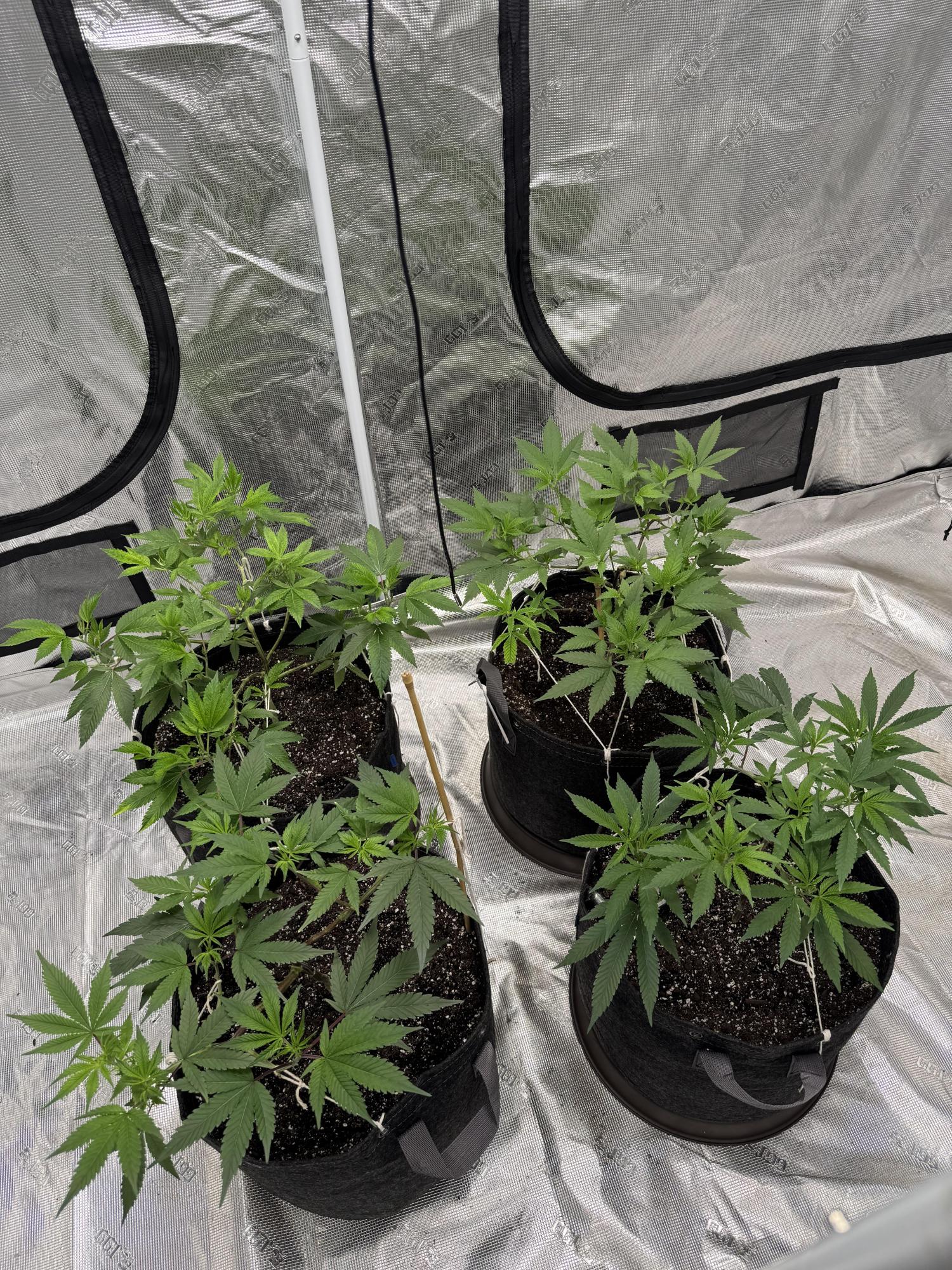
Think I have a low PH issue. Have a digital probe that says @ 5 near bottom of pot and @ 8 near top where dry. Coast of Maine soil stays wet long time this grow. It also looks and feels different than previously. What best to raise ph in this soil if probe is somewhat accurate
Solved
Week 5 likes

JUNGLE_B4RNSanswered grow question 8mo ago
Is it the kind of probe with 2 longs copper nails where you can switch from Humidity to pH that cost around 30 bucks ? 😊
Or did you really get a serious probe costing around 500 bucks ?
One or another, this isn’t really a big deal, I have issues with my soil , just have a look on my last diary, seeds started to grow in a soil at pH 3.5-3.8 and plants are now growing at pH 4.5-4.8
And finally, just look at your plants, they are healthy

AsNoriuanswered grow question 8mo ago
First you strip plants heavily and expect that they will drink same or even more after that ....
Second , your light too weak, by week 5 branches should be way thicker.
Third, most probably you have cheap worthless soil meter for 5$ and expect it to do work of 300-400$ probe ... that meter shows milk fat better than ph of soil.
Create watering rhythm, lift pots to understand when to water. Review lights and feeding too ...
1 like
Complain

00110001001001111Oanswered grow question 8mo ago
add more perlite or vermiculite if staying wet too long ... a 'soil' should have roughly 50% of volume be some sort fo drainage amenment. I like vermiculite becuase it adds some plant-avaialble silica over time. Add to whatever comes in it to get to 50% of volume... it may require more frequent irrigation, but the roots will be happier. Also, it dilutes the nutrition content per volume so expect to fertilize a bit sooner than normal too.
likes
Complain
00110001001001111Oanswered grow question 8mo ago
it's not going to be 100% homogenous. Different amount of saturation may impct it, for example as well as just more or less solutes in one zone or another. Maybe, there's a bit of garden lime right near the probe and causing it to read higher than what is representative of the entire volume.
So, if you are new to measuring this way, i'd wait to learn what 'normal' is before overreacting to anything. Do react to what you see in the canopy, of course, but until you know what to expect from the soil probes i'd just be familiarizing myself with the normal ebb and flow when things are healthy and happy... from there you can discern what is unusual. Soil probes are finnicky.
If you are following good irrigation practices, you should be fine. Always fully saturate... wait for healthy dryback... repeat. pH balance the water to your target pH ... if you find it's regularly too high or low in the medium, ph-balance the water to help offset it.
if pH is off, it'll impact the plant.. if you see normal growth and normal growth rates that you have come to expect, then it's probably fine.
1 like
Complain

Ultravioletanswered grow question 8mo ago
The relationship between oxygen and pH is often overlooked as part of a medium. While pH is strictly the "potential of hydrogen"(concentration), oxygen plays a crucial role in regulating, indicating, and interacting with that balance. Possible leached nutrients? This process is accelerated by over-irrigation. Along with the combination of hypoxia or anoxia. At the bottom of the pot, the environment is dense, compacted, and lacks oxygen; anaerobic (no-oxygen) conditions exist, skewing the pH down. Topsoil has far more oxygen, but it may also be overfed with too much Ca, Mg, K, and Na. Ph of 8 indicates a base saturation(in medium) of cations above 100% capacity. Soil compaction is a bitch, and those fabrics are not half as airy as you think they are, The wet/dry cycle of your grow cycle must match the medium size; you're maybe moving water too slow from the pots to the atmosphere, allowing moisture to stagnate, you need to incorporate negative pressure into your grow space, if not then you need to run your growroom a little drier and a little warmer than you normally would to assist with evaporation, if soil compaction goes above a point, a root cannot penetrate, then it cannot remove water from a medium through transpiration, if the roots cant do it, and there is no evaporation occuring, then water becomes trapped, anerobic fermentation, acids etc yada yada all that good stuff. Good luck.
1 like
Complain

RasendeRollo92answered grow question 8mo ago
Hi 🙋♂️,
I'm not sure what exactly you mean, but it seems like you're measuring the pH level in the soil. The only reliable way to determine pH levels is in the drain itself.
If you have pH issues, here are some symptoms:
Too low usually shows up with "burnt" leaves/tips and/or red stems — I don't see that in your case.
Too high usually shows up with faded leaves — I don't see that either.
If the value fluctuates, you typically have "rust spots" — I can't see that either.
In conclusion: I would advise against trying to adjust anything without knowing the pH level in the drain, as it often leads to irreversible damage.
Hope that helps, good luck with the grow 👊🤞🏽👌
likes
Complain

Green_Clawsanswered grow question 8mo ago
I'm not sure how accurate your probe is so try the run off test to give an estimate atleast, worth a try. don't act on hope and assumption.. Best of luck
1 like
Complain
Green_Clawsanswered grow question 8mo ago
Hi there.. Used coffee grounds is a good organic additive to raise pH.. Normally 6.6- 6.9.. Or dolomite lime is probably the best.. Hope this helps
1 like
Complain