The Grow Awards 2026 🏆 






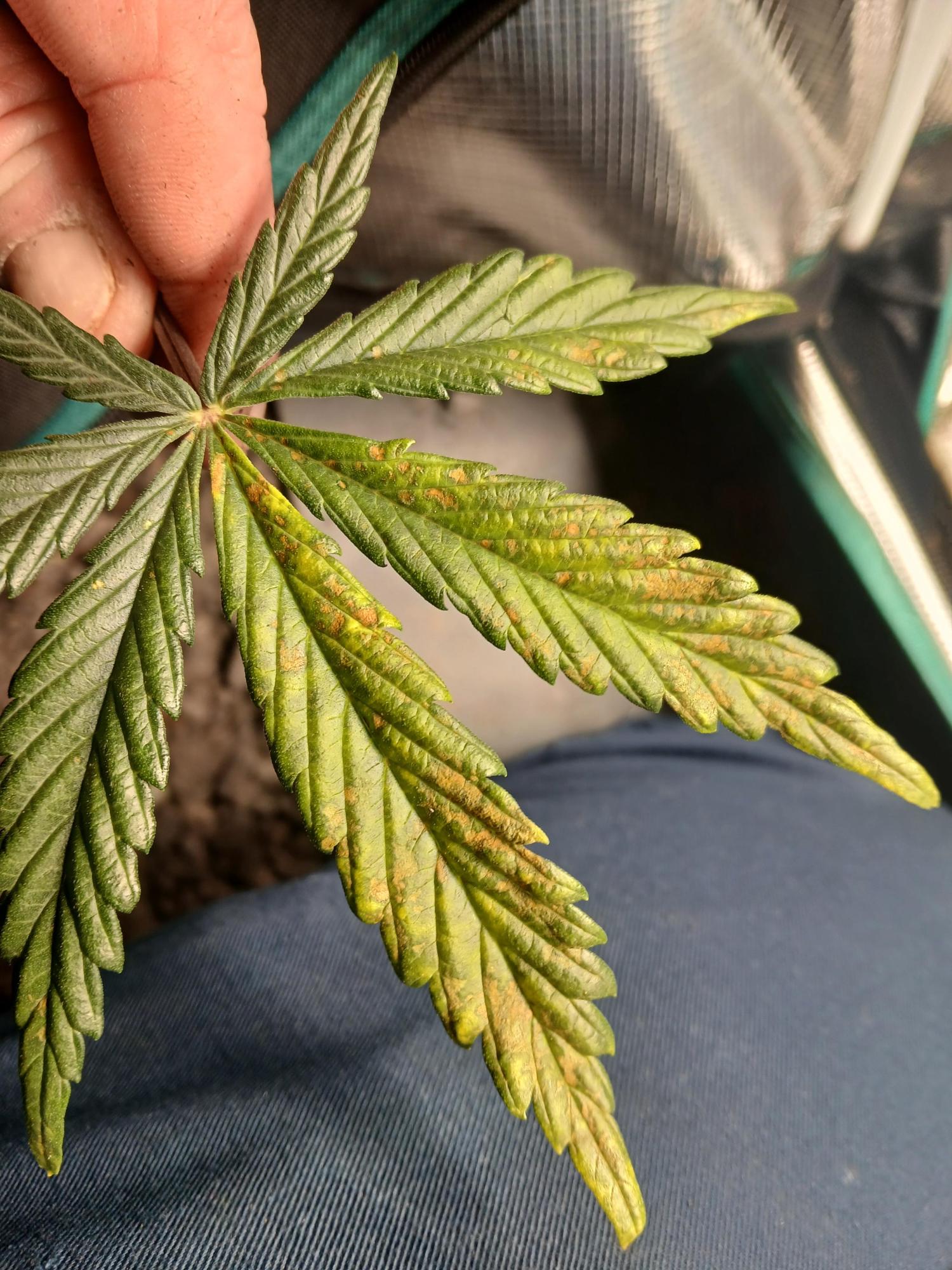
Help please
wolfvbanswered grow question 1h ago
Salam Cooperind! 👋 That leaf is definitely sending an SOS signal! 🆘
I'm with @Ultraviolet on this one—this looks like a Root Zone / Oxygen issue. 🌊
Here is the "Modern Engineering" breakdown: 🛠️ When the roots sit in too much water (or heavy soil), they run out of oxygen. If the roots can't breathe, they can't drink. 🚫🥤 Then, your lights keep hitting the leaves, but the plant can't cool itself down because the water transport is shut off. The result? These chaotic, rusty dead spots that look like a deficiency but are actually suffocation.
Your Emergency Plan: 🚑
Stop Watering: Lift the pot. If it feels heavy, put the water jug away! Let her dry out until the pot feels light.
The "Smell Check": Sniff the drainage holes. If it smells swampy/rotten, you might have root rot. (If so, you'll need H2O2 or enzymes).
Check pH: Suffocating roots mess up the soil pH. If your runoff pH is crazy (under 5.5 or over 7.5), that confirms the root zone is unhappy.
Let the soil breathe, Habibi. Roots need air just as much as water! 🌬️
Happy Growing! 💚
likes
Complain
Ultravioletanswered grow question 1h ago
Really helps to keep the leaf attached to the plant for a better idea of where the mobility is at and other minor symptoms that could help narrow things down, with just a picture its tricky to diagnose with accuracy, ill give it a go anyway, tips not showing osmotic dmg or burn, ec held within range, lowers chances of it being nutrient burn through high salinity, red petiole and stems tells oxygen was most likely in high demand in the immediate rootzone area. Not necessarily due to soil composition, but if the medium is oversaturated, it acts like an oxygen lockout. Photooxidative damage occurs when a plant absorbs excessive light energy that exceeds its photosynthetic capacity, leading to the generation of reactive oxygen species (ROS) that harm cellular components, eventually breaking down fats and internal membranes driven by lipid peroxidation, initiating oxidative stress-induced cell death or "programmed cell death.". The narrow and sharp shape of the leaf itself is often indicative of a leaf grown in a high-light environment. if water uptake is affected, the supply of electrons and protons fails, photosynthesis stalls, and the plant loses its ability to handle light energy, leading to severe ROS damage (photooxidation). A plant, to a degree, can control where to sacrifice a leaf or where to store salts it knows will burn it. While they lack a central nervous system, they possess a sophisticated, decentralized network for sensing, decision-making, and resource allocation, and they treat their bodies as dynamic, reconfigurable systems. They constantly weigh the cost of maintaining a part against the benefit it provides, sacrificing the few to save the many. Abscission, compartmentalization, and signaling, among a few, abscission and compartmentalization are active, programmed, and organized physiological processes, whereas Reactive Oxygen Species (ROS) damage is chaotic, oxidative destruction. This is the cause of the chaotic pattern I see on your leaf.
1 like
Complain