


High PH Runoff (7.24)

Garden-of-weedenstarted grow question 5mo ago
I have a high p.h run off (7.24). I do not want to flush with a high volume of water. Is the correct action to just continue to lower ph of watering to 6-6.1-ish? See latest grow dairy updated earlier today. Thank you!
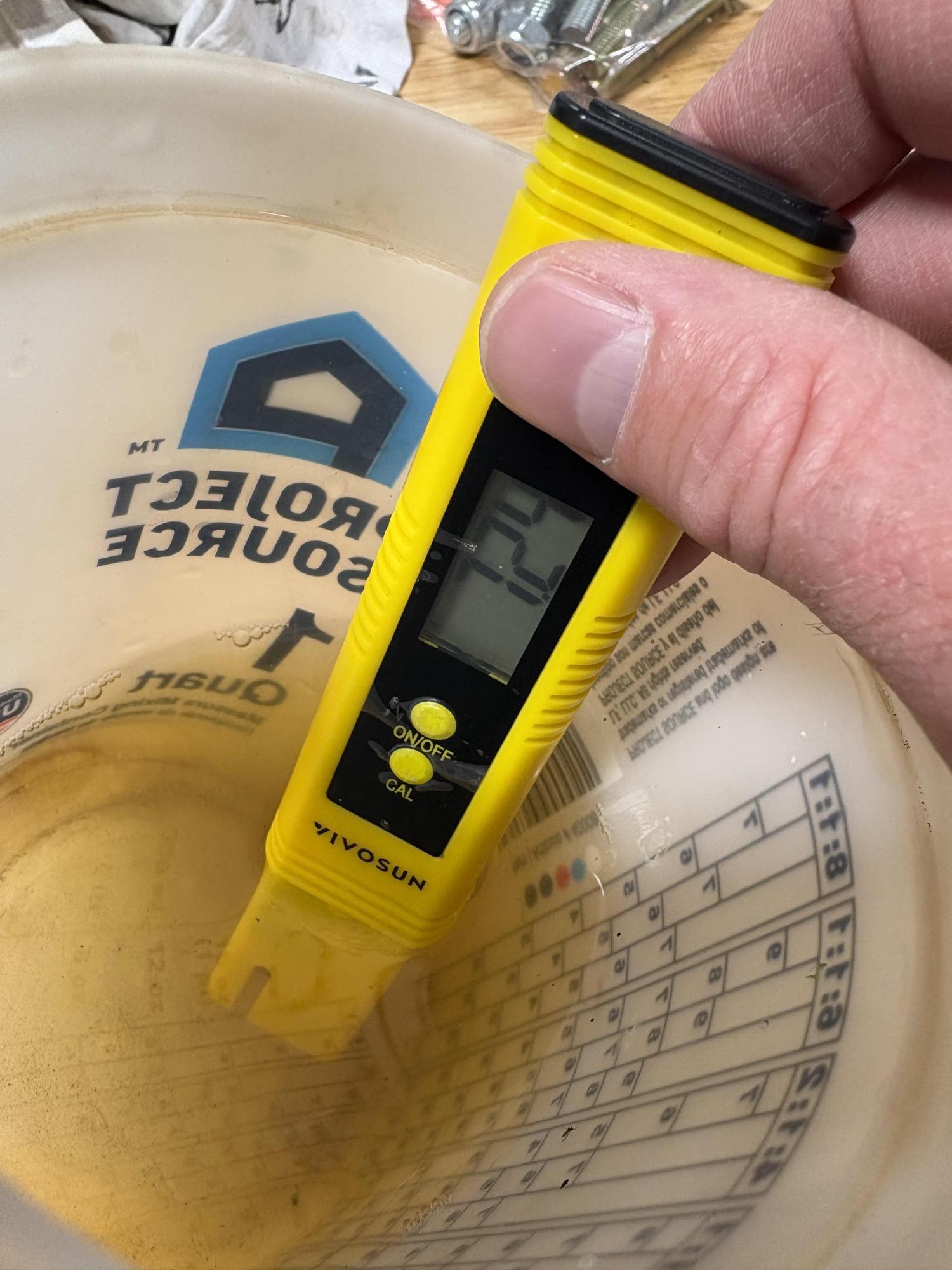
Solved
Week 6 2 likes

Altitonans_Fulmenanswered grow question 5mo ago
Garden-of-weeden, Hi dude! I had to run earlier, so I didn't get a chance to mention I noticed you are using organic amendments, which I love, but it makes it more critical you get the pH back to where it needs to be; if the pH drifts from 6.3-6.7 anyone telling you to deviate from that range should do some homework , hydrogen will no longer be available to cycle the medium's Cation exchange capacity, organic rhizosphere will require much higher levels of oxygen within a medium to be efficient compared to synthetic, and if oxygen becomes scarce for any reason, bad things happen, slowly and creepingly, but by the time you notice 5 deficiency looking symptoms will hit at once, and some dufus will tell you to add cal mag to make it worse.
You can have the best soil in the world with optimal porosity, but understand this one thing above all: Oxygen travels 10,000 times slower in soil than air. Oxygen travels 320,000 times slower in soil saturated(watered) above a point. Oxygen lockout occurs. No matter even if it's there its too slow to keep up metabolically.
Organic matter will deposit increased levels of CO2 into the soil, around 40% of all the carbon your plant captures is exuded into the soil. The microorganisms chew that shit up and fill the soil with carbon dioxide, which will slowly increase moisture retention and eventually be the reason why the soil becomes infertile.
Sync your daytime VPD, lock it in, 85F 70RH% or whatever suits you, but at night, you hold that exhaust fan and link it to the ambient RH% at the canopy. Keep it 45-55% RH ambient. This replicates high and low pressure fronts in nature, essentially performing a type of barometric pumping of the soil. (critical for organics, increased demand for oxy)
At night, the plant performs cellular respiration, constantly adding water to the air (make sure you always have a very gentle airflow (24/7) on the leaves themselves to prevent moisture building on the underside of leaves.
There is no such thing as too much water, only water that sits in the same place for too long.
By linking your RH% at night to exhaust, this creates a negative pressure (more air going out than comes in). Negative pressure is required in order to inject oxygen into the soil and CO2 and N2 out of the soil. (critical for organics, extra oxygen requirements)
Water in the mornings, perfect soil moisture levels by night, repeat every morning or as needed, but never water right before lights out.
Once you remove all the water from a plant, the dry matter that's left consists of 95-97% Carbon, Oxygen, and Hydrogen. NPK & all the rest is 3-5% of that dry matter.
As pH shifts closer to 7+, the rate of nitrification (the rate of organic breakdown of nitrogen) increases dramatically. The rate is 3x - 4x faster above pH 7 than at pH 6.
pH drifting above 6.7 prevents nutrient cycling within the medium, essentially making the plant stuck with what "EC" it has. But the rate of nitrification breakdown is exceeding the rate at which it's being used up by the plant.
As nitrogen breakdown exceeds plant uptake, nitrogen builds up, and high pH prevents other essential nutrients from being balanced. The plant becomes “stuck” with high ammonium or nitrate levels in the medium, but the lack of balanced uptake causes nutrient deficiencies, resulting in a high-EC, high-pH, and nutrient-deficient scenario.
Past week 4 of flower, so I can't advise you to add sulfur (add elemental sulfur 1 week prior to flip).
Add carbon in the form of molasses, best is powdered, blackstrap if you can't get powdered, warm water, make sure properly dissolved fully, no globs, 1 teaspoon in 1 gallon moving forward, will gobble up nitrogen if there is any excess sitting around, using up the N should whip back the pH to where it should be. Carbon sugars are the counter to too much nitrogen.
Nitrogen is arguably the most critical nutrient for plant growers to master due to its foundational role in nearly every metabolic process, enzyme, and amino acid. Understanding its nuances is essential because it is a "leaky" system, often requiring sophisticated management to prevent losses, especially when attempting organic delivery.
Generally speaking, so long as you keep oxygen going in, CO2 going out. It's very difficult to mess with an organic pH, as soon as oxygen goes its tits up.
pH goes up (generally too much N released too fast)
Increase demand for growth.
Or add carbon to chew up nitrogen (if it's a cause of ph skew)
Or lime up if pH drifts too low.
Good luck and TOKE ON BRO!

DrGruenanswered grow question 5mo ago
hi....
You're exactly right with your thoughts, and I would do it the way you plan to. 👍
Good luck!
1 like
Complain

John_Krameranswered grow question 5mo ago
plants selectively grab nutrients, so it doesn't all enter at the same ratios 👈
called ur BS, if it was true then there wouldn't be any excesses 💩👈
likes
Complain

00110001001001111Oanswered grow question 5mo ago
Soil - 6.5-6.8 ... maybe 6.3-6.8
soilless / hydro i'd shoot for 6.0 and gives a little leeway under that.
The primary difference is related to the type of fertilizer used... Nitrogen that requires a biome to break it down before it's plant-available benefits from the higher pH, but with 100% plant-available nutrients upon dilution, you don't need to cater to bacteria levels and benefit from the likely boost to inflorescence at a slightly lower pH. No worries, the extra mass is probably irrelevant for anything but a commercial scale.
how badly is the plant impacted? If not visibly having issues, i'd definitely just continue normal irrigation with a slightly more acidic ph-balance. Becareful. pH is not a linear scale. the further from 7 the significantly larger impact it'll have on pH. e.g. 5.0 is 10x more acidic than 6.0. so, 6 mixed with 5 does not result in 5.5, assuming same volumes mixed. If the plant is showing visible problems related to pH, then i'd give some extra runoff to help hasten the balancing of pH. 10-20% runoff will never cause a problem unless the medium is poorly constituted.
Also, consider error of runoff readings. All sorts of things can make that reading quite a bit different than what is actually in the medium. Measuring acidity of a soil is kind of a pain in and of itself, too. You'll want to do things in a very similar way to limit these errors.. .like not measuring initial runoff or end of runoff (kinda like a piss sample for a drug test.. the middle is the cleanest, lol). a clean runoff surface that isn't addding shit to the water as it runs over it etc.. or a soil ph meter, which is garbage anyway, .. reading it at same saturation levels is best.
learning what is normal when growth is rocking and healthy before you use the readings in earnest is recommended. You may find the better information gleaned is more bout the needle consistently moving one way or another and ignoring some oscillation or some offset as long as it is consistently so.
plants selectively grab nutrients, so it doesn't all enter at the same ratios as what is in the water around the roots. This is one reason why pH can drift. A little runoff with a properly balanced fertilizer can help at times. In a soilless context, the religious runoff avoids this problem completely.
1 like
Complain
John_Krameranswered grow question 5mo ago
aw man, not u2 😭
the lack of N causes PH up
u're disappointing me😩👇
likes
Complain
Altitonans_Fulmenanswered grow question 5mo ago
Don't use too much sugar either, good chance you will trigger early senescence if you do, the plant might try to dump its own nitrogen in order to feed the microorganisms starving for nitrogen, in order to convert the excess sugars you add (in addition to the sugars exuded by roots). Just use enough until the pH comes back to where you want it. If the pH drifts back, add a touch of carbon to chew it up and bring back the balance. So long as you keep oxygen in the medium and keep the water flowing, you can't go wrong; best of luck, happY growing!
1 like
Complain

cangrowzanswered grow question 5mo ago
i see you're dealing with a pH runoff of 7.24 as shown in image.png, which is definitely a bit on the high side for most setups. You're actually on the right track by wanting to avoid a massive flush, as that can often stress the roots or cause overwatering issues if not done carefully. The best move here is to gradually steer the substrate back into the sweet spot by adjusting your input water to around 6.0 or 6.1 just like you suggested. This "slow and steady" approach allows the medium's buffer to shift without shocking the plant, and you should see that runoff number start to drop over the next few waterings. Just keep a close eye on the plant's overall health and keep monitoring that runoff to ensure it's trending in the right direction. Happy Growing Growmie🌱
1 like
Complain

John_Krameranswered grow question 5mo ago
Bah xD checked ur diary, u have classic N deficiency
Here are part 🤫
Rhizosphere pH Shifts: A lack of (text{N}) leads to unequal absorption rates, which can rapidly alter the pH in the root zone (rhizosphere), making other nutrients unavailable.
U welcome 😎
1 like
Complain
John_Krameranswered grow question 5mo ago
Mb ur problem is not PH ?
Mb smth odd with ur feed?
Do read about anions and cations changes due to excess and deficiency
Or better give us a new question with pics of ur plant from different sides and i,ll tell u what u need to do
likes
Complain

Nocone_Purpleanswered grow question 5mo ago
Yeah, that’s the right move. Don’t flush just continue watering at pH 6.0–6.1 and let the lower pH gradually bring the soil pH down over time.
A big flush creates stress. Small, consistent waterings at lower pH will naturally correct it without shocking the plant. Keep monitoring the runoff pH. It should drop over the next 2–3 waterings. Once it hits 6.2–6.5 range, you’re dialed in.
1 like
Complain