Likes
7
Share
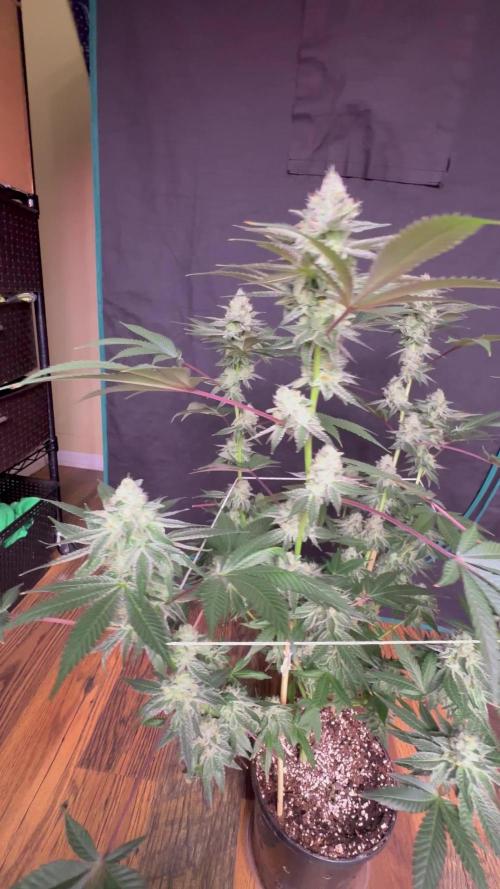
Start to finish 11 weeks, dense, sticky trichombe filled buds. Recommend lollipoping also she didn’t like drying up so changed to daily feeds. Happy growing
Likes
38
Share
@Snakeking
Follow
I assume this Gz #1 Week 8(d50) Gz #2 week 10(d71)chopped:) Gz #3 week 8(d50) Gz #4 week 8(d52) but maturing faster(chopped:) Gz #5 week 9(d62)last week( chopped:) Gz #6 week 8(d50) This week 2 days raining but rest of it is sunny. One plant is faded more than others and i will chop it one week sooner. Only 4 plant give light organic and then tap water for a week or more.
Likes
4
Share
🌈 LSD — Week 5 Veg Report 8×8 Tent | 12/12 From Seed & Short Veg Comparison 👋 Quick Welcome Welcome to everyone joining us now — and thank you for being here. This diary documents LSD genetics grown under a shared environment, with different early-life strategies (short veg vs 12/12 from seed), allowing us to observe how structure, vigor, and timing express themselves under identical conditions. ⸻ 🌱 Overall Status — Week 5 All LSDs are doing beautifully — not as a figure of speech, but in structure, color, and behavior. • Strong vertical growth • Active lateral branching • Clear phenotypic differences depending on early light exposure • Early signs of pre-flower expression, which is fully expected at this stage There is no panic, no rush — just plants doing plant things. ⸻ Plant-by-Plant Observations 🌿 LSD #1 — Former Autopot Plant (Short Veg) • Initially placed in autopots • Showed early nutrient demand stress (“hangry” expression) • Removed from autopots and transitioned to regular feeding • Recovery is excellent: • Purple stems fading • Leaf color returning to healthy green • Strong upward momentum Structure & Behavior • 9–11 visible branches • Lower branches aggressively reaching upward • Clear sativa-leaning dominance in structure • Responds quickly to nutritional correction → a demanding but expressive genotype This plant tells us clearly: “Feed me, and I will perform.” ⸻ 🌿 LSD #2 — 12/12 From Seed • No autopot exposure • No nutrient issues observed • Grew entirely under 12/12 from seed Structure • 7–8 nodes • More compact internodal spacing • Heavy lateral branching • Balanced, controlled architecture Roots clearly prioritized first, followed by steady vertical growth — classic 12/12-from-seed behavior. ⸻ 🌿 LSD #3 — 12/12 From Seed (More Compact Expression) • Also 12/12 from seed • Even tighter internodal spacing than LSD #2 • Similar node count • Excellent symmetry and branch development This one reinforces the pattern: 12/12-from-seed LSDs are stacking nodes tightly while still branching hard. ⸻ 🔍 Key Insight — 12/12 From Seed Behavior This run is revealing something important: • These LSDs are vegging, structuring, and initiating pre-flower simultaneously • Behavior closely resembles autoflowers, despite being photoperiods • The same pattern is visible in the autoflowers sharing the room This suggests: • Time efficiency without sacrificing structure • Reduced “waiting” between phases • Early architectural decisions locked in sooner This is not a flaw — it’s a different rhythm. ⸻ 🌸 Pre-Flower Signals — What to Expect ✔️ Expect • Continued vertical stretch • Ongoing lateral branch expansion • Gradual, overlapping transition into flower • Plants “deciding” their final shape soon ❌ Don’t Expect • A sharp, sudden flip • A clean separation between veg and flower • Uniform behavior across all phenotypes These plants are layering growth stages, not switching them. ⸻ 🧠 Closing Thoughts This week confirms something important: When conditions are stable, plants don’t rush — they express. The differences we’re seeing are not problems. They are information. And we’re doing exactly what a good steward does: • observing • adapting • and letting the plants teach first Week 5 Veg/pre-flower | 8×8 Tent | Master Conditions 🌍 External Environment (Context) • Outside temperature: ~5 °C • Outside RH: 92–96% (very high humidity) • Strong seasonal pressure influencing internal stability ⸻ 🌡️ Internal Tent Conditions • Tent temperature: ~21.8 °C (noted drop due to cold external temps) • Tent RH: ~58% → Very good considering outside conditions ⸻ 💨 Airflow & Circulation • Primary airflow: Bottom → top → wall return • Pattern: Full-room vortex circulation • Additional fans: Central airflow to break blind spots and mix layers • Goal: No stagnant pockets, uniform VPD across canopy ⸻ 💧 Water Source & Rationale • Water: Dehumidifier water + rainwater • Base EC: force • Systems designed to support plant intelligence, not override it FOR DISCOUNT CODES AND MORE JUST FOLLOW THE LINK https://website.beacons.ai/dogdoctorofficial 📲 Don’t forget to Subscribe and follow me on Instagram and YouTube @DogDoctorOfficial for exclusive content, real-time updates, and behind-the-scenes magic. We’ve got so much more coming, including transplanting and all the amazing techniques that go along with it. You won’t want to miss it.GrowDiaries Journal: https://growdiaries.com/grower/dogdoctorofficial Instagram: https://www.instagram.com/dogdoctorofficial/ YouTube: https://www.youtube.com/@dogdoctorofficial ⸻ Explore the Gear that Powers My Grow If you’re curious about the tech I’m using, check out these links: 🔆 Lighting & Environmental Control • Future of Grow — Advanced LED lighting technology https://www.futureofgrow.com/ DISCOUNT CODE: DOG20 • Lumiflora — Under-canopy LED lighting https://lumiflorade.com/ • TrollMaster — Environmental controllers and automation gear (past collaboration) ⸻ Genetics • Zamnesia Seeds — Genetics used in this project https://www.zamnesia.com/ ⸻ 🌱 Soil, Substrates, Boosters & Root Support • Plagron — Substrates, bio mixes, and supportive products https://plagron.com/en/ ⸻ 🎒 Storage, Curing & Preservation • Grove Bags — Curing and storage solutions https://grovebags.com/ ⸻ 📸 Photography Equipment & Tools (Not sponsors, but part of my creative toolkit) • Sony A6700 • Sony full-frame macro lens + few more • Stacking photography workflow - learning • iPhone (for behind-the-scenes shots) We’ve got much more coming as we move through the grow cycles. Trust me, you won’t want to miss the next steps, let’s push the boundaries of indoor horticulture together! As always, this is shared for educational purposes, aiming to spread understanding and appreciation for this plant. Let’s celebrate it responsibly and continue to learn and grow together. With true love comes happiness. Always believe in yourself, and always do things expecting nothing and with an open heart. Be a giver, and the universe will give back in ways you could never imagine. 💚 Growers love to all 💚 📸 P.S. – The Eye Behind the Lens All photos in this diary (for now — except for the ones showing the camera, which I took with an iPhone) are taken with a Sony A6700 paired with a Sony full-frame macro lens and a few more. Photography is part of the story — it’s how we share the fine textures, the glow, and the quiet details that words can’t always capture. I’ve also started experimenting with photo stacking — a technique where multiple images, each taken at a slightly different focus point, are layered together to create one perfectly sharp image from front to back. It’s not digital enhancement or AI; it’s pure photography — a way to reveal the plant’s beauty in microscopic depth, from trichome to petal. You’ll even see a few shots of "ghost me" capturing the shots — camera, lens, setup — because every grow deserves not just to be cultivated, but documented like art. FOR DISCOUNT CODES AND MORE JUST FOLLOW THE LINK https://website.beacons.ai/dogdoctorofficial NEW DISCORD - Official Server Invite Link : https://discord.gg/ksjAkA5T74
Likes
11
Share
Day 42 : Watering with co2 tab / 5L. Also added food again because i think they need it. Increased ppm to 850. Maybe the next one will be pure water. Ventilation works all the time when lights are on. Temp and humi are stable and this is good for the girls. 6 cm in 3 days. Patience is the key always. Also removed some burned leaves from all ladies. She is beautiful community. Edit (Day 46) : Watering with co2 tab every 5L. I watered with juices again at 850ppm because i felt that they need it. Only DsD drank pure water because of burns. She stopped height grow. Her buds are the most fat. She will be the first chop chop guys. :D :D :D . She is full of crystals.
Likes
10
Share
Ph issues here too. Hope it's not too late to correct it!
Likes
2
Share
Hi folks, hope you are doing great! Here pretty much everything is under control. We are trying some LST and it's getting better ans better. We have found the screen, so why don't use it ans test some scrog after all? I will use the screen just to disciplinate the colas, but I won't cut any branch or leaf. Normally this is going to be the last week of veg, knowing that they will stretch quite a bit normally :) Stay safe folks!
Likes
55
Share
@Reyden
Follow
Devo dire che le due Gorilla RQS sono contente e stanno bene nei loro nuovi vasi da 11 L ed in confronto a settimana scorsa sembrano più sane e in forma, purtroppo sono stato quasi una settimana senza misuratore PH perché mi dava problemi e quindi per una volta non ero effettivamente sicuro quanto era bilanciata la soluzione ma penso di non aver fatto danni…andiamo avanti, ieri ho sciacquato solo con acqua a PH 5.9/6 e ora aspetto che asciuga bene questa volta salgo con EC e arrivo intorno a 1250…vediamo come reagiscono 🧐😶‍🌫️
Likes
11
Share
@SackShopG
Follow
I did a 5 day flush and 5 days of 24 hour light before harvest. Dried for 16 days with 60% humidity
Likes
78
Share
@deFharo
Follow
Bienvenidos cultivadores de marihuana clandestinos, y también, a los que tienen la fortuna de no serlo!🖐️👨‍🌾... todo por la causa! Mañana nublada, mañana de porros y música junto a esta gitana agradecida, hace cuatro días cambié el horario a floración 12/12h. Después de una semana donde he hecho tres riegos profundos (4,7L) con componentes variados y dirigidos a estimular el cultivo, la planta está respondiendo espectacularmente... esta gitana a perdido la timidez! ahora crece, se fortalece y orgullosa se esfuerza por alcanzar a sus compañeras de cultivo mayores, y no dudo que lo consiga! En el último riego he estrenado dos nuevas fórmulas de Bio Fertilizantes que puse en fermentación anaeróbica con Microorganismos Eficientes y enzimas hace casi un año y que abro ahora, el primero basado en la disolución de tres tipos de algas (Bio Algas EM) para usarlo en cualquier momento del cultivo como Bio estimulante, el segundo con una combinación de Guanos de ave y Murciélago donde disuelvo principalmente el fósforo y también el resto de macro/micro nutrientes y los ácidos húmicos de esta materia prima excepcional, lo comienzo usar al final de la etapa de crecimiento vegetativo hasta el final del cultivo, en combinaciones de riego con otras fórmulas fuertes en potasio... a jugar!! Un dato: la semana pasada hice, llevado por la pasión, las ganas y el colocón, varias aplicaciones foliares en días consecutivos con una mezcla explosiva de mi Hidrolizado Enzimático de Sangre Fresca (Aminoácidos y Nitrógeno 70%) con Lacto Fermento multi frutas NPK... La primera aplicación en todas las plantas fue espectacular, continué aplicando como si no hubiera mañana, y conseguí bloquear varias plantas y quemar muchas hojas... pero esta planta resistió como la mejor, y ahora se impone mientras sus compañeras se recuperan! El paso a floración es como nuestra entrada en la adolescencia, la revolución hormonal que la planta experimenta es similar a la nuestra, y como tal, hemos hecho una fiesta gitana para celebrar la vida que le espera esta chica andaluza... Hasta la próxima... SALUDOS A TODOS!! ================================= Info de la cepa GYPSY KUSH: https://en.seedfinder.eu/strain-info/Gypsy_Kush/Kannabia_Seeds/ "una variedad única con un duende flamenco que no se puede aguantar y que solo puede venir del sur..." Kannabia Seeds - Genética: Black Domina x Afghan x Ginger Ale - Hibrido: Sativa 50% Indica 50% - Tiempo de Floración: 58-62 días - Rendimiento: 500 gr/m - THC - Hasta 16% ==============
Likes
6
Share
@Gordy
Follow
Week 7 Bloom: This girl is still hungry. I’m still feeding twice a week. I think my grow room is too hot for the plant. In the evenings I’m opening the tent up and letting fresh air get inside. May need to consider finding a way to keep it cool in there for her. The silver is really here now on this girl, So many Trichomes 😍. The buds on this thing are so big, and I still have about a month of growing left on her. I think I’m going to have some monster buds at harvest.
Likes
13
Share
@Dean1
Follow
Another good week they are all coming along nicely they have a bit more room now I can get the door closed the new fan set up seems to work better and is quieter using plastic drainage pipe instead of the foil ducting was hard trying to get hold of some 8 inch pipe back to the plants well having 8 down still, sizes vary fro 50cm to 137cm they’re a few that seem to be a week or 2 behind the rest in the size of the budz but they have plenty of time to catch up. Well the beginning of a new week let’s see what it brings thanks for looking
Likes
29
Share
@TightNugs
Follow
Well into flower now,no issues so not much to report.day 15 of bloom 🤞🍁
Likes
25
Share
ANTHOCYANIN production is primarily controlled by the Cryptochrome (CR1) Photoreceptor ( !! UV and Blue Spectrums are primary drivers in the production of the pigment that replaces chlorophyll, isn't that awesome! 1. Diverse photoreceptors in plants Many civilizations, including the sun god of ancient Egypt, thought that the blessings of sunlight were the source of life. In fact, the survival of all life, including humans, is supported by the photosynthesis of plants that capture solar energy. Plants that perform photosynthesis have no means of transportation except for some algae. Therefore, it is necessary to monitor various changes in the external environment and respond appropriately to the place to survive. Among various environmental information, light is especially important information for plants that perform photosynthesis. In the process of evolution, plants acquired phytochrome, which mainly receives light in the red light region, and multiple blue light receptors, including his hytropin and phototropin, in order to sense the light environment. .. In addition to these, an ultraviolet light receptor named UVR8 was recently discovered. The latest image of the molecular structure and function of these various plant photoreceptors (Fig. 1), focusing on phytochrome and phototropin. Figure 1 Ultraviolet-visible absorption spectra of phytochrome, cryptochrome, phototropin, and UVR8. The dashed line represents each bioactive absorption spectrum. 2. Phytochrome; red-far red photoreversible molecular switch What is phytochrome? Phytochrome is a photochromic photoreceptor, and has two absorption types, a red light absorption type Pr (absorption maximum wavelength of about 665 nm) and a far-red light absorption type Pfr (730 nm). Reversible light conversion between the two by red light and far-red light, respectively(Fig. 1A, solid line and broken line). In general, Pfr is the active form that causes a physiological response. With some exceptions, phytochrome can be said to function as a photoreversible molecular switch. The background of the discovery is as follows. There are some types of plants that require light for germination (light seed germination). From that study, it was found that germination was induced by red light, the effect was inhibited by subsequent far-red light irradiation, and this could be repeated, and the existence of photoreceptors that reversibly photoconvert was predicted. In 1959, its existence was confirmed by the absorption spectrum measurement of the yellow sprout tissue, and it was named phytochrome. Why does the plant have a sensor to distinguish between such red light and far-red light? There is no big difference between the red and far-red light regions in the open-field spectrum of sunlight, but the proportion of red light is greatly reduced due to the absorption of chloroplasts in the shade of plants. Similar changes in light quality occur in the evening sunlight. Plants perceive this difference in light quality as the ratio of Pr and Pfr, recognize the light environment, and respond to it. Subsequent studies have revealed that it is responsible for various photomorphogenic reactions such as photoperiodic flowering induction, shade repellent, and deyellowing (greening). Furthermore, with the introduction of the model plant Arabidopsis thaliana (At) and the development of molecular biological analysis methods, research has progressed dramatically, and his five types of phytochromes (phyA-E) are present in Arabidopsis thaliana. all right. With the progress of the genome project, Fi’s tochrome-like photoreceptors were found in cyanobacteria, a photosynthetic prokaryotes other than plants. Furthermore, in non-photosynthetic bacteria, a homologue molecule called bacteriophytochrome photoreceptor (BphP) was found in Pseudomonas aeruginosa (Pa) and radiation-resistant bacteria (Deinococcus radiodurans, Dr). Domain structure of phytochrome molecule Phytochrome molecule can be roughly divided into N-terminal side and C-terminal side region. PAS (Per / Arndt / Sim: blue), GAF (cGMP phosphodiesterase / adenylyl cyclase / FhlA: green), PHY (phyto-chrome: purple) 3 in the N-terminal region of plant phytochrome (Fig. 2A) There are two domains and an N-terminal extension region (NTE: dark blue), and phytochromobilin (PΦB), which is one of the ring-opening tetrapyrroles, is thioether-bonded to the system stored in GAF as a chromophore. ing. PAS is a domain involved in the interaction between signal transduction-related proteins, and PHY is a phytochrome-specific domain. There are two PASs and her histidine kinase-related (HKR) domain (red) in the C-terminal region, but the histidine essential for kinase activity is not conserved. 3. Phototropin; photosynthetic efficiency optimized blue light receptor What is phototropin? Charles Darwin, who is famous for his theory of evolution, wrote in his book “The power of move-ment in plants” published in 1882 that plants bend toward blue light. Approximately 100 years later, the protein nph1 (nonphoto-tropic hypocotyl 1) encoded by one of the causative genes of Arabidopsis mutants causing phototropic abnormalities was identified as a blue photoreceptor. Later, another isotype npl1 was found and renamed phototropin 1 (phot1) and 2 (phot2), respectively. In addition to phototropism, phototropin is damaged by chloroplast photolocalization (chloroplasts move through the epidermal cells of the leaves and gather on the cell surface under appropriate light intensity for photosynthesis. As a photoreceptor for reactions such as escaping to the side of cells under dangerous strong light) and stomata (reactions that open stomata to optimize the uptake of carbon dioxide, which is the rate-determining process of photosynthetic reactions). It became clear that it worked. In this way, phototropin can be said to be a blue light receptor responsible for optimizing photosynthetic efficiency. Domain structure and LOV photoreaction of phototropin molecule Phototropin molecule has two photoreceptive domains (LOV1 and LOV2) called LOV (Light-Oxygen-Voltage sensing) on the N-terminal side, and serine / on the C-terminal side. It is a protein kinase that forms threonine kinase (STK) (Fig. 4Aa) and whose activity is regulated by light. LOV is one molecule as a chromophore, he binds FMN (flavin mononucleotide) non-covalently. The LOV forms an α/βfold, and the FMN is located on a β-sheet consisting of five antiparallel β-strands (Fig. 4B). The FMN in the ground state LOV shows the absorption spectrum of a typical oxidized flavin protein with a triplet oscillation structure and an absorption maximum wavelength of 450 nm, and is called D450 (Fig. 1C and Fig. 4E). After being excited to the singlet excited state by blue light, the FMN shifts to the triplet excited state (L660t *) due to intersystem crossing, and then the C4 (Fig. 4C) of the isoaroxazine ring of the FMN is conserved in the vicinity. It forms a transient accretionary prism with the tain (red part in Fig. 4B Eα) (S390I). When this cysteine is replaced with alanine (C / A substitution), the addition reaction does not occur. The effect of adduct formation propagates to the protein moiety, causing kinase activation (S390II). After that, the formed cysteine-flavin adduct spontaneously dissociates and returns to the original D450 (Fig. 4E, dark regression reaction). Phototropin kinase activity control mechanism by LOV2 Why does phototropin have two LOVs? Atphot1 was found as a protein that is rapidly autophosphorylated when irradiated with blue light. The effect of the above C / A substitution on this self-phosphorylation reaction and phototropism was investigated, and LOV2 is the main photomolecular switch in both self-phosphorylation and phototropism. It turns out that it functions as. After that, from experiments using artificial substrates, STK has a constitutive activity, LOV2 functions as an inhibitory domain of this activity, and the inhibition is eliminated by photoreaction, while LOV1 is kinase light. It was shown to modify the photosensitivity of the activation reaction. In addition to this, LOV1 was found to act as a dimerization site from the crystal structure and his SAXS. What kind of molecular mechanism does LOV2 use to photoregulate kinase activity? The following two modules play important roles in this intramolecular signal transduction. Figure 4 (A) Domain structure of LOV photoreceptors. a: Phototropin b: Neochrome c: FKF1 family protein d: Aureochrome (B) Crystal structure of auto barley phot1 LOV2. (C) Structure of FMN isoaroxazine ring. (D) Schematic diagram of the functional domain and module of Arabidopsis thaliana phot1. L, A’α, and Jα represent linker, A’α helix, and Jα helix, respectively. (E) LOV photoreaction. (F) Molecular structure model (mesh) of the LOV2-STK sample (black line) containing A’α of phot2 obtained based on SAXS under dark (top) and under bright (bottom). The yellow, red, and green space-filled models represent the crystal structures of LOV2-Jα, protein kinase A N-lobe, and C-robe, respectively, and black represents FMN. See the text for details. 1) Jα. LOV2 C of oat phot1-to α immediately after the terminus Rix (Jα) is present (Fig. 4D), which interacts with the β-sheet (Fig. 4B) that forms the FMN-bound scaffold of LOV2 in the dark, but unfolds and dissociates from the β-sheet with photoreaction. It was shown by NMR that it does. According to the crystal structure of LOV2-Jα, this Jα is located on the back surface of the β sheet and mainly has a hydrophobic interaction. The formation of S390II causes twisting of the isoaroxazine ring and protonation of N5 (Fig. 4C). As a result, the glutamine side chain present on his Iβ strand (Fig. 4B) in the β-sheet rotates to form a hydrogen bond with this protonated N5. Jα interacts with this his Iβ strand, and these changes are thought to cause the unfold-ing of Jα and dissociation from the β-sheet described above. Experiments such as amino acid substitution of Iβ strands revealed that kinases exhibit constitutive activity when this interaction is eliminated, and that Jα plays an important role in photoactivation of kinases. 2) A’α / Aβ gap. Recently, several results have been reported showing the involvement of amino acids near the A’α helix (Fig. 4D) located upstream of the N-terminal of LOV2 in kinase photoactivation. Therefore, he investigated the role of this A’α and its neighboring amino acids in kinase photoactivation, photoreaction, and Jα structural change for Atphot1. The LOV2-STK polypeptide (Fig. 4D, underlined in black) was used as a photocontrollable kinase for kinase activity analysis. As a result, it was found that the photoactivation of the kinase was abolished when amino acid substitution was introduced into the A’α / Aβ gap between A’α and Aβ of the LOV2 core. Interestingly, he had no effect on the structural changes in Jα examined on the peptide map due to the photoreaction of LOV2 or trypsin degradation. Therefore, the A’α / Aβ gap is considered to play an important role in intramolecular signal transduction after Jα. Structural changes detected by SAXS Structural changes of Jα have been detected by various biophysical methods other than NMR, but structural information on samples including up to STK is reported only by his results to his SAXS. Not. The SAXS measurement of the Atphot2 LOV2-STK polypeptide showed that the radius of inertia increased from 32.4 Å to 34.8 Å, and the molecular model (Fig. 4F) obtained by the ab initio modeling software GASBOR is that of LOV2 and STK. It was shown that the N lobes and C lobes lined up in tandem, and the relative position of LOV2 with respect to STK shifted by about 13 Å under light irradiation. The difference in the molecular model between the two is considered to reflect the structural changes that occur in the Jα and A’α / Aβ gaps mentioned above. Two phototropins with different photosensitivity In the phototropic reaction of Arabidopsis Arabidopsis, Arabidopsis responds to a very wide range of light intensities from 10–4 to 102 μmol photon / sec / m2. At that time, phot1 functions as an optical sensor in a wide range from low light to strong light, while phot2 reacts with light stronger than 1 μmol photon / sec / m2. What is the origin of these differences? As is well known, animal photoreceptors have a high photosensitivity due to the abundance of rhodopsin and the presence of biochemical amplification mechanisms. The exact abundance of phot1 and phot2 in vivo is unknown, but interesting results have been obtained in terms of amplification. The light intensity dependence of the photoactivation of the LOV2-STK polypeptide used in the above kinase analysis was investigated. It was found that phot1 was about 10 times more photosensitive than phot2. On the other hand, when the photochemical reactions of both were examined, it was found that the rate of the dark return reaction of phot1 was about 10 times slower than that of phot2. This result indicates that the longer the lifetime of S390II, which is in the kinase-activated state, the higher the photosensitivity of kinase activation. This correlation was further confirmed by extending the lifespan of her S390II with amino acid substitutions. This alone cannot explain the widespread differences in photosensitivity between phot1 and phot2, but it may explain some of them. Furthermore, it is necessary to investigate in detail protein modifications such as phosphorylation and the effects of phot interacting factors on photosensitivity. Other LOV photoreceptors Among fern plants and green algae, phytochrome ɾphotosensory module (PSM) on the N-terminal side and chimera photoreceptor with full-length phototropin on the C-terminal side, neochrome (Fig. There are types with 4Ab). It has been reported that some neochromes play a role in chloroplast photolocalization as a red light receiver. It is considered that fern plants have such a chimera photoreceptor in order to survive in a habitat such as undergrowth in a jungle where only red light reaches. In addition to this, plants have only one LOV domain, and three proteins involved in the degradation of photomorphogenesis-related proteins, FKF1 (Flavin-binding, Kelch repeat, F-box 1, ZTL (ZEITLUPE)), LKP2 ( There are LOV Kelch Protein2) (Fig. 4Ac) and aureochrome (Fig. 4Ad), which has a bZip domain on the N-terminal side of LOV and functions as a gene transcription factor. 4. Cryptochrome and UVR8 Cryptochrome is one of the blue photoreceptors and forms a superfamily with the DNA photoreceptor photolyase. It has FAD (flavin adenine dinucle-otide) as a chromophore and tetrahydrofolic acid, which is a condensing pigment. The ground state of FAD is considered to be the oxidized type, and the radical type (broken line in Fig. 1B) generated by blue light irradiation is considered to be the signaling state. The radical type also absorbs in the green to orange light region, and may widen the wavelength region of the plant morphogenesis reaction spectrum. Cryptochrome uses blue light to control physiological functions similar to phytochrome. It was identified as a photoreceptor from one of the causative genes of UVR8 Arabidopsis thaliana, and the chromophore is absorbed in the UVB region by a Trp triad consisting of three tryptophans (Fig. 1D). It is involved in the biosynthesis of flavonoids and anthocyanins that function as UV scavengers in plants. Conclusion It is thought that plants have acquired various photoreceptors necessary for their survival during a long evolutionary process. The photoreceptors that cover the existing far-red light to UVB mentioned here are considered to be some of them. More and more diverse photoreceptor genes are conserved in cyanobacteria and marine plankton. By examining these, it is thought that the understanding of plant photoreceptors will be further deepened.
Likes
8
Share
Really impressed with dry harvest amount. 7.8 ounces of buds. I used my trim bowl to trim and came out with 3.5 ounces off trim which will be used for edibles. Really sweet smell coming off these buds. They are lovely.
Likes
11
Share
@JoeyGonz
Follow
My only regret is not mainling all. Everything is growing great still got couple few weeks left. But the difference in bud growth is still my topic cause there really no other issues. Buds from the bottom to the top of the mainline ones are all basically the same size. All on the same growth rate. I know due to shape and open canopy yada yada.. Fimmed, the canopy is more bushy. I mean I can see the bottom from the top, I know that's one of the main rules.. But just the leaf growth is different too... So of course buds on bottom still gonna be more popcorny. I still defoliate a little every few days.. Nothing crazy, just wanna irritate her a little. So going forward I'll only do one fimmed with my grows the rest mainlined..Just to get an idea how each one reacts to both grow techniques but still get my weight.
Likes
7
Share
Beginning of week 9, the usual SST foliar and and 5l via drip, also 5l of rain water into the reservoir yesterday . I’ll probably veg week 10 & 11 maybe , want to fill the scrogg and stretch the tops after flip
Processing
Likes
12
Share
Está semana as cores estão mais vivas e o cheiro está forte ualll Red Hot com cheiro floral bastante tricômas, a sweet zkitllez cheiro de frutas tropicais intenso e doce adoro sweet seeds está de parabéns lol