


Likes
Comments
Share


Likes
10
Share


@DeepRootsGrowTrees
Follow
APRICOT GORILLA AUTO
/ GANJA FARMER
WEEK #12 OVERALL
WEEK #6 FLOWER
This week she's stacking nicely as her buds have trichome and are more round in shape. She's got a funky like fruity gas smell to her. Stay Growing!!!
Thank you for stopping by and taking a look it's much appreciated!!
THANK YOU GANJA FARMER!!
APRICOT GORILLA AUTO /
GANJA FARMER

Likes
13
Share


@TheIceCreamParlour
Follow
Yo! Week 2 Flower diary. Honestly I'm lost now I'd say it's closer to the end of week 3. I've done a full res wash, sterilization and refill ahead of adding another 5 plants. Even in one day I'd say I can see a visible 'perk' in these girls since doing that.
Now off big bud and onto PK. They were showing signs of K deficiency so I took that and threw in some PK and the results speak for themselves. Frost is now in full swing. Got me drooling at the already grapey terps coming from them.
Photos are poor this week as lights had already come on before I got to them. Will try for some with just the fluorescent on next week.

Likes
1
Share


@42breeding
Follow
Meanwhile, our flowering cycle continues. In just one week, the plants have changed noticeably and are developing exactly as expected.

Likes
8
Share


@CanadianFillmore
Follow
Small pot Do-si-Dos is struggling, she needs extra feeding each week. Buds are a bit smaller than expected, but they are frosty and sticky and I can see that they're starting to take shape.

Likes
4
Share


@NordicClosetGrower
Follow
Off to a sloppy start with these good old classic seeds. I kinda forgot I was going away for a few days and the giraffe neck vs the dwarf version are the result.
Nevertheless, these aren't autos so I can very likely fix everything by delaying flowering for a bit :)
Very curious to see how easy it will be to grow these in such a small space. 😎
They will be placed in 7l All-Mix soil by BioBizz and will get a full range on BioBizz nutrients after a few weeks of Root Juice. I will however be using BioGrow, BioBloom, TopMax and CalMag as my main nutrients. The others will be used occasionally and if the plant uptakes all nutrients without issues (nutrient lock paranoia is always there)

Likes
9
Share


@KcKush
Follow
*increased ppm from 1050 to 1100
*i don’t see a lot of bud production but they do show a lot of heavy frost.
*one of the strains has long colas while the other ones remain short.

Likes
7
Share


@OG_NordGrow
Follow
So Leute Blüte Tag 5 ist durch strech läuft gleichmäßig ab wie gewünscht. Hoffe das es ohne nachhelfen ab hier weiter laufen kann.
Updates folgen

Likes
11
Share


@midEastern
Follow
just before flowering 8 weeks ago-I took 2 clones of each strain from my last 4 diaries - 8 clones total and vegged them with CFL then went to LED reflector mars 192 (400w wall).
now,my flowering room has just finished the last crop so i moved all 8 grown ups to veg another week and today i started 1212.
i will be adding 2 X 300w BloomSpect LED panels in a week so total flowering led power is
Mars Reflector 192 plus the 2units bloomspect 300 (660w wall).
This diary records only flowering weeks without the clones vegging.
I am having 8 plants with 660w @ 1.2m by 1.2m room - 10-12 oz dry is expected.
Pictures soon
Cheers


Likes
4
Share

@Nitrifier
Follow
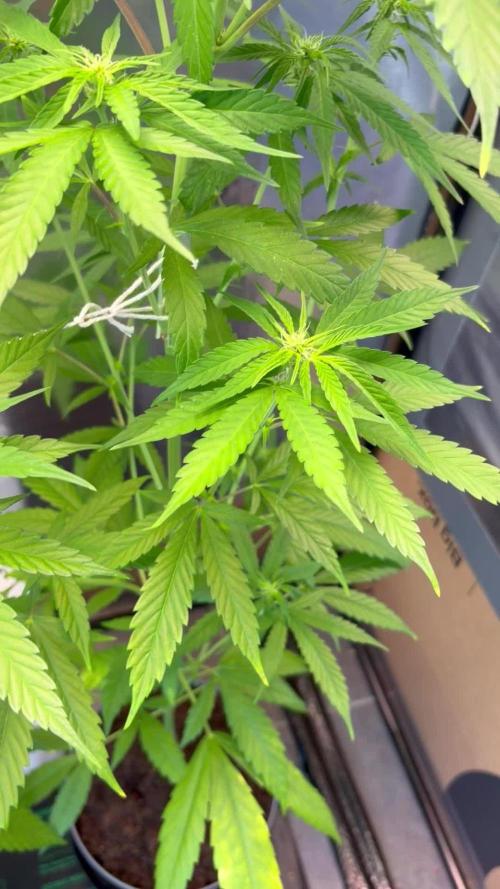
One of the two plants is getting ahead, so I will focus on that one (the other one seems a week or so behind). I got a thermometer/hydrometer, humidity is around 35%, while temperature ranges from 14-25 throughout the week.
Likes
2
Share


@ao_grows1978
Follow
Week 3 for the solo is officially complete. She's been growing with no trouble. Root development has been excellent. As you can see, I decided to mainline. Seeing as she's in a solo cup, I'm not too worried about stunting. I'm horrible at measuring the water intake, but the cup needs to be watered daily. It's as lite as a feather everyday.
Likes
3
Share

@MrWeeedWorld
Follow
Jetzt beginnt die Ernte langsam ihren Schatten vorauszuwerfen.
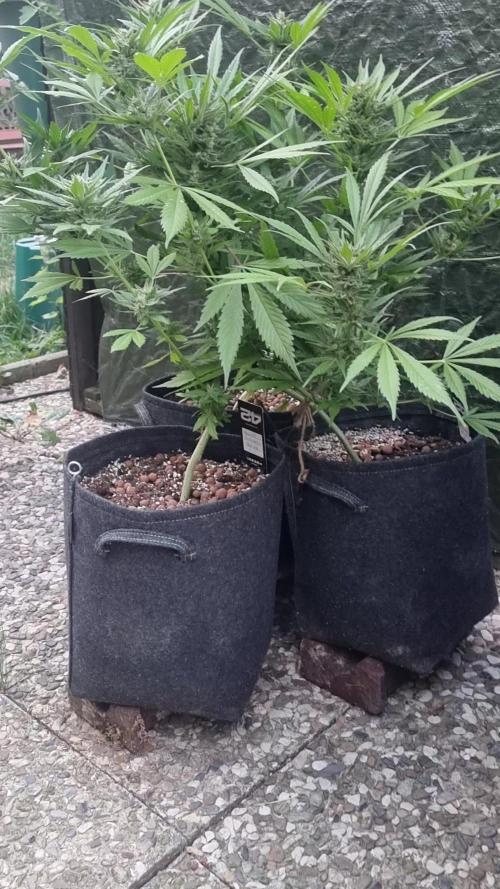
Jede Woche zeigt diese Apricot Auto ein neues Gesicht. Was vor wenigen Wochen noch wie eine sauber trainierte Outdoor-Pflanze aussah, entwickelt sich nun immer mehr zu einer beeindruckenden Sammlung harziger Colas.
Das Training der vergangenen Wochen macht sich jetzt richtig bezahlt. Die offene Pflanzenstruktur sorgt dafür, dass nahezu jeder Haupttrieb ausreichend Licht erhält und sich gleichmäßig entwickeln kann. Statt einer dominanten Hauptblüte stehen inzwischen zahlreiche kräftige Colas im Mittelpunkt, die Woche für Woche an Größe und Dichte gewinnen.
Besonders schön zu beobachten ist die Entwicklung der Blüten. Die Kelche beginnen sichtbar anzuschwellen, viele der ersten Blütenstempel färben sich bereits orange, während an den Spitzen weiterhin frische weiße Pistillen entstehen. Genau diese Mischung zeigt, dass die Pflanze noch einmal ordentlich Energie in den Endspurt investiert.
Auch die Harzproduktion legt deutlich zu. Inzwischen sind nicht nur die Buds selbst, sondern auch die Sugar Leaves von einer dicken Trichomschicht überzogen. Je näher man herangeht, desto deutlicher wird, wie frostig die Blüten mittlerweile aussehen.
Die großen Fächerblätter verlieren langsam etwas Farbe – ein typisches Bild einer Pflanze, die ihre gespeicherten Reserven zunehmend in die Blütenbildung steckt. Insgesamt wirkt sie jedoch weiterhin vital, stabil und ausgesprochen gesund.
Jetzt beginnt die spannendste Phase. Von Woche zu Woche werden die Blüten dichter, schwerer und aromatischer. Wenn das Wetter weiterhin mitspielt, dürfte in den kommenden Tagen noch einmal ein ordentlicher Gewichtszuwachs bevorstehen.
Ich freue mich schon darauf zu sehen, wie sich diese Apricot Auto auf den letzten Metern noch einmal entwickelt.
--------------------------------------------------------------------------------------------------------------------------------------------------------------------
The finish line is finally coming into sight.
Every week this Apricot Auto reveals a new side of herself. What started as a carefully trained outdoor plant has now transformed into a beautiful canopy full of resin-covered colas.
The training from the previous weeks is now paying off perfectly. The open structure allows almost every top to receive excellent sunlight, resulting in an even canopy where multiple main colas continue to develop together instead of a single dominant top.
The flowers have clearly entered their swelling phase. The calyxes are becoming thicker, many of the early pistils have already turned orange, while fresh white hairs continue to emerge on the upper buds. This combination is always a great sign that the plant is still pushing hard toward the finish.
Resin production has increased noticeably once again. The buds are becoming increasingly frosty, and even the sugar leaves are now heavily coated in sparkling trichomes. Up close, the flowers are beginning to develop that sticky, icy appearance every grower hopes to see.
Some of the larger fan leaves are gradually fading as the plant redirects its stored nutrients into flower production. This is a completely natural part of late flowering, while the overall plant still looks healthy, vigorous and well-balanced.
Now comes the most exciting stage of the entire grow. Every passing day adds a little more weight, a little more density and another layer of resin. If the weather stays cooperative, the final weeks should reward all the patience invested since day one.
I can't wait to see how this Apricot Auto finishes her journey.
Likes
17
Share


@HeartStrong_Garden
Follow
She is definitely not as big as the other, but on different nutes looks a bit cleaner. This is my lowest humidy level in a week
Likes
20
Share


@Elysian_gardens710
Follow
Hey Guys! Check out our AK-47 Goxuak from Genehtik 😊 we are very proud of and impressed by this girls so far!
This weeks Objective; hardening off for the Optic 8+ tent. We will be moving her to the big tent in a couple weeks and the light is MUCH more powerful, so right now she goes under it for a couple hours b4 bed each evening.
She has overcome some obstacles in her life and is thriving! It's kinda funny. We had never heard of Genehtik b4 buying the seed from single seed centre, and honestly didnt expect much. So, when the time came to transplant and we realized we were out of pots we decided to put her in the only container handy (we were transplanting them in the kitchen at the time lol) and she has thrived!
It's really cool because we can see root growth through the pitcher. But we wrapped it in duct tape to protect them.
Of the 3 autos we sprouted, she is the only not yet in flower (thankfully) hopefully the pitcher is large enough for her to put on some wieght!
We are new to this diary thing so if anyone takes the time to read this and has and questions or advice please please let us know!! And thanks for checking her out! We will name her at flower
Stats:
Vivosun 2x4 tent
1gal water pitcher
Fox Farms Happy Frog soil
2x viparspectra 600w refractive LEDs
2hrs,3hrs,4hrs 5hrs then permanently under an Optic 8+
Durabreeze carbon filter
4" inline fan

Likes
10
Share


@ChopperMcOG
Follow
Not much changed this week in regard to growth. Except the fattening of buds is all I’m waiting on. A few more pistils are darkening n there are plenty of trichomes on the buds n leaves! Even big leaves r covered. Trichomes r mainly milky n clear with a tiny amount of amber. Hoping these buds get a nice bit bigger before I must give her the chop!
Likes
27
Share


@BB_UK
Follow
Can’t say I’m not disappointed, I can say it was probably caused by wrong nutrition and it’s good to say that I have the opportunity to re run it and either way on the next run in 2 weeks or so is watermelon candy back to back one trimmed topped etc and one not so I can see if it actually makes a difference as I’ve done this on its own and not in a visual to see together so will be good to do! But stay tuned she’s still a great smelling flower! Smells like a nice Cali I smoked a while back part of the paris packs and she’s frosting over already as she’s setting herself to finalise!

Likes
15
Share


@Lazuli
Follow
My plants dont look like 5week flower, is this because of defoliation ? I hope they bulk up now.

Likes
12
Share

@DogDoctorOfficial
Follow
💙 Project Blue Tent – Week 13
🌈 Blue Waffle F1 – Pheno A
❄️ A Rainbow of Colours, Dense Flowers, and the Final Chapter Approaching
Hello everyone, and welcome back to another chapter of Project Blue Tent! 💙🌱
If you're new to this diary, welcome! And if you've been following our adventure from the beginning, you already know that this project has become something truly special.
Four plants.
Two cultivars.
One shared ecosystem.
And four individual stories that we're documenting week after week.
We're growing Blue Waffle F1 and Pickle Lemon Haze F1 together inside the same tent, sharing the same environment, reservoir, irrigation system, and general cultivation approach.
We've spent weeks building the structure, training the plants, managing the canopy, and establishing the lighting and irrigation systems.
But now, my friends...
We're entering another chapter.
The final stage of flowering is approaching, the environmental conditions are changing, and the girls are starting to show us some absolutely beautiful colours.
And Blue Waffle F1 Pheno A?
Oh my God! 😂🌈
This girl is looking outstanding.
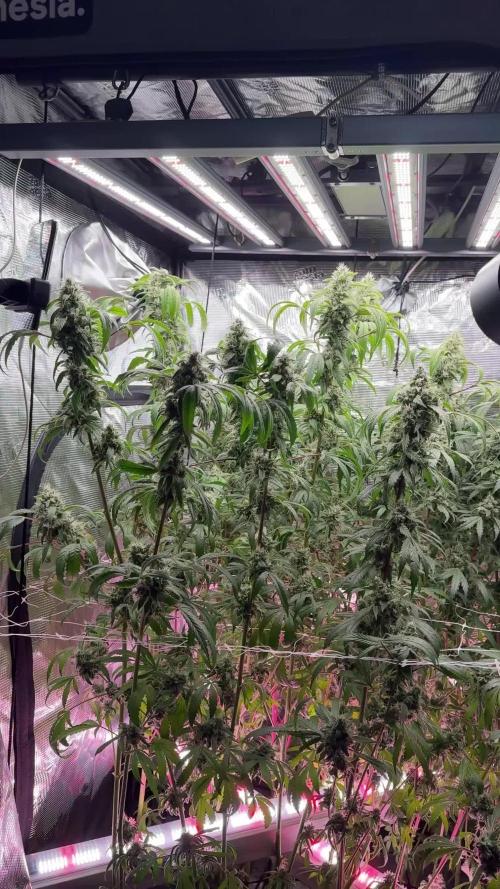
Compact, dense, colourful, beautifully structured, and smelling absolutely incredible.
But before we get into the details of this particular phenotype, let's take a quick look at what's happening throughout the room, because the latest adjustments are part of the bigger story.
🌡️ THE WHOLE ROOM – PREPARING FOR THE FINAL STAGE
The first thing worth mentioning this week is that we've started bringing the temperatures down throughout the room.
Both daytime and nighttime temperatures are being reduced as we move towards the end of flowering.
We're also lowering the solution temperature and substrate temperature, which are now sitting at approximately 21°C.
During the night, when the plants are sleeping, the air temperature is dropping to around 19–20°C.
These changes are part of our approach to the final stage of flowering.
We're aiming to provide a slightly cooler environment while the plants continue maturing, and we're particularly excited to observe how their natural colours develop over the coming days.
Of course, every cultivar and phenotype has its own genetic potential.
Some plants develop spectacular reds, blues, purples, and other shades as they mature, while others remain predominantly green.
We can't force a plant to express colours that aren't in its genetics, but we can observe how each individual responds as flowering progresses.
And in this room?
We're starting to see some beautiful changes! 🌈💙
🍃 HUMIDITY – DON'T BELIEVE EVERY SINGLE SNAPSHOT!
A quick note about the environmental readings shown in the photographs.
Some of the screenshots show relative humidity at 66%, but our actual target reading for the room is around 55%.
Why the difference?
Well, sometimes the biggest environmental variable inside the tent is... me! 😂
When I'm working inside the room, moving around, taking photographs, checking equipment, and breathing, the humidity reading can rise.
Even with the air conditioning running, the conditions can temporarily change while I'm in there.
That's why I don't treat every single screenshot as a perfect representation of the room's normal operating conditions.
The important distinction is between a temporary reading during maintenance and the conditions we're actually maintaining once the room has settled.
For this week's report, we're recording the relative humidity at approximately 55%.
It's a small detail, but it's worth explaining so that anyone following the project understands what they're seeing in the photographs.
Transparency matters, especially when we're documenting a shared environment across multiple diaries.
💧 NUTRITION – WE'RE STARTING TO LOWER THE NUMBERS
Another important change this week is our nutritional program.
We've started reducing the quantities of Hydro A and Hydro B.
The new recipe is:
PLAGRON Hydro A – 1.8 ml/L
PLAGRON Hydro B – 1.8 ml/L
PLAGRON Power Buds – 1 ml/L
PLAGRON pH Plus – as required
PLAGRON pH Minus – as required
The recorded pH is approximately 5.96, and the EC is around 1.86 mS/cm.
As expected, reducing Hydro A and Hydro B has also reduced the overall nutrient concentration, reflected in the EC and TDS readings.
The pH can also change as the solution composition changes, although it doesn't necessarily move in a predictable direction every time.
Our approach is straightforward.
We aim to keep the pH close to 6, allowing for small variations above or below that point, and we avoid unnecessary adjustments as long as the reading remains within our intended range.
We're not chasing a perfectly fixed number every minute.
We're looking at the measurements, considering the complete solution, and keeping the system stable.
As we move towards the end of flowering, we're also beginning to reduce the overall nutrient input rather than continuing with the same concentrations indefinitely.
We'll continue observing the plants and adjusting the program according to how the room and the individual cultivars develop.
🌡️ SOLUTION AND SUBSTRATE TEMPERATURES – EVERYTHING IS COMING DOWN
The solution temperature is now approximately 21°C.
The substrate temperature is also around 21°C.
At night, the room temperature drops to approximately 19–20°C.
Together with the reduction in daytime temperature, these adjustments are part of our approach to the final flowering stage.
We're particularly interested in observing the plants as the temperatures change and their natural colours become more visible.
Some cultivars can express more intense pigmentation under cooler finishing conditions, depending on their genetics and the environment.
However, colour development isn't guaranteed, and cooler temperatures aren't automatically better in every situation.
Our aim is to provide a stable, appropriate environment while observing what each plant naturally expresses.
And Blue Waffle F1 Pheno A is already giving us plenty to appreciate!
💡 LIGHTING – A GRADUAL REDUCTION FROM ABOVE
We've also started reducing the power of the overhead LEDs.
The main lights are now running at approximately 90%.
From here, our plan is to reduce their output gradually, by around one or two percentage points per day, as we progress through the final stage.
The idea is to make these adjustments progressively rather than suddenly changing the entire lighting environment.
We're also taking the under-canopy lighting into consideration.
The two LumiFlora 150W full-spectrum fixtures remain arranged in their X-cross configuration beneath the canopy.
For now, we're keeping their output around 90–95%, with the possibility of reducing it closer to the finish.
This gives us a different balance between the overhead lighting and the supplemental lighting underneath the canopy.
The main LEDs continue providing the primary light from above, while the LumiFlora fixtures supplement the lower portions of the plants.
One of the things we're particularly interested in is how this arrangement affects the development of the lower flowering sites.
Those flowers are part of the plant too, and we want to observe how they progress rather than focusing exclusively on the upper canopy.
The idea is to maintain useful light distribution throughout the plant while gradually reducing the overall overhead intensity as we approach the end.
Whether this helps the different flowering sites finish more uniformly is something we'll continue observing.
We're not going to assume the result before we see it.
We'll document the changes and let the plants tell us their story. 💡🌿
🌈 BLUE WAFFLE F1 PHENO A – THIS GIRL IS A RAINBOW!
Now, let's talk about the star of this week's report.
Blue Waffle F1 Pheno A.
My friends...
This girl is absolutely beautiful! 😂💙🌈
The first thing that catches my attention is her structure.
She's compact, dense, and beautifully developed.
The flowers have a substantial appearance, the overall plant structure remains impressive, and the whole phenotype looks like she's reaching another important stage in her flowering journey.
And then we get to the colours.
WOW.
We're seeing greens, blues, purples, reddish tones, and beautiful orange accents throughout the plant.
It's like she's decided to show us a little bit of everything!
Of course, these colours don't all necessarily have the same cause. Some pigmentation is associated with the plant's genetics, while the changing environment and stage of maturity can influence how those colours become expressed.
But whatever the combination of factors, the visual result is stunning.
She's developing her own beautiful palette, and I'm loving every minute of it.
The flowers are dense, the structure is compact, and the changing colours are making her increasingly photogenic.
And this is precisely why we keep documenting each phenotype separately.
Even when the plants share the same ecosystem, each one can express her own characteristics.
Blue Waffle F1 Pheno A is certainly making herself noticed this week! 🌈❄️
🌸 COMPACT, DENSE, AND BEAUTIFULLY STRUCTURED
Let's come back to the structure for a moment, because it's one of the defining features of this phenotype.
She's compact.
She's dense.
And the flowers are developing beautifully within the structure we've established throughout the project.
Remember the earlier weeks?
The training.
The topping.
The SCROG.
The canopy management.
The defoliation.
The work involved in keeping the plants organized inside this shared space.
All of that earlier work forms part of the story we're looking at today.
Now, as flowering progresses, we're able to appreciate the resulting structure without constantly having to reshape it.
The branches are supported, the canopy is established, and the plant has had time to develop within that framework.
This is where the earlier work starts to make sense visually.
We're no longer looking at a plant that needs to be built.
We're looking at a plant whose structure is already there, with the flowers becoming the main attraction.
And in this case, those flowers are looking fantastic!
❄️ THE FLOWERS – DENSE, FROSTY, AND GETTING CLOSER TO THE FINISH
The flowers are another reason this girl deserves her own spotlight.
They're developing a dense, compact appearance, and the photographs capture the changing details of the buds as they progress through flowering.
The pistils are changing, and we're also watching the trichomes closely as they develop and mature.
Those are two important visual details to follow at this stage.
Pistils can darken and curl as flowering progresses, but their appearance alone doesn't tell us everything about maturity.
Likewise, trichome appearance can provide useful information, but it needs to be interpreted alongside the overall development of the plant and flowers.
That's why we'll keep observing rather than relying on any single visual indicator.
The main thing I can tell you right now is that Pheno A is looking beautiful.
The flowers are dense, the structure is compact, and the whole plant is showing us the results of weeks of development.
We're getting closer to the finish, and I'm very curious to see how she continues changing.
🌿 RED STEMS – AND A BEAUTIFUL EXPRESSION OF HER CHARACTER
Something else worth mentioning is the colour of the stems.
We're seeing beautiful red and reddish-purple tones developing along the plant.
And before anyone jumps straight to a deficiency diagnosis because they see red stems, let's remember that plant pigmentation can have several causes.
Genetics can play a major role in stem colour, and environmental conditions can also influence pigmentation.
A red stem on its own doesn't establish that a plant has a nutritional deficiency.
In Pheno A's case, the overall plant looks vigorous and beautifully developed, with healthy-looking foliage and impressive flowers.
We're not going to diagnose a problem simply because a stem has a particular colour.
Instead, we'll continue considering the entire plant, its development, the environmental measurements, and the other signs it shows us.
And visually?
Those red stems are another beautiful detail in the colourful picture this girl is creating.
🌈💙
👃 THE SMELL – THE WHOLE ROOM KNOWS SHE'S HERE!
Now, we need to talk about the aroma.
Because, my friends...
THE WHOLE ROOM SMELLS AMAZING! 😂🌸
The aroma throughout the tent has become increasingly noticeable, and Pheno A is certainly contributing to that experience.
She's developing a strong, distinctive smell, and every time I spend time in the room, it's another reminder of how much these flowers have progressed.
Aroma is one of the most interesting characteristics to follow as flowering advances.
It's also something that photographs simply cannot communicate.
We can show the structure.
We can capture the colours.
We can photograph the trichomes.
But the aroma?
You'll have to take my word for it!
😂💙
I'm not going to invent a detailed terpene profile or assign specific aromas without properly documenting them.
For now, what I can say is that the smell is strong, the room is wonderfully aromatic, and this girl is becoming increasingly impressive as she approaches the final stage.
📸 STACKING, PHOTOGRAPHY, AND A LITTLE LOOK BEHIND THE SCENES
This week, we've continued documenting the plants through close-up photography and focus stacking.
As many of you already know, focus stacking allows us to combine multiple photographs taken at different focus distances to produce a final image with greater depth of field.
It's a process that requires patience, especially when photographing intricate flower structures.
And sometimes, the final image is only a small part of the work involved.
There's the time spent setting up the camera, choosing the composition, capturing the individual frames, processing the stacks, and reviewing the results.
But I genuinely enjoy the process.
It gives us another way to document the plants and appreciate details that are easy to overlook when looking at the whole canopy.
The photographs in this update are part of that ongoing documentation.
And we've also prepared a longer video showing the stacks, sharing a little of my own medicine, and taking you around the garden.
The video isn't simply about showing the finished photographs.
It's about giving you a better idea of the process behind them and what happens when we're working inside the room.
There's a personal soundtrack included as well, titled "Who Owns the Sky".
The soundtrack and the growing footage aren't necessarily telling the same story, but I felt the music suited the atmosphere of the video.
Sometimes, you put something together because it feels right.
And this one felt right to me. 💙🎶
🎥 A LONGER VIDEO – COME AND SPEND SOME TIME IN THE GARDEN
Alongside the photographs, we've included a longer video showing the photo stacks and giving you a closer look at the garden.
You'll see me sharing the results of the stacking process, moving around the room, and showing a little more of what goes on behind the scenes.
It's not a short highlight reel designed to show only the most dramatic moments.
It's an opportunity to spend a little more time with the project and see how the process unfolds.
From the plants themselves to the equipment, the photographs, and the work that goes into documenting everything, there's a lot happening behind the scenes.
I wanted to share more of that with you.
The video also includes my own soundtrack, "Who Owns the Sky", which adds a personal touch to the experience.
I hope you enjoy it as much as I enjoyed putting it together.
And if you have a little time, settle in, enjoy the video, and come take a walk around the garden with me! 🌿💙
🔬 FOUR PLANTS, ONE ECOSYSTEM – BUT EVERY PHENOTYPE MATTERS
One of the most important parts of Project Blue Tent is the way we're documenting each plant.
The girls share the same room, lighting environment, reservoir, irrigation, and general cultivation approach.
That gives us a useful basis for comparing their development over time.
But it doesn't mean every plant will respond identically.
Each phenotype has its own genetic background and may express different characteristics as flowering progresses.
Some differences can be subtle.
Others can become much more obvious as the flowers mature.
That's why we're keeping individual diaries rather than putting everything into one general report.
Blue Waffle F1 Pheno A has her own story.
Her compact structure, dense flowers, developing colours, red stems, and strong aroma are all part of that story.
And we'll continue documenting those characteristics as she moves towards the finish.
The shared environment gives us the context.
The individual observations give each plant her identity.
And that's what makes these reports worth following.
🌡️ CURRENT GROW CONDITIONS – BLUE WAFFLE F1 PHENO A
Cultivar: Blue Waffle F1
Phenotype: Pheno A
Flowering: Week 13
Height: Approximately 145 cm
Light schedule: 12/12
Day air temperature: 25°C
Night air temperature: Approximately 19–20°C
Relative humidity: Approximately 55% under normal room conditions
pH: 5.96
EC: Approximately 1.86 mS/cm
Solution temperature: Approximately 21°C
Substrate temperature: Approximately 21°C
CO₂: Approximately 666 ppm, as recorded
Pot size: 8 litres
Watering volume: Approximately 1.6 litres per plant per 24 hours
Nutrient line: PLAGRON Hydro
Hydro A: 1.8 ml/L
Hydro B: 1.8 ml/L
Power Buds: 1 ml/L
Main LED output: Approximately 90%, with gradual reductions planned
Under-canopy lighting: 2 × LumiFlora 150W full-spectrum fixtures
Under-canopy output: Approximately 90–95%
Under-canopy arrangement: X-cross configuration
The humidity reading can temporarily rise while I'm working inside the room. The approximately 55% value above represents the normal operating condition described for this update.
💙 A QUICK INVITATION – COME JOIN OUR DISCORD FAMILY!
Before we wrap things up, I also want to invite everyone to join our Discord community.
If you're already part of it, you know how much fun we have in there.
And if you haven't joined us yet, you're more than welcome!
We have a beautiful community of growers who share their experiences, help each other, exchange ideas, and enjoy this hobby together.
No level requirements.
No need to be an expert.
No need to have the biggest garden or the fanciest equipment.
Everyone is welcome.
We also organize giveaways and photo championships, with prizes for the winners.
It's a great place to share your photographs, meet other growers, learn new things, and become part of a community where people genuinely enjoy helping one another.
For me, the best part is that it feels like a family.
So, if you'd like to join us, here's the invitation:
💙 DogDoctorOfficial Discord:
https://discord.gg/dogdoctorofficial
Come say hello, introduce yourself, share your garden, and get involved.
We're always happy to welcome new members!
🌈 FINAL THOUGHTS – THIS GIRL IS SOMETHING SPECIAL
My friends, Blue Waffle F1 Pheno A is looking outstanding.
And honestly, all four girls are looking beautiful right now.
But this particular phenotype deserves her own moment in the spotlight.
She's compact.
She's dense.
She's beautifully structured.
She's developing gorgeous colours.
Her stems are showing beautiful red tones.
Her flowers are progressing.
And the aroma throughout the room is becoming increasingly impressive.
We're also making the transition towards the final stage of flowering.
The temperatures are coming down.
The solution and substrate temperatures are around 21°C.
The nutrient concentrations have been reduced.
The overhead LED power is being lowered gradually.
And the under-canopy lighting remains in place as we continue observing the development of the lower flowering sites.
We're making these adjustments while keeping the wider ecosystem in mind.
The goal isn't to force a particular appearance or assume that every plant will respond in the same way.
It's to maintain a stable environment, document what happens, and appreciate what each phenotype naturally expresses.
And Pheno A is giving us plenty to appreciate.
The colours are beautiful.
The flowers are dense.
The structure is impressive.
And the smell?
Absolutely incredible! 😂🌸
We're getting closer to the end of this journey, but there's still plenty to observe and document.
So we'll keep the camera ready, keep monitoring the environment, and continue giving these girls the attention they deserve.
Thank you for following another chapter of Project Blue Tent.
Thank you for being part of the journey.
And if you haven't joined our Discord yet, come and say hello!
Until next week, my friends...
More colours.
More flowers.
More photographs.
More observations.
And hopefully, even more beautiful moments to share with you.
💙🌈❄️🌸
🙏 A HUGE THANK YOU
A huge thank you to Zamnesia for making Project Blue Tent possible and giving us the opportunity to document these beautiful Blue Waffle F1 and Pickle Lemon Haze F1 cultivars.
Thank you to PLAGRON for the Hydro nutrient line supporting the girls throughout their flowering journey.
A massive thank you to Zamnesia for the Phytonaut LED lighting, curved scissors, and clip fans that continue playing important roles inside the tent.
Thank you to Mars Hydro for the irrigation and drainage equipment that helps us maintain consistency throughout the room.
And a special thank you to LumiFlora for the under-canopy lighting that we're using to explore another dimension of supplemental lighting.
Thank you to GrowDiaries for providing the platform where we can document the plants, share our photographs, and record the lessons we learn along the way.
And finally, thank you to everyone who follows Project Blue Tent, supports the diaries, watches the videos, and takes the time to leave a comment.
Your support means a lot.
Remember to join us on Discord if you'd like to become part of the community:
https://discord.gg/dogdoctorofficial
Growers Love, happy growing, and take care everyone! 🌱💙

Likes
10
Share


@BushDoctor740
Follow
These 3 ladies are exploding in growth and doing quite well.Its almost spring so heavy rains keep the humidity a little high.Im running the ac infinity inline fan to pull some out.Light intensity is still set at 50 percent power which I’ll leave it there and let these girls stretch out a bit.Im still doing a lot of leaf tucking and pinning branches to get a wider structure.


