The Grow Awards 2026 🏆
Likes
Comments
Share
@AsNoriu
Follow
Day 78. Girls is down. Dry trim chosen as to most smaller plants. Overall I am happy with Urban Legend brand, only Gorilla will be meh.... ;))) Day 88. Girl went to jars, amazing 62 g of her !!! Top quality all the plant through. We are testing it with my friend's wife and it's pure joy, think after cure I'll keep it pure for myself, no share ;))) Happy Growing !!!
Likes
13
Share
To be honest overall this strain done good so as the others. Reflecting back on how i started with just a tent and light, and slowly buying the fans and filters whiles the plants were growing. But i did want these plants to grow naturally without topping and Low Stress Training. I regret not removing the lower branches becuase i did get alot of small airy buds down there. But it was all trial and error. All i done was remove some fan leaves when good to do so every now and then. Not on a mad level tho, i did have alot of sugar leaves which i will be making some stuff with! At veg the plants had deficiencies due to out of date Biobizz bottles. But that got sorted with the magic of Algimac and Calmag. Overall Next time I will definitely train the plants and maybe top a few. Final Yield: Plant #1 21.88 Grams Plant #2 33.36 Grams Plant #3 56.06 Grams Which yield exactly 110 grams! Ounces come out very fat with these light buds Not bad for the conditions they were brought up in, and with no training! Thanks for everyone who has followed this diary throught out the journey! I hope this diary will help people out. And thank you to Seedstockers for very cheap and quality seeds. And special thanks for the GrowDiaries Team for providing the best platform for growing journals! I couldnt explain how much this Diary helped me. Its like a dream come true finding a site like this! And if you do see this message, i would love to see a Iphone app coming soon! Kind Regards! One love!
Likes
2
Share
@FicoCG
Follow
Liebe Leute, Woche 5 ist im vollen Gange! PK 13-14 schlägt gut an, die Buds werden dichter und wachsen so langsam zusammen! Harz Produktion ist heftig, die Finger kleben nach dem entlaufen für die kleineren Colas weiter unten. Manche Härchen werden langsam braun aber die Ladys haben noch viel Zeit um groß und stark zu werden. Momentan ist es für mich schwierig mit dem Wassermanagement, bei 29-30 Grad im Zelt und Stofftöpfen brauchen sie 5 Liter alle drei Tage! Ich bin gespannt wie die nächsten Wochen werden! Liebe Grüße Fićo
Likes
27
Share
@w33dhawk
Follow
Hallo liebe growmies, ich hoffe euch geht es allen gut! die Woche war wieder eine erfolgreiche Woche 😁 ich muss sagen ich bin erstaunt wie gut die runde bis jetzt läuft und wie schön sich meine Ladys entwickelt haben, bis jetzt habe ich noch keine Mängel vernehmen können und die Damen sind meines Erachtens nach auf dem besten Weg zur sicheren ernte aber nun zur Woche Am 08.03.23 also einen Tag bevor diese Woche begann habe ich den compost Tee angesetzt dafür habe ich 2,5L Wasser was ich ja eh in der Tonne ab stehen lasse entnommen und habe es in einen leeren behälter von destilliertem Wasser getan, dem ganzen habe ich 2x luftstein hinzu gefügt mit Belüftung's Pumpe (Eheim 200) eine kleine mini heizung für 8 L Aquarien (regelbar) auf 20 Grad eingestellt. Dem ganzen habe ich dann 15g/L wasser compost Tee (37,5g bei 2,5L Wasser) hinzu gefügt bactrex drauf 1g/L wasser (2,5g bei 2,5L Wasser) und 5ml/L orgatrex ( 12,5ml bei 2,5/L wasser) gab es auch noch hinzu das ganze habe ich dann 24 h belüftet und bei ca 20 Grad Wassertemperatur gebraut (Bactrex gab es jetzt 1x bei dieser gabe hinzu,bei dem nächsten compost Tee fällt bactrex dann weg) hab jeder Pflanze von dieser Lösung jeweils 0,5L an die Pflanzen basis gegossen vorher habe ich die Ladys aber natürlich Gewässer mit 2,5L Wasser und Dann Die Lösung oben drauf. Danach saß ich Dann knapp 4 Std vor dem Zelt und hab ausgeschnitten unten rum (alle Blätter und Triebe unter dem netzt entfernt) danach hab ich noch ca 1 Std damit verbracht Triebe von oben heraus zu entfernen die zu dicht an anderen standen ( war echt nicht einfach da nicht zu viel weg zu schnippeln) aber ich glaube ich bin auf nem guten Weg. Den Rest der Woche habe ich nur noch gehofft das sich die Pflanzen gut erholen von dem was ich ihnen angetan habe, und hab die Fächer Blätter so gut wie es geht täglich runter gedrückt unters netzt damit genug Licht eindringen kann in den Baldachin, aber irgendwie hat die Damen das harte ausrasieren nicht wirklich gestört da wie auf den Bildern zu sehen ist, ist der stretch immer noch in gange ist, aber schon deutlich weniger geworden zum Ende dieser Woche. Am Sonntag dem 12.03.23 gab es nur Wasser zum trinken hab jetzt 3,5L Wasser gegossen und somit den Topf komplett mit Wasser gefüllt es kamen dabei ungefähr 20 ml Wasser unten raus, was halb so wild ist, aber immer hin Weiss ich jetzt die gieß menge um den Topf gleichmäßig zu füllen. Ich wünsche euch allen eine schöne erfolgreiche Woche! Cu ihr growmies!
Likes
19
Share
Yellow butterfly came to see me the other day; that was nice. Starting to show signs of stress on the odd leaf, localized isolated blips, blemishes, who said growing up was going to be easy! Smaller leaves have less surface area for stomata to occupy, so the stomata are packed more densely to maintain adequate gas exchange. Smaller leaves might have higher stomatal density to compensate for their smaller size, potentially maximizing carbon uptake and minimizing water loss. Environmental conditions like light intensity and water availability can influence stomatal density, and these factors can affect leaf size as well. Leaf development involves cell division and expansion, and stomatal differentiation is sensitive to these processes. In essence, the smaller leaf size can lead to a higher stomatal density due to the constraints of available space and the need to optimize gas exchange for photosynthesis and transpiration. In the long term, UV-B radiation can lead to more complex changes in stomatal morphology, including effects on both stomatal density and size, potentially impacting carbon sequestration and water use. In essence, UV-B can be a double-edged sword for stomata: It can induce stomatal closure and potentially reduce stomatal size, but it may also trigger an increase in stomatal density as a compensatory mechanism. It is generally more efficient for gas exchange to have smaller leaves with a higher stomatal density, rather than large leaves with lower stomatal density. This is because smaller stomata can facilitate faster gas exchange due to shorter diffusion pathways, even though they may have the same total pore area as fewer, larger stomata. Leaf size tends to decrease in colder climates to reduce heat loss, while larger leaves are more common in warmer, humid environments. Plants in arid regions often develop smaller leaves with a thicker cuticle and/or hairs to minimize water loss through transpiration. Conversely, plants in wet environments may have larger leaves and drip tips to facilitate water runoff. Leaf size and shape can vary based on light availability. For example, leaves in shaded areas may be larger and thinner to maximize light absorption. Leaf mass per area (LMA) can be higher in stressful environments with limited nutrients, indicating a greater investment in structural components for protection and critical resource conservation. Wind speed, humidity, and soil conditions can also influence leaf morphology, leading to variations in leaf shape, size, and surface characteristics. Small leaves: Reduce water loss in arid or cold climates. Environmental conditions significantly affect gene expression in plants. Plants are sessile organisms, meaning they cannot move to escape unfavorable conditions, so they rely on gene expression to adapt to their surroundings. Environmental factors like light, temperature, water, and nutrient availability can trigger changes in gene expression, allowing plants to respond to and survive in diverse environments. Depending on the environment a young seedling encounters, the developmental program following seed germination could be skotomorphogenesis in the dark or photomorphogenesis in the light. Light signals are interpreted by a repertoire of photoreceptors followed by sophisticated gene expression networks, eventually resulting in developmental changes. The expression and functions of photoreceptors and key signaling molecules are highly coordinated and regulated at multiple levels of the central dogma in molecular biology. Light activates gene expression through the actions of positive transcriptional regulators and the relaxation of chromatin by histone acetylation. Small regulatory RNAs help attenuate the expression of light-responsive genes. Alternative splicing, protein phosphorylation/dephosphorylation, the formation of diverse transcriptional complexes, and selective protein degradation all contribute to proteome diversity and change the functions of individual proteins. Photomorphogenesis, the light-driven developmental changes in plants, significantly impacts gene expression. It involves a cascade of events where light signals, perceived by photoreceptors, trigger changes in gene expression patterns, ultimately leading to the development of a plant in response to its light environment. Genes are expressed, not dictated! While having the potential to encode proteins, genes are not automatically and constantly active. Instead, their expression (the process of turning them into proteins) is carefully regulated by the cell, responding to internal and external signals. This means that genes can be "turned on" or "turned off," and the level of expression can be adjusted, depending on the cell's needs and the surrounding environment. In plants, genes are not simply "on" or "off" but rather their expression is carefully regulated based on various factors, including the cell type, developmental stage, and environmental conditions. This means that while all cells in a plant contain the same genetic information (the same genes), different cells will express different subsets of those genes at different times. This regulation is crucial for the proper functioning and development of the plant. When a green plant is exposed to red light, much of the red light is absorbed, but some is also reflected back. The reflected red light, along with any blue light reflected from other parts of the plant, can be perceived by our eyes as purple. Carotenoids absorb light in blue-green region of the visible spectrum, complementing chlorophyll's absorption in the red region. They safeguard the photosynthetic machinery from excessive light by activating singlet oxygen, an oxidant formed during photosynthesis. Carotenoids also quench triplet chlorophyll, which can negatively affect photosynthesis, and scavenge reactive oxygen species (ROS) that can damage cellular proteins. Additionally, carotenoid derivatives signal plant development and responses to environmental cues. They serve as precursors for the biosynthesis of phytohormones such as abscisic acid () and strigolactones (SLs). These pigments are responsible for the orange, red, and yellow hues of fruits and vegetables, while acting as free scavengers to protect plants during photosynthesis. Singlet oxygen (¹O₂) is an electronically excited state of molecular oxygen (O₂). Singlet oxygen is produced as a byproduct during photosynthesis, primarily within the photosystem II (PSII) reaction center and light-harvesting antenna complex. This occurs when excess energy from excited chlorophyll molecules is transferred to molecular oxygen. While singlet oxygen can cause oxidative damage, plants have mechanisms to manage its production and mitigate its harmful effects. Singlet oxygen (¹O₂) is considered a reactive oxygen species (ROS). It's a form of oxygen with higher energy and reactivity compared to the more common triplet oxygen found in its ground state. Singlet oxygen is generated both in biological systems, such as during photosynthesis in plants, and in cellular processes, and through chemical and photochemical reactions. While singlet oxygen is a ROS, it's important to note that it differs from other ROS like superoxide (O₂⁻), hydrogen peroxide (H₂O₂), and hydroxyl radicals (OH) in its formation, reactivity, and specific biological roles. Non-photochemical quenching (NPQ) protects plants from damage caused by reactive oxygen species (ROS) by dissipating excess light energy as heat. This process reduces the overexcitation of photosynthetic pigments, which can lead to the production of ROS, thus mitigating the potential for photodamage. Zeaxanthin, a carotenoid pigment, plays a crucial role in photoprotection in plants by both enhancing non-photochemical quenching (NPQ) and scavenging reactive oxygen species (ROS). In high-light conditions, zeaxanthin is synthesized from violaxanthin through the xanthophyll cycle, and this zeaxanthin then facilitates heat dissipation of excess light energy (NPQ) and quenches harmful ROS. The Issue of Singlet Oxygen!! ROS Formation: Blue light, with its higher energy photons, can promote the formation of reactive oxygen species (ROS), including singlet oxygen, within the plant. Potential Damage: High levels of ROS can damage cellular components, including proteins, lipids, and DNA, potentially impacting plant health and productivity. Balancing Act: A balanced spectrum of light, including both blue and red light, is crucial for mitigating the harmful effects of excessive blue light and promoting optimal plant growth and stress tolerance. The Importance of Red Light: Red light (especially far-red) can help to mitigate the negative effects of excessive blue light by: Balancing the Photoreceptor Response: Red light can influence the activity of photoreceptors like phytochrome, which are involved in regulating plant responses to different light wavelengths. Enhancing Antioxidant Production: Red and blue light can stimulate the production of antioxidants, which help to neutralize ROS and protect the plant from oxidative damage. Optimizing Photosynthesis: Red light is efficiently used in photosynthesis, and its combination with blue light can lead to increased photosynthetic efficiency and biomass production. In controlled environments like greenhouses and vertical farms, optimizing the ratio of blue and red light is a key strategy for promoting healthy plant growth and yield. Understanding the interplay between blue light signaling, ROS production, and antioxidant defense mechanisms can inform breeding programs and biotechnological interventions aimed at improving plant stress resistance. In summary, while blue light is essential for plant development and photosynthesis, it's crucial to balance it with other light wavelengths, particularly red light, to prevent excessive ROS formation and promote overall plant health. Oxidative damage in plants occurs when there's an imbalance between the production of reactive oxygen species (ROS) and the plant's ability to neutralize them, leading to cellular damage. This imbalance, known as oxidative stress, can result from various environmental stressors, affecting plant growth, development, and overall productivity. Causes of Oxidative Damage: Abiotic stresses: These include extreme temperatures (heat and cold), drought, salinity, heavy metal toxicity, and excessive light. Biotic stresses: Pathogen attacks and insect infestations can also trigger oxidative stress. Metabolic processes: Normal cellular activities, particularly in chloroplasts, mitochondria, and peroxisomes, can generate ROS as byproducts. Certain chlorophyll biosynthesis intermediates can produce singlet oxygen (1O2), a potent ROS, leading to oxidative damage. ROS can damage lipids (lipid peroxidation), proteins, carbohydrates, and nucleic acids (DNA). Oxidative stress can compromise the integrity of cell membranes, affecting their function and permeability. Oxidative damage can interfere with essential cellular functions, including photosynthesis, respiration, and signal transduction. In severe cases, oxidative stress can trigger programmed cell death (apoptosis). Oxidative damage can lead to stunted growth, reduced biomass, and lower crop yields. Plants have evolved intricate antioxidant defense systems to counteract oxidative stress. These include: Enzymes like superoxide dismutase (SOD), catalase (CAT), and various peroxidases scavenge ROS and neutralize their damaging effects. Antioxidant molecules like glutathione, ascorbic acid (vitamin C), C60 fullerene, and carotenoids directly neutralize ROS. Developing plant varieties with gene expression focused on enhanced antioxidant capacity and stress tolerance is crucial. Optimizing irrigation, fertilization, and other management practices can help minimize stress and oxidative damage. Applying antioxidant compounds or elicitors can help plants cope with oxidative stress. Introducing genes for enhanced antioxidant enzymes or stress-related proteins over generations. Phytohormones, also known as plant hormones, are a group of naturally occurring organic compounds that regulate plant growth, development, and various physiological processes. The five major classes of phytohormones are: auxins, gibberellins, cytokinins, ethylene, and abscisic acid. In addition to these, other phytohormones like brassinosteroids, jasmonates, and salicylates also play significant roles. Here's a breakdown of the key phytohormones: Auxins: Primarily involved in cell elongation, root initiation, and apical dominance. Gibberellins: Promote stem elongation, seed germination, and flowering. Cytokinins: Stimulate cell division and differentiation, and delay leaf senescence. Ethylene: Regulates fruit ripening, leaf abscission, and senescence. Abscisic acid (ABA): Plays a role in seed dormancy, stomatal closure, and stress responses. Brassinosteroids: Involved in cell elongation, division, and stress responses. Jasmonates: Regulate plant defense against pathogens and herbivores, as well as other processes. Salicylic acid: Plays a role in plant defense against pathogens. 1. Red and Far-Red Light (Phytochromes): Red light: Primarily activates the phytochrome system, converting it to its active form (Pfr), which promotes processes like stem elongation and flowering. Far-red light: Inhibits the phytochrome system by converting the active Pfr form back to the inactive Pr form. This can trigger shade avoidance responses and inhibit germination. Phytohormones: Red and far-red light regulate phytohormones like auxin and gibberellins, which are involved in stem elongation and other growth processes. 2. Blue Light (Cryptochromes and Phototropins): Blue light: Activates cryptochromes and phototropins, which are involved in various processes like stomatal opening, seedling de-etiolation, and phototropism (growth towards light). Phytohormones: Blue light affects auxin levels, influencing stem growth, and also impacts other phytohormones involved in these processes. Example: Blue light can promote vegetative growth and can interact with red light to promote flowering. 3. UV-B Light (UV-B Receptors): UV-B light: Perceived by UVR8 receptors, it can affect plant growth and development and has roles in stress responses, like UV protection. Phytohormones: UV-B light can influence phytohormones involved in stress responses, potentially affecting growth and development. 4. Other Colors: Green light: Plants are generally less sensitive to green light, as chlorophyll reflects it. Other wavelengths: While less studied, other wavelengths can also influence plant growth and development through interactions with different photoreceptors and phytohormones. Key Points: Cross-Signaling: Plants often experience a mix of light wavelengths, leading to complex interactions between different photoreceptors and phytohormones. Species Variability: The precise effects of light color on phytohormones can vary between different plant species. Hormonal Interactions: Phytohormones don't act in isolation; their interactions and interplay with other phytohormones and environmental signals are critical for plant responses. The spectral ratio of light (the composition of different colors of light) significantly influences a plant's hormonal balance. Different wavelengths of light are perceived by specific photoreceptors in plants, which in turn regulate the production and activity of various plant hormones (phytohormones). These hormones then control a wide range of developmental processes.
Likes
39
Share
@KitaKush
Follow
A white christmas for me after all! 😂 Week 13 harvest! Plant 1 = 67 grams/2.3 oz Plant 2= 55 grams/1.9 oz overall= 4.2 oz (5-7 day dry) The Gorilla Cookies are soooo damn frosty and stinky…i’ll be drooling at them for a month until I can taste them!!!! Photos mostly of plant 2..1 was coated in resin but plant 2..the frostiness can be seen from far away! My first top shelf grow 😈…hopefully more to come! My glove was literally sticking to the stems and getting stuck with plant #2 The stench reminds me of thanksgiving dinner LOL..sausage stuffing and gas is what comes to mind..very savory aroma! One plant flushed partially the other not flushed and I can tell you that the flushed plant has much more flavorrrr..if this didn’t prove to me that flushing is absolutely essential IDK what would! LOL
Likes
23
Share
@KanaTiger
Follow
Переехала в теплицу, температура днём до +28, ночью +12
Processing
Likes
27
Share
Week 5 begins! Mandarin dreams 1 & 2 are doing well, however MD1 stinks like shit 💩 and MD2 has a mild earthy smell. Increased feeding to 5 liters per plant and did some defoliation of the yellowing leaves. Moved the ladies to the other side of the room for the rest of the grow. Thanks for stopping by 👽🌳🔥
Likes
1
Share
@Generix
Follow
So at the start of the week I did what everyone says not to with autos; top/fim em!! As I said this is 💯 an experiment so, why not?? The last pic and vid are 3 days after topping
Likes
11
Share
      Settimana 12 Lunedì 12/12/2022 8 lt demineralizzata 800ml rubinetto ec 305 Aggiungiamo 20 ml APT 9 ml enzimi ¾ cucchiaino silicate 8 g megabud 4 ml calmagpro ottendo Ec 2096 Ph 6.2 Martedi 13/12/2022 8 lt demineralizzata 800ml rubinetto ec 305 Aggiungiamo 20 ml APT 9 ml enzimi ¾ cucchiaino silicate 8 g megabud ottendo Ec 1844 Ph 6.3 Giovedi 15/12/2022 15 lt acqua demineralizzata Aggiungo 30 ml Flaschclean (ec 179) 1 lt per pianta. Domenica 18/12 raccogliamo.
Likes
35
Share
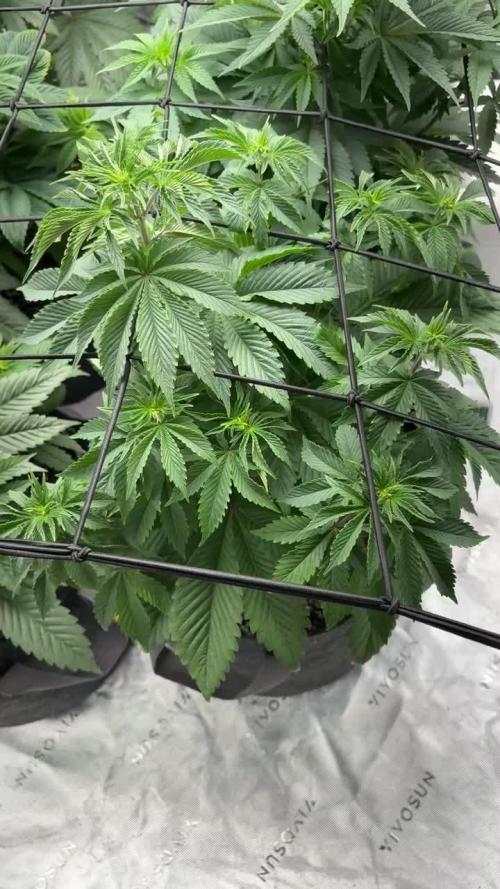
The start of the week is going well.Did some defoliation. Added a scrog net. I removed the scrog the next day, might use it if the buds need support. There’s no way to add the rabbit poo to the nutrients accurately all I did was top dress the soil with a few scoops and worked it in the soil lightly. Water with distilled water.
Likes
15
Share
@Rinna
Follow
Added the scrog net and defoliated a bit to help spread out the canopy. They are looking healthy and happy and ready for the flip! That deep-topping really was a great way of creating a very even and clean canopy (you'll see that in the next week's update)
Likes
2
Share
Lovely start and lovely end to week 1
Likes
8
Share
The buds are pretty airy.. Not dense at all. But still very happy with the outcome. Can't wait to have it all weighed out.. (Dry of course) The root ball was HUGE... I always have an issue with drying too quick (3 days) so, I'm hoping that the box with the computer fan will still move enough air to keep mold from growing.. But not too much to dry out too fast. Also, keeping it in an unused room that stays alot cooler than the rest of the house. Will update when dried and ready for jars! 50 hours of drying.. She still seems pretty moist.. At least.. That's what she said.. Lol.. Had to.. Anyways.. Yeah leaves are still pretty soft almost lively kinda still.. Not crispy.. Trying to make this dry super slow.. And NO hay smell so far.. That's a good thing.. I think.. As long as it still smells like dank.. Tired of drying my buds too quick or too much if I push for 4 days.. 3 days is not good enough.. Im pushing for at least.. AT LEAST 5 days drying and the buds still able to produce about 65% humidity, or so, on their own.. That is what has worked best for me.. Even if it dried in 3 days.. As long as I get the humidity right for curing it wont ruin the terpenes from what I have been experiencing.. Anybody got any other ideas? Lol cuz what I find on the net doesnt work for me.. I didnt wanna use a fan on this.. And im only using a very small weak computer fan that I rigged up to use even less power.. Just scared to dry this too quickor too much.. Thinking about turning the fan off for a little bit.. Maybe the rest of the day and night.. Ok.. So 6 hours after I turned the fan off.. Still reading 55% RH and 20.5C.. It shouldnt mold *crosses fingers* 74 hours drying.. The buds seem very very airy.. And it seems like its one of those types that look like alot but really weighs half of what it looks.. Maybe when I trim her up she'll look better.. Still a very fun and interesting learning experience! On to the next! Still going to update more!!! Probably tomorrow lol Its been a little over 100 hours of drying and the buds and leaves are feeling pretty crisp.. If I wait till the branches "snap" then it usually comes out too dry.. And so far jars 1 and 2 which are the popcorn buds is ready 70% after being in the jars for about 2 hours.. That is too wet still.. Just going to burp very frequently (3 or 4 times daily) and using a fan for a few minutes to help pull that moisture out and let her go right back into curing.. That's the best way I can get it to not smell like hay.. So far so good.. Still smells pretty dank. Some of the nugs are so linky it reminds me of Dr. Grinspoon's from Barney's Farm.. The calyxs are just spaced apart by stem.. Still looks pretty and smells great.. And smokes even better!.. Will update as I go... After about 24 hours in the jars.. The hygrometers are reading 70% - 75% so I left them out overnight to dry out a bit more.. Just put them back into the jars and will check on them when I get home from work tonight.. I'd much rather not dry enough.. Than over dry ANY DAY.. ifit was overdried, it would smell like hay.. But it still smells dank asf.. Plus.. This is just technically giving more time to dry before the cure.. I read that this is considered the "pre-cure phase"... Wish I would have read that before my last 3 - 4 harvests.. But I have learned it now.. So no more excuses for fuckin it up anymore lol.. https://www.cannabisprogrower.com/curing-cannabis/ That is the link to the way that I have started curing.. It seems to be working pretty well. This has details that I could not find anywhere else and basically had to try and figure out on my own... Then I came across this page.. This is the perfect method for curing in my opinion.. Works great for me! Its been in the jars for 6 days.. I now have the hygrometers reading 61% - 63%... According to that website.. I should stop burping daily.. That makes me a little nervous.. I will atleast open each jar daily to get a wiff of them lol.. They smell pretty good.. Not the best I've smelled.. But atleast I know I'm doing it right this time.. Geez.. The drying and curing is the most detailed part of growing.. My first time i thought you just dry it and throw it into the jars.. No matter how long or short of time it took lol.. My first grow was reading 49% after 3 days of drying.. With a fan!.. So glad I got it figured out finally! Made some Bubble Hash with the trim.. Havent weighed it.. But judging by the size (plus I used to be addicted to black tar heroin) it looks like it could be just about 2 grams.. I'll weigh it later.. Still haven't smoked any of it. I only used the 220 micron and 25 micron bags.. 220 to remove all the leafy substance and the 25 to catch all the trichomes.. Usually my bubble hash turns out very dry and breaks apart.. This stuff is super gooey.. Even after drying for 4 days.. Hmm... Smells amazing.. Wish I could smoke it.. I wonder if I could make capsules of this stuff.. And just take it like vitamins.. Lol.. If anybody has tried that or knows anything about it, comment please.. I'm curious A little after 2 weeks of curing.. The buds smell and taste pretty dank! I feel like I got the curing and drying down.. Yessss!
Processing
Likes
14
Share
Week 12, Day 83 from seed and 3rd day of flower.....The 5 day of this week officially marked the start of the flowering season!! So I flushed both of these bad boys with ph'd water for two days and then today I switched them to 12/12. I gave them their first dose of bloom nutrients and then lollipoped them as you can see, pixs . Grateful no issues to report for the past 3 weeks have been trouble-free!! I'm going to leave the MH bulb in for an additional 2 weeks to prevent any stretching before switching to the HPS. But so far they are still loving their environment. I'm also in the process of keeping clones of fat banana and hulkberry while i try this new strain of Peanut Butter Tree.
Likes
Comments
Share
@Robom069
Follow
Hello there from Colorado, i germinated the seeds a few days ago. lookin great, its not my first rodeo and definetly not my last. i bought the ripper seeds online and the black domina on our trip to poland from a local shop at a mall.
Likes
1
Share
She going good just been giving water
Likes
25
Share
@Ratch33
Follow
All went steady! Re-Adjusted my Fan positions & velocity! Full 900W running again - Lights were moved further from canopy to decrease leaf temperature. I pruned some affected leaf tips/fingers Pest & Mould prevention H2o2 Lets hope for the best