The Grow Awards 2026 🏆
Likes
Comments
Share
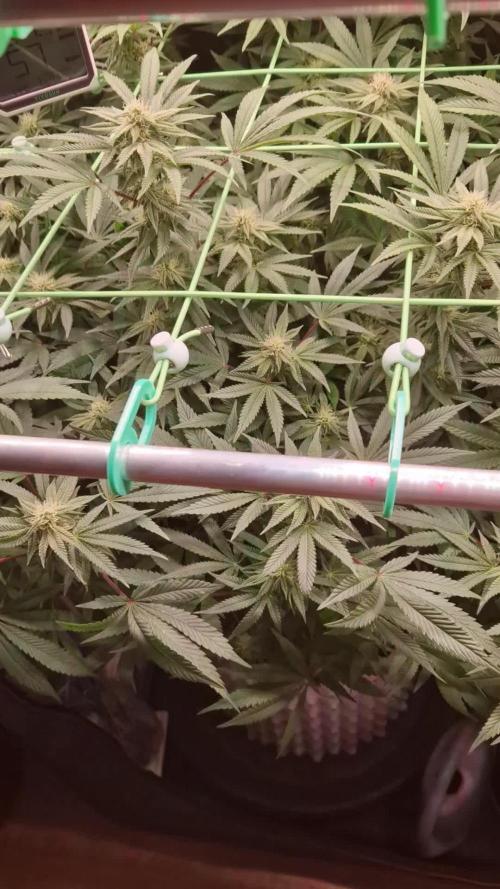
I’m happy to be here at this point. Hoping In these few weeks these ladies start to thicken out. Sundae Batter is sticky sweet as hell. Bubbles smells so good, just stomping up my nostrils.
Processing
Likes
8
Share
Likes
15
Share
@Venabr96
Follow
Estamos aqui começando mais uma semana, algumas folhas apareceram manchadinhas e com uns buraquinhos. Pode ter sido por causa da queda da lampada ensima delas... Folhas muitos grandes e desenvolvimento muito bom A piquena esta crescendo bem,muito forte e linda com belas folhas. Ira crescer para cima reta sem nenhuma tecnica.
Likes
45
Share
Day 54: added some nematodes to kill the fungus gnats Day 56: nutrients like plan Last feeding Pictures are taken on day 56 --------------------------------------------- She develops great buds and is getting some nice colour😎👍 she is the Queen of this run 😁 Happy growing 🍌🌱
Processing
Likes
39
Share
BHB has stretched from 20 cm to 70 cm in 3 weeks. DinaMed is at 50 cm. DinaMed's deficiency seems much better since flipping to flower. EC of BHB 1.3, DinaMed is 1.1, New air pump is shooting 396 Gal/h per bucket compared to just 58 last grow. Root mass has doubled. No sign of rot or root problems. Check out the video for more.
Likes
3
Share
I had to add some support. Especially plant 2, the mainlined plant, is getting some crazy large buds and needs help keeping them up. It seems the mainlined plant is handling the heat better. But she is also getting less direct sunlight which seems to be good for her.
Processing
Likes
16
Share
@MG2009
Follow
1/29/2019 Late to update could not upload pics for some reason. Good week #1 is now 17.5" tall # 2 is 18.5" # 2 in the lead again. My temps were lower than usually cause I shut off red spectrum for pics,and been off for a week so reds back to 100% this week. Little budlets forming nicely. Starting to smell. Sorry only one pic this week can't seem to get pics uploaded,hope I figure it out for next week.Thank for stopping by. 1/30/2019 Ps. Finally got some pics to upload. 2/01/2019 The stretching begins👊 #1 definitely not stretching as much as #2 Number 2 looks like the keeper so far but we will see at the end !🙏
Likes
21
Share
So this weeks Been warm again. Mid 20s all the way up to mid 30s I've started to Schwazz my plants in an effort to keep the airflow along the greenhouse floor . Seems to be working so far so we will see how they start to stack up.
Processing
Likes
11
Share
Muy saludables en su dia 18 de vida se ven todas! An comenzado a alimentarse con fertilizante de crecimiento y en unos días más les haremos transplante a maceta de 7 litros definitiva.
Likes
13
Share
@gr3g4l
Follow
Una vez pasados los dias huele bién, sabe bién y buen efecto. Sabor: Matices dulces y cítricos fácil de cultivar.
Likes
48
Share
@Rit031
Follow
You should try this one. I will update when she dry.
Likes
44
Share
24 Oct 2021 Week 16 began yesterday, but the first watering of the week was today. I’m keeping up with the flush, starting the 2nd week today. Hopefully I’ll be able to harvest in a few days. My Trio is looking really lovely. Their buds are covered in trichomes that glisten under the lights. They are starting to darken in color in some areas like their mother did. They may take on some pinkish/purple hues before it’s all done. Some of their leaves are turning purple as well. The sugar leaves are somewhat dark, but still green. All three of them are very nice to look at, and their smell is super strong! It’s really nice in my grow room! Yesterday I went out and got some more of those support sticks from the local home store and provided support for all of the branches that needed it. Which was a lot! I got 7 new support sticks and used them all. All of the branches are now supported and flourishing! Today each of my girls received a gallon of properly pH’ed water, and each had a sufficient amount of runoff from which to gather measurements. The process went as follows: C1 & C2 had an initial pH of 6.9, and C3’s initial pH was 6.8. I added .2ml of pH DOWN to each gallon which adjusted the pH to 6.4 for C1, and 6.3 for C2 and C3. TDS going in was 88 ppm for C1, 86 ppm for C2, and 84 ppm for C3. Runoff measurements were a little weird. The runoff pH for C1 was 5.9. The TDS was (at first) 600 ppm. I thought that was an incredible drop from the other day, so I did it again. It was 603 ppm the second time. Ok, moving along nicely! The runoff for C2 was pH - 5.8, and TDS was 1101 ppm. 😳 That’s a lot more than C1. C3 had a pH of 5.6, and TDS of 1212 ppm. Which is even more; so I measured a little more from C1 again, and the 3rd time it measured 736 ppm. 🤔 That seems weird to me, but I’ll keep an eye on it. If it continues to be that low then I will end up harvesting it before the others which won’t be so terrible. I’ll just have to wait and see. The temperature in the tent was 81F, and humidity was 47%. My ladies are looking lovely and growing better than I could have hoped for. This grow has been awesome, but I can’t wait to be done. Happy growing everyone! 27 Oct 2021 Feeding/flushing time again! I was somewhat perplexed the other day when I got the runoff reading for the TDS in C1. It was 500-600 ppm less than C2 & C3 respectively. Since I was having some issues with the TDS meter I thought that IT may be the cause. I made a note to check on it today, and there seems to be no problem with the TDS meter at all. Keep reading for details. My plants are still looking as lovely as I could ever have hoped for! C1 has started showing more color changes than the other 2, and the only thing I can say the difference is, is that I defoliated some of C1’s larger fan leaves last week, and wasn’t able to do the same for the other 2. That is the ONLY thing I can think of that has been different between all 3 plants this entire grow. Regardless, all 3 plants are looking wonderful! Today each of my lovely ladies received a gallon of property pH’ed water with an expected amount of runoff for testing. The preparation went as follows: C1 & C2 had an initial pH of 6.9, and C3 was at 7.0. I added 0.2ml’s of pH DOWN to each gallon which adjusted the pH of all 3 gallons to 6.3. TDS going in for C1 & C2 was 85 ppm, and C3 was 84 ppm. Runoff levels were different for all three plants. C2’s runoff pH was 5.7, and TDS was 1041 ppm. C3’s pH was 5.6, and TDS was 1059 ppm. Last time C1 was significantly lower than the others, and I thought that maybe it was a TDS meter issue. Evidently it wasn’t. C1’s TDS today was 526 ppm! 😳 still much lower than the others, and pretty much ready for harvest. The temperature in the tent was 81F, and humidity was 43%. Although harvest time is much closer, I don’t believe it will be done in time for this month’s grow diary of the month contest. So sad, but that’s life. Happy growing everyone! See you again soon. 29 Oct 2021 Today is the last day of week 16. I was planning on continuing the flush today, but remembered something that I had forgotten about…. I remembered the branch that had broken off of C1 back on October 10th in week 14. She had held on for well over a week in a can of water, but finally her leaves started to droop. I hung it up all by itself in my small tent to dry. Until today that is! I took it outside and trimmed it on my deck. Even outside, in a pleasant breeze, the amazing smell of this branch was easily detected. It’s kind of windy, rainy, and chilly here today, but still …. That sweet blueberry muffin smell was there. Her buds; still covered in the dried, crystallized trichomes were super sticky! I must admit that they are the stickiest buds I have grown to date. I weighed the dry bud to add to the grand total of C1’s harvest later. Then I ground it up and smoked it. All I am going to say is that from my reaction to smoking it; I have decided that no additional flushing is needed. After all, what I smoked today broke right before I started flushing, and I could taste nothing other than what I would hope to taste. So my fellow Growmies; I am ending this week right here. The next report you will see will be the harvest report!! Stay tuned!
Likes
49
Share
Well guys batman adjusted her nutes to 500 ppm keeping her at 5.5 - 5.8 ph jumps up every now and then but trying my best to keep on top of it had to trim her up just a little to space her out but wierd enough batman hasnt had to lst her as she has grown outwards without any training at all yet. Guess she knows what she is doing so batman leave her to it. She should start pre flower pretty soon so hopefully Batman can make it past the transition and get a nicely shaped plant ready for flowering. Had to g
Likes
145
Share
@Salokin
Follow
Hi Growmies, Here we are at week 11, and our botanical star continues to astound with her growth. The stretching phase has persisted throughout the week, each day adding a bit more to her stature. It's as if she's reaching for her personal best, and I'm here to cheer her on every step of the way. As the buds begin their own stretch along the colas, it's time to introduce Green Sensations into her diet. This should give her the extra boost she needs for this critical phase of development. Her thirst is growing, a sign of her expanding needs and vigorous metabolism. It's a balancing act to match her hydration requirements, but one that's deeply rewarding. I can't emphasize enough how smooth and stress-free this experience has been. There's a certain peace that comes with tending to a plant that asks so little yet gives so much. If the yield is anywhere near my usual harvests, I might seriously consider making a permanent switch to soil and the Plagron lineup. It's exciting to ponder the potential of a new cultivation method. This journey has been one of simplicity and satisfaction. The connection between grower and plant, the quiet anticipation of each new stage of growth – these are the moments that make it all worthwhile. As always, a reminder for my fellow plant lovers: use the code ZAMMIGD2023 at Zamnesia's online store to get a 20% discount. Sharing is caring, especially in our tight-knit community. Stay tuned for the next update. We're on this journey together, and I'm grateful for every step.
Likes
30
Share
Hello 👋 and welcome back. I've been really, really stoned for a month or two. I do enjoy a good cleaning. No need to be rushing this one, I've got a lot of stuff to tweak in the grow tent. Give it a good scrub to boot. Added a bunch of organic amendments to the medium and reloaded mineral content. Giving it a few weeks to let everything break down, settle in, and balance out before beginning, I'll be doing a thorough pH and EC prior to placing anything in the final pot and making sure to give it a good till in the top soil once everything is broken down into more palatable size. Organic fertilizer = organic matter that's still in the process of breaking down. Mineral fertilizer = salt mineral that's already broken down and ready for uptake in its current form. Synthetic mineral fertilizer = man-made minerals ready for uptake in their current form. Synthetic concentrated fertilizer = man-made concentrates that don't exist in nature. Adding this grow. 500g Horticultural charcoal. 454g Elite Shungite Coal (Fullerene C60). 1kg Spirulina is approx NPK 10%, 100g/1kg (N), 20% 200g/1kg (P), and 20% 200g/1kg (K). In 1 kg (1000g) of spirulina, you can expect approximately 50 mg to 177 mg of Zeaxanthin. 1 kg of moringa powder, approximate NPK : 4.8% N, 0.5% P, and 1.9% K. 500g Azomite. (Ultimate mineral micro nutrient). 1kg of Gaia green 4-4-4, 1kg of 4-4-4 fertilizer contains 4% which is equivalent to 40 grams of each in 1000g. 500g eggshells, 20grams of calcium per 500g. Generally, the more organic matter a plant breaks down, the higher the soil's electrical conductivity (EC) tends to be. This is because the breakdown of organic matter releases nutrients into the soil solution, which increases the concentration of dissolved ions that conduct electricity. Roots and microorganisms do not directly compete for electrical conductivity itself. However, they do interact in the rhizosphere, a zone around plant roots where microbes and plants compete for resources like nutrients and water, which can indirectly influence electrical conductivity. Plant roots release exudates (carbon) into the soil, providing energy and nutrients for microbes. In return, microbes can help plants access nutrients, particularly in the rhizosphere, where nutrient availability can be high. Both roots and microbes compete for the same resources, such as phosphorus (P) and iron (Fe). Factors like microbial decomposition of plant-derived chelators and the proximity of microbes to the root surface can influence this competition. Carbon 60 (Fullerene) can enhance plant growth by boosting microbial activity in the soil, improving water retention, and even increasing plant biomass and yield. It's not a fertilizer, but rather a soil amendment that acts as an ideal companion product for fertilization programs. Studies have shown that fullerenes can influence soil bacterial communities and potentially activate processes like nitrogen transformation in the soil. Some research suggests that fullerenes can increase the availability of nutrients and enhance plant growth. Buckminsterfullerene is a type of fullerene with the formula C60. It has a cage-like fused-ring structure (truncated icosahedron) made of twenty hexagons and twelve pentagons, and resembles a soccer ball. Each of its 60 carbon atoms is bonded to its three neighbors. Shungite coal, particularly the "precious Shungite" variety, is known to contain fullerenes, with a higher content found in Shungite of category 3. The most common fullerene, C60 (also known as buckminsterfullerene or a buckyball), is a well-studied example. The influence of water-soluble carboxylated light fullerene derivatives on the physiological plant state is not well studied. The addition of Spirulina is primarily for zeaxanthin, as it contains a lot. But on top of that, Hawaiian Spirulina is cultivated in open ponds using a combination of 100% fresh potable water from Hawaiian aquifers and ultra-pure, deep ocean water containing all 94 trace minerals & elements. It is then gently dried using patented Ocean Chill Drying technology and cold-pressed to ensure maximum nutrient levels. Spirulina, a blue-green alga, is rich in nitrogen, phosphorus, and potassium (NPK), making it an excellent source of nutrients for plant growth. Studies have shown that Spirulina can be used as a biofertilizer, effectively replacing chemical fertilizers, especially for nitrogen with a whopping, NPK of 10% (N), 20% (P), and 20% (K). Azomite needs no introduction; Just incase, Azomite delivers 70+ minerals and trace elements to boost BRIX, root strength, soil vitality, and yields. Micronized. Moringa is a highly nutrient-dense plant, often called the "miracle tree" or "tree of life" due to its impressive nutritional profile and potential health benefits. It's particularly rich in vitamins, minerals, antioxidants, and other bioactive compounds, making it a valuable resource for addressing malnutrition and promoting overall health. Containing over 92 verifiable nutrients, Moringa oleifera is found to be the most nutrient-dense plant on earth. As far as we know this is the only place online where we list all 92 (and more) nutrients of the Moringa tree and we list all 46 antioxidants of the Moringa tree too. Deep in the Himalayas is a tree called Moringa oleifera, also known as the drumstick tree, and throughout the subtropics, this tree is cultivated for its amazing health benefits. This amazing tree has the ability to grow in an array of conditions, and its health benefits are astonishing. The drumstick tree contains a staggering 92 nutrients and 46 natural antioxidants and as it also holds a number of anti-inflammatory compounds. The sheer number of nutrients found in this tree brings it to the top of the superfoods list, and in its native locations, it is said to have the ability to help treat more than 300 diseases and illnesses. To give you an idea, just a single serving of the Moringa tree contains: 4 times the amount of calcium in the same amount of milk. More vitamin C than 7 oranges. Double the protein and 3 times the amount of potassium in a banana. It's high antioxidant levels can help fight free radicals, potentially slowing down the ageing process and promoting longevity. It is thought to be able to help lower cholesterol levels and regulate blood pressure, due to the high levels of niacin and vitamins B3 and B10. A serving of 100g of this tree gives: Over 8g protein Over 400mg potassium Nearly 450mg calcium 164mg vitamin C 738 ¼g of vitamin A. Moringa also contains vitamins B1, B2, B3, B6, B7, A, C, K, E and D. Amino Acids: In addition, it contains various other nutrients, including the following essential amino acids: Threonine – a nutrient that helps metabolism and prevents fatty buildup in the liver. It also aids digestion. Isoleucine – good for a healthy brain and helps to give the body natural energy. Leucine – works hand in hand with isoleucine to increase energy levels. Phenylalanine – aids communication between the brain’s nerve cells and also helps to reduce hunger pangs as well as increasing alertness and improving memory. Tryptophan – supports your immune system, and its mood boosting ability helps to beat depression and anxiety-associated insomnia. It also reduces the risk of heart attack and lowers bad cholesterol levels. Lysine – aids the absorption of calcium into the bones, supports antibodies and regulates various hormones as well as inhibiting the growth of virus cells. Methionine – provides the body with sulphur as well as helping to lower cholesterol. It also supports the liver, kidneys, and helps keep skin, hair and nails healthy. Valine – helps to keep the mind calm. There are other amino acids in Moringa too, which are not essential to the body but are still beneficial in supporting health. These include histidine, alanine, glutamic acid, arginine, cysteine, proline, aspartic acid, glycine, serine, and tyrosine. Moringa seeds contain oils that hold high levels of oleic acid, which may act to reduce inflammation. https://amchara.com/detox-cleanse/92-nutrients-and-46-antioxidants-in-one-tree-maringa-oleifera/ 4.8% N, 0.5% P, and 1.9% K. Moringa can also serve as a natural source of nitrogen, potentially replacing chemical fertilizers. About 95% of the dry eggshell is calcium carbonate weighing 5.5 grams. The average eggshell contains about . 3% phosphorus and . 3% magnesium and traces of sodium, potassium, zinc, manganese, iron and copper. 1 ppm in water (mg/L) = 1 ppm in soil (mg/kg) If you use 10 grams of 10-20-20 fertilizer in 4 liters of water: Nitrogen: (10 grams * 10/100 * 1000000) / 4000 mL = 2500 ppm N Phosphorus: (10 grams * 20/100 * 1000000) / 4000 mL = 5000 ppm P Potassium: (10 grams * 20/100 * 1000000) / 4000 mL = 5000 ppm K In summary, to determine the precise ppm of an NPK fertilizer, you need to know the specific weight of fertilizer used, the volume of water, and the NPK percentages. The general formula and example calculations can help you make these conversions.
Likes
23
Share
@PapasGrow
Follow
Used 300 watts, produced over 400 grams of dry, extremely dank cookies. Thanks to top quality genetics, lights and nutrients.