


Likes
Comments
Share


@CanadianFillmore
Follow
Week 8 begins! Strawberry Banana is doing great, nice buds super frosty, sticky, heavy and dense. I continue to be impressed by this light and how this plant has grown under it.


Processing
Likes
7
Share


@thephalanx420
Follow
One of my seeds didn't germinate, so I had to plant another. The 2nd one is now in the 64L reservoir and is 6 days behind the one in the 1L reservoir.
Roots are starting to make their way down into the nutrient solution in the 1L bottle.
Likes
8
Share


@pzwags420
Follow
On day 1 I adjusted the PH of my reservoir from 6.3 to 6.1. On day 2 the PH was 6.0. On day 3 the buds are really bulking up :) and the reservoir is at 6.0. On day 4 I applied a BTI drench Ph of 6.0. This should be the final application for any remaining fungus gnats. The reservoir's PH is also 6.0. On day 5 I had to PH up my reservoir to 6.2. When I get to the last half of my reservoir the PH seems to dive down instead of up. On day 6 the reservoir PH is 6.3. On day 7 I adjusted the PH of the reservoir to 6.1 and did my final defoliation before harvest. I have one cola that may have gotten pollen somehow... I cant find any male pollen sacks anywhere on my plants so it's kind of a mystery at the moment. Only time will tell and all my other colas seem unaffected.
Likes
6
Share


@ToastFarmer
Follow
No deficiencies thus far adding some molasses each feeding 1 tbls per gal water

Likes
7
Share


@Rinaldo
Follow
Leaves are green, no nutrients deficiency, she does what she’s good at, shape is clean, she’s doing so good that i’ll let her listen to some Four Seasons from Vivaldi this afternoon.

Likes
2
Share


@FlowerBloom09
Follow
Crazy jump in growth , starting to flower , everything seems healthy so me! Alittle bit of a smell now! LST done daily , let me know what you think!

Processing
Likes
76
Share


@ThrashedTV_BakedByGlaze
Follow
MID-WEEK UPDATE:
Gave the twins their second last feeding today. A few nights of 14-16 Hour Dark periods as well due to plans/not having timers but as I said before I think the longer Dark periods have really sped up the flower development.
PURPLE IS STARTING! Some very nice purple is starting to come into the cals and sugar leaves 😈 Going to push some lower temps in week 8 to get as much colour out of them as possible.
Arnold still heavy fan leaf fading. Ran straight water through the medium before todays feeding incase any build up nute locked it. Never fully bounced back from the last feed but also getting near the end. I have a feeling I'll pull Arnold first in week 8 then maybe let Danny go for a more couch lock.
Danny: GRAPE SMELL. Holy, I don't know if it's more of a Grand Daddy Purp pheno or what but holy is the grape smell off of Danny insane. Almost like a different strain compared to the smells off Arnold.
WEEK 6! HOME STRETCH OF GLAZED GROW #1!
The smell is insane. What started as a premature musk has slowly evolved into sticky ass chocolate goodness, fresh mint/herb, and even some grape/fresh fruit smell on the fingers after defol and mold checks. Noticing a hint of that GASSS too as we start to enter the final ripen.
This will also mark the final week of Nute feeding. Fed today and probably two more Weds/Sun. Then will switch to Molasses/Water for Week 7 and plain water for first half of Week 8 before the dry out.
As you can see, Big Arnold is showing cal/mag and PH problems. Always bounces back after PH perfect feedings and I've been defoliating the faders as we go to save bud energy. It's been rootbound since mid-flower and I'm sure the whole root zone is a mess. The extra work I've had to put into a soilless peat-based medium like ProMix with a photoperiod plant has been great practice and experience but I'm looking forward to a few round of autoflowers and soil grows to dial back the difficulty settings through the winter months.
Broke out the good camera for some shots since we're getting to the good stuff 😎
- Canon EOS 760d
- 75-300mm
- 50mm
Have the twins hanging out with the SoundLink again for those good vibrations 👊
PLANT PLAYLIST:
Kendrick Lamar - To Pimp A Butterfly
Sublime - Sublime
Shad - TSOL


Processing
Likes
28
Share


@BIGBUDZ450
Follow
Day 57. Everything looking good, some look like their stretch is done, bud sites everywhere, fed them 1 L - 1.5 L of their solution. Using boost and terpinator.
Day 58. Fed them Full with 20% runoff. They are starting to smell really good.
Removed a lower branch on some of the plants since the light wasn't going to reach.
Removed some fan leaves on some of the plants giving room for bud sites to get some light.
Day 59. Looking real good, some still haven't stretched but have buds growing.
I'm expecting them to stretch this week. I'm always giving them something to drink and they love it! ***********
Day 60. So down to 8 plants. It sucks because one of the barney’s pinneaple chunk that hermied was a real beast with huge branches and buds,
but tips of pistils were brown so probably would of had seeds even if i would of cut the balls as they grew. I saw some pistils on another plant that turned brown,
Going to keep that one since it’s not hermie and just 2 pistils that are brown tipped. Fed them 1.5 L of solution each no runoff.
Day 61. Looking good, buds growing nicely, long white hairs so i’m expecting big colas. All of them stretched except the 2 Diesel strain.
Keeping light at 14-22inches from top of colas and humidity at 35-40%. Fed them 1 L -1.5 L solution each no runoff.
Day 62. Defoliation, removed some fan leaves covering bud sites towards the middle of the lights. I make sure to not over do it and place the plants correctly for the bud sites to get direct light. I’m having a hard time with the 2 Diesel plants, they aren’t stretching and are slow on forming buds, they gave me a hard time through whole grow. Fed them All 1.5 - 2.5 L each of their solution with little or no runoff.
Day 63. The 2 Diesel are starting to have their stretch. Everything looking good, buds are getting bigger and bigger. Making sure humidity is always under 45%. Keeping lights at 10-20inches from top of main colas. 40k-70k lux on the lights , updated with pictures.
***** Checked out plants and signs of hermies are showing, i see some male balls
Both Barneys Pinneaple Chunk are showing signs of hermies ( balls growing ), going to remove both from tent and focus on the 8 other ones. What a terrible day ( day 59 )


Likes
9
Share


@Jazpa_be
Follow
Hi, this week i checked the trychomes and They are cloudy and the cheese is showing Here and there a little amber trychome. So I started flushing the plants each 2 days with 1.5l per pot and Collect the run off i dont have a ppm meter but every time i flush the water is getting clearer. I am doing this intik the trychomes are 10% Amber on the whole plant. Of you have Some tips let me know!
Processing
Likes
4
Share


@MoneyMorris
Follow
The plants are really starting to frost up, definitely starting to smell. I’ve got my carbon filter running to keep the house from wreaking.


Likes
167
Share


@DeepWaterGrower
Follow
⭐ TrolMaster tracking ⭐
I started to track my crop during week 15, when I got the Tent-X TCS-1 by TrolMaster. First impression was: this is too professional for me, I can't handle setting it up and using it well. Then I started reading some posts on Instagram, I visited their site and in 5 minutes my cultivation experience took a huge step forward with disarming simplicity, I couldn't believe it.
I have uploaded tracking videos from the TrolMaster app for each week from the 15th to the 19th, as well as the two weeks of drying stage.
⭐ Controller Chronicles ⭐
Day after day I appreciated the clarity and precision for data, access to all settings and instant readings by connecting a WIFI router to the controller's LAN port. I loved the possibility to dim my lamps remotely, or even automatically based on the temperature in the box!
🌱 GERMINATION (2 days)
Seeds in a glass of EC 0.4 tap water for 10 hours, then in root riots and under the lamp. They sprouted after 48 hours from dry seed.
🌿 GROWING STAGE (10 weeks and half)
I decided to give these plants a long vegetative growth and this allowed me to do a lot of training on both.
Starting from the 4th veg week I started with defoliation sessions every two weeks, for a total of four during the entire vegetative phase. The last defoliation was done a couple of days before the switch, in order to allow the lower parts of the plant to get as much light as possible.
Furthermore I did Topping on week 6, cutting the apical branch, then on week 8 I did Topping again on several sites, as well as SuperCropping on the highest branches to make the canopy uniform.
The light cycle I used is 18/6 and the last two veg weeks I lowered the light hours to 16/8 first and 14/10 then.
During the veg stage I made 4 DWC change, PH was always between 5.5 and 6, about EC I started with 0.6 and was 1.4 on the last veg week.
🌸 FLOWERING STAGE (9 weeks)
I started this phase after 36 hours of darkness, I then changed the DWCs solution (adding a flowering stimulator).
Then I mounted the ScrOG-net about 50 cm from the base of the plants and I wove the phenotype #1 through the net occupying at least 60% of the available space; the phenotype #2 stretched shortly after the switch and I used the net only to widen the central branches.
They showed the pre-flowers two weeks after the switch, then I made two defoliations on week 3 and 5 flo.
During the last four weeks of flowering (weeks 6-9) I simply paid attention to the PH-EC levels to provide the roots with optimal conditions. I then kept the TEMP-RH-VPD-PPFD values under control and this also thanks to the Tent-X controller by TrolMaster which allows me to provide optimal conditions also above.
I chopped them when trichomes were about 85% milky and 15% amber.
During the flowering stage PH was always between 5.8 and 6.2, about EC I started with 2 and was 2.3 on the last week before flush.
✅ HARVEST
- From dry seed to harvest: 140 days (2 days germination + 75 days veg + 63 days flo).
- Chopped after 4 days flush and 48 hours in dark;
- Wet trim, removed fan leaves.
✅ DRYING STAGE
- Time: 14 days;
- Average: 20° C - 50% RH.
- After that I made a dry trim, removed branches and sugar leaves.
⚖️ DRY WEIGHT
- Phenotype #1: 230 gr buds + 25 gr larf;
- Phenotype #2: 105 gr buds + 50 gr larf.
So, the overall dry weight is: 335 gr buds + 75 gr larf.
✅ CURING STAGE
- Curing is done after 30 days with Boveda 62%.

Likes
5
Share

@RockoCalenberg
Follow
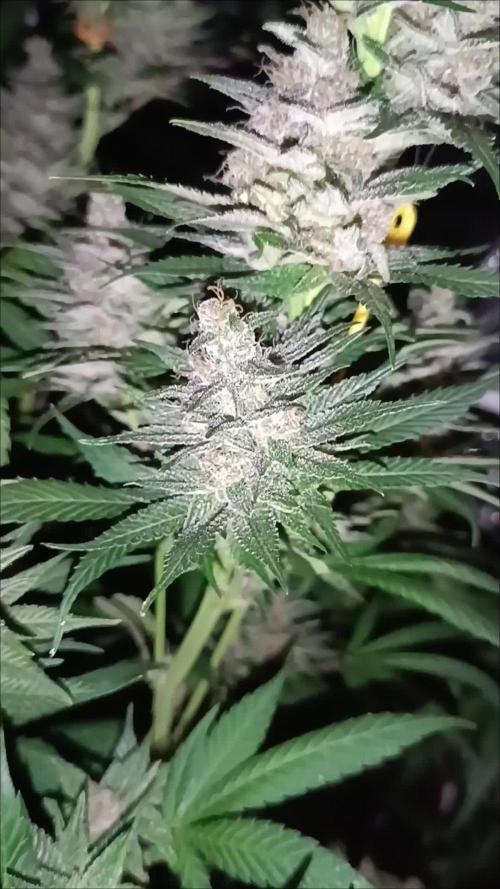
Die 7.te Blüte Woche beginnt...
Sie riecht betörend und das Harz schimmert und funkelt so schön 😍
Gezwittere hat zum Glück nachgelassen und ihre Blätter herbsteln jetzt auch etwas...
Likes
17
Share


@Myrcene_Dream
Follow
Plant took well to topping, mainlining, and heavy defoliation and bounced back right away. Stretched quite a bit during flower and stayed relatively uniform. Could have probably top dressed every 2 weeks instead of 3 and leaf to calyx ratio was also a bit more on the leafy side but still produced some nice buds. Overall an easy grow without any issues.

Likes
50
Share

@DogDoctorOfficial
Follow
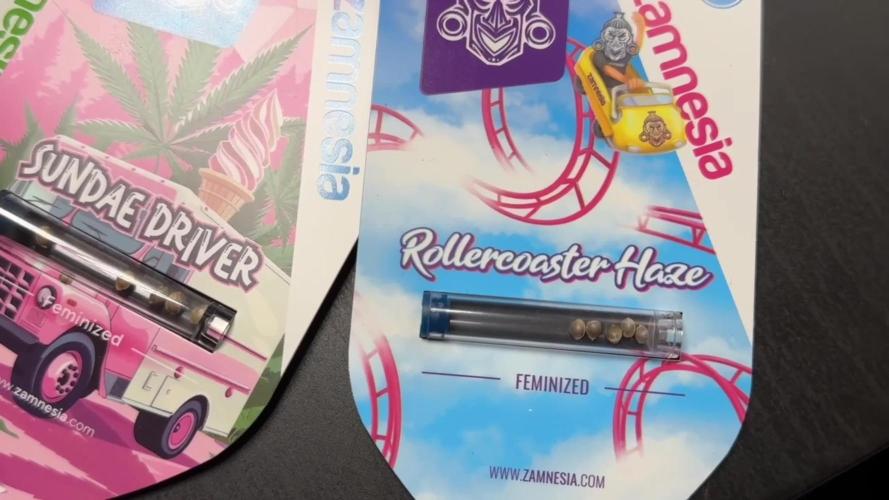
🌸 Sundae Driver — Week 9 Flower / Week 12 From Seed
When the plant decides it’s time… you listen!
Another beautiful, crazy, unforgettable week in our Sundae Driver adventure! The tent has been full of aromas, colors, and emotions — and this week brought a little surprise twist. Our Pheno #2, the bold one, the heavy one, decided she couldn’t hold her own weight anymore and literally bowed to gravity. When I arrived, half of her was on the ground, saying: “It’s time, my friend. Harvest me.”
And honestly, she was right. Perfect trichomes, perfect colors — it was exactly her moment. So, we harvested her with love, laughter, and respect. Sometimes, nature tells you what to do, and all you can do is listen.
We didn’t dry her whole as we usually do — since she broke herself in half, we had to go with a different approach this time. A reminder that every grow has its own personality and surprises. We took it as part of the adventure and had a good laugh about it — because in the end, that’s what growing is: learning, adapting, and enjoying every step.
Meanwhile, her sister Pheno #3 is still standing tall and absolutely shining. She’s thriving under the LUMATEK, with her buds swelling beautifully, trichomes sparkling like sugar dust, and her structure holding strong (for now!).
🌱 Nutrients & Environment
This week we’re keeping the mix balanced — still using the Plagron PowerBuds, Sugar Royal, Green Sensation, together with Aptus Regulator and CalMag Boost.
Our pH sits nicely around 6.1, EC around 0.7, and the soil is still rich enough to carry the girls through these final stages. Temperatures hover around 28°C, humidity slightly high at 60+, but both phenos have been adapting beautifully.
🌿 About the Harvest
For Pheno #2 — the early harvest wasn’t planned, but it turned out perfect. The trichomes were milky with just a few ambers, the aroma intense, and the density incredible. This shows that sometimes the plants truly know best. Her colas were so heavy they couldn’t stand anymore — that’s a good problem to have!
💪 Super Crop & Structure
The earlier super crop training clearly paid off — the buds on the bent tops were some of the thickest and frostiest of all. It’s beautiful to see how resilience leads to strength; those stress points turned into power centers for growth.
🧠 What to Expect & What Not to Expect
• Expect Pheno #3 to keep maturing beautifully over the next week or two — trichomes are developing wonderfully, and aromas are getting more complex by the day.
• Don’t expect her to rush. She’s taking her sweet time, and that’s perfectly fine — every flower deserves her full moment.
• Expect me to keep double-checking the branches — after what happened with #2, I’m making sure no more girls decide to “self-harvest” behind my back. 😂
💬 P.S. — About Holding the Weight
For those reading this — always support your branches properly during late flower! When the buds get heavy (and believe me, they will), the stems can only handle so much. It’s always better to tie, stake, or net them before nature makes the decision for you. Trust me, it’s a funny story after the fact… but quite the shock when you find half your plant bowing to the floor.
💬 P.P.S. — About Super Cropping & Experimentation
For anyone afraid to try new techniques — this is living proof that super cropping works beautifully and that plants are incredibly resilient. Don’t be afraid to experiment, to bend, to learn, and to adapt. Each grow is a new journey, and your plants will always reward your courage with lessons and beauty.
💚 Final Words & Gratitude
As always, I want to send a massive thank-you to everyone following this journey — the readers, growers, dreamers, learners, and friends who stop by the diary. Your presence, comments, and good vibes make this all worthwhile.
A special thanks to Zamnesia for the genetics, LUMATEK LED for the incredible light performance, Plagron and Aptus Holland for the outstanding nutrients and additives, and of course TrollMaster for helping keep everything perfectly dialed in.
And to everyone out there — whether you’re just starting or have been growing for years — remember that every plant, every week, every harvest teaches something new. Stay curious, stay passionate, and never stop growing — in the garden and in life.
📲 Don’t forget to Subscribe and follow me on Instagram and YouTube @DogDoctorOfficial for exclusive content, real-time updates, and behind-the-scenes magic. You won’t want to miss it.
• GrowDiaries Journal: https://growdiaries.com/grower/dogdoctorofficial
• Instagram: https://www.instagram.com/dogdoctorofficial/
• YouTube: https://www.youtube.com/@dogdoctorofficial
⸻
Explore the Gear that Powers My Grow
If you’re curious about the tech I’m using, check out these links:
• Genetics, gear, nutrients, and more – Zamnesia: https://www.zamnesia.com/
• Environmental control & automation – TrolMaster: https://www.trolmaster.eu/
• Advanced LED lighting – Future of Grow: https://www.futureofgrow.com/
• Root and growth nutrition – Aptus Holland: https://aptus-holland.com/
• Nutrient systems & boosters – Plagron: https://plagron.com/en/
• Soil & substrate excellence – PRO-MIX BX: https://www.pthorticulture.com/en-us/products/pro-mix-bx-mycorrhizae
• Curing and storage – Grove Bags: https://grovebags.com/
⸻
We’ve got much more coming as we move through the grow cycles. Trust me, you won’t want to miss the next steps, let’s push the boundaries of indoor horticulture together!
As always, this is shared for educational purposes, aiming to spread understanding and appreciation for this plant. Let’s celebrate it responsibly and continue to learn and grow together.
With true love comes happiness. Always believe in yourself, and always do things expecting nothing and with an open heart. Be a giver, and the universe will give back in ways you could never imagine.
💚 Growers love to all 💚
Likes
14
Share


@Quintall
Follow
Hallo lieber Grower,
hier mein erster Grow^^
Nach 3 Tagen Wasserbad alle in die Erde gelegt mit der Wurzel nach unten zeigend.
Bis alle aus der Erde kommen 24/7 Licht. Dann 18/6
Luftfeuchtigkeit auserhalb des mini Gewächshäuschens 60-70 %
Temperatur 20-25 grad


