


Likes
Comments
Share


@Kosta_boy16
Follow
Ppm spike this week read around 2700
Topped up with fresh water
Still learning will do things a little different next time
Her height seems to have maxed out
Room temp still an issue high 33 deg cel day temps lately .

Likes
14
Share

@Northern_Ent
Follow
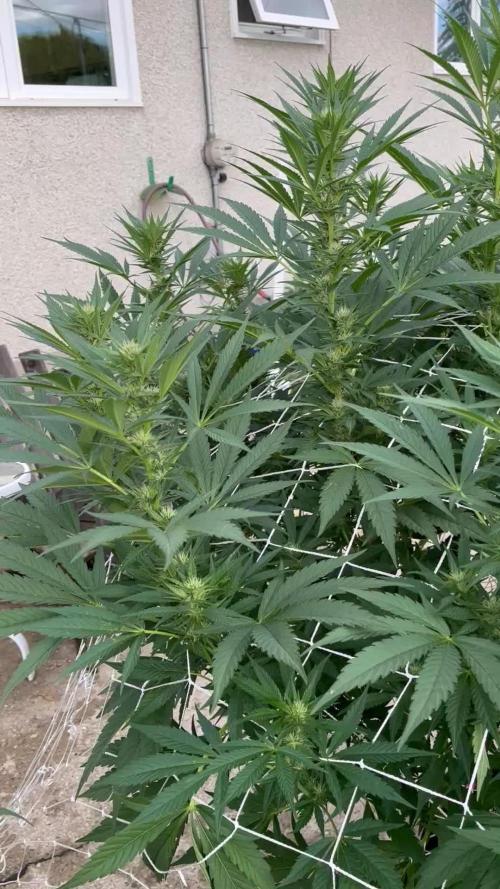
Aug 9: Now done three weeks of flowering for Tropicana Cookies EV. She is the youngest plant but also the tallest and looking quite happy.
Got the UV led lights from AC Infinity going for the first time. Used these last year and they seem to work. UV lights stimulates trichome production and makes up for weak sunlight this far north.
Aug 12: has stretched again but the bud sites are filling nicely. Pistils have started to turn pink. This plant is looking very happy and will likely be a big producer.
Added another top dressing of malted barley and Power Bloom. It has been about two weeks at least since the last round, and this will be the final round.
Stopped using molasses about two weeks ago. Great for growing but I don’t want to be smoking sugar. Use during veg stage but only 2-3 weeks into flowering.

Likes
18
Share


@Chronicbastard
Follow
Things are moving along nicely.i introduced my central air into my tent
this week so it's keeping at 50r.h. and around 80 degrees with co2.these girls drink alot I split one gallon every day and they are drinking it all.lol.they aren't bone dry but when I lift them up to check they are pretty light.

Likes
18
Share


@RickJames_Mcdank
Follow
So I had some internet issues so I couldn't upload. But now everything is alright.
This last week I only gave her water 2 times. first time I gave her 500 ml water and the second time only 250 ml water only.
And I took more fan leafs off her as you can see I only had to hang her up without trimming or anything.
After she is dried I am going to weigh her and see how much I got.
*****************************************************************************************************
As for grow report :
Blue kush is really easy to grow just make sure the temps optimal.
The buds grow really dense thats 1 of the parts I like about this strain.
She takes normal feeding.
Very strong genetics.
And she can take a few mistakes so this strain is perfect for beginners and in medium or expert hands she can get really nice with the colors and smell and taste.
Next week i will post the weight and the dried product.

Processing
Likes
12
Share


@cherokee
Follow
Это было прекрасное приключение. Девочки цвели 60+ дней и все еще были готовы продолжать... стигмы все лезли и лезли, убеждаюсь в том что 55 дней указанные заводчиком это слишком маленький срок, растению нужно 65-70 или даже 75 дней что бы созреть на 100%. У меня к сожалению не было возможности продолжить цикл из за отсутствия места,пришлось резать ((( ну ничего уже новые 7-8 клонов готовы к новому дневнику и к новому приключению))) С каждим циклом вижу как мой результат стает все лучше и лучше, я начинаю понимать этот сорт и что он любит и как с ним нужно себя вести , соответственно с каждым циклом урожай все больше и больше, думаю в горшках 5л этот результат будет еще больше. ))) Великолепное растение OG !
Likes
8
Share


@jaydee702
Follow
bubba cheesecake
tiny pot grow is doing very well its growing fast and thick still no sign of gender yet after 2 weeks in 12/12 tent should see what gender soon im sure its female because its was a femenized seed planted.


Likes
8
Share


@Hiroots420
Follow
Comienza un nuevo cultivo hidropónico de la mano de unas Glueberry de Dutch Passion en un sistema re-circulante de 3 contenedores de 20L mas 20L de cisterna.

Likes
32
Share


@Bossman
Follow
Well I'm over satisfied with the grow everyone said I did a great job the taste and smell was on point to the exact. Thank you @sweetseeds much appreciated

Processing
Likes
5
Share


@AgroCultiveta
Follow
Holaa, 6ta semana y ya vamos superando los problemas de temperatura. Recibí la manta calefactora y la temperatura con el led apagado subió a 16-17ºC, es un gran avance con respecto a los 13-14ºC que alcanzaba.
Los esquejes van avanzando bien, el esqueje con la poda apical va desarrollando los tallos del centro y esta tomando una buena forma. El esqueje con LST esta tomando más fuerza en sus tallos principales y se vuelve más frondosa.
Empece a regar agua con EC casi nula y no eh podido agregar los nutrientes básicos para llegar a un EC base de 0.4. Por esto es que creo que los esquejes están presentando una deficiencia de calcio para esto estoy a la espera del producto SENSI CAL-MAG XTRA de Advanced Nutrients con este voy a corregir la EC base del agua de riego y aplicare una fertilización foliar para las carencias presentes. Espero que los resultados sean los esperados.
A los esquejes los acompaña la Negra 44 que tiene un diario aparte y un palto(aguacate).
Cualquier recomendación sera bien recibida!!
Likes
8
Share


@Gonjuk
Follow
GreenHouse seeds è sempre una garanzia, super lemon haze più volte vincitrice di premi non delude mai, una pianta fantastica

Likes
10
Share


@BR1CK_SANCHEZ
Follow
Flowering has really taken off. Kolas are thickening up and smelling amazing... The plants are still a little short. I think I may have stunted them in veg, possibly by giving them some bloom nutrients too early. Was a recommendation from "Mr. Canuck's Grow" (not sure that it was a good one).... Brewing a fungal-dominated compost tea for flower rn, going to administer tomorrow and show the results next week... also trellis didn't make much difference with the uneven canopy, maybe I installed it too late 🤷♂️
Likes
57
Share


@MadeInGermany
Follow
Hey everyone :-)
We arrived in the last week before the harvest 😍😍😍.
I can hardly wait because both are beautiful and smell extremely good 👍😃.
Let's start with the weekly overview:
Flowering day 56
Both were poured with 1.2 l each and checked for their health.
Flowering day 57
Today the tent was cleaned and the humidifier refilled.
The trichomes have been checked and are about 80% milky and 20% amber.
Flowering day 58
Both were checked, and the technology was checked for functionality.
Flowering day 59
Today both were checked and fresh osmosis water was left in the tank.
Flowering day 60
Again, both were poured with 1 liter.
Flowering day 61
Today was a pure control day.
The trichomes are now 30% amber and 70% milky (a few days until harvest).
Flowering day 62
Today the whole tent was cleaned.
And got the darkroom ready. In the next few days we will go to the darkroom.
Of course, there will be a harvest update before the last update.
Until then, I wish you all the best, stay healthy 🙏🏻 and let it grow 🍀
You can buy this Strain at :
https://sweetseeds.es/de/red-mandarine-f1-fast-version/
Type:
Red Mandarine F1 Fast Version
☝️🏼
Genetics:
Red Poison Auto®️ (SWS39)
X
Tangie (California Orange x Hybrid Skunk)
👍
Vega lamp:
2 x Todogrow Led
Quantum Board 100 W
💡
Bloom Lamp :
2 x Todogrow Led
Cxb 3590 COB 3500 K 205W
💡💡☝️🏼
Soil :
Canna Coco Professional +
☝️🏼
Fertilizer:
Green House Powder Feeding
☝️🏼🌱
Water:
Osmosis water mixed with normal water (24 hours stale that the chlorine evaporates) to 0.2 EC. Add Cal / Mag to 0.4 Ec Ph with Organic Ph - to 5.5 - 5.8 .
Likes
7
Share


@BudLoveJohn
Follow
Plants sprouted in just three days after planting! First week for the seedlings was me learning to get the humidity and light the right distance. A little bit of stretching but not too big of a deal. Plants fixed themselves
Likes
42
Share


@JohnDee
Follow
Hello all, some pistils are turning brown, a quick google search tells me it could be 3 things
1-Light heat
2-Herm
3-Nutrient burn
I would appreciate any opinions
Happy growing

Likes
5
Share


@GaiaGreenGiant
Follow
I thought I wanted to let her grow without any training but I just couldn’t help myself. It’s just so satisfying. I might one day have the patience to do it. Cheers 🍻

Likes
17
Share


@Lazuli
Follow
The smell is insane.
Purple colors.. sooo much resin
The quality is very high on this beautifull plant
Likes
24
Share


@3lementa1
Follow
Fed nutes at 6.3 pH. Runoff was close to 7 pH. Other than that they look like they're doing well. Very sticky and very fragrant.
The leaves of the CBD Blue Shark are a nice dark shiny green. The Wedding Cake is lighter. The profiles of both are starting to come out in the flowers. The CBD Blue Shark has these long, dramatic white pistils. The Wedding Cake is starting to show its creamy colouration with red hairs mixing in with the white and looking very delicious.
The smell is incredible in there now. Fruity and creamy and delicious.

Likes
21
Share


@Trickybis82
Follow
OK hi growmies,
I'm in to final flush week with purple lemonade. She looks and smells amazing so 7days until we cut her down :()
Also wedding cheesecake coming along beautifully. Her aroma is amazing and creamy with the hint of cheese and I j8st cannot wait... i have a couple more weeks for her and Grape gushers...
Next week i will have pics and videos or crop from purple lemonade 💜
Still will have curing process and final taste to show and describe.
Shout out to these auto seed companies
@420FASTBUDS @TASTEBUDZ

Likes
8
Share


@Kirsten
Follow
17.3.25:
I've starred a Hulkberry auto. This was the first pack of seeds I bought! I realised it was mostly sativa, but now I'm ready to give it a go!
Made my soil mix, which I will update next week. Planted the seed into an RQS seed starter plug. Mainly to keep the seed in place when watering.
Join my journey and hang out 🌱✌️

Likes
93
Share

@MadeInGermany
Follow
Welcome to the Zamnesia Spring Cup.
Hi everyone :-)
I hope you are all fine 🙏🏻.
This week the lady has developed really well 😍👍, which probably has something to do with the Monster Bud Mix that she has been using for a few days 😎.
I will top her tomorrow for the first time. After a few more days, I will spontaneously decide whether to do LST or a few more times top :-)
Depending on what time allows and how it develops 🤗. It seems to be a very nice genetics.
This is how you are used to from Zamnesia 😍🙏🏻.
I wish you all a good start to the week, stay healthy 🙏🏻 and let it grow 😎👍
Zamnesia Spring Cup 🏆
Type:
Runtz
☝️🏼
Genetics:
Zkittlez x Gelato
👍
Vega lamp: 2 x Todogrow Led
Quantum Board 100 W
💡
Bloom Lamp : 2 x Todogrow Led
Cxb 3590 COB 3500 K 205 W
💡💡☝️🏼
Soil : Canna Bio
☝️🏼
Nutrients : Monster Bud Mix
☝️🏼🌱
Water: Osmosis water mixed with normal water (24 hours stale that the chlorine evaporates) to 0.2 EC. Add Cal / Mag to 0.4 Ec Ph with Organic Ph - to 6.0 - 6.3
💦💧
