


Likes
Comments
Share


@TiRobotProds
Follow
Nous somme dans la 9ème semaine de fruits encore 2 semaines pour cette dame. Rinçage des racines.

Likes
34
Share


@SalocinSpecial
Follow
D89 (18/02/2021): Copy paste of last week... I think max one week and she is done 😁 I gave around 2L of tap water. Glue Gelato is dry and in jar since one week. I did not move back Banana Kush in the tent since I was sure it was her last week. At this point I should have move her back in the tent. I think being in the closet might have slow her down since there is no reflective wall but at least the environment conditions are good.
- temp in the closet: 18-21C
- water: 2L of tap water
- RH in the closet: 33-35%
D90 (19/02/2021): I can definitely see more resin gland forming on buds and can also tell that the calyx are swelling nicely.
- temp in the closet: 18-21C
- no water
- RH in the closet: 33-35%
D91 (20/02/2021): I gave 1.75L of tap water.
- temp in the closet: 18-21C
- water: 1.75L, PH7.5
- RH in the closet: 33-35%
D92 (21/02/2021): I checked the trichomes and they are more abundant. It's beautiful to see the buds becoming frostier day by day 😍
- temp in the closet: 18-21C
- no water
- RH in the closet: 33-35%
D93 (22/02/2021): She is starting to show some amber trichomes but not enough. I will let her some days to ripen but she is close to harvest!
- temp in the closet: 18-21C
- no water
- RH in the closet: 33-35%
D94 (23/02/2021): I gave 3L of tap water.
- temp in the closet: 18-21C
- water: 3L, PH7.5, 130PPM
- RH in the closet: 33-35%
D95 (24/02/2021): Trichomes are all cloudy with some ambers. Due to a timing issue, I will need to chop her this weekend in two or three days. Yesterday I did reduce light intensity to 50% power. She will pass 2 days with this light intensity and then 2 days in complete darkness.
- temp in the closet: 18-21C
- no water
- RH in the closet: 33-35%
D96 (25/02/2021): I will not change for week 14 since she is going into darkness tonight for two more days. Trichomes are not exactly where I would like. More ambers would be better but at least they are all milky white with some amber. She's at her peek in term of THC potency.
- temp in the closet: 18-21C
- no water
- RH in the closet: 33-35%
D97 (26/02/2021): 24h into complete darkness is done
- temp in the closet: 18-21C
- no water
- RH in the closet: 35-40%


Likes
2
Share


@FEBREZE
Follow
Studio54 – Original DeepEast x WizardTreez Cut aka RS54
Sunset Sherbert x OZ Kush#54
Tag 35 der Blütephase wurde etwas Entlaubt. Die Buds sind schon ordentlich dick geworden und fangen an zu Purplen.
Likes
22
Share


@PrairieFrostGrow
Follow
*
***************** Week 1 of Growth From Seed, April 11 to 17, 2020 - Days 1 to 7 from germination **********************
*
Okay, we are off running now. Through germination and was delighted to experience 100% success rate👍
Two girls this run and now have a GSC and a GSC2 this run. GSC was chosen for the first to break the surface and while the second GSC to come up is now GSC2, she was actually the third to break the surface. Excited to run this strain from Fast Buds.......there are newer strains but sometimes a classic is good😃
Greater focus on VPD this run. Already pushing the humidity higher than I ever have with having controller set at 72% with temperature at 79 degrees. I have been reviewing the numbers and I have normally been close but it looks like I have to raise everything by about 10% and for a few weeks long😬😬😬😬😬😬 Trust the science and lets learn some more from this grow!!!
*****Daily Detail:
Apr 11, Day 1:
- VPD - 1.2
- 500ml first watering given with nutrients as listed. (minus Velokelp)
- pH water to 5.6
- Girls up and looking like they are ready to go.
Apr 12, Day 2:
- VPD - 1.0
- 500ml feeding with VeloKelp @ 2ml/L, Piranha & Voodoo @ 2ml/L. pH to 5.6
- lowered light intensity a bit more.
- Both girls are doing very well. Nice leaf colour and tips are turning up now!!
Apr 13, Day 3
- VPD - 1.2
- 500ml water with 0.5ml/L each of Piranha & Voodoo, Dual Fuel.
- 300ppm with 5.4pH.
Apr 14, Day 4
- VPD - 1.1
- 500ml water with Virtathrive and Piranha & Voodoo Juice @ 1ml/L, VeloKelp @ 2ml/L, and SensiCal @ 0.5ml/L.
- 210ppm with 5.5pH.
- the girls are very happy and colour looking good. Tips are pointed way up on GSC and GSC2 seems happy but may have a little more going on below the soil right now so a little slower looking.
Apr 15, Day 5
- VPD 1.0
- 250ml water with VeloKelp @ 1ml/L.
- 95ppm with 5.4pH
- GSC really looks happy and hope she is pushing out some serious roots below:)
- GSC2 is holding her own looks fine.
Apr 16, Day 6
- VPD 1.0
- 500ml water with Piranha & Voodoo @ 1ml/L, Vitathrive @ 0.5ml/L, Dual Fuel @ 0.5ml/L.
- 300ppm with 5.8pH
- GSC still looking pretty happy and continues to point tips up.
- GSC2 is standing up a little more and over looking like a nice.
- Moved all the girls today one spot in a clockwise rotation.
- Noticed more residual moisture on the bottom of the pots than anticipated.
Apr 17, Day 7
- VPD 1.1
- Turned on flower light on UnitFarm this afternoon and they are happier.
- Both ladies up and proud to be alive this afternoon.
- Dry out day today and no added water/feed, just misting.
- Let the medium dry out a bit and give a nice week 2 feed tomorrow.....they are ready for a little more nutrients now.

Likes
8
Share


@Mr_nugs_lover_David
Follow
Very good journey to me, she has responded very well to the lst training, providing me beautiful colas, enough for me to have nice clean organic nuggets to smoke. I would definitely would run this Ak420 by seedstockers again, the sweetest phenotype was the number #2 which you can take a look at here in my page!

Likes
Comments
Share


@Shneeblay
Follow
All coming on strong now uploading photos next week for the start of week 4 of veg all bushing up nicely. Not sure but I think the sugar breath may have topped itself.


Likes
18
Share


@Canna96
Follow
Hey now, hope everyone is having a great weekend and staying safe. Another great week for the ladies, as they are now about 2 weeks into flower, and the stretch is winding down. I am still feeding them silica, cal mag, and flower nutrients maxi bloom by GHE. I will start to add a PK booster this week. I also will be switching to light from V1 to F1 sometime this week, and also integrating the UV/IR bar into the light cycle later this week. I will run the UV/IR bar for approximately 30 minutes prior to lights off to get started.
The 5X5 is really starting to fill up nicely, I am running two dehumidifiers outside of the tent and I am able to maintain around 50% RH in the tent during lights on, and around 55% RH with lights off.
Still very happy with the Spectrum X from Medic Grow. I am running her at 90% in the V1 cycle and will be transitioning to the F1 cycle later this week. Overall, the plants seem very happy and healthy. The temperature and humidity is significantly dropping so that helps keeping the tent cool and not overly humid. This is by far the best time of year to be flowering plants in my region.
I hope everyone has a great weekend, Thanks for stopping by, Stay Safe and Blaze On!!! 💪
Website: https://medicgrow.com/
https://growdiaries.com/grower/medicgrowled


Likes
82
Share


@Schnabeldino
Follow
🏆The First Grow Cup Diary🏆
_____📅 Week 7 | 📅 Day 43 - 49 | 22.02 - 27.02 Feb. ______
27.02.25 | Day 49 🌞💧
🔸 I didn't spend much time with the ladies this week, I had a lot to do and then there was the carnival. So this week just a little video of the three cuties. I try to cut off as few leaves as possible and try to do more with LST. It doesn't look very nice, but the fewer leaves you cut, the faster the plant grows....Yes, I know it itches in your fingers to cut every day, but just give your plants a rest.
🔸 Runtz 1 and 2 are doing really well and look just as I imagined. Runtz 1 looks a bit thirsty and therefore lets the leaves hang a bit.
🔸 I can't do much LST with Runtz 3 because the main branches on the stem are a bit broken and I don't want to break them off completely...shit happens hehe.
🔸 each Plant 3 l
__________________________________________________________________
🌡️🔆= 25-26°
🌡️🌜= 18-19°
💨 Hum. = 65%
🔦 PPFD = 600 umol 18/6
🔦⌚DLI = ~38
___________________________________________________________________
Equipment: Veggie
💡2 x 200 Watt Cosmos LED
💡4 x 40 Watt Spider-Farmer
⛺120 x 120 x 200 Tent (4 x 4 x 8)
🍯 18 liter pots

Likes
9
Share


@BeanCrop420
Follow
After realising that it was the temps in my reservoir changing causing my ph levels to change I have now sorted the issue and levels are a lot more stable.
This week I will begin diluting/flushing my system by just adding water ph 6.2 to the reservoir before I do a full system change for the final 2 week flush
Starting to see a lot more too her now and her buds are starting to bulk. I'm really pleased with how she is turning out and I can't wait for harvest!
Happy growing 🌱

Likes
13
Share


@StickyFingah420
Follow
Planta hermosa, de estructura resistente y cogollos rocosos y repletos de resina.
Resistente bien el entrenamiento LST y topping, pide bastante alimentos y te recomiendo lavar bien las raíces antes de cosechar si has usado fertilizantes.
Los frutos desprenden una fragancia exquisita y muy dulce.
Likes
7
Share

@Chubbs
Follow
420Fastbuds-Papayton
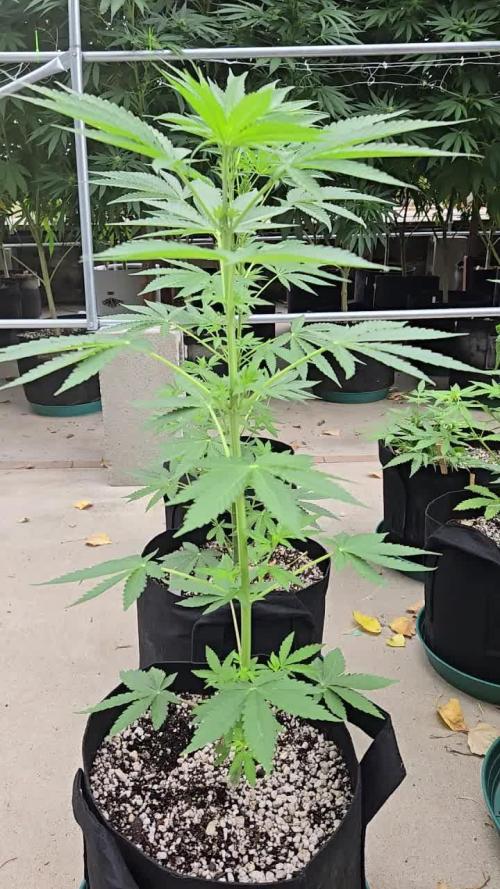
What up, fam, little update on these beautiful girls. They got rained on a few times the last couple of days as we've had some summer storms come through. I'm starting to see some pistols on one. I'll guess the other two won't be too far behind. All in all, Happy Growing.
Likes
35
Share


@Rangaku
Follow
Girls are growing strong and first signs of flower are showing up , been defoliating and removing all lower vegetation, hopefully I won’t run out of height , it’s gonna be a big old tent full of the fruit shortly .
The little auto in the corner is looking little and chunky and is coping ok with 12-12 lights
Lost the extraction fan sometime during the night , looks like I caught it in time


Likes
7
Share


@Cogollo_eu
Follow
**Encontrarás la traducción a español al final de la descripción**
From/Desde: 05/04/19 || To/Hasta: 11/04/19
From day/Desde día: 43 || To day/Hasta día: 49
You can find the Gorillas Diary here:
** Podéis encontrar el diario de las Gorilla aquí:**
https://growdiaries.com/diaries/25675-makingmoney-with-gorilla-mm-vs-gorilla
-----IMAGES & VIDEOS-----
Video 1:
Complete week 7 in 2 minutes (Original frame rate modified), i used something composed by me playing with Logic Audio, please don't blame me 👉😳👊
Video 2:
Complete growing stage plus some flowering days in 2 minutes, same audio
Photo 3:
Additives used at day 5, all but Iguana
Video 13:
Overview video of the Moneys and the Gorillas
Photo 14:
Nutrients & additives used on day 9, again all but Iguana
-----WEEK SUMMARY-----
Finally I decided to Switch to 12/12 the first day of this week, and at the end of the week i will leave the SCROG mall fixed. As you can see it's not a tru SCROG as the man-lining Gorilla is taller than the Moneys. In the other hand i'm very happy on how the plants are distributing themselves after i removed the training structures. I removed those structures to prevent more stress to the plants, as they have recieved a hard training and i want to give them a breath and also grow as they like.
You can see how many vegetation they have, it almost cover the 85-90% of the tent, in the middle of flowering week 3 i will perform a massive defoliation.
This week i can see how the Gorilla with the main-lining is developing more defined and taller colas than the other plants, let's see how they evolve in some weeks.
Also this week i will apply the last foliar irrigation, just to help them a bit.
-----WATERING CALENDAR-----
05/04/19 - 1.250 ml with all week nutrients -(Foliars, Bloom Stimulator & Bloom Nutrition) @ 1.1 E.C. PH6.4
- Foliar application of 250 ml of water with (Foliar Nutrition & Plant Vitality+) among the 4 plants
09/04/19 - 1.250 ml with (Sensizym, Bloom Stimulator, Bloom Nutrition & bud Ignitor) @ 1.4 E.C PH6.4
*****ESPAÑOL*****
-----IMÁGENES Y VÍDEOS-----
Vídeo 1:
Semana 7 completa en 2 minutos (Frame rate original modificado), he usado algo que he compuesto jugando con el logic audio, disculpadme por esto 👉😳👊
Vídeo 2:
Fase de crecimiento completa y algunos días de floración en 2 minutos
Foto 3:
Aditivos usados el día 5 excepto Iguana
Vídeo 13:
Vídeo general de las Moneys y las Gorilas
Foto 14:
Nutrientes y Aditivos usados el día 9, de nuevo todos menos Iguana
-----SUMARIO SEMANAL-----
Finalmente he decidido cambiar a 12/12 el primer día de esta semana y al final de la semana dejaré fina la red de SCROG, como veréis no es realmente un SCROG pues la Gorilla con Man-Lining tiene colas más largas que las Moneys. Por otro lado estoy muy contento en como se están distribuyendo las plantas después de haberles quitado las estructuras de entrenamiento, las he quitado para quitarlas stress ya que han tenido un entrenamiento duro y quiero dejarlas respirar e ir por si solas a partir de aquí.
También podéis observar como tienen mucha vegetación que casi cubre el 85-90% de la superficie del armario, a mitad de semana 3 de floración les haré una defoliación masiva dejándolas peladas.
Esta semana ya puedo observar cómo la Gorilla con man-lining está creando colas más definidas y largas que el resto de las plantas, veremos a ver en unas semanas como evolucionan las Moneys.
Por último esta semana también aplicaré el último riego foliar para ayudarlas un poco con el cambio de estado y el stress recibido.
-----CALENDARIO DE RIEGO-----
05/04/19 - 1.250 ml con todos los nutrientes semanales excepto -(Foliars, Bloom Stimulator & Bloom Nutrition) @ 1.1 E.C. PH6.4
- Aplicación foliar de 250 ml de agua con (Foliar Nutrition & Plant Vitality+) para las 4 plantas
09/04/19 - 1.250 ml con (Sensizym, Bloom Stimulator, Bloom Nutrition & bud Ignitor) @ 1.4 E.C PH6.4


Likes
20
Share


@UDAAC
Follow
I am open to any information
Good morning December 1 week six flowers looking good .she is still growing vertically but also still fill out . It’s amazing how much tca has grown in the last two weeks ! . Any questions or comments down below let’s go up down all around !!
December 2nd
Likes
2
Share


@Ultraviolet_
Follow
67 days since April 16th, 2026
We become aware at such times of man's wonderful ability to bring seemingly unrelated elements into harmonic balance, and receive a glimpse into a world where everything exists in conscious sympathetic attunement to everything else. When we listen to a piece of music that seems to strike a beautiful chord somewhere inside us, or view a painting that simply glows with harmonic awareness well executed, we probably do not spare much time to contemplate the wonderfully intricate combination of vibrations that our sensors make it possible for us to perceive. We tend to appreciate the relationship between the parts of something by an awareness of the harmony or dissonance of the whole. This ability enables us to say "what a beautiful house!" instead of "analysis has proven that this collection of building materials exhibits certain elements of harmonic proportion." While this ability to instinctively appreciate the beauty of true harmony has an important role to play in evolution, a more analytical understanding of the laws involved can be most useful. This is especially so if we wish to create works of art where each part exists in true harmony, not only with the other part of that particular whole, but with the universe within which the creator and the created exist.
Everything vibrates. From the most dense matter to the most subtle cosmic rays, everything which our senses allow our thoughts to become aware of, can be specified in terms of wavelength or frequency of vibration. These two terms define the same thing, but from different points of view.
The following are the approximate wavelengths of various energy carriers:
Cosmic rays 0.000,000,001 mm
Gamma rays 0.000,000,1 mm
X rays 0.000,500 mm
Ultraviolet rays 0.003 mm
Visible light 0.006 mm
Infrared 0.01 mm
Sound waves 1 meter
Radio waves 300 meters
Violet light 400 nm to 450 nm
Blue light 450 nm to 500 nm
Green light 500 nm to 570 nm
Yellow light 570 nm to 590 nm
Orange light 590 nm to 610 nm
Red light 610 to 700 nm
1 nanometer (nm) = 0.000,000,1 cm = 1/10,000,000 cm
If a guitar string is plucked and we hear a sound, it is not too difficult for the human mind to associate this sound with the vibration of the guitar string. With color it is quite different. It is difficult for us to conceive that the color of a substance is not an inherent property of the substance itself, but an indication picked up by our senses of that substance's ability to absorb or reflect the light which happens to be shining on it at that moment. Neither the matter nor the light is colored. What happens is that the brain learns to differentiate between the frequencies reflected or transmitted by the substance the eyes are focused on. The same thing happens with sound. When we say "Oh! Listen, they're playing my favorite song," what we really mean is: "My brain has stored within it a particular pattern of frequencies. I have compared the new information being received with this stored pattern and have deduced the answer that the two patterns are similar within certain specified tolerances." The 'pleasure' involved could have something to do with our running the pre-recorded pattern at the same time, in 'sympathy' with the new pattern as it is received.
The word sympathy describes very well our ability to appreciate color and sound. It also describes the reason behind certain elements of harmony. For instance, if a substance vibrating at 100 cycles per second (tone 1) is in the proximity of another substance vibrating at 200 cycles per second (tone 2), we could perceive, if we had the right equipment, a certain sympathetic relationship between the two.
We will see from this that there is a uniform doubling of the first tone seen in the second. At various points along the waves, the two are the same in amplitude. At other points, they are at opposite poles to each other. This doubled frequency has more points of similarity to the original than any other frequency except the original itself. If the equipment we had available for measuring these two frequencies was a soundboard amplifier and a pair of ears, then we would hear what would sound to us like one tone. If we had the opportunity to hear one at a time, we would hear that although they sound the same, one is higher in pitch than the other. This characteristic of 'the same but different in pitch', musicians have called the octave. Any two tones produced where one has exactly doubled the frequency of the other is called an octave. Speaking in ratios, an octave would appear then as the ratio 2:1 or 1:2, depending on whether we are talking of an octave up or down.
A single note produced by almost any instrument will contain more than one wavelength or frequency. It will have a dominant frequency, the wavelength of which we would call the note's 'fundamental' or 1st harmonic. It will also have a varying number of upper harmonics, gradually fading in intensity into infinity or silence.
Natural harmonics always have the same pattern of intervals between them. The interval between the 1st and 2nd harmonic is a perfect octave; between the 2nd and 3rd a perfect fifth; between the 3rd and 4th a perfect 4th; and so on, the intervals becoming smaller and smaller until they lose any relationship with the western 12 tone scale as it exists at the moment. Just as an octave has certain elements of sympathy with its fundamental, so some intervals have been noted to be more perfectly in sympathy with the fundamental than others. The ratio of the 'perfect 5th' or interval of 7 semitones, as it occurs in the harmonic series, is 3:2 or 2:3, while that of the 'perfect fourth" is 4:3 or 3:4. All the tones in the western 12 tone scale can be expressed in terms of the ratio between the upper tone and its fundamental. This would seem to be an ideal way of generating a scale from any given fundamental and several attempts have been made to do this, the Pythagorean system being probably the most well known. Although when working with a single tone instrument playing on its own, the Pythagorean formula works wonderfully well, if we had several instruments tuned this way together and asked them to play almost any western music, we would find that at times they sounded quite out of tune to each other.
The lack of flexibility of the various scale systems based on the harmonic series has led to what is known as the 'tempered' scale. This uses as its primary unit of interval the ratio of the octave or 2:1. It then proceeds to divide the interval between any fundamental and its upper octave into 12 smaller intervals by applying the ratio: two to the one-twelfth power, to one (21/12:1). This equals 1.059463094, so by multiplying any frequency by this number, we will obtain the tempered semitone next up from our fundamental. We will also find that any tone twelve semitones up from any other tone, in a scale generated in this way, will have exactly double the frequency.
If we took the note middle C on a piano and halved the wavelength, we would have the note C one octave above. If we halved this, we would have the C above, and so on. However, within about 6 octaves, we would find that although a 'sound' was being produced, no human ear could perceive it. If we kept on going, halving and producing upper octaves of our fundamental C, we would proceed through the infrared band, into the visible light spectrum. If we happened to be outside during the day, we would, for one octave only, see the note C with our eyes. The next octave above would already be in the ultraviolet band, and outside the eye's sensitivity range. If we can think of color as being an indication of a substance's vibratory rate or wavelength, we may begin to see a relationship that could exist between the color and sound spectrums.
The logical extension of what has so far been said is that there exists a scale in the color spectrum that corresponds exactly to the scale in the sound spectrum, each color tone being an octave of the equivalent note in the sound range.
This is not the end of the story but only the beginning. If we can for the moment accept that any wavelength in one band has upper and lower octave stretching out to infinity, then the next question is 'fine, but what shall we use as our fundamental? A particular color? A particular sound frequency?' The musicians among us will probably say 'A 440'. This means that the note A should vibrate at 440 Hertz, or 440 times per second. They would tell us that this is standard pitch has been adopted by most orchestras around the world; pianos are tuned to it, instruments are constructed to formulas based on it, and so to them it would probably seem the most appropriate place to begin. Some of these musicians may know of the battle that is still raging with regards to this being the standard, but few would know why A = 440 Hz was chosen except that it worked when it was set to be a suitable compromise between the many different pitches in use at the time.
432 Hz is said to be mathematically consistent with the patterns of the universe. Studies reveal that 432 Hz tuning vibrates with the universe’s golden mean PHI and unifies the properties of light, time, space, matter, gravity, and magnetism with biology, the DNA code, and consciousness. When our atoms and DNA start to resonate in harmony with the spiraling pattern of nature, our sense of connection to nature is said to be magnified.
Another interesting factor to consider is that the A=432 Hz tuning correlates with the color spectrum, while the A=440 Hz is off. Audiophiles have also stated that A = 432 Hz music seems to be non-local and can fill an entire room, whereas A=440 Hz can be perceived as directional or linear in sound propagation.
Once you adopt the idea that sound (or vibration in general) can have an equalizing and harmonizing effect (as well as a disturbing effect), the science of harmony can be applied to bring greater harmony into one's life or tune to specific energies. There is a form of absolute and relative harmony. Absolute harmony can, for example, be determined by the tuning of an instrument. The ancients tuned their instruments at an A of 432 Hz instead of 440 Hz - and for a good reason. There are plenty of music examples on the internet that you can listen to in order to establish the difference for yourself.
Attuning the instrument to 432 Hz results in a more relaxing sound, while 440 Hz slightly tenses up the body. This is because 440 Hz is out of tune with both macro and micro cosmos. On the contrary, 432 Hz is in tune. To give an example of how this is manifested microcosmically: our breath (0,3 Hz) and our pulse (1,2 Hz) relate to the frequency of the lower octave of an A of 432 Hz (108 Hz) as 1:360 and 1:90.
It is interesting to note that 432 Hz was the standard pitch of many old instruments and that it was only recently (19th and 20th century) the standard pitch was increased. This was done in order to be able to play for bigger audiences. Bigger audiences (more bodies) absorb more of the lower frequencies, so the higher pitch was more likely to “cut through”. One of the oldest instruments of the world is the bell ensemble of Yi Zeng (dated 423 BC), tuned to a standard F4 of 345 Hz, which gives an A= 432 Hz. The frequency of 345 Hz is that of the platonic year! Similarly, many old organs are tuned in A=432 as well; for example, St. Peter’s Capella Gregoriana, St. Peter’s Capella Giulia, S. Maria Maggiore in Rome.
Maria Renold’s book “Intervals Scales Tones and the Concert Pitch C=128 Hz” claims conclusive evidence that 440 Hz and raising concert pitch above scientific “C” Prime=128 Hz (Concert A=432 Hz) disassociates the connection of consciousness to the body and creates anti-social conditions in humanity.
The difference between concert pitch A=440 Hz and Concert A=432 Hz is only 8 cycles per second, but it is a perceptible difference of awareness in the human consciousness experience of the dream we share called existence.
Likes
10
Share


@teabee
Follow
harvested one blue dream this week, leaving the rest of the plants go one more week. lost a few colas to mold cause the humidity has been high but the rest of the plant seemed good.

Likes
33
Share


@Bread_n_Buds
Follow
There are good genetics and there are genetic masterpieces. The Great Jefa is part of the second case. Truly exceptional.
It is a plant that has vegetated in a graceful and regular manner, the 16 bud topping seems tailor-made for it, all 16 have been successful, I would say excellent.
All this happened in a short time, I don't know if it's the topping but it was practically ready in 6-7 weeks I took it to 8 because it was still very colored with leaves but it was ready for all the rest of the signs. Milky trichomes and lots of amber ones this time I don't think anyone can accuse me of being early. Also because the advance sometimes saves lives from mold.
In this regard, I would like to give the advice NOT TO DO TOO MUCH FLUSH, if the plant is already very mature, washing the roots would risk spoiling the tops. So my advice is to flush at the very first red hairs, when the flower starts to take the color away with the flush, you clean it up and finish composing the flower.
The flowers are really full of resin, a wonderful foliage gave us shades of colors from dark purple to light green and the tips of all the buds and violet.
The trichomes and hashish pulled off the gloves are scary. so much. lots and lots of resin.
The family is sweet-sour, I know Money Maker very much like us and is embellished with Attitude's Californian genetic Runtz.
Greenhouse feeding gave us satisfaction from start to finish with a clever use of Enancher. The plant is still colored because I added some bloom.
A few words must be said for Greenhouse Seeds who, with this declaration work in partnership with the strains, is doing a pretty good job of clarity. Many strains are children of an unknown mother and this exposes them to a thousand defects. Strain motherfuckers aren't tough they're problematic.
Congratulations to Greenhouse always masterpieces.
My favorite from the new line of GHSC masters but the others are arriving...
Music of the week Music for Plants 432 hz https://www.youtube.com/watch?v=3EZqEvMoS3w
Seeds by the King this is a phenomaenal strain in featuring with Attitude seed Bank https://shop.greenhouseseeds.nl/feminised-cannabis-seeds/gran-jefa/
"I can see the light"
https://marshydro.eu/negozio/?lang=it
