Likes
Comments
Share
@MYFUNGROW
Follow
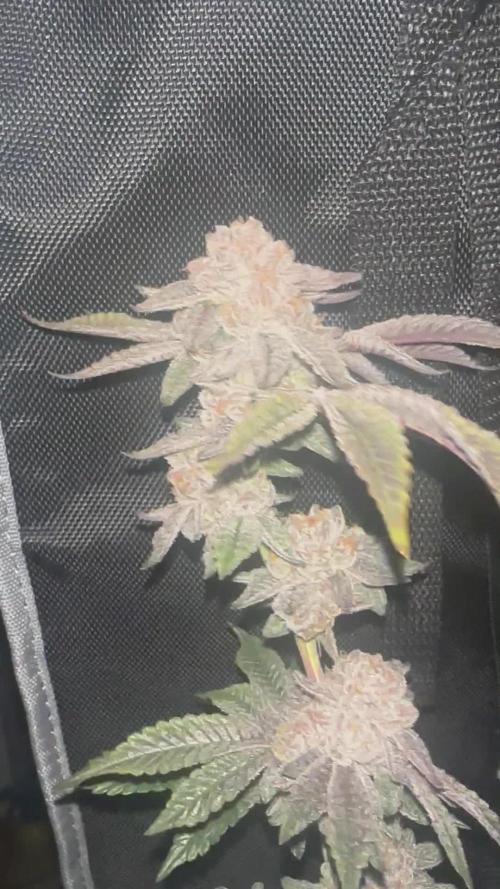
It looks like to going to the final 🙂 Trichomes slow changing a color from pure Crystal to the fogy. Next week I will start with flushing.
Likes
15
Share
----- WEEK 9 ----- ----- Day 57 ----- Easy day of watching. Just 1 pic today so far. not much reason to go downstairs to take a pic yet. Glookies is turning Purple on sugar and fan leaves now. Harvest is very soon. I'd wager within 7 days now just going to depend on the High I get off tester nugs. ***Update*** I destroyed the trellis and took em out for some pics and vids. Trichs = Tropicana is ready Tuesday, Wedding Cake probably Friday or within that weekend. ----- Day 58 ----- Last couple days. Fed about 30ml of Cal/Mag and 30ml of Molasses. Wanted to just keep the photosynthesis process and the plant in general alive for reveg. Was getting a bit too yellow for my liking. Harvest soon. ----- Day 59 ----- Harvested Tropicanna Glookies today Deleted this week by accident trying to make it a harvest week, so remade it. Will add harvest week once plants are dry and tester has been smoked to give proper info Put some more photos in. Basically the tent is 4 feet wide and the ruler is 12 inches long from bottom of duct tape Really loving the colors of this plant. ------ Day 60 ----- Fed only the Wedding Cake - 5-10ml of Calimagic and 20ml of molasses (NO Liter level marked or PPM or PH, i could cut today its done but im just maturing the trichs) Tropicanna Glookies is a friggin BEAUTIFUL strain. Moved the Wedding Cake in the tent so largest nugs are furthest away from light and dropped light from 1000w to 600w to save electricity Chop on Wedding Cake happens at mostly amber trichs. Prob 5-6 days max for that i'll know when I check trichs tonight and update with photo. ----- Day 61 ----- Wedding Cake is about 5% amber... so prob 6 days or so. Slow day today. ----- Day 62 ----- Feeding is today, going to just use some CaliMagic and Molasses again. Trichs aren't golden yet, so not chop time ... 8-9 weeks is what it is supposed to take, but it's got at least another 5-8+ days until 30-40% amber trichs for Indica couch-lock effect to shine in the Wedding Cake. Tropicanna could still be going right now, but I did not want more than 5-10% amber gold trichs to prevent a couch-lock effect. This has worked very well. On day 64 I will post a smoke report and full harvest/trim details as Saturday/Sunday is trimming. Will have dry weight results of Tropicanna (per plant, and as a whole). Tropicanna being sent to lab for full analysis will post results when they arrive (Usually 2-3 weeks after sending sample via mail) ------ Day 63 ------ Nothing to talk about today, slow day. almost done. *Update* 1 pic, i think it explains everything.
Likes
17
Share
Likes
6
Share
Being Mephisto Freebies there’s not a lot of info on how these particular seeds grow. I found them low maintenance, they weren’t the thirstiest girls I’ve grown and I found quite late on they didn’t like high temperatures, caused over half of them to foxtail. That being said the trichome production was there from week 2 of flower and by the time I cut them down they were some of the greasiest plants I’ve grown to date! I left a decent amount of the sugar leaves on while trimming with the hopes it will slow the drying process by a few extra days, between 7-10 days hanging, then into jars with humidity packs to cure. It’s been a fun grow and an exciting introduction into the Mephisto brand, over the last year I’ve managed to purchase a few different strains on there Monday drops so il definitely be running some more in the future. Hope this diary has been helpful ✌️ Il upload the dry weight before I put it all into jars.
Likes
14
Share
I had a late lockout not by watering too often but too much at once trying to get back to back ppm runoff readings and it was 4 days twice of the roots looking for oxygen. I know I can do better with it because I love the strain I’m going to take it to the hydro setup. Those first 4 weeks are super critical to make the last 8 count. Over all it was fun and Dinafem never lets me down with great genetics and customer service! If you’ve grown or are growing it share your data to help make mine better if you have a minute. Thanks for lookin’. Ps final weight will be updated but this is my guess ;)
Likes
10
Share
Bonjours à tous, nous entamons les deux dernières semaines de rinçage pour ces dames. La gorilla sherbet 1 a été récolter.
Likes
3
Share
@Lilze
Follow
It’s finally getting a nice green colour This week I changed the scrog net , it’s about 7” above the top of the pots . upped the nutes to 1.8-2 ec. Sprayed with canna cure Watering every morning to about 10% run off Lollipoped an defoliated ,Waiting to fill the net a bit more but will be switching to 12/12 very soon.
Likes
25
Share
Finaler Grow-Report – Lemon Cherry Gelato Mein erster legaler Grow mit Lemon Cherry Gelato von Barney’s Farm ist fast abgeschlossen – das Curing läuft noch, aber es ist Zeit für ein Fazit zum Anbau! Setup & Bedingungen: Ich habe in einer Spider Farmer 90x90x180 cm Growbox unter der Spider Farmer SF-G3000 (300W LED) angebaut. Als Medium kam BioBizz Light-Mix zum Einsatz, gedüngt wurde mineralisch mit Advanced Nutrients (Grow, Bloom, Micro). Um das volle Potenzial der Pflanzen auszuschöpfen, setzte ich auf Low-Stress-Training (LST) und ein ScrOG-Netz zur optimalen Lichtverteilung. Keimung & Wachstum: Die Keimung verlief problemlos – 4 von 5 Samen sind innerhalb von zwei Tagen aufgegangen. Während der Vegetationsphase entwickelten sich die Pflanzen kräftig und reagierten gut auf das Training. Die ScrOG-Methode half, ein gleichmäßiges Wachstum und eine bessere Lichtnutzung zu erzielen. Blüte & Ernte: Nach etwa 6 Wochen Vegetation leitete ich die Blütephase ein. Die Pflanzen zeigten eine starke Harzproduktion und eine beeindruckende Farbgebung mit einer Mischung aus dunklen Grüntönen, lila Highlights und frostigen Trichomen. Das Aroma war von Anfang an fruchtig und zitronig, mit phänotypischen Unterschieden in der Intensität. Die Ernte fiel mit 300-350 g trockenen Blüten sehr zufriedenstellend aus – für meinen ersten legalen Grow ein starkes Ergebnis. Curing (still in run ): Aktuell lagern die Blüten in 24 Mason Jars (16oz) und einem 2L-CVault, um das Aroma weiter zu entwickeln. Derzeit dominiert eine zitronige Note, während die erhofften Kirsch-Terpene langsam stärker hervortreten. Mein Ziel ist es, die Haze-Noten möglichst gering zu halten und das volle fruchtige Profil herauszuarbeiten – der Prozess ist also noch nicht abgeschlossen. Fazit: Ich bin sehr zufrieden mit dem Grow – die Kombination aus hochwertiger Genetik, gutem Training und präziser Nährstoffversorgung hat sich definitiv ausgezahlt. Die Buds sind harzig, aromatisch und vielversprechend, und ich bin gespannt, wie sich das Curing weiterentwickelt. Der nächste Schritt ist, das perfekte Terpenprofil zu treffen – und das Curing geduldig zu optimieren.
Likes
4
Share
@KhaVigga
Follow
tried rapid 8 times nutrient tea and she act just fine
Likes
Comments
Share
I had to decrease the light intensity as the tent was cooking my ladies. Some leaves are burned but she is growing frosty small buds.
Likes
51
Share
Okay so it's been a while since I've been able to update anything and I think it's working now emphasis on think I don't know if videos are working as I have one on Kabul that keeps saying processing something happen with the update that didn't jive with the device I'm on so I've had a gap into those awaiting my updates I do apologize.. with that being said look at this thing.. this plant made it through the roughest childhood possible just to go through Navy SEAL training and now we're about to see the fruits of her and my labor.. WEEDSEEDSEXPRESS big shout out to you for the opportunity to showcase this strain and your genetics hope all is doing well happy growing everyone ✌️
Likes
6
Share
@Moss420
Follow
Run-off got pretty high on the plants in the main tent when I tested it this week (2300ppm) so I flushed the plants down to around 900 over a few water events with half-strength nutes (~450). I think this, plus (mainly) the plants being too close to the LED caused them to throw some foxtails - particularly the middle plant (although I still think that spindly shit is also partly due to the bag seed pheno). Noob mistake on my end and I didn't realize until it was too late. Now the light is turned down and the run-off is back in a good range. It got high because my auto-watering halos were mostly running off the pots and not sinking in - this is because I filled the pots to the brim with coco (another noob mistake). Looks like I'm hand watering until harvest :) Big Mumma in the blurple tent on the other hand is still killing it.. Apologies for having to upload videos of the microscope - too hard to hold it still and press the button for photos lol.
Likes
44
Share
144v Lux in tenebris lucet. The video on this channel/diary is for inspirational and entertainment purposes only. The ideas shared are not a substitute for professional advice. All materials are used under the principles of fair use, and no copyright infringement is intended. I aim to share timeless wisdom in a respectful manner. Aristotle said "It is the mark of an educated mind to be able to entertain a thought without accepting it." Those who are able to refrain from judgement long enough to genuinely research and weigh the evidence from all sides of a given subject are those most likely to arrive at the truth. Those who instantly resort to knee-jerk ridicule and continue to believe whatever they were first taught are those most easily deceived. Raised UVB light to final position. (No more very high intensity UV-B inhibiting hypocotyl elongation, including the regulation of growth-inhibiting hormone gibberellin GA). We want LOTS of gibbereeeeelin! Very high light intensity can slow vertical growth, which I call releasing the kraken. She just doesn't want to grow vertically for 18 hours any longer; once the flower is initiated, that goes right out the window. Apical dominance is shattered; you now have every single stem fighting for survival against each other, with none given particular precedence. That is some stretch for a week, explosion. Doesn't matter if they are crowded now; there is space up ahead, and plant perception will fill every inch of available space. The divine intelligence that drives plant growth is far more efficient than any canopy I could make or spread myself. No defoliation. Sometimes you just need to give her what she needs to fill the space herself. All I do is guide the initial framework into the desired outcome, keep everything else flowing and in optimal parameters. Fast-growing leaves to have a lighter green color, sometimes appearing almost yellowish-green, because they haven't had time to produce much chlorophyll yet. New leaves are soft and pale, but they will gradually darken and become a deeper green as they mature and are exposed to light. Every morning, new lime green, with the micros supercharged, may be immobilizing nitrogen in the medium, magnesium was creeping in earlier, so I'll try to hold the line and see what progresses. The ratio of sugar leaves to buds is determined by a combination of hormonal signaling, nutrient availability, and genetics. Sugar levels act as a key signaling molecule, with high sugar availability influencing hormones like auxins and cytokinins to promote bud outgrowth, while nutrient deficiencies can limit development. Specific genes also play a critical role in leaf and bud initiation, expansion, and the overall balance of growth. Buds are like balloons! Need lots of pressure to blow up lots of balloons! Sugar balloons! Plant transpiration and turgor pressure are crucial for bud development because turgor pressure provides the cell expansion needed for growth, while transpiration creates a "pull" that draws water and nutrients up through the plant to fuel this process. High turgor pressure is essential for cells to grow and expand, allowing buds to open and young leaves to unfurl. Transpiration maintains this necessary turgor by driving a continuous flow of water from the soil up to the leaves, where it evaporates. No holding back, this is it, 4-5 weeks of all-out war! What we develop now will be all we have for the final 4-5 weeks. The carbon to nitrogen (C:N) ratio indicates how much carbon is in a substance relative to its nitrogen, affecting nitrogen availability in soil through microbial activity. A high C:N ratio (like in straw or corn residue) requires soil microbes to use a significant amount of nitrogen for decomposition, temporarily tying it up and making it unavailable to plants. A low C:N ratio results in a more rapid release of nitrogen for plant use. The carbon-to-sulfur C:S ratio in plant residue determines whether soil microbes will immobilize or mineralize sulfur (S) during decomposition. This affects the availability of sulfate SO42, the primary form of S that plants can absorb. Mineralization is the process by which microbes decompose organic matter and release excess nutrients, like sulfate, into the soil in an inorganic, plant-available form. Immobilization is the reverse process, where microbes absorb inorganic sulfate from the soil to meet their own nutritional needs, making it unavailable to plants. Glucose typically uses more oxygen than sucrose in a medium because it can be metabolized more directly, while sucrose must first be broken down into glucose and fructose, which can involve additional energy costs and a slower overall process. However, the efficiency of oxygen use can vary depending on the specific organism and conditions, as some bacteria, for instance, can use sucrose for a growth advantage under certain circumstances by producing exopolysaccharides that are more efficient at oxygen extrusion. Why glucose is generally more oxygen-efficient: •Glucose is a monosaccharide and can be used directly by many organisms in cellular respiration. •It does not require an initial enzymatic step to break it down before entering the metabolic pathway, unlike sucrose. •Due to its direct use, glucose can lead to a faster rate of oxygen consumption and carbon dioxide production in comparison to sucrose under typical aerobic conditions. Why sucrose might seem to use more oxygen in certain contexts: •When sucrose is metabolized, it is first broken down into glucose and fructose. This initial hydrolysis is an extra step that requires enzymes. •The fructose component is metabolized differently from glucose, and its specific metabolic pathway can affect the overall oxygen demand. •Some organisms may have regulatory mechanisms that lead to a higher initial oxygen demand when switching from glucose to sucrose, especially if the organisms have specific metabolic pathways that are optimized for sucrose. •While glucose may be used faster, sucrose might provide a growth advantage under certain oxygen-limited conditions due to the specific metabolic pathways and products it can generate. Seems my initial concept of sucrose was inaccurate. Really need to study up on all of this in the coming months. Take care. “A cat has 9 lives” “On cloud 9” “Dressed to the nines” To go “the whole nine yards” “A stitch in time saves nine” “Nine-ness” seems to be synonymous with the maximum, with the furthest extent of what’s possible. With fullness, completion, and when every effort has been exhausted. In the ancient world (which is, let’s face it, is where numbers and their spiritual power were understood SO much more than they are today) the number 9 resonated with sacred structure and the furthest limitations of this world before human experience meets the Divine. Perhaps more than any other, the number nine had an extra special significance, which spread far and wide. It features across pretty much all cultures, worldwide, rippling through culture, mythology, history, law and time. Nine is the central number in the ancient Celtic tradition. Nine expresses through the triple Goddess (see Number 3) and in myths of the nine Celtic maidens or sorceresses. In fact, stories of nine mystical women presiding over nature spread from England, Ireland and Wales to Scandinavia, Iceland, and even as far as Kenya. Even today, it’s tradition for nine groups of nine men to dance around Beltane fires. The limit of winter (which is what Beltane Almost all of the mythological tales from around the world have patterns of the number 9 weaving throughout. The Northern European sagas tell of Odin, who rules over the nine Norse worlds. His trial to win the secrets of wisdom for mankind was to hang on the Yggdrasil tree for nine days. Demeter, the Greek Goddess of the Earth searched for nine days for her daughter Persephone (who was in the underworld with Hades). Demeter is often depicted holding nine pieces of corn. Once recovered, Persephone was obliged to spend three months per year below the ground, and nine months above. Native American, Mayan and Aztec myths tell of a total of nine cosmic levels (and many of the temples comprise 9 stories). And in ancient China, nine was the most auspicious number of divine power: the Chinese had nine sacred rites, nine social laws, nine classes of officials in the government and built nine-story pagodas. In astrology, the planet Mars vibrates to the frequency of the nine. The ninth sign of the Zodiac is Sagittarius (where the Sun sails from November 22nd – December 21st) InTarot, card number nine is the Hermit. In Hinduism, nine is the number of Brahma. In the Greek Sagas, the city of Troy was under siege for nine years. 9
Likes
Comments
Share
F07 - Good start after 1 week of 12-12 lighting. They're growing so fast! I think i left just enough room for my lights to keep them from burning/stressing the buds but I think I'm going to max out on my vertical room. Fl13 - I think the stretch is finally over and I was right - I pretty much maxed out my vertical room with only have a few inches to spare above my lights. Gave the girls their first low-dose feeding today.
Likes
Comments
Share
Day 30; Both plants showed signs of going into bud stage so I top dressed & feeding. 1st, 24hrs before I prepared worm tea. I put 3tbsp Molasses, 5ml/gal Cal/Mag, 10ml/gal Seaweed/Fish extract, .5ml/gal Orca, 2-packs Green Tea, 1-1/2cups worm castings. aerated 24hrs. 2nd, Prepare coir for top dressing, remove all LST ties & stakes, Scoop out cedar chips from surface. Add 1/4cup Dr. Earth Organic 4-6-3, 1/4cup Bone Meal, 1/8cup Bat Guano, 1/2cup Coffee Chaff, 1/2cup Worm Castings to surface. Hand mix in dressing into top 2" of coco coir. Re-apply Cedar chips, do LST. 3rd, Top Feed 3/4gal per plant, Bottom Feed 3/4gal per plant. By day33 plants had doubled in size so I re-LST & light leaf removal, sprayed Neems Oil on both ladies, the stretch was on... Day35, watered 1-1/2gal ea. 5mil/gal Cal/Mag, 5ml/gal seaweed/fish extract. Lil LST and light leaf removal.
Likes
Comments
Share
Flowering Week 6 – Fading Leaves, Persistent Flies The sixth week of flowering brought a mix of progress and persistent problems. The whitefly issue unfortunately hasn’t gone away. I replaced both yellow sticky traps at the end of the week, and within minutes, two new whiteflies were already spotted on the fresh left trap. The old one had four additional flies on the back. This pest pressure remains a concern, but I’ve decided to hold off on further neem oil sprays for now, given how far along we are in flowering. I’ll keep monitoring closely. Nutrient-wise, I stayed cautious this week due to ongoing signs of overfeeding. Leaf tips are still showing yellowing and some burn, especially on the lower leaves. Many leaves have pronounced yellow spots and curled tips — a clear sign of excess nutrients earlier on. To reduce stress, I watered with plain pH-adjusted water (5.5–6.0). Total watering volume was approximately 29 liters This week I also did a second round of lollipopping, focusing on removing all small popcorn buds and lower growth under the net that wouldn’t develop well. Despite the nutrient stress and the ongoing whitefly presence, the plants are still developing well. Buds are getting chunkier, trichome production is visibly increasing, and the overall structure is solid. Still, I’ll be keeping a close eye on both leaf health and pest activity in the coming days. ⸻ TL;DR – Week 6: • New whiteflies still showing up – 7 total seen this week. Both sticky traps replaced. • Additional lollipopping done: removed popcorn buds and shaded growth under SCROG. • Leaf symptoms (tip burn, spotting) persist – watered with plain pH water, once with half HESI dose. • Watered 3x this week: 9.5 L (pH only) • Light stayed at intensity level 7
Likes
5
Share
December 21st: 2.5ml Armour Si, 1ml CalMag, 5ml FloraMicro, 1ml FloraGro, 3ml FloraBloom, 1ml Floralicious Plus, 1ml Rapid Start, both plants got .75gal pH to 6.8, 650ppm December 26th: 2.5ml Armour Si, 1ml CalMag, 6ml FloraMicro, 1ml FloraGro, 3ml FloraBloom, 1ml Floalicious Plus, 1ml Rapid Start, 1/2tsp Recharge. Both plants got just under 1gal each, pH to 6.6, 850ppm, watered until runoff, RUNOFF: 2300ppm, 6,0pH. I did a defoliation today as well. Also, i will be flipping these girls into flower on Monday December 30th. That is the actual day my 7th week starts I'm starting to mess around with video editing as well so hopefully in the future i can give you guys some cool videos.