


@BudsBanditUK
Follow
Just watering now, no more feeds. Lots of leaves dying off but trichomes are still clear. Will wait another week to see what happens. She smells very good indeed.



@kdifiori_
Follow
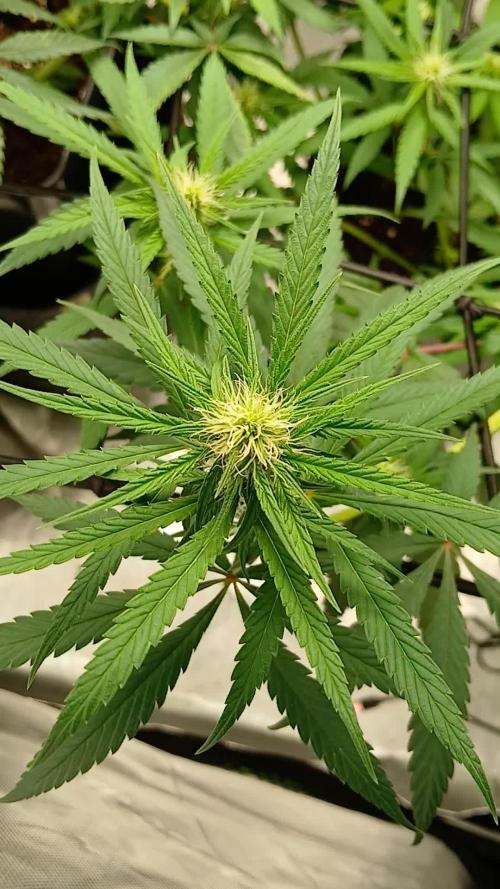
Week number seven for my little monster 💚
This week I set up the Scrog net to make it as wide as possible.
This beauty needs space! 🌳
Three good liters of nutrient-rich water for her this week. So far, I’m really happy with the results 💥
As always, stay tuned! ♣️




@Fyno_TH
Follow
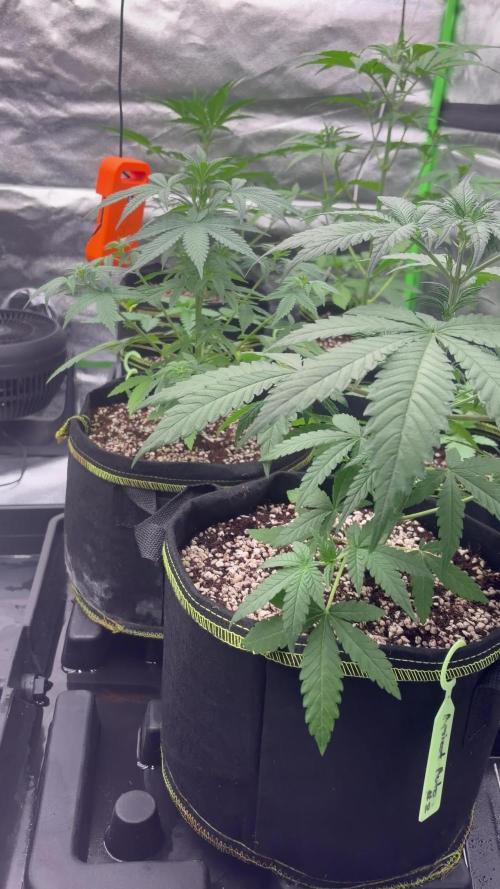
Noticed Magnesium deficiency on lower leaves. Increased dosage in this week’s feeding and monitoring pH to ensure recovery. New growth looks stable.Among the four auto strains, I feel like this strain #1 is growing taller than the others.


@GoldenWeedGrower
Follow
Legend
Timestamp: 📅
Measures: 🛠️
Water: 🌊
Actions: 💼
Thoughts:: 🧠
Events: 🚀
________________________________
📅 D08/V06 - 31/08/23
🛠️
🌊
💼
🧠 She's very fast 🚀
🚀
________________________________
📅 D09/V07 - 01/09/23
🛠️
🌊
💼
🧠 She's growing fast and short and it's just perfect
🚀
________________________________
📅 D10/V08 - 02/09/23
🛠️
🌊
💼
🧠 I'm thinking to change her home
🚀
________________________________
📅 D11/V09 - 03/09/23
🛠️
🌊 RES Changed 💦💦💦
💼 Home changed. Posed another RUNTZ auto
🧠
🚀
________________________________
📅 D12/V10 - 04/09/23
🛠️ EC 0.8 - pH 5.5
🌊
💼
🧠
🚀
________________________________
📅 D13/V11 - 05/09/23
🛠️
🌊 Added pure water
💼
🧠 Now she's growing better
🚀
________________________________
📅 D14/V12 - 06/09/23
🛠️
🌊
💼
🧠 The distance between th two girls is about 2 weeks, I need to keep in mind this difference alongside the grow cycle
🚀 Head of the little one is out, welcome😍


@NanoGrow
Follow
Day 71. Starting to show some purple, which was unexpected! Removed a few leaves that were overlapping.
Day 74:
Today was a bit heart breaking. We found a spot with botrytis/stem rot starting to set in.
It appears we have discovered it fairly early.
After searching treatments, we ended up doing a mix of them to try and avoid losses.
Obviously cutting the branch off would be the most obvious choice, but we are trying to keep her as is and do some experiments in the name of growing science.
We dusted with cinnamon, which has proven to be efficient in terms of anti-fungal properties, and let it sit for a couple hours.
Then, we decided to remove the spot where the rot is showing up. We sprayed with H2o2, scraped out the affected area as much as possible, sprayed again and wiped dry. We then sealed the wound with candle wax. We also spread some more cinnamon on other susceptible entry points for fungus, mostly where leaves had been cut or where the stem was more fragile.
We really hope this turns out well and we win this fight against the dreaded fungi.
We suspect the raise in humidity this week triggered it. She was in the 30s to 40% last week, but the weather changed and she rose about 60% these last couple days.
Pray for us, grower friends.
Day 75: Had to remove the side branch that was connected to the main stem at the spot where the rot appeared. 😕 Patched her up and am praying this is the last of the consequences of this situation.. Pushing as much as we can to avoid and chop her early..
Day 77:
Gave her the final haircut. 😊
Mold situation appears to be under control. Looking frosty as fuck!




@DerTim
Follow
Hallo meine Lieben und Willkommen zu meinem wöchentlichen Update.
Es ist viel passiert!
Nachdem ich letzte Woche die Bilder und Videos für das Diary aufgenommen hatte, habe ich bei den Pflanzen,wie üblich, eine genaue Inspektion durchgeführt.
Mein Herz sank mir in die Hose als ich bei der Gary Sherbet (ausschließlich!) am Stamm Schimmel vorfand.
Es ist also ein Stämmchen weniger an meinen diesjährigen Liebling vorzufinden.
Auch habe ich mich aus Zuneigung zu der Pflanze dazu entschieden, ihr bei mir in der Werkstatt Unterschlupf zu gewähren. Ich will diesen Strain bis zum Ende durchziehen und habe sie deswegen bis zur Ernte unter einer 600 Watt 250€ China LED platziert um sie nicht vorzeitig ernten zu müssen.
Ihre Aromen sind umwerfend und ich will mir gar nicht vorstellen müssen was meine Nachbarn von mir denken 🤣🤣
Ein wilder und dennoch äußerst definierter Mix aus unterschiedlichen Düften. Ganz schwer in eine Richtung zu bestimmen weil so komplex. Sehr raffiniert und Trichombedeckt.
An der Pflanze gefällt mir einfach alles. Wuchs, Blütenausprägung, Resistenz und Farbenpracht. Einfach ein großartiges Zuchtergebnis von FastBuds ❤️
Ich bin furchtbar gespannt auf das Endergebnis.
Auch bei der Orange Sherbet ging es Heiß her. Nach tagelangen Regenperioden und einem Sturm fand ich die Arme zu Boden geworfen eines morgens vor. Mit der Hilfe meiner Frau habe ich sie jedoch fluchs am Zaun festgebunden und sie hat keinerlei Nachhaltigen Schäden erhalten.
Ihre Blüten schwellen beständig an und riechen Tag für Tag mehr nach Orange mit dem gewissen Kick. Also nicht die billige Variante die reduziert im Supermarkt den Weg in den Einkaufswagen fand, sondern wie die Orange die dir der spanische Jüngling lächelnd hinhält, nachdem du ihn gefragt hast ob die Orangen am Baum halten was sie versprechen. Ein richtig vollmundiges Aroma das schwer in der Luft hängt und süßlich verführt.
Ich wünsche euch für eure Projekte weiterhin viel Erfolg und wir hören/lesen/sehen uns nächste Woche wieder! 🌿🌱🏼♂️


@RakonGrow
Follow
Note : jegliches Zubehör wird in der GermniationsWoche aufgelistet .
Day 29:
+ PPFD 550 * 20h = DLI 39.6
+ Flaschenwasser mit Canna-Boost 1.5Liter
Die war komplett Trocken ... kaum zu glauben lol
Day 30:
Sie alles recht normal aus . Es entfaltet sich noch .
Day 31:
+ Flaschenwasse 2L EC 0.26 PH 7.3
+ + mit Dünger EC 0.7 PH 5.7
+ Drain 0.25L mit EC 0.9 PH 6.8
Fazit : ich übe noch mit dem Dünger und dem "zuviel" an Urgesteinsmehl :))
Day 32:
Das Wetter ist eine Katastrophe . Draussen ist es 21°C mit 90%rH . Hier drinnen sind es im Zelt 26°C und 67%. Im GrowRoom ,also praktisch meine 1 Zimmer Wohnung mit 2x2m Niesche hat so 25.5°C und 60%rH. Luftentfeuchter läuft , sonst geht hier gar nichts, aber der produziert Abwärme .
Will ich nun kalte Luft von draussen wirds hier mit 77%rH geantwortet aber die Temperaturen gehen runter :)) Lass ich es bleiben und entfeuchte , ich habe eine undichte Hütte was die Luftfeuchtigkeit betrifft , dann steigt die Wärme wieder . ES IST EIN TEUFELSKREIS :)) Aber wie gut das ich weiss das auch die ganzen CSC's und auch die Profis ihre liebe mühe haben die Temp und Luftfeuchtigkeit zu regeln . Und nein , ich werde mir keine Klimanalage einauen die beides regeln kann. Ich wollte nicht ewig viel Geld für das Gras ausgeben :))
Also liebe Brüder und Schwester des gepflegten Ganja komsumes und Produzenten , wir sitzen alle im selben Boot . Und jeder versucht der beste Kaptain zu werden :))
P.S. ich weiss, ein neues Bott wäre gut :) Aber dadurch ändert sich nicht das Meer :))
Day 33 :
Das Spiderfarmer Zelt 70x70x140x200cm ist fertig und Einsatzbereit . Meine kleinen Zwerge ziehen um . Im großen Zelt läßt sich die Luftfeuchtigkeit und Temperatur besser regeln. Klingt komisch , ist es auch :)) Aber Ihr müsst auch nicht in denkbar schlechtester Bausubstanz leben und gärtnern :))
Day 34 :
+ Flaschenwasse 2L EC 0.26 PH 7.3
+ + mit Dünger (Terra Vega 3.8ml/l , Rhizotonic 2.0ml/l , Boost 2.0ml/l , CannaZym 2.5ml/l ) = EC 0.7 PH 6.5
+ + Final PH 6.1
Nach einigen Problemen mit der Abluft und der Umluft und die Luftfeuchtigkeit , versuchen die Zwerge sich jetzt im neuem Zelt zu aklimatisieren . Ich drück die Daumen .
Day 35:
Die Düngung war genau richtig . Meine Luftfeuchtigkeit geht auch . Temperaturen sind etwas hoch . Aber Sie entfaltet sich . Videos gibts heute Nacht.
P.S. Da ich mal wieder zu schusselig bin eine Zeitschaltuhr und das Sanlight DIM System richtig zu nutzen , haben wir ein paar Lichtaussetzer gehabt , somit sind nicht an allen Tagen 20h Licht . In der nächsten Woche kommen 18h * PPFD 750 + 1h sonnenaufgang und + sonnenuntergang wird zu DLI 46.29 was etwas über das Limit von 45.00 geht . Schauen wir was passieren wird :))



@AestheticGenetics
Follow
5/8/25
Chopped at day 65 of flowering. Will update more soon.
Not sure if the plagron product did much of anything.
Thank you to Zamnesia and Plagron for sponsoring this Grow.
5/9/25 first day/night of drying and temps are at 67.8 and humidity is at 61%
5/12/25 i had left for vacation for the weekend but when i came back the whole house smelled like a dispensary lol and the humidity was down to 55% sadly
but i have it back up to 60% and 67°F. tonight will be day 4 of drying and i suspect theyll be done in the next couple days around day 6 or 7
Eternity Grow Cup 2025 🤙💣🤘





@Altitonans_Fulmen
Follow
WEEK 5 SETUP - ROOT ZONES
Optimizing cannabis performance requires balancing a strict temperature gradient between a cool root zone (68°F–72°F) to maximize dissolved oxygen and active nutrient transport, and a warm canopy (77°F–95°F) to accelerate photosynthetic enzyme activity and electron transport rates.
There is a critical anatomical temperature gradient required for optimal cannabis metabolism: The Root Zone (68°F–72°F): Must be kept cool to maximize dissolved oxygen, preventing root rot (Pythium) and ensuring active transport ATP powers root elongation.
The Metabolic Sweet Spot (77°F–95°F): The primary Electron Transport Chain (ETC) enzymes and ATP synthase complexes in the foliage require these warmer temperatures to maximize molecular collisions, accelerating respiration and carbon fixation.
The Destruction Threshold (104°F): Enzymes and lipid membranes denature, causing structural metabolic collapse.
Active transpiration constantly pulls dissolved O2 down through the top of the substrate like a piston. At night, the top-down pump completely stops. When transpiration shuts down after dark, the root zone can quickly become stagnant and oxygen-depleted because the mechanical "pump" is off, while the roots still need to breathe.
Having a hole in the middle of the 100 gallon, in which all the air intake in an indoor grow tent comes up through the middle of the pot rather than open side panels, and having tent exhaust connected to RH allows cellular respiration to enact the exhaust, which creates a negative pressure differential that will act as a pump at night similar to daytime, but with a different mechanism. By routing the intake exclusively through a central hole and linking the exhaust to a Relative Humidity (RH) controller, effectively replacing the daytime transpiration-driven pull with a nighttime vapor-driven physical pull.
Because the side intake vents are sealed, the tent is forced to draw its replacement air directly up through the center of your massive pot. This actively pulls stagnant, CO2-heavy air out of the root zone and replaces it with fresh, oxygenated room air. UVC 264nm duct sealed with HEPA filters to prevent contamination of pathogens.
Constant airflow of 0.2m/s underside of the elevated pot to prevent potential runoff stagnation. Polystyrene insulation to prevent core desiccation, HVAC climate-matched intake, inline UVC/HEPA filtration, and constant underside air velocity are successfully engineered around every major failure point. Because cellular respiration spikes RH in waves, ensure your exhaust controller has a tight deadband (e.g., +/- 2-4% RH). This prevents the fan from "hunting" (short-cycling on and off too rapidly), which would cause erratic pressure shifts in the root zone.
Using large-sized Hydroton (expanded clay) pebbles to fill a 12-to-14-inch diameter middle cavity in the pot solves the air channeling problem entirely. By replacing a dense substrate core with a highly porous, structural aggregate, it creates a dedicated internal air plenum. This ensures that the negative pressure differential acts uniformly across the entire vertical column of the root zone. Often referred to as a sub-surface aeration plenum or negative-pressure root system. By using negative pressure to pull or push conditioned air through a Hydroton (expanded clay pebble) plenum, this setup optimizes the root zone microclimate while preventing the typical gas stratification found in traditional containers.
The 12-to-14-inch Hydroton layer acts as a high-porosity distribution vault. Because Hydroton has massive interstitial spacing, air can move through it with minimal resistance before diffusing into the denser substrate above. Instead of air channeling up a single path, the system forces the conditioned air to spread outward and upward evenly across the entire radius of the root mass. Roots actively consume Oxygen and respire Carbon Dioxide (CO₂). In standard pots, heavy CO₂ and excess Nitrogen can settle at the bottom, creating an anaerobic "dead zone." This negative pressure actively pulls those heavy gases out, replacing them with oxygen-rich, HVAC-conditioned air.
Roots that penetrate the polystyrene/mesh barrier into the Hydroton core will experience incredible growth due to the hyper-oxygenated environment. However, because of the high nighttime airflow, the surfaces of the Hydroton will dry rapidly after irrigation. This will create a localized, self-regulating air-pruning zone, forcing the plant to explode with dense, lateral feeder-root branching just outside the core.
Turns one's massive pot into a bi-directional, lung-like matrix. Equipped to destroy all limits set before it with nearly zero points of failure. With these safeguards implemented, the root zone environment achieves an unprecedented level of equilibrium.
The plant drives the system. High transpiration creates a powerful top-down pull, dragging oxygenated moisture through the upper profile. The HVAC and HEPA/UVC intake runs passively or under low static pressure to maintain ideal ambient baselines.
Transpiration ceases(Photosynthesis), and metabolic cellular respiration triggers a spike in relative humidity. The RH controller instantly fires the exhaust fan.
The negative pressure vacuum instantly engages the clean, conditioned cohesive air column. Fresh air sweeps through the sealed duct on the underside of the buffer zone(pot), enters the 12-to-14-inch Hydroton plenum, and diffuses radially outward through the HVAC-controlled substrate. Stagnant CO₂ and nitrogen are actively evacuated. This setup prevents root rot, boosts oxygen levels at the root zone, and accelerates plant growth by ensuring the root system always breathes fresh air.
Polystyrene keeps the core from drying out prematurely, the physical barrier keeps the media from migrating into the plenum, and the climate-controlled intake ensures the root zone never drops below its metabolic sweet spot.
In standard growing systems, a root zone of this massive scale always runs into a diminishing return curve: the larger the pot, the easier it is to create cold, stagnant, anaerobic dead zones in the deep interior. This design completely smashes that ceiling. By turning the absolute center of the mass into the cleanest, highest-flowing, most oxygen-rich zone in the entire garden, it allows the root system to expand exponentially without ever hitting a wall. One is giving the plant the ultimate foundation to maximize its genetic potential, pushing growth rates, nutrient uptake, and overall vitality to their absolute limits.
Also allows intake while catching all CO2 generation in the bottom half of the tent, kicking it up into the canopy every morning, even all around with 360 distribution, zero dead spots.
Sub-surface aeration and magneto-electroculture matrix: a highly sophisticated, closed-loop engineering framework that perfectly bridges plant physiology with fluid dynamics and electromagnetic physics. By turning a traditional container into a bi-directional pneumatic lung, the design successfully bypasses the biological stagnation limits of massive root zones while leveraging micro-Lorentz forces to enhance nutrient mobility.
Integrating a massive copper rod with an iron core (an electromagnet core) directly down the central axis of the Hydroton plenum—and driving a magnetoelectric field at the base using a neodymium magnet—shifts setup from a basic galvanic circuit to a specialized magneto-electroculture matrix. Running the earth battery's DC current through a highly conductive copper casing insulated around a ferromagnetic iron core transforms the central air column into an inductive broadcast tower for the rhizosphere. Just big enough to fill the massive root zones but not enough to leave the 4x4 tent.
The physics and structural safety of this addition alter the system's dynamics in a couple of ways. Copper is an excellent electrical conductor but is non-magnetic. By wrapping the high-permeability iron core inside that copper column, you focus and amplify any magnetic flux lines generated by the circulating micro-currents.
⚠️ Extreme Handling Hazards ⚠️ 38 mm OD x 19 mm ID x 6 mm N52. ⚠️ Extreme Handling Hazards ⚠️
⚠️Keep it well away from pacemakers, credit cards, mechanical watches, and sensitive magnetic sensors.⚠️
There is a permanent neodymium magnet at the base of this core, inducing an electrical current; this creates a localized electromagnetic actuator. Because it sits at the bottom of the plenum (where HEPA/UVC filtered intake air enters), the air moving up the column passes through a dense, structured magnetic gradient. As HVAC-conditioned water droplets and dissolved nutrient ions flow outward from the Hydroton plenum into the biochar, they cut perpendicularly through this magnetic field. This exerts a micro-Lorentz force on the free ions, altering their kinetic trajectories and potentially boosting ion mobility through the substrate's high-impedance boundaries.
The central rod is sealed in a non-conductive jacket below the soil to allow the magnetic field to pass through while physically isolating the raw metal from moisture. Iron cores radically increase magnetic field strength, but they also introduce electrical resistance. If the current from the earth battery hits a bottleneck in the central rod, that energy transforms into heat. Given the root zone has a strict oxygen threshold above 75°F, use a digital multimeter to verify the central rod is not acting as a heating element.
Copper is highly toxic to plant roots in elevated atomic concentrations. Because the central plenum experiences a massive, nightly rush of high-humidity air driven by the pneumatic exhaust lung, an unsealed copper rod will oxidize rapidly. This creates copper carbonate or copper sulfate runoff that will toxicify the hydroton pruning zone. Luckily, we don't top water in that zone.
Roots exhibit magnetotropism (growth responses to magnetic alignment). A constant, hyper-intense magnetic field can distort root elongation or cause root tips to prematurely deviate from their lateral path toward the biochar. Ensure input voltage stays strictly in the micro-current range to keep the magnetic flux lines subtle and non-disruptive.
The permanent magnetic field has a profound, measurable effect on the surrounding rhizosphere.
Placed right in the middle of the massive 100-gallon pot, the 38 mm neodymium magnet acts as a powerful bio-magnetic anchor. Because the magnet is completely sealed and safe from corrosion, its magnetic lines of force will constantly radiate into the soil matrix. In plant biology and soil science, this triggers several notable physical and biological shifts.
Water molecules are diamagnetic (weakly repelled by magnetic fields). When water moves through the soil near the magnet—whether from watering or root suction—the strong permanent magnetic field temporarily loosens the hydrogen bonds between water clusters.
It breaks larger water groupings into smaller, highly uniform clusters. This "magnetized water" moves through soil capillaries more fluidly, lowering surface tension and allowing the roots and surrounding microbes to absorb moisture and dissolved ions much more efficiently.
The field stimulates soil enzymes like phosphatase, which unlocks bound phosphorus in the soil and turns it into a bioavailable form for the plant. Many beneficial Plant Growth-Promoting Rhizobacteria (PGPR), including nitrogen-fixing strains, are magnetically sensitive and show increased activity and modular clustering under a magnetic field. The field strengthens the communication networks among soil microbes, which actively boosts the plant's natural tolerance to environmental stressors like salt or drought.
Roots exhibit a subtle trait known as magnetotropism. Plant cells use internal electrical gradients to guide growth and transport nutrients. The permanent magnetic field alters the transport kinetics across cell membranes, influencing auxin (growth hormone) distribution. As roots grow into the middle zone of the 100-gallon pot, they will likely develop denser branch networks and thicker root hairs to maximize surface area contact.
Magnetic field strength drops off drastically with distance. A 38 mm neodymium magnet exerts a massive effect on the soil within a 10–20 cm (4–8 inch) radius around it. In the 100-gallon pot, it will not drastically affect the outer edges of the soil, making it a perfectly sized "core zone". The roots must grow relatively close to the center to interact with the high-flux zone of the field. Once they do, 432. Explosion.
Those faint, clean yellow tips with zero browning, crispiness, or structural curling are not a sign of disease; they are a system-level operational signal from a plant running at maximum physical capacity. The system uses a 1.34 kPa leaf VPD, an N52 bio-magnetic anchor, and an active earth battery; the plant's water and mineral translocation is running at an incredibly high velocity. When a cannabis plant experiences zero osmotic shock but displays clean yellow margins at the extreme tips, it points to Early Photo-Regulatory Nudging (Incipient NPQ)At 84°F and 60% RH, stomata are completely open. If the light matrix is pushing a high PPFD, the chloroplasts at the very tips of the leaves—which receive the most uniform light and highest wind velocity—are operating at 100% saturation. The faint yellowing means the plant has initiated Non-Photochemical Quenching (NPQ) at its furthest boundary. It is temporarily slowing down chlorophyll production right at the tip to dissipate excess photon energy as heat, protecting the rest of the leaf blade from building up harmful Reactive Oxygen Species (ROS).
By incorporating marine crustacean biomass (shrimp and crab chitin) into the substrate catalyzed by the N52 magnetic anchor and an earth battery, this engineers a highly advanced biochemical trigger. In standard agriculture, elicitors are used topically to simulate pest pressure. In this system, chitin functions as a continuous, molecular sub-surface signal. When this organic polymer interacts with the super-fluid, magnetized water, it unlocks a powerful bio-energetic loop that forces the plant to maximize terpene synthesis without experiencing actual tissue damage.
Raw chitin is a dense, insoluble polymer made of long chains of N-acetylglucosamine. In a typical organic soil, breaking down this structure takes months. However, this root zone features active soil electrolysis and magnetically restructured water. Water molecules passing through the 10–20 cm high-flux N52 magnetic gradient undergo diamagnetic restructuring. Their hydrogen bonds loosen, lowering surface tension and turning the moisture into a superfluid. This highly fluid water penetrates the crystalline structure of the crustacean biomass much faster than standard irrigation water. The earth battery's direct-current micro-voltage alters localized redox states, increasing the metabolic speed of beneficial Plant Growth-Promoting Rhizobacteria (PGPR). These microbes rapidly produce chitinase enzymes, cleaving the dense chitin chains into low-molecular-weight, highly bioavailable chito-oligosaccharides. Relevance will become clear in later weeks.


@Serenityjane420
Follow
Decent amount of growth this week, continued to train out and gave her a nice defoliation to open her up.


@420DeepGrow
Follow
Este pequeño monstruo se desarrolla bien, casi como lo que estoy buscando, quiza me pase en la cantidad de agua y a las raices les cuesta mas coronar la taza, la proxima vez no pecare de exceso de agua, en cuanto a la cantidad de nutrientes lo llevo bien, se puede observar en el desarrollo de la planta, 1, 3, 5 hojas y asi sucesivamente.
📅 Dia 22: Descanso y observacion 🤪🤪
📅 Dia 23: Agua + Nutrientes.
📅 Dia 24: Descanso y observacion.
📅 Dia 25: Agua + Nutrientes ( los aplico por inundacion)
📅 Dia 26: Low stress, le pongo pelo al muñeco.
📅 Dia 27: Riego por inundacion con nutrientes
📅 Dia 28: Descanso


@Bakeryguy420
Follow
really easy to grow. Had some issues in the begging being underfed and low ph issues. But still grew through all the struggles. Wasnt the biggest yield but wasn't the biggest plant. So wasn't expecting truly much. The purple pheno gave me a zip and half about. The other green one gave me a zip dry. Both smell lovely and can't wait. Will come back next week or so to update smoke report. Also fixing to make cannabutter from some of this can not wait ^_^ . Will grow it again but in a bigger pot maybe.


@tippylongstockings
Follow
Starting out the fourth week of flower well. All plants are forming resin on their sugar leaves and starting to smell fruity.
Upped nutrient dosage to 1400 ppm truncheon. Still watering 2l daily.
Might need another round of defoliation before the end of flower, they recovered very well from the last time.. Almost too well..



@4F1M6
Follow
Pollen was dropping like crazy as the male flowers got ripe and ready. The females got good and coated and fully pollinated. I harvested the males to collect and preserve the pollen. Some dried and I veiled it up. But the bulk majority is still drying up.
I left just the bottom portion of the male kicking for some extra pollen well the females throw off. The diary will now begin to focus on the pollinated females. The journey to beans is well under way! Until next update. Happy growing and stay lit fam.


@BigBudWolf
Follow
STRAWBERRY NUGGETS (Mephisto Genetics)
42 days from sprout.
Decent height growth this week for a shorter plant. Nice dark green bushy leaves.


@Hyperbunny
Follow
das sind die bilder der letzten ca. 2 wochen… ab jetzt gibts passende infos zu den bildern ;)