


Likes
Comments
Share


@PapaBaer
Follow
Super gewachsen tolle Woche bei der einen Dame habe ich das FIM verfahren angewendet. mal schauen. Die andere bekommt noch ein anderes HST lasst euch überraschen. ;-)


Likes
9
Share


@Herbie
Follow
A good week.
Then again any week that doesn't have problems is a good week.
Which is what I have just had.
I have trimmed some lower dying leaves that were no longer getting any light..
I have super cropped 2 stems just to help shape her in the small environment.
I have tucked away (rather than remove) any leaves that are blocking bud sites.
I have noticed she is a very thirsty girl perhaps just noticeable next to her white widow sister.
She's stiffened up like a tree, she probably won't change much now except for stretching upwards so this will be her final shape really for the next few weeks, while she buds up nice and fat.
Crystals are showing around the bud sites
A fair few week off yet unfortunately


Likes
35
Share


@Jaked
Follow
This week we started 12/12 cycle.
I decided to do this because of the limited height of the box. Now I am focusing on the fact that it will stretch out in 2X. If she becomes taller, it will be a problem for me and her.
Fertilizers:
Throughout the vegetation cycle, I added silica to each watering. Now I will alternate 1 watering with silica and another without. I also increased the dosage of plagron "B" to increase the concentration of phosphorus and magnesium. There is a lot of calcium in my water, so there shouldn't be a deficiency.
Thank you for attention🙏
Peace🙌

Processing
Likes
2
Share


@Pardy
Follow
The flowering went down under great conditions. Everything went pretty alright with this grow and I'm satisfied with the result. It was my second time growing this strain first outdoor however. The colas looked amazing. The plant didn't get too tall and stayed bushy. Good thing however as I was trying to keep it discreet. The smell wasn't an issue either.

Processing
Likes
23
Share


@eldruida_lamota
Follow
Que Pasa familia,Tenemos cambios , 12/12 empieza lo bueno(floración), empieza a oler el cuarto a un aroma especial 😉, os voy a dejar muchos vídeos para que no tengáis ninguna queja.
•primer problema y único , es la temperatura. (Max30 min28 con Luz).
Llevaba varios días comiéndome la cabeza , de mientras tengo medio abierto las compuertas del indoor.
Todo lo demás funciona, se las ve Sanas, veremos las próximas semanas.
Likes
15
Share


@tomeugironella
Follow
Repoted them into 5 gallon smart pots and toped them . Im gona lst them now for 10 days or so and flip to flower . What are ur thoughts guys ?


Likes
422
Share


@Crashoverite
Follow
Hi everyone.
Welcome to my🍌💜👊 week update.
Hope everyone keeping well and having a great week.
Daily updates and uploads so if week not over yet. Please revisit to see full week content😊
Thank you all for such amazing support 😊🤗💜
So far everything is going great. No issues at all. Both girls started preflower on Tuesday and already I can see that they started stretching nicely. Scrog net will be installed by the end of this week.
Week 5
13-19 Nov.
13/11 day 36
First runoff experience for girls. Loaded both pots with approx. 2.5 ltr each in 4 stages of 500-700ml. Runoff 100-150ml from each. Runoff PH 5.9. Nutrients for this watering were same as on previous week and added only calmag. Next watering possibly Friday but with new measurements.
14/11 day 37
Both 🍌💜👊 girls started preflower on same day. Xena is catching up quick to her larger sister and possibly soon they will be sharing this growing space 50/50
15-16/11 days 38-39
Just happy and healthy days 😁 nice steady growth.
17/11 day 40
Second watering for this week. 5.5l beetwen both. Runoff Ph 6.1
19/11 day 42
Most busiest day so far. Both girls got very bushy in last few days and they stretched enough to install scrog net. Before installing net applied selective defoliation on both girls. 8-10 fan leaves from each.
It's the end of this amazing week 😁
Thank you all again for such a great support 🤗✌️💚

Likes
36
Share

@Miketama
Follow
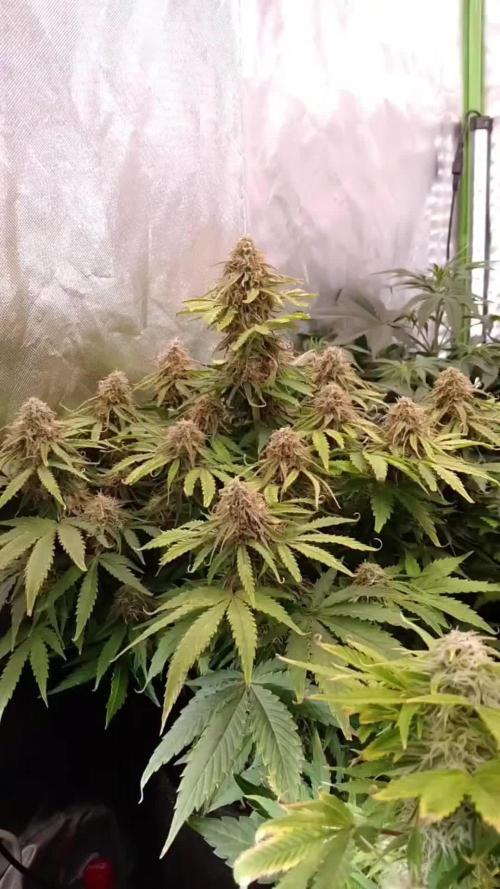
Week 10 – Day 70 🌱
She’s now finishing the last swelling phase of the buds. From this point on I’m giving only plain water and letting the soil dry well between waterings.
The buds are not the biggest I’ve ever grown and it probably won’t be my highest yield per plant, but what really surprised me is how uniform this plant is. The buds are very consistent in size and the whole structure is super compact.
In my 1m grow box I think I could easily run 9 plants like this. The canopy would be very even and the space would be used much better.
Now I’m just waiting for the final ripening and keeping an eye on the trichomes. Harvest is getting close.
Terpene profile & trichomes ✨
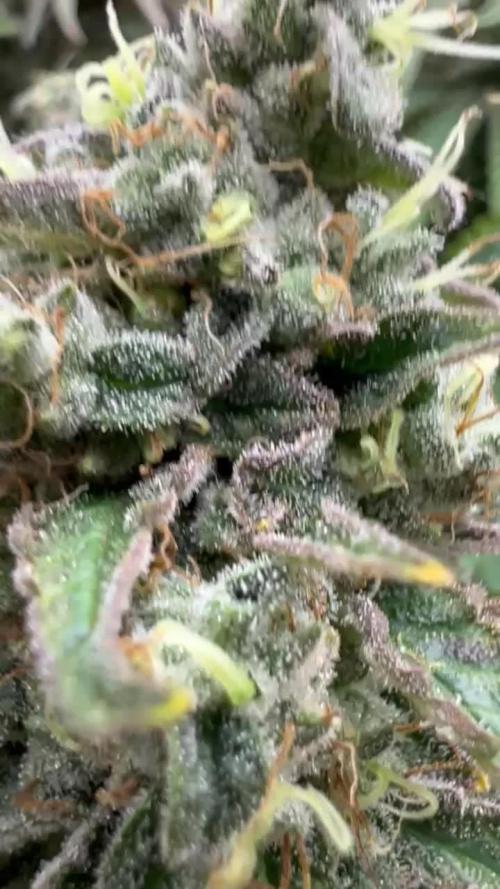
The plant is not covered with a very thick layer of resin. In my opinion this might be one of the downsides of running a 24/0 light cycle. From my experience it seems to increase yield but slightly reduce the quality, quantity and size of the trichomes.
Because of this I recently changed my light schedule to 23 hours. The central light now turns off a bit earlier while the side lights and the 660nm far-red stay on for a short time to simulate a sunset effect. I think this could be more beneficial for the other plants in the tent.
With this plant I will also try to induce a bit of mechanical stress to see if it can stimulate more resin production. I’ll document the results in the next few days.
The terpene profile is already very interesting. The aroma clearly reminds me of ginger, with sweet candy-like notes and a touch of lime. Very unique and quite surprising.
Big thanks to the breeders at RQS for this little gem. And as always, happy growing to everyone! 🌱




Likes
15
Share


@MrJones
Follow
MrJones Ztrawberriez Auto
🍓╰⊰🍓´🍓⊱╮🍓╰⊰🍓´🍓⊱╮🍓╰⊰🍓´🍓⊱╮🍓╰⊰🍓´🍓⊱╮🍓
💧 Feeding - Using Gaia Green Grow / Bloom and Compost Teas
🍃Training / LST-Defoliation-Topping TBA
🕷️ IPM - Will be using Green Cleaner" 1 OZ per Gallon, and CannControl from Mammoth alternating between products each month for Integrated Pest
🍓╰⊰🍓´🍓⊱╮🍓╰⊰🍓´🍓⊱╮🍓╰⊰🍓´🍓⊱╮🍓╰⊰🍓´🍓⊱╮🍓
▶️Sunday 10.29.23 - Going to leave the light cycle alone for another week, these ladies are blowing up pretty well, don't want to mess with the MoJo :)
🍓╰⊰🍓´🍓⊱╮🍓╰⊰🍓´🍓⊱╮🍓╰⊰🍓´🍓⊱╮🍓╰⊰🍓´🍓⊱╮🍓
▶️Bud Description Ztrawberriez Auto produces long and fat buds with a beautiful light green shade with oftentimes purplish hues and a thick layer of resin that starts at the top of the flowers and continues all the way to the tip of the sugar leaves. It’s the typical bud structure you would expect from hybrid varieties topped with an explosion of fruity terps that’ll hit you in the face with a blend of creamy, fruity, and sweet aromas as soon as you break the buds open. Definitely a must for terp heads and extractors looking for exaggerated flavors and aromas
🍓╰⊰🍓´🍓⊱╮🍓╰⊰🍓´🍓⊱╮🍓╰⊰🍓´🍓⊱╮🍓╰⊰🍓´🍓⊱╮🍓
▶️SOIL MIX
40% ProMix HP
40% Coco Coir 70/30
15% Worm Castings
05% Malibu Compost
🍓╰⊰🍓´🍓⊱╮🍓╰⊰🍓´🍓⊱╮🍓╰⊰🍓´🍓⊱╮🍓╰⊰🍓´🍓⊱╮🍓
Likes
6
Share

@Simba732
Follow
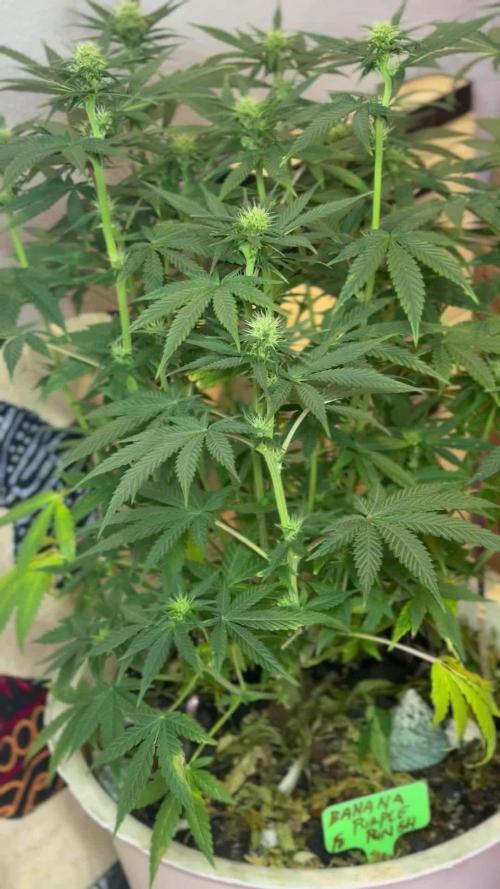
Week full of stretch!
Good day lovely people ✌️
Ms Purple spend the week reaching for the stars.
We are now entering the bulking phase of our journey and our lady is smelling wonderful ( some banana with a hint of lemon) love it ❤️
She is drinking more, and I’m making sure to water to full full saturation when about 3 cm of my top soil gets dry.
Can’t wait for the coming weeks.
Let’s go
Likes
18
Share

@eldruida_lamota
Follow
Que pasa familia, vamos con la septima semana de floración de estas Tropicana Cookies Fast Flowering, de FastBuds.
Los ejemplares tienen muy buen color han crecido muy uniformes y las flores están progresando a muy buen ritmo.
El ph se controla en 6.2 , la temperatura la tenemos entre 21/24 grados y la humedad ronda el 50%.
Van madurando las flores yo creo que esta es la última semana ya de alimentación, a partir de aquí solo agua.
Mars hydro:
Code discount: EL420
https://www.mars-hydro.com/
Agrobeta:
https://www.agrobeta.com/agrobetatiendaonline/36-abonos-canamo
Hasta aquí todo, Buenos humos 💨💨💨
Likes
22
Share


@Strega
Follow
This is the last week 😍💚💚 I really want to say thxs to Sweet seeds for the wonderfull seeds. I love my mandarine and now, when this grow is at the end, I just have to wait
Likes
5
Share


@HIAZ_urbanbudfarmer
Follow
Going to mainline this plant, was topped today at the 3rd node. Interested to see how this pheno turns out as I've done a few runs with this strain recently, both from seed & clone. Two very different phenotypes, 1 grew very bushy with bigger buds & the 2nd was quite different with smaller buds. Both were pretty similar when it came to quality & potency but phenotype 1 yielded more each time around an ounce +. She is in week 3 day 16
Likes
6
Share

@Skynets_Growing
Follow
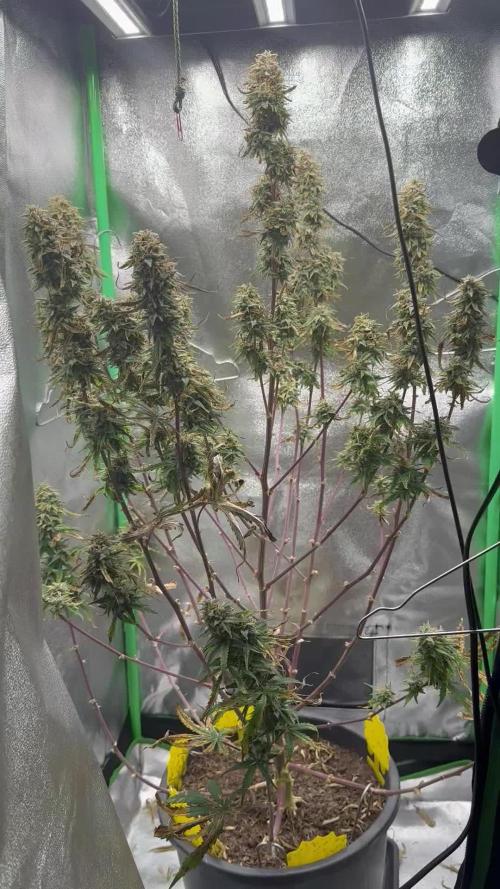
Elsa‘s grow and our Community Grow goes to an end. It‘s hard for me to say her goodbye, because we share 100 days together. But a good friend told me… it‘s always a friendship of time. Thx for Zamnesia for Elsa‘s Seed and That i have good and bad times with her. But i learn a lot in this grow and that is the most important thing… See you on harvest day 😉
Likes
8
Share


@HeartStrong_Garden
Follow
I had to skip a week as we went out of town for the 4 th of July. My AC Infinity self watering pots worked great. I gone seven days. I let them dry back a bit for the couple of days prior to the trip, then watered from the top until nice and wet and filled the reservoir completely. The reservoir was dry when i got back and only one (plant 2) showed just barely signs of needing water again. Now I'm doing trichome checks almost daily. Lots of clear and cloudy, some amber here and there. I'm guessing I'll probably see another 4-7 days max before harvest?
Likes
77
Share


@Ukfarmer420
Follow
So this week the little gelatocake is on week 8 and is really starting to eat herself now, full of trichomes and smells like tutti fruity chewie sweets.
Last week of nutes for her then mollases only. Week 7 for the othere gelatocake and shes starting to fatten up now as well as fade also.
Babys have got big since re potting I will.bend them over later.
Sherbert mimosa are still taking there time I think they are starting to get bigger 🤔🤣 I Will keep you updated lol.
Happy growing guys 👌💪💚


