The Grow Awards 2026 🏆
Likes
7
Share
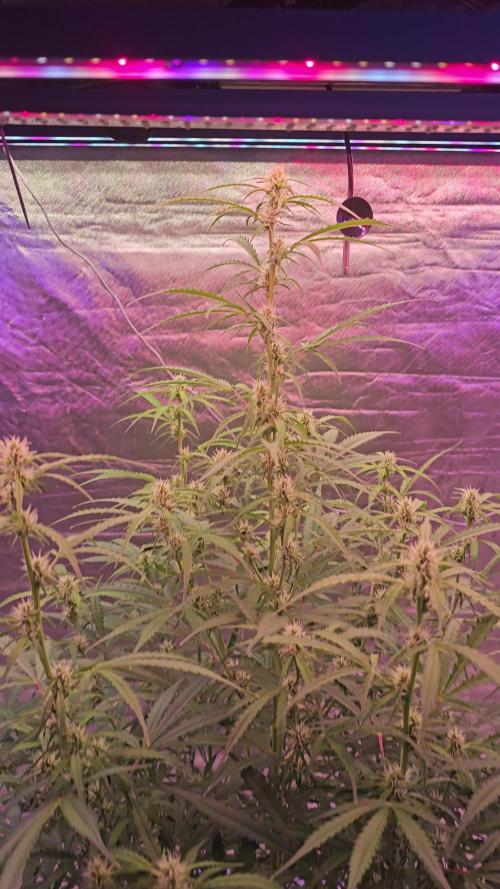
Day 36 she keeps stretching and looks very happy i'm also very happy because soil PH is finally good, now it's 6.5PH after watering with 5.2 PH'ed water(with nutes in it) for the last several waterings. Light is 30cm away from the canopy ~850 PPFD Cut some leaves from center of the canopy for better air circulation and light penetration. Day 38 : watered with 2.5 L of water with nutes and 5.6 PH water, runoff water PH is now perfect 6.5 Day 39: She's been stretching very well, can't wait to deflate already(maybe tomorrow) Day 40: deefoliation day finally has come! And i'm so happy how she turned out after all. I did some LST to even out canopy for better light penetration and air movement! Note: she uses much Calcium - Magnesium (cal-mag) soo you definitely need to add it in your water.
Likes
36
Share
@SAC87
Follow
Hi Growers. So all 3 FastBuds Blue Dream Auto seeds popped in less than 3 days. I’ve left them uncovered, added a humidifier and turned a fan on low to just to give them a little wiggle. They were sprayed and lightly watered in a 4” circle around the stalks to have those roots go search for water. One of the seeds hulls is still stuck to the cotyledon leaves. I’ve been spraying it to keep the membrane moist and hopefully she’ll split it open by herself. In the past when I’ve tried to remove them they cause damage to the leaves so we’ll wait and see. Just gonna give them some time and mist for a week and start super low feeding according to the FastBuds auto feed schedule. I’m looking forward to seeing these babies grow!!! Happy Growing 🌱
Likes
9
Share
@Fyno_TH
Follow
🌸 Flowering Week 8 — Mid Bloom Madness! 🔥❄️ Week 8 and she’s officially in her prime. Buds are swelling harder every day — stacking tight, pistils turning color, and the frost level just exploded this week. Trichomes are covering everything like sugar dust ❄️✨ Aroma also jumped to a new level… sweet, fruity and loud as soon as the tent unzips. Energy is still strong, leaves healthy, and she’s cruising through mid-bloom like a champ. counting down to the final push — next weeks should be all about density + resin 👑🌿
Likes
5
Share
Day 11: We have: 3x White Widow 1x Critical 2x Special Queen #1 1x Special Kush #1 Important: The method used "jiffy" is efficient and fast but in another possible germination I will definitely do the "paper towel" method first. It is important to note that for good germination, the seeds must have as little soil as possible on top, where I delayed by 1 week due to the fact that the seed was very deep in a jiffy. I reduced the distance of the LED from 60cm to 30cm because we still have plants that are stretching too much so this was the measure adopted awaiting results. For 8 pots of 0.5L, 500ml of pure water containing: 1ml Voodoo Juice 1ml Sensi Grow A+B (2ml total) 1ml B52 2ml CalMag The net proportion was satisfactory.
Likes
22
Share
I sowed these seeds on Sunday, June 20, 2021. They sprouted on Wednesday, June 23, 2021. I moved them into the veg tent today (6/24) and planted them in a soil mix of 80% Fox Farm Ocean Forest and 20% Fox Farm Happy Frog. I also used Dynomyco when I planted these! I wasn't planning on putting them in the soil this quickly.... but, if you look at the pics of the seedlings in the tray you will notice the taproot shot right out the side of the pellet!! I didn't want to leave it exposed to air... so, in the soil it went!! Otherwise, we are off and running!! I definitely need to give a huge shoutout to Seedsman!!! I won these seeds (x5) and 5 Blue Dream from a contest back in January. I believe it was the holiday one where you needed to visit their social media accounts... Anyways, they were free and I'm excited to grow them!! So, THANK YOU SEEDSMAN!!!!
Likes
7
Share
( RUNTZ X F1DURB X GUSHERS )🍬🌈🍨🍧 PURP KICKIN INN END #WEEK4 CANT WAIT TILL THE BUDS SWELL UPP!! SUPA INTENSE CANDY TERPS THIS ROUND NOT BIG BUDS BUT SUPA HIGH IN BRIXX LEVEL WITH ALL THE ORGANIC CARBON INPUTS!! PPM 900/1200 1.2 max (Face Off OG x Watermelon Zkittlez) X (Runtz x F1 Durb x Gushers) 🍉🍬🌈🍧🍨🍦 LIL PRUPLE TINT WIT MOUTH WATERING SUGARY TERPS KICK INN END #WEEK4 BY WEEK 7/8 SHE WILL BE PURPLE PURPLE WIT SUPER INTENSE CANDY MOUTH WATERING TERPS CANT WAIT TILL SEE THEM BUDS SWELL UPP!! PHENO A/B NOT BIG BUDS BUT SUPA HIGH IN BRIXX LEVEL WITH ALL THE ORGANIC CARBON INPUTS!! PPM 900/1200 1.2 max
Likes
18
Share
Green light is radiation with wavelengths between 520 and 560 nm and it affects photosynthesis, plant height, and flowering. Plants reflect green light and this is why they appear green to our eyes. As a result, some growers think that plants don’t use green wavelengths, but they actually do! In fact, only around 5 – 10% of green light is reflected from leaves and the rest (90 – 95 %) is absorbed or transmitted to lower leaves [1]. Green wavelengths get used in photosynthesis. Chlorophyll pigments absorb small amounts of green wavelengths. Light that doesn’t get absorbed is transmitted to leaves that are shaded out from direct light. This means that leaves at the bottom of the canopy get more green light than leaves at the top. A high proportion of green wavelengths compared to other colors tells lower leaves that they are being shaded out, so they are able to react accordingly. Lower leaves may react by opening or closing their stomata or growing longer stems that help the leaves reach brighter light [1, 2, 3]. When it comes to growing cannabis, many cultivators are interested in the quality of light used for the flowering stage. In many plants, flowering is regulated by two main photoreceptors: cryptochrome and phytochrome. Both photoreceptors primarily respond to blue light but can also respond to green, although to a lesser extent. Green can accelerate the start of flowering in several species (although cannabis has yet to be tested) [1, 4, 5]. However, once flowering has begun, it’s important to provide plants with a “full spectrum” light that has high amounts of blue and red light, and moderate amounts of green, in order for photosynthesis to be optimized. Green light mediates seed germination in some species. Seeds use green wavelengths to decide whether the environment is good for germination. Shade environments are enriched in green relative to red and blue light, so a plant can tell if it is shady or sunny. A seed that senses a shaded environment may stay dormant to avoid poor growing conditions [1]. Some examples of plant species where researchers have documented this response are: ryegrass (a grass that grows in tufts) and Chondrilla (a plant related to dandelion) [1, 6]. Although green wavelengths generally tell plants NOT to germinate, there are some exceptions! Surprisingly, green wavelengths can stimulate seed germination in some species like Aeschynomene, Tephrosia, Solidago, Cyrtopodium, and Atriplex [1, 6, 7]. Of course, light is not the only factor affecting seed germination – it’s a combination of many factors, such as soil moisture, soil type, temperature, photoperiod, and light quality. When combined with red and blue light, green can really enhance plant growth [1, 8]. However, too much green light (more than 50% of the total light) can actually reduce plant growth [8]. Based on the most current research, the ideal ratio of green, red, and blue light is thought to be around 1:2:1 for green:blue:red [9]. When choosing a horticultural light, choose one that has high amounts of blue and red light and moderate amounts of green and other colors of light. Not many studies can be found about the effect of green light on cannabis growth or metabolism. However, if one reads carefully, there are clues and data available even from the very early papers. Mahlberg and Hemphill (1983) used colored filters in their study to alter the sunlight spectrum and study green light among others. They concluded that the green filter, which makes the environment green by cutting other wavelengths out, reduced the THC concentration significantly compared to the daylight control treatment. It has been demonstrated that green color can reduce secondary metabolite activity with other species as well. For example, the addition of green to a light spectrum decreases anthocyanin concentration in lettuce (Zhang and Folta 2012). If green light only reverses the biosynthesis of some secondary metabolites, then why put green light into a growth spectrum at all? Well, there are a couple of good reasons. One is that green penetrates leaf layers effectively. Conversely red and blue light is almost completely absorbed by the first leaf layer. Green travels through the first, second, and even third layers effectively (Figure 2). Lower leaf layers can utilize green light in photosynthesis and therefore produce yields as well. Even though a green light-specific photoreceptor has not yet been found, it is known that green light has effects independent from the cryptochrome but then again, also cryptochrome-dependent ones, just like blue light. It is known that green light in low light intensity conditions can enhance far red stimulating secondary metabolite production in microgreens and then again, counteracts the production of these compounds in high-intensity light conditions (Kim et al. 2004). In many cases, green light promoted physiological changes in plants that are opposite to the actions of blue light. In the study by Kim et al. blue light-induced anthocyanin accumulation was inhibited by green light. In another study it has been found that blue light promotes stomatal opening whereas green light promotes stomatal closure (Frechilla et al. 2000). Blue light inhibits the early stem elongation in the seedling stage whereas green light promotes it (Folta 2004). Also, blue light results in flowering induction, and green light inhibits it (Banerjee et al., 2007). As you can see, green light works very closely with blue light, and therefore not only the amount of these two wavelengths separately is important but also the ratio (Blue: Green) between these two in the designed spectrum. Furthermore, green light has been found to affect the elongation of petioles and upward leaf reorientation with the model plant Arabidopsis thaliana both of which are a sign of shade avoidance symptoms (Zhang et al. 2011) and also gene expression in the same plant (Dhingra et al. 2006). As mentioned before, green light produces shade avoidance symptoms which are quite intuitive if you consider the natural conditions where the plants grow. Not all the green light is reflected from the highest canopy leaves in nature but a lot of it (50-90%) has been estimated to penetrate the upper leaves at the plant level ((Terashima et al., 2009; Nishio, 2000). For the plant growing in the understory of the forest green light is a signal for the plant of being in the shade of a bigger plant. Then again, the plants growing under unobstructed sunlight can take advantage of the green photons that can more easily penetrate the upper leaves than the red and blue photons. From the photosynthetic pigments in higher plants, chlorophyll is crucial for plant growth. Dissolved chlorophyll and absorb maximally in the red (λ600–700 nm) and blue (λ400–500 nm) regions of the spectrum and not as easily in the green (λ500–600 nm) regions. Up to 80% of all green light is thought to be transmitted through the chloroplast (Terashima et al., 2009) and this allows more green photons to pass deeper into the leaf mesophyll layer than red and blue photons. When the green light is scattered in the vertical leaf profile its journey is lengthened and therefore photons have a higher chance of hitting and being absorbed by chloroplasts on their passage through the leaf to the lower leaves of the plant. Photons of PPFD (photosynthetic photon flux density) are captured by chlorophyll causing an excitation of an electron to enter a higher energy state in which the energy is immediately passed on to the neighboring chlorophyll molecule by resonance transfer or released to the electron transport chain (PSII and PSI). Despite the low extinction coefficient of chlorophyll in the green 500–600 nm region it needs to be noted that the absorbance can be significant if the pigment (chlorophyll) concentration in the leaf is high enough. The research available clearly shows that plants use green wavelengths to promote higher biomass and yield (photosynthetic activity), and that it is a crucial signal for long-term developmental and short-term dynamic acclimation (Blue:Green ratio) to the environment. It should not be dismissed but studied more because it brings more opportunities to control plant gene expression and physiology in plant production. REFERENCES Banerjee R., Schleicher E., Meier S. Viana R. M., Pokorny R., Ahmad M., Bittl R., Batschauer. 2007. The signaling state of Arabidopsis cryptochrome 2 contains flavin semiquinone. The Journal of Biological Chemistry 282, 14916–14922. Dhingra, A., Bies, D. H., Lehner, K. R., and Folta, K. M. 2006. Green light adjusts the plastic transcriptome during early photomorphogenic development. Plant Physiol. 142, 1256-1266. Folta, K. M. 2004. Green light stimulates early stem elongation, antagonizing light-mediated growth inhibition. Plant Physiol. 135, 1407-1416. Frechilla, S., Talbott, L. D., Bogomolmi, R. A., and Zeiger, E. 2000. Reversal of blue light -stimulated stomatal opening by green light. Plant Cell Physiol. 41, 171-176. Kim, H.H., Goins, G. D., Wheeler, R. M., and Sager, J. C. 2004.Green-light supplementation for enhanced lettuce growth under red- and blue-light emitting diodes. HortScience 39, 1617-1622. Nishio, J.N. 2000. Why are higher plants green? Evolution of the higher plant photosynthetic pigment complement. Plant Cell and Environment 23, 539–548. Terashima I., Fujita T., Inoue T., Chow W.S., Oguchi R. 2009. Green light drives leaf photosynthesis more efficiently than red light in strong white light: revisiting the enigmatic question of why leaves are green. Plant & Cell Physiology 50, 684–697. Zhang, T., Maruhnich, S. A., and Folta, K. M. 2011. Green light induces shade avoidance symptoms. Plant Physiol. 157, 1528-156. Wang, Y. & Folta, K. M. Contributions of green light to plant growth and development. Am. J. Bot. 100, 70–78 (2013). Zhang, T. & Folta, K. M. Green light signaling and adaptive response. Plant Signal. Behav. 7, 75–78 (2012). Johkan, M. et al. Blue light-emitting diode light irradiation of seedlings improves seedling quality and growth after transplanting in red leaf lettuce. HortScience 45, 1809–1814 (2010). Kasajima, S., et al. Effect of Light Quality on Developmental Rate of Wheat under Continuous Light at a Constant Temperature. Plant Prod. Sci. 10, 286–291 (2007). Banerjee, R. et al. The signaling state of Arabidopsis cryptochrome 2 contains flavin semiquinone. J. Biol. Chem. 282, 14916–14922 (2007). Goggin, D. E. & Steadman, K. J. Blue and green are frequently seen: responses of seeds to short- and mid-wavelength light. Seed Sci. Res. 22, 27–35 (2012). Mandák, B. & Pyšek, P. The effects of light quality, nitrate concentration and presence of bracteoles on germination of different fruit types in the heterocarpous Atriplex sagittata. J. Ecol. 89, 149–158 (2001). Darko, E. et al. Photosynthesis under artificial light: the shift in primary and secondary metabolism. Philos. Trans. R. Soc. B Biol. Sci. 369 (2014). Lu, N. et al. Effects of Supplemental Lighting with Light-Emitting Diodes (LEDs) on Tomato Yield and Quality of Single-Truss Tomato Plants Grown at High Planting Density. Environ. Control Biol. 50, 63–74 (2012).
Likes
9
Share
Planta fácil de cultivar, de estatura media y producción importante de tricomas. Sus fragancias son dulces parecidas a la panela, canela, especias y un fondo un poco kush con notas a crema. Flores hermosas macizos, compactas y totalmente cubiertas de fragante resina, las tonalidades son hermosas, al moler se despliegan todos los aromas y ese tono violeta en el interior de las flores. Gracias a fastbuds una vez más por su confianza y a toda la gente que sigue el contenido. Buenos humos!
Likes
27
Share
@WestOzzie
Follow
She's nearly all done,smells amazing,looks amazing
Likes
13
Share
@XanHalen
Follow
Mar 24: Watering till runoff now... runoff ppm was 2500+... Will be using very mild nutes to flush over 1 - 3 feeds... or until I am near my input. Mar 26: Continuing to use 650ppm feed with bloom focus, 2L per plant gives 15% runoff... Runoff ppm is still very high... I wanted to check pH of runoff but the color is so vibrant i cant use the pH drops to view color, need to get a pH probe. Plants are thriving, no issues at all. the extra fan fixed the post-water droop. One plant is bushy and has the most bud sites, One is the smallest but has the most uniform structure, this one has the biggest buds and thickest stalk, One is about in the middle of the 2. Mar 29: one of these girls gets droopy early when its time for water, thought the canopy was too high so i tied down some more, no cigar... gonna try increasing calmag, if that doesent work im going to reposition in the grow box to a side instead of middle, may not need the upper end ppfd...
Likes
4
Share
@Kelly420
Follow
Okay so after 48 hours instead of 24 of darkness. These ladies were begging to be chopped with how much more intense the smell got. Cheesy , sweet , skunky , and a floral incense kind of scent. Made lots of finger hash just getting them off the plants , already smoked. I’m about 75% done with chopping all the major tops. This time I decided to cut off the branches and dry on an eight tier 24” diameter rack off Amazon. All 8 tiers are full with gorgeous top colas. I’m drooling. Can’t believe just how much bud this is turning out to be. They are dense , and oozing. Not going to get a wet weight because this is just too much. But holding the rack it’s like 20 lbs or more. My scales don’t go that high. Lol. Gotta say it, I think my buds look 10 times better than the advertisement photos g13 lab’s mozzarella. My 2 cents and honest opinion. Please do give me your opinions. I know I didn’t show the full grow because life gets busy. My next grow I want to control the humidity and heat levels a bit better. Or just humidity and run co2 to withstand higher temps. I have every angle of the grow under my tips now. It feels amazing to have this kind of harvest after the dedication these plants received. I’m Convinced…. rdwc with a water chiller , is by far the best way to do hydro. When it’s dry I’ll add the final weights. My nutrient reg is this. Jacks 321 , botanic are cal mag plus, hydroguard,PK booster is flower fuel(purple can off Amazon) and unsulfured molasses. If you don’t have an ability to keep water at 70 degrees then only use jacks hydroguard and cal mag. You’ll still do well but that molasses , that sauce is the boss.
Likes
Comments
Share
@Rko41
Follow
Cut!!! Sechage curing et smoke test!!
Likes
4
Share
She doesn't still recovering... but doesn't look that bad, ph is around 5, and decided to stop feeding with nutrition for a few days, any tip will be appreciated
Likes
4
Share
Week 1 of flower, gave her some composed tea an did some LST as well
Likes
5
Share
This is week 8 day 4 video. I have tried about 30g in testers rapid 1:05 dry. I’m waiting on seeds to finish. Plants are 7ft tall super cropped 3x on some branches and monsters just pop up. I highly don’t recommend super ripping or manipulating breaking stems. You will have jungles and delicious harvest. Some tops were touching doides so lights were raised to maximum tent ceiling. Every day is 2tbsp soluble pk into 5 gal water, 1/2-1tbsp folvic acid, sometimes humid acid, sometimes fishsh!t, sometimes microbial mass. 2 times only I added 1tbsp of magnesium phosphate into5gal. Every watering in 5gal has 2tbsp of carbs, I don’t use black molasses but it’s bluesky organic booster. Buds smell sweet, 2 and 3 are where the terps are but no1 is frosty af. 2 is og. As numbers left to right. Split between the middle bar. Running about 840w. 640is my reg along with 5x 20w blurples and my friends 100w “lm301h” but I beg to differ. My 640w is lm301h. I wish I had more light but I am not a facility. I just have a 4x8x7h. I’m very happy with this grow. Everything is to the max been flushing last week and it’s burning my plants lol. Just 1tbsp ph down. I have not been using ph down in my entire flower because the soluble pk 1-1.5 tbsp per 5gal water is enough to lower and make things happy. Every day is watering and every plant gets 1gal water daily. They could do a lot more but I don’t have the space as you can see ❤️
Likes
8
Share
next week of the flowering stage in the life of this amazing beauty her big leafes still amazes me. all nutrients are in ger section if not other mentioned all by maufactures instructions.
Processing
Likes
26
Share
Thanks Short Stuff Super Cali Haze will be a nice one, I hear she gets big . This strain is the holy grail of auto flowering growers, a true and pure auto-Sativa and one which has been described as a SUPER AUTO by its breeder stitch. Stitch has been working for many years on refining an autoflowering haze strain but as many other breeders know this a very difficult and some say an impossible task. Stitch finally managed to do this when he created his ‘Nirvana sky’ strain and this has been used as the basis of super cali-haze. First a ruderalis was crossed with haze special and bred until it was 100% autoflowering. This was then crossed back with a resinuous colombian mother from Cali state and the super auto was then stabilised. Super cali haze is our first SUPER AUTO and she is a big tall strain which can grow over 2 metres outdoors and produce upwards of 4 ounces. This is perfect for someone wanting to fit 2 harvests into one summer season and still be cropping out before everyone using traditional photo-period strains. Super cali haze also works perfectly indoors although some training and tying down may be required to help control her unbelievable growth. Unlike most autoflowering strains which are indica dominant Super cali-haze is a pure Sativa strain so will give you that soaring cerebral hit you expect from a good old fashioned haze. The aroma of the plant is not too potent but when you take your first hit you will truly experience its wonderful earthy and spicy flavour. The high comes on fast and is uplifting, energetic and incredibly potent keeping you on another level for a good few hours. When you come down its without a big bump and super cali haze will not leave you feeling groggy and lethargic. This really is a very different auto and one which you will surely want in your collection. The super auto is here and its here to stay, this is going be Big!!!