Likes
Comments
Share
@m99smith
Follow
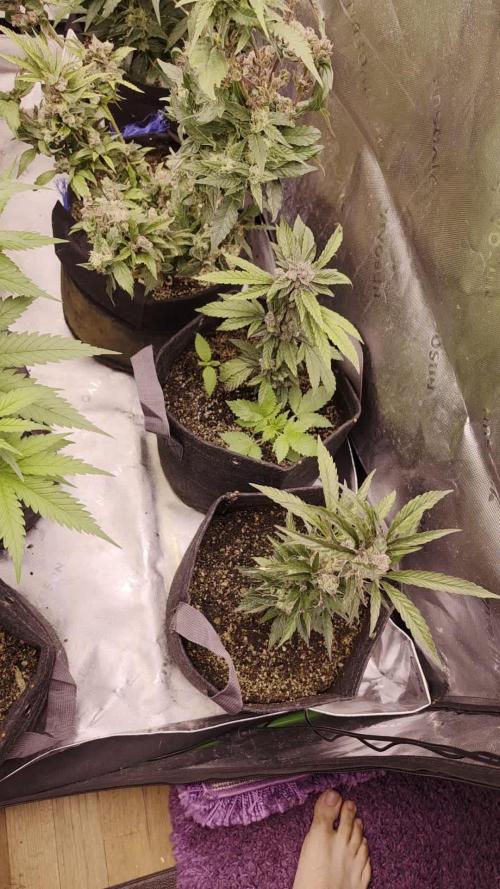
Afghan Hash Plant, week 6 of flower. Another frosty strain, but not quite as frosty as the Mango Merengue but still beautiful. The Afghan Hash has a sweet citrus smell with an earthy smell. Not much to do other then water since they got their last bit of slow release nutrients acouple days ago which lasts 3 weeks.
Likes
64
Share
@Ju_Bps
Follow
Hello happy Growers! This week was better than early, I've founded few very litle banana spend the week, I will continue to check this week, Harvest will be in 2 or 3 weeks, I hope can take situation under control untill harvest. If banana start to be too big, I'll remove the branch. If no, buds start to be compact, Nice sweet smeel and sticky, Probably my last fertilizer week, after I'll start flush Plant start to take less water, sign harvest for soon :) Have a good week my friends
Likes
283
Share
D21 - Start of week three of veg for the second girl, while it is only the start of week two for the first girl as I had to replant her. I will probably do the first topping on the second girl this week but I'll see in a few days where she's at. I gave both girls around one liter of water @ pH 5.9. A bit on the low side as I used too much pH down but it'll be fine for one watering. D24 - Yesterday I switched my light from the seedlings program to the veg program, and I'm now reading around 500-600 PPFD across the canopy. On the high end for sure, so let's see how the girls handle it. However, the daytime temp in the tent jumped up to around 30 degrees C after I switched the lights. #tinytentproblems I also added some support to #1 as she has a relatively thin stem but large leaves, so the oscillating fan keeps knocking her around. The second girl also initially had a slender stem, so I guess it is their genetics. (#1 is 12 cm tall and 15 cm wide, while #2 is 20 cm tall and 35 cm wide.) I will need to top the second girl this week as she grows a lot each day. I'm considering mainlining her but haven't made up my mind yet. I gave both girls around one liter of water @ pH 6.5. D25 - A couple of days ago, switching the lights to the veg program made the cover crop explode and turn into a jungle. I decided to trim down the red clover to increase the airflow around the girls and reduce water use. I watered the girls only yesterday, but they were already thirsty again, so I think that the clover was drinking quite a bit as well. After cutting back the clover, I gave each girl around 1.2-liters of water @ pH 6.5. D27- Today was the last day in week three of veg for the second girl and the last day in week two for the first girl. I really should have topped the second girl already, so that will need to be done as soon as possible. She is 26 cm tall and 38 cm wide, while the first girl is 13 cm tall and 27 cm wide. Yesterday, I removed the support from the first girl as her stem had gotten more robust, so it was no longer necessary. Today, I started brewing compost tea (worm castings, neem meal, kelp meal, biochar, rock dust, algal limestone, bentonite, and molasses) which I will leave overnight and feed to the girls tomorrow.
Likes
48
Share
@AsNoriu
Follow
Day 57. Statement : Even with hard beginning - thats my best run ! Zamnesia is AMAZING !!! With veg hiccups, they still bushout to really nice plants in less than 7 weeks. Now Blue Dream is targeting my roof, Kalini Asias are thick as f@ck. Runtz very dense plants, thought they would be a bit bigger ... They drink every 36 hours, hard to keep up with work, but i do my best not to screw up with them ;) This week : feed, water, water. Defoliation too !!! Day 59. That game - "who will reach sealings" - I don't like !!!! Moved lights two days ago ... Soon i will need axe for my roof !!! ;)) That Monster Blue Dream is insane !!! Hope will do heavy defoliation in two days, maybe this will shock her ;))) other plants keep up with her and canopy is even without all three Blue Dreams. Huge plants. Day 60. Video is showing how less space is left, but they just keep climbing !!! ;)) Day 61. Thinking to defoliate all girls tonight, but maybe i will do it after next watering. Had to reposition them, loads of branches need to be chopped, some didn't see light for last two weeks( Curly, looks like sh$t, will never reach light). Girls are too big for my setup and i really hope it will be enough light and HEIGHT for them... And so Defoliation has started !!! Hope everything will go fine !!! All done !! With the thought " WHAT HAVE I DONE !!!!??????!!!!!" i go to try to fall asleep ;))) Happy Growing !!!
Likes
15
Share
This is the start of week 9 and she is doing GREAT!! Pistols are turning nice and pretty 😍! Buds are fattening nicely, and the thing im most proud of, no sighs of defiency!! She is a very good plant to grow. And is going to give me some very nice smoke!!
Likes
35
Share
@SAC87
Follow
Hi Growers. So all 3 FastBuds Pineapple Express Auto seeds popped in less than 3 days. I’ve left them uncovered, added a humidifier and turned a fan on low to just to give them a little wiggle. They were sprayed and lightly watered in a 4” circle around the stalks to have those roots go search for water. Just gonna give them some time and mist for a week and start super low feeding according to the FastBuds auto feed schedule. I’m looking forward to seeing these babies grow!!! Happy Growing 🌱
Likes
35
Share
@Zengrower
Follow
The Frosty Tooth germinated within 2 days after placing it in the seedplug. I immediately placed the seedplug in the final 11L container. The soil is Plagron Allmix so I don't have to add nutrients for the first six weeks. I will add some Plagron Power Roots in the next few days to stimulate a strong root system. Let's see how this little seedling will grow in the next few days. Stay tuned for more updates and pics later this week ✌️ After the little seedling germinated it barely seemed to grow at all. My first guess was that it had to do with the low humidity (45%). In my GTools I have a humidifier, but that's not an option in the Minigrow. So I gave the seedling a mini plastic bottle greenhouse and she immediately recovered!
Likes
9
Share
Likes
13
Share
@Prozak
Follow
the strain is really strong , low temperatures resist , 3 weeks around 12/16º graus and steell growing wel nice new colos between week 4/6 in flowering. really good strain to manipulate! 5 stars * * * * *
Likes
25
Share
@Mosi420
Follow
16 g trocken für meine erste Pflanze recht zufrieden
Processing
Likes
35
Share
The ladies really didn’t have too much change this week except girl #2 seems like she’s caught up in height to girl #1. I have to make a correction to from week 3. I stated I topped the girls when i actually did some light FIMing.I wanted to be sure i corrected that mistake before my diary process any further. I kind of went a little too heavy on the feeding and the girls showed some slight yellowing and a 1 leaf started to Slightly curl into a taco. Nothing too serious but I definitely will be dialing back on the feeding doses. decided to do some defoliation To the fan leafs that were significantly blocking light from future bud sites. I’m not sure how these girls will take to me cutting off foliage. Only time will tell. These girl are starting to put off Some stank. The smell it’s very strong but you can get a sense of what’s to come. It smells of gassy sweet pineapple citrus. Have to admit I was skeptical until I did a stem rub and these girls were spot on. When rubbing the stem they smell so much more sweeter almost like a candy sweet smell. really appreciate all who have viewed my diary. I’m actually shocked how people viewed it so far. Thank you very much for the love 💚. I’m grateful and humbled for your support. Hopefully these girls start to go into the pre flowering stage in the next week, I’m over excited to see them develop. Again thank you all for your support and comments and suggestions are welcomed💚
Likes
1
Share
9/20 Adjusted lights to 40% at 24 inches. It looks like I have a whorled phyllotaxy with the Sticky Mango. 3 branches per node. Should be cool to see how she develops. 9/22 Watered at 900 mS/cm 9/23 Dropped ir light on plants. Broke a fan leaf off the Moonberry Pie Auto. Removed other leaf to maintain light distribution and symmetry. Otherwise plants look great. 9/24 Added IR lighting. 10 before and after lights on and off. Hung at about 48 inches. 9/25 Topped Pink Apple Soda and Yuzu Sour above 4th node. Watered at 1.080 mS/cm pH 6.1. Watered to minimal runoff. Reduced RH to 62% 9/28 Increased lighting to 50%. Topped the Sticky Mango Auto. Was going to get to tall. The whorled phyllotaxy aspect of the plant is interesting. It is definitely growing faster than the others . It even has pistils already and a VERY dominant side branch. The plant I dropped the IR light on (Moonberry Pie Auto) definitely got stunted even though only 2 fan leaves had to be removed. The other topped plants (Yuzu Sour Auto and Pink Apple Soda Auto) look great. Starting to get bushy. Tucked the large fan leaves. Turtle Taffy Auto has been rather disappointing. If it doesn't show me something soon I may not waist the nutrients and get another Tastebudz Genetics seed going. PLANT HEIGHTS : Sticky Mango Auto 12" Turtle Taffy Auto 8.5" Moonberry Pie Auto 5" Pink Apple Soda Auto 7.5" Yuzu Sour 6.5"
Likes
12
Share
Englisch Week 3 is coming to an end and the ladies are growing magnificently. The only real outlier is Gelato #4, I don't know whether it was too stressed because of the repotting or why it isn't growing as fast as the others. When fertilizing, I continue to follow the feeding chart and Athena's hand watering strategy. The plants are accepting the very high dose of fertilizer wonderfully, which is somewhat to my astonishment, as I am not used to running these high EC levels from the start. Now that my Par Meter has finally arrived, I can keep a better eye on the light levels, which are currently at 500u/mol. Deutsch Woche 3 neigt sich dem Ende zu und die Ladies wachsen prächtig. Den einzigen richtigen Ausreißer macht die Gelato #4, ich weiß nicht ob sie wegen des Umtopfens zu viel Stress hatte, oder woran es liegt, dass sie nicht so schnell wie die anderen 4 wächst. Beim Düngen halte ich mich weiterhin an das feeding chart und die hand watering strategy von Athena. Die Pflanzen nehmen die doch sehr hohe Dosis Dünger wunderbar an, was etwas zu meinem Erstaunen ist, da ich es nicht gewohnt bin diese hohen EC Werte von Anfang an zu fahren. Da nun endlich mein Par Meter angekommen ist, habe ich die Lichtwerte auch etwas besser im Blick, womit wir aktuell bei 500u/mol liege.
Likes
3
Share
I defoliated most of the purple stemmed fan leaves on day 19 of flower. They are already filling in after just a few days. I'm still feeding at 1000ppm with 20% run off.
Likes
17
Share
Zum Pressen waren beide Strains super. Angenehm zum Rauchen und ertragreich. Terps sind hauptsächlich Citrusnoten.
Likes
43
Share
Diese Woche ist mir die Idee gekommen mein Noname Growlight einfach auf die Töpfe zu installieren dammit die unteren Buds auch Licht abbekommen. Zwei 5 Watt Ventilatoren wurden auch unterhalb der Pflanzen installiert Hunrig sind sie nach wie vor !
Likes
2
Share
67 days since April 16th, 2026 We become aware at such times of man's wonderful ability to bring seemingly unrelated elements into harmonic balance, and receive a glimpse into a world where everything exists in conscious sympathetic attunement to everything else. When we listen to a piece of music that seems to strike a beautiful chord somewhere inside us, or view a painting that simply glows with harmonic awareness well executed, we probably do not spare much time to contemplate the wonderfully intricate combination of vibrations that our sensors make it possible for us to perceive. We tend to appreciate the relationship between the parts of something by an awareness of the harmony or dissonance of the whole. This ability enables us to say "what a beautiful house!" instead of "analysis has proven that this collection of building materials exhibits certain elements of harmonic proportion." While this ability to instinctively appreciate the beauty of true harmony has an important role to play in evolution, a more analytical understanding of the laws involved can be most useful. This is especially so if we wish to create works of art where each part exists in true harmony, not only with the other part of that particular whole, but with the universe within which the creator and the created exist. Everything vibrates. From the most dense matter to the most subtle cosmic rays, everything which our senses allow our thoughts to become aware of, can be specified in terms of wavelength or frequency of vibration. These two terms define the same thing, but from different points of view. The following are the approximate wavelengths of various energy carriers: Cosmic rays 0.000,000,001 mm Gamma rays 0.000,000,1 mm X rays 0.000,500 mm Ultraviolet rays 0.003 mm Visible light 0.006 mm Infrared 0.01 mm Sound waves 1 meter Radio waves 300 meters Violet light 400 nm to 450 nm Blue light 450 nm to 500 nm Green light 500 nm to 570 nm Yellow light 570 nm to 590 nm Orange light 590 nm to 610 nm Red light 610 to 700 nm 1 nanometer (nm) = 0.000,000,1 cm = 1/10,000,000 cm If a guitar string is plucked and we hear a sound, it is not too difficult for the human mind to associate this sound with the vibration of the guitar string. With color it is quite different. It is difficult for us to conceive that the color of a substance is not an inherent property of the substance itself, but an indication picked up by our senses of that substance's ability to absorb or reflect the light which happens to be shining on it at that moment. Neither the matter nor the light is colored. What happens is that the brain learns to differentiate between the frequencies reflected or transmitted by the substance the eyes are focused on. The same thing happens with sound. When we say "Oh! Listen, they're playing my favorite song," what we really mean is: "My brain has stored within it a particular pattern of frequencies. I have compared the new information being received with this stored pattern and have deduced the answer that the two patterns are similar within certain specified tolerances." The 'pleasure' involved could have something to do with our running the pre-recorded pattern at the same time, in 'sympathy' with the new pattern as it is received. The word sympathy describes very well our ability to appreciate color and sound. It also describes the reason behind certain elements of harmony. For instance, if a substance vibrating at 100 cycles per second (tone 1) is in the proximity of another substance vibrating at 200 cycles per second (tone 2), we could perceive, if we had the right equipment, a certain sympathetic relationship between the two. We will see from this that there is a uniform doubling of the first tone seen in the second. At various points along the waves, the two are the same in amplitude. At other points, they are at opposite poles to each other. This doubled frequency has more points of similarity to the original than any other frequency except the original itself. If the equipment we had available for measuring these two frequencies was a soundboard amplifier and a pair of ears, then we would hear what would sound to us like one tone. If we had the opportunity to hear one at a time, we would hear that although they sound the same, one is higher in pitch than the other. This characteristic of 'the same but different in pitch', musicians have called the octave. Any two tones produced where one has exactly doubled the frequency of the other is called an octave. Speaking in ratios, an octave would appear then as the ratio 2:1 or 1:2, depending on whether we are talking of an octave up or down. A single note produced by almost any instrument will contain more than one wavelength or frequency. It will have a dominant frequency, the wavelength of which we would call the note's 'fundamental' or 1st harmonic. It will also have a varying number of upper harmonics, gradually fading in intensity into infinity or silence. Natural harmonics always have the same pattern of intervals between them. The interval between the 1st and 2nd harmonic is a perfect octave; between the 2nd and 3rd a perfect fifth; between the 3rd and 4th a perfect 4th; and so on, the intervals becoming smaller and smaller until they lose any relationship with the western 12 tone scale as it exists at the moment. Just as an octave has certain elements of sympathy with its fundamental, so some intervals have been noted to be more perfectly in sympathy with the fundamental than others. The ratio of the 'perfect 5th' or interval of 7 semitones, as it occurs in the harmonic series, is 3:2 or 2:3, while that of the 'perfect fourth" is 4:3 or 3:4. All the tones in the western 12 tone scale can be expressed in terms of the ratio between the upper tone and its fundamental. This would seem to be an ideal way of generating a scale from any given fundamental and several attempts have been made to do this, the Pythagorean system being probably the most well known. Although when working with a single tone instrument playing on its own, the Pythagorean formula works wonderfully well, if we had several instruments tuned this way together and asked them to play almost any western music, we would find that at times they sounded quite out of tune to each other. The lack of flexibility of the various scale systems based on the harmonic series has led to what is known as the 'tempered' scale. This uses as its primary unit of interval the ratio of the octave or 2:1. It then proceeds to divide the interval between any fundamental and its upper octave into 12 smaller intervals by applying the ratio: two to the one-twelfth power, to one (21/12:1). This equals 1.059463094, so by multiplying any frequency by this number, we will obtain the tempered semitone next up from our fundamental. We will also find that any tone twelve semitones up from any other tone, in a scale generated in this way, will have exactly double the frequency. If we took the note middle C on a piano and halved the wavelength, we would have the note C one octave above. If we halved this, we would have the C above, and so on. However, within about 6 octaves, we would find that although a 'sound' was being produced, no human ear could perceive it. If we kept on going, halving and producing upper octaves of our fundamental C, we would proceed through the infrared band, into the visible light spectrum. If we happened to be outside during the day, we would, for one octave only, see the note C with our eyes. The next octave above would already be in the ultraviolet band, and outside the eye's sensitivity range. If we can think of color as being an indication of a substance's vibratory rate or wavelength, we may begin to see a relationship that could exist between the color and sound spectrums. The logical extension of what has so far been said is that there exists a scale in the color spectrum that corresponds exactly to the scale in the sound spectrum, each color tone being an octave of the equivalent note in the sound range. This is not the end of the story but only the beginning. If we can for the moment accept that any wavelength in one band has upper and lower octave stretching out to infinity, then the next question is 'fine, but what shall we use as our fundamental? A particular color? A particular sound frequency?' The musicians among us will probably say 'A 440'. This means that the note A should vibrate at 440 Hertz, or 440 times per second. They would tell us that this is standard pitch has been adopted by most orchestras around the world; pianos are tuned to it, instruments are constructed to formulas based on it, and so to them it would probably seem the most appropriate place to begin. Some of these musicians may know of the battle that is still raging with regards to this being the standard, but few would know why A = 440 Hz was chosen except that it worked when it was set to be a suitable compromise between the many different pitches in use at the time. 432 Hz is said to be mathematically consistent with the patterns of the universe. Studies reveal that 432 Hz tuning vibrates with the universe’s golden mean PHI and unifies the properties of light, time, space, matter, gravity, and magnetism with biology, the DNA code, and consciousness. When our atoms and DNA start to resonate in harmony with the spiraling pattern of nature, our sense of connection to nature is said to be magnified. Another interesting factor to consider is that the A=432 Hz tuning correlates with the color spectrum, while the A=440 Hz is off. Audiophiles have also stated that A = 432 Hz music seems to be non-local and can fill an entire room, whereas A=440 Hz can be perceived as directional or linear in sound propagation. Once you adopt the idea that sound (or vibration in general) can have an equalizing and harmonizing effect (as well as a disturbing effect), the science of harmony can be applied to bring greater harmony into one's life or tune to specific energies. There is a form of absolute and relative harmony. Absolute harmony can, for example, be determined by the tuning of an instrument. The ancients tuned their instruments at an A of 432 Hz instead of 440 Hz - and for a good reason. There are plenty of music examples on the internet that you can listen to in order to establish the difference for yourself. Attuning the instrument to 432 Hz results in a more relaxing sound, while 440 Hz slightly tenses up the body. This is because 440 Hz is out of tune with both macro and micro cosmos. On the contrary, 432 Hz is in tune. To give an example of how this is manifested microcosmically: our breath (0,3 Hz) and our pulse (1,2 Hz) relate to the frequency of the lower octave of an A of 432 Hz (108 Hz) as 1:360 and 1:90. It is interesting to note that 432 Hz was the standard pitch of many old instruments and that it was only recently (19th and 20th century) the standard pitch was increased. This was done in order to be able to play for bigger audiences. Bigger audiences (more bodies) absorb more of the lower frequencies, so the higher pitch was more likely to “cut through”. One of the oldest instruments of the world is the bell ensemble of Yi Zeng (dated 423 BC), tuned to a standard F4 of 345 Hz, which gives an A= 432 Hz. The frequency of 345 Hz is that of the platonic year! Similarly, many old organs are tuned in A=432 as well; for example, St. Peter’s Capella Gregoriana, St. Peter’s Capella Giulia, S. Maria Maggiore in Rome. Maria Renold’s book “Intervals Scales Tones and the Concert Pitch C=128 Hz” claims conclusive evidence that 440 Hz and raising concert pitch above scientific “C” Prime=128 Hz (Concert A=432 Hz) disassociates the connection of consciousness to the body and creates anti-social conditions in humanity. The difference between concert pitch A=440 Hz and Concert A=432 Hz is only 8 cycles per second, but it is a perceptible difference of awareness in the human consciousness experience of the dream we share called existence.
Likes
4
Share
Buds getting dense now, absolutely covered in thc, smells very orangey. Really happy with how it’s going so far.
Likes
4
Share
Comenzamos la semana de floración con una gran poda de bajos dejando estas con forma de palmera o Chupa Chups. En el día de hoy le bajé dos horas al horario de vegetación de 18/6 a 16/8 en los siguientes días bajo dos horas así hasta alcanzar el 12/12 de manera gradual. Hoy se aplicará un riego de vitaminas y entaizante.
Likes
3
Share