Likes
Comments
Share


@GrowinHome
Follow
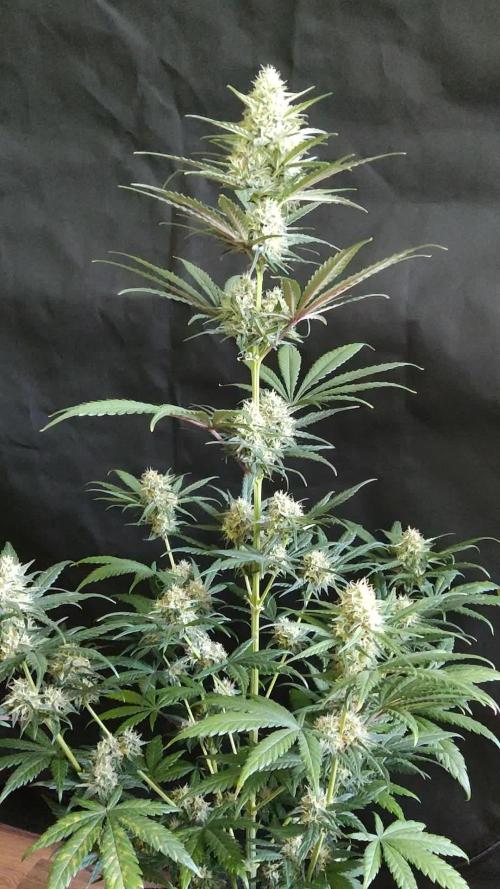
Nice short and firm plants.
It wont be long untill I flip them in to flower

Likes
66
Share


@DogDoctorOfficial
Follow
i decided its time to start flushing this girls, so for this week only i will give them some enzymes and conditioner and after that just water for the next couple of weeks , lets see how long it will take them to finish 😅😆 so far I’m pretty happy with all of them, nothing to point out all is going as supposed 🙏💚 keeping my Par and VPD the same for now but soon i will start lowering them so that by the ending of this cycle I’l finish around 450/600 Ppfd
Week 8 day 50 since flipped to 12/12, I’m flushing and all is going as nomal, starting to fade out and I’m loving the frosty levels so far 😅🤩💚💚💚🙏🙏🙏
No idea why this doesn't allow me to crate a new week but I’ll keep updating here
Day 59 F And they are getting closer and closer but stil not ready, checking tricomes every day but all still very clear to my taste 😆 i think one more week at least, let’s see how they roll 🙏💪💚
Day 63 F And they are close but not there yet 😅 provably next couple days , I’ll keep on checking 😆 patience is a virtue, specially in this faze 💚😅
Week 11 day 72 FLower and j just gave them last watering 😅😁 they will have the day to enjoy lights as from today there will b no more of it for this girls 😅 i will do a 48h dark before harvest to increase more the tricomes production and the thc/cbd levels . From there hehehe we know whats coming from there , but lets wait for that time to comment on it 😆😅😁
Growers love you all see you on harvest mode asap hihihi
Ppfd- 1400 wUmol/m2s
VPD-A 1.51 kPa
Girls :
Tropicana Poison @sweetseeds - 7X
Chocolate Skunk @00seeds - 2X
Badazz Cookies OG @seedsman- 3X
Lights 2X Lumatek Zeus 465W Compact Pro @ 100%
All i Grow is medicine for myself, i do it with love for the love 💚💚💚
Growers love to you all💚💚💚


Likes
3
Share


@Unculti_responsable
Follow
Esta semana la dejamos más tranquila a la Jack solo le hicimos un trasplante a 5 litros quedo bien , la dejamos recuperar unos días y después le hacemos las últimas podas y ya va a estar lista para florecer

Likes
13
Share


@NicoKh
Follow
Was a little bit challenging for me, due to the outdated nutrients table, mostly on the Flowering period, also little thing like i have to fill more the pots, also with this kind a strain and also with cuts instead of seeds, may be is better to don't do the topping and don't loose time and energy on the vegetative period. At the same time, more or less about the 8th week of flowering it starts to appear something like Alternalia or Overfeed of Phosphor still don't sure. All this issues have impact the grow in terms of the size of the branches and the whole plant, the size of the buds and the hardness.
In strictly terms about the strain, the quality is out of mind, amount of resin is crazy, just have to improve my skills and get bigger crops



Likes
72
Share


@Natrona
Follow
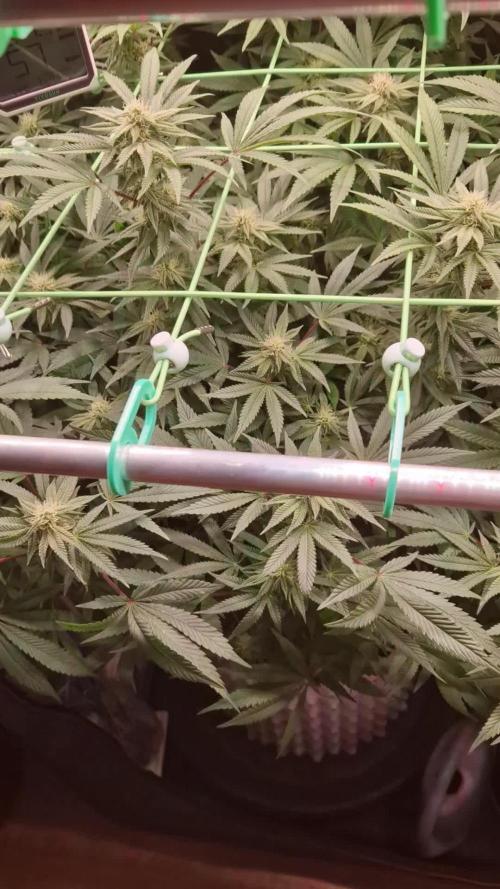
Welcome to week 9. 7/2 today I defoiliated some damaged leaves from Gaia and Circe trying to make them look presentable. The lock out has done damage last will last until they are harvested.
Last week was flushing every 2 days with 2 gallons of water for each plant in the tent. PH of the soil is down from 8 .2 to 7.2 not so alkaline.
7/3 water feed and some pics. I made 4 gallon fertilizer solutions using
TPS1 fertilizer 10ml per gal. I made 1/2 strength at total 22,5ml
Signal 1ml per gal. Total 2.5ml
Ppm total 620
After I fed 4 liters each I followed 3 hours later to test the run off.
Cream caramel Ec .99 ppm 690 ph 5.95 runoff 2 ltr in drip pan
Gaia EC .88 ppm 620 ph 6.82 run off 2.5 ltr
Circe Ec 1.30 ppm 910 ph 6.16 runoff .75 ltr
7/4 reduced light schedule to 15 hrs from 18 hrs.
7/5 flushed all with 2 gal each
7/6 cream Caramel is showing lockout now too😨 even with flushing.
7/7 more flushing.
Last week I mentioned books that I've read that influenced my thoughts, beliefs and how I see the world. I grew up in the 1970s, ( my formative years) in Tidewater Virginia, situated on the Atlantic Ocean. Friends and I went to the beach, not for fun in the sun but to go to the A.R.E. The ARE is Edgar Cayce's, Association for Research and Enlightenment and the Heritage store which was a new age metaphysical crystal shop with crystals, stones, meditation, and yoga classes. I scoured old bookstores looking for books written on spiritualism, psychology, alternative religions, old doctor books, etc. My desire to be a healing practitioner stems from my books from Jeanne Rose in 1970s. She is the first herbal medicine woman in modern times. Florence Scovel Shinn, metaphysician, lecturer, artist- The Game of Life and others written in 1925. Edgar Cayce's trance readings. The older books are out of print but may still be found. There is a River is Edgar Cayce's life story. Hidden Life of Trees is a must read. It explains connectedness.
Interestingly, my great uncle, in his writings (above) references the spiritual laws written in the books mentioned above. From various religious scriptures, the existence of personal behavioral laws, as I would describe as code of honor, as indicated are the ways to true Peace. Throughout my generations the search for spiritual truths have fallen outside the realm of traditional religious formation. From the spiritual sense, I have emerged full circle.
grandparents' and parents' lifetimes, there were world wars. Everyone had a focus on world peace. Mucha's quote on week 8 emphasizes the need to build bridges, to achieve peace.
Sadly, I remember watching the Vietnam War on the news when I was growing up.
Well I started college with dream of becoming a doctor, but changed to business and accounting. During my college years, I worked part time jobs in a stock brokerage firm and jewelry store. From that point on I loved nice jewelry and desired the unusual gemstones that were mentioned by Edgar Cayce. Eventually I started my career in Accounting working in in hospitals, banking and finally in local and state government and higher education. In my late 30's having a midlife crisis, I felt that I really belonged in as a healer. I considered homeopathic school but my daughter was recently born. I did not want to travel to New York and be away from my family. An opportunity missed. My words of wisdom: If you have strong feelings in your gut, the little voice in your heart tells you that "this", what ever this represents to you, is your path. Follow your dream. My gut still gnaws at me.
I graduated with a BS in accounting with a minor in psychology, continues my education thru MBA. My entire career was in accounting and finance. My last position was the Director of Financial Reporting and Revenue. I was happy, loved my job, I had a great staff. My plan was to work until I was 70 as I have good genes for longevity. Cancer changed that. The focus of oncologists is to check the cancer free box at 5 years. I'm working on cleaning up the aftermath of the storm. Yeah, my hormones are still wrecked. Ladies and Gentlemen, tell all the females you know, never take hormone replacement therapy. Try acupuncture, herbal teas, deep breathing.
Likes
8
Share


@CecilioJardinero
Follow
Se van a la última semana de vegetación. 🌲🌱
Las estamos recuperando de un estrés debido al exceso de agua en el sustrato, a 🇨🇱 ya llego el invierno y está costando más secar la tierra para volver a regar 🍂🏔️🏔️🏔️🌧️

Likes
41
Share


@HollowSource
Follow
Crazy growth. Just crazy. The rest of the ladies are up on pots to try and keep the canopy as level as possible. She is super thirsty and is needing her nutrients upped. The training has really paid off, she has a cracking canopy. Looking forward to seeing her develop 😎

Likes
4
Share


@Organic473
Follow
Lovely weather this week had her dry out and fed her then I defoliate and started training her lower branches. I started seeing pre flowers but I will keep her in veg for anther 2 weeks.

Likes
9
Share


@Mr_nugs_lover_David
Follow
She looks extremely frosty and stink like good lemony shit it's crazy but she doesn't smell like the other phenotype I have of lemon pie,she smells very citric but very floral at the same time, very sweet, her sister smells just like moby dick. Can't wait to try this lady 😍

Likes
3
Share


@High_Grade_Dadli
Follow
Moved dem girls into direct sunlight so they are getting more light coverage now....jus leave dem to do their


Likes
16
Share

@GERGrowDesigns
Follow
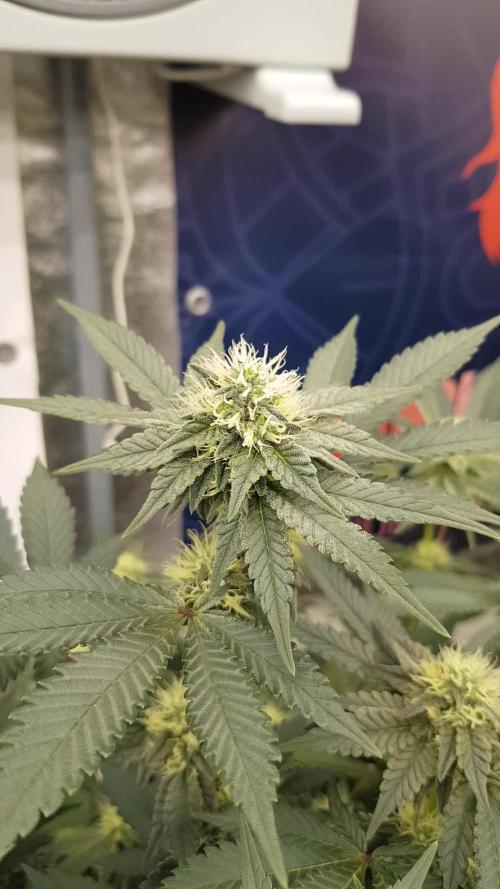
Welcome to Flower Week 3 of Kannabia Zoap Rosé
I'm excited to share my grow journey with you from my
Kannabia Seeds Project . It's going to be an incredible ride, full of learning, growing, and connecting with fellow growers from all around the world!
Check out Kannabia Seeds with my link [https://www.kannabia.com/de?ref=61966] and grab the germination device or the strains I used . Trust me – it’s worth it for sure !
Get another 20% Discount at all products using the code [GGD] at the checkout.
For this Project , I’ve chosen the Feminized Photo Strain Zoap Rosé :
Here’s what I’m working with:
• 🌱 Tent: 225x150x150
• 🧑🌾 Breeder Company: Kannabia Seeds
• 💧 Humidity Range: 50
• ⏳ Flowering Time: 56-63 Days
• Strain Info: 22%THC
• 🌡️ Temperature: 26
• 🍵 Pot Size: 20
• Nutrient Brand: Hy-Pro
• ⚡ Lights : 600W x 2
A huge thank you to Kannabia Seeds for allowing me to try my Best with this amazing collection from Photo Strains they managed to Sponsore . Big thanks for supporting the grower community worldwide! Your genetics and passion speak for themselves!
Let’s grow together – and don’t forget to stop by again to see the latest updates!
Happy growing!
Stay lifted and stay curious!
Peace & Buds!

Likes
5
Share

@PapaTerps
Follow
Monaco - Nine Weeks Harvest
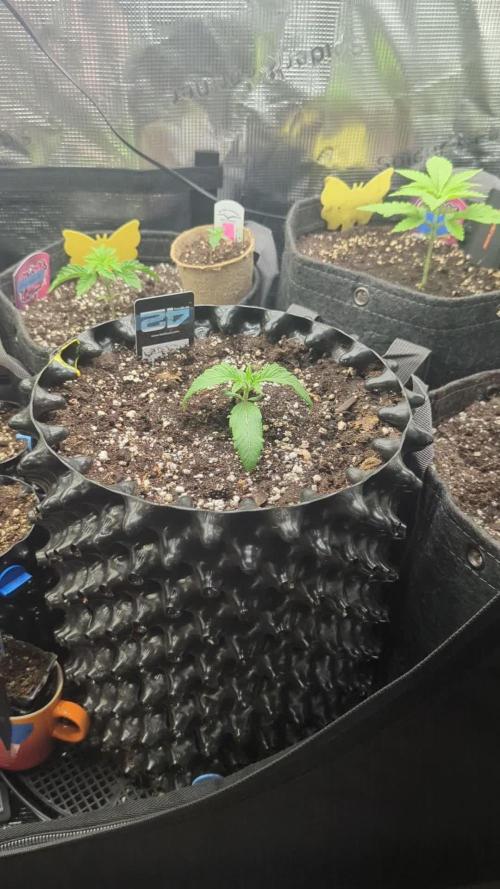
Day 20 - I've transplanted her to her main grow pot, a 10L "original air pot", which are meant to actively enhance the development of healthy roots. I also watered her with 1L of RO tap water, with defined nutrients mixed individually in order and then pH'd to 6.3. I will now let her settle in over the next few days before she's watered again. 🙏🏻

Likes
3
Share

@Organic473
Follow
I love how this girl came back legendary silver haze…this is her first week of flower. She will be crossed with skunk regular pollen for a legendary new strain.
Likes
8
Share


@Salokin
Follow
The week went again pretty uneventful, other than me not getting the tip burn under control. I have further reduced base nutrients, removed the green sensation (simply because I ran out ;)) and increased pk 13/14 further. The buds continue to develop new pistils and continue to swell. The trichomes look mostly milky at this stage, I will however wait until I have around 20%-25% amber. I have cut a bud from the lower canopy (pictures attached), which is quite solid to touch and had a wet weight of roughly 1,2 gr and is currently drying. Overall the bud structure on this plant looks amazing the buds a re super dense, nicely clustered around the stems and she looks like she'll be a joy to trim.
Likes
28
Share


@Felloffthegrid420
Follow
9 and half foot tall lil yellow low part look like red ants might be eating the bark was 4 or 5 there at the hole on the steam of the plant

Processing
Likes
9
Share


@TheWeedPimp
Follow
Think the last mixture was a little to Strong looks like she burned some of the flowers 😅 but otherwise she’s doing good! Just one little area was infected with mold. Removed it.... check to her in weekend again
Hope she can get a least 3-4 weeks more what do you guys think ?

Likes
5
Share


@Efflorescent11
Follow
I believe this is around week 10 I haven’t been keep up with the time frame..
Likes
27
Share


@LSchnabel
Follow
This plant was amazing from start to finish.
I will update a final comment soon as well as final weigh and a review of the smoke once sent out to a group of testers.