The Grow Awards 2026 🏆
Likes
Comments
Share
@dcneardc
Follow
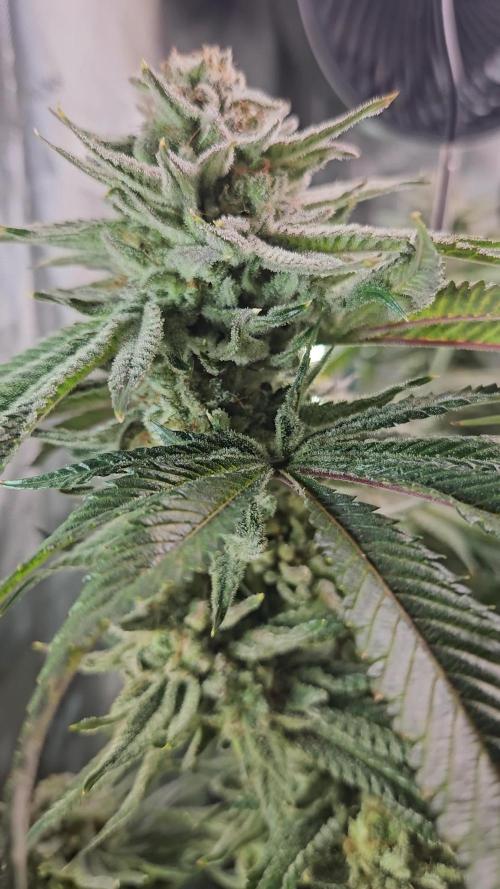
Day 64 - True to the strain description she's coming on strong. I have a little more of last week's nute mix to go and then all water from here on out. I put her in a ScrOG net to help with the humidity and did minor trimming of the bottom 1/5th. As you can see from the pictures: tons o'frost. Starting to get milky and the rest of the pistils below the top are beginning to get color. Supposedly tomorrow is harvest day but I don't see it. I may let her go to day 70 but I'll be checking every day. She might surprise me.

Likes
145
Share
@StarLorr
Follow
Welcome to My Pro~Mix Open Top Grow Bag diary. The end is near my friends😎 3-4 days at the most. Feeding: Sun 03Dec:3L water flawless pH'd 6.5 Wed06Dec:3L water flawless pH'd 6.4 Thanks for stopping by, likes and comments are duly appreciated 👊🏻😎 Keep on growin! Keep on tokin!!! 😙💨💨💨💨💨
Likes
5
Share
@buzbun
Follow
today is the harvest day.make pohot before chopping on 65 day
Likes
7
Share
it's big I must say that it has an imposing structure although it is still low and its stem is very big and mighty like the leaves no problem to highlight here everything is ok ... I forgot .... the bloom has already started a few days ...
Likes
346
Share
@Canna96
Follow
This week went pretty well, other than she stretched like crazy and I am now getting worried about running out of vertical space. I also had a few of my bottom leaves get a few brown and yellow spots on them. I did post some pics and asked a question, thank you for the responses, much appreciated! I am thinking about adding my Spyder Farmer LED 100 Watt light into the tent for the nebula auto because it is about 23 inches shorter than the sour diesel. I believe it would only raise my temp about 2 degrees, and possibly lower the humidity by one or two percent. I must say my dehumidifier has been a freaking stud, running 24X7 and not complaining. I should look into adding another unit, it has been in the mid 90's and muggy for about a week. So far I have to say I am super impressed and excited with this setup, the genetics, and with growing this wonderful plant in general. Already planning ahead to my next grow, and what I can do better. I have been enjoying myself and I really appreciate everyone who has taken the time to answer my questions! I am having a blast and am excited to see what this lady will give up in a few weeks!
Processing
Likes
3
Share
30 September 2020 Sunset Sherbet Plant is growing very strong and the bottom 3 cola branches are being stress trained to all edges of the pot, this helps - with all the branches being exposed to the light and to grow the same height as the rest of the canopy. The stem is of this plant is growing really thick 🍑 about 1cm thick Leaves are big and strong reaching ( 15,5cm length ) My experience with growing Sunset Sherbet so far ( Week 6 Day 2 ) This strain from Cape Ape Seeds is actually so good, just the plant itself is a bright lime green and the nugs it will carry is going to be Frosty Purple❄️💜 nugs. By growing this beautiful strain so far it has grown very healthy and just in general very fast, this plant has no problems so far and all it wants to do is continue growing. Do-Si-Wine The Do-Si-Wine is growing very well, a very moderate growth as it says in it’s subscription, but none the less still a very grow so far. The bottom 4 colas are all stress trained to the edges of the pot to ensure each branch from each cola gets to grow outwards in its own space and to get more light. The stem is about 0.7cm thick which is not that thick compared to the SunSet Sherbet. While writing this I noticed my she has SNAPPED from her previous stress straining session, I was checking out the stem thickness and noticed the main stem had snapped. But luckily this is not the first this happened and I know how to fix this. To fix this all you need is some tape, now see if the plant didn’t completely break off you can still tape the plant back together and the plant should heal itself within a few days, although I need to wait a bit before I stress train this one again. She started making pistols🤗, but I’m not sure if this is because of the snap or if it’s getting ready to start blooming. All the side branches from the bottom 4 colas are all nice and long growing at a nice rate. The leaves are nice and strong reaching ( 11cm in length ) My experience from growing Do-Si-Wine 🎶🍷 from Cape Ape Seed seed bank is very good so far, on the site it says moderate growth difficulty and it is quite accurate compared to the Sunset Sherbet’s easy growth difficulty, it’s quite fun working with a moderate growth because the plant needs more tending to, for instance the side branches are thinnish and need to be stress trained often to reach the end of the pot, the plant is also very stiff because she snapped without me realising and had to tend to the break a day later. Also while growing this plant I noticed that the plant’s leaves are very dark green and the bud it’s going carry is going to be white so I can’t wait to see how she makes her buds.
Likes
12
Share
@Rob96
Follow
Really late to post this week so gotta do next week aswell tonight, plant been doing really well, quite different to the others in terms of height, much higher and plant is almost touching lights, regardless she has been doing fine no problems, she seems to be able to really hack the heat as she’s not even burnt at top, fattening up a bit more now. Overall quite pleased
Likes
11
Share
Ready for a week of water only. Really frosty buds and extremely fruity terps. I did hit he with a little dose of PK before the flush which looks like it has helped.
Likes
6
Share
@Kendoda
Follow
It’s day 1 of week 7 flower. She’s looking a little hungry today. Last week I reduced the feed as I had a little nute burn, the general appearance of the plant is looking slightly lighter in colour, so this week I’ll add back the extra 0.5 ml of each nute. Three more feeds of 1.5 l then on to the plain water.
Likes
9
Share
after 10days in the 12/12 light cycle we lollipopped our plants a little bit. 3 days later we were shocked: the supa choopz was hermaphroditic...What an unfortunate thing considering the good genetics of zmoothiez. We sorted her out, luckily we still have a clone in reserve and he will now make use of the free space. The clone only had one week of veggie in the tent then it was sent into flowering, it has developed magnificently and is as big or bigger than the other ladies but unfortunately not quite as strong. We are still curious and hope for no further unpleasant surprises.
Likes
25
Share
@DrGanj
Follow
This plant was a dream to grow, wish I'd taken cuts. Halfway through dry at 7 days. Drying at 55 - 60 % RH and 17 - 19 degrees C. I anticipate she'll be done between 10 - 14 days total dry time and I'll then trim and update weights on this Harvest. 133.75g total after trim. She's a nice smoke, very happy.
Likes
116
Share
Вот мы и прошли рубеж в 100 дней от каски. К сожалению, задерживается доставка моего досвета, надеюсь успеть установить до конца грова. Переключился на нижний обдув. 27/04 PH6,0 PPM1200 28/04 PH6,1 PPM1080 01/05 PH5,9 PPM1490 Надо промывать 👉Планирую сделать интересный досвет низов по периметру, оставайтесь на связи. Спасибо, что заглянули, и будьте здоровы! 🙏 Продолжение следует ...😶
Likes
18
Share
Day 66 : These lady is exploding day each day. From each cola started new growth. And all this pistils are still white, any brown pistils. So imagine the crystals, all cloudy.!!! She likes food and its obvious. I found a spider in the room but let her become part of the ecosystem. These spiders eats all king of predators like white flies, tetranychus, thripe etc. If you are in flower stage and you have bugs , you cant spray nothing, because of moisture. You can add ladybugs (Coccinella) and they will destroy all the insects. Edit (Day 70) : Small buds explode from buds. I watered with juice on this lady because her trichomes are still developing. If you notice some stems inflect , because of the weight of buds. Gains are noticeable when i lift the pot. 2 weeks for sure for BC.
Likes
11
Share
fast growing auto, overloaded on nutes with this one but she still produced beautiful buds
Likes
28
Share
If you are lonely when you are alone, then you are in bad company. Bee pollen is considered a “vitamin bomb” due to the presence of almost all vitamins with an average of 0.02–0.7% of its total content, with a higher amount of water-soluble than fat-soluble vitamins. Bee pollen contains vitamins A, D, E, B1, B2, B6, and C. It also provides minerals such as calcium, magnesium, phosphorus, potassium, zinc, copper, manganese, iron, and selenium, I mixed a bunch of that with some honey and RAW cane molasses to make a nice big bucket of tea. A family friend who is a beekeeper was kind enough to share some honey. The nutritional content of raw honey is impressive and includes high levels of protein, amino acids, B vitamins, calcium, manganese, potassium, magnesium, zinc, and iron, as well as various polyphenolic antioxidants. I am loading up nature's finest sugars, and sweet things, Honey & Mollases. UV-B-induced DNA damage (CPDs and 6–4 PPs) can be repaired efficiently by photolyases. Pyrimidine dimers can be repaired by nucleotide excision repair (NER), or bypassed by replicative polymerases (Britt 2004). The expression of the CPD photolyase (PHR) gene is induced by UV-B light dependent on UVR8 signaling pathway, and is also induced by blue and UV-A light (Li et al. 2015) https://link.springer.com/article/10.1007/s44154-022-00076-9?fromPaywallRec=true Old but gold. The camera picks up far more light than there is during the night cycle, camera is showing bright pink violet collages but my eyes barely see a thing, about 0.25ppfd in that tent overnight. Have been tweaking the spectrum of moonlight/intensity and watching the responses overnight. Tweak, tweak, tweak all week. PAR is 400-700nm, Overnight UVA in the tent is all 365nm and 385nm, so the meter only picks up a fraction of the light curve that makes it photosynthetically active past 400nm. Of the light in the tent, 0.25ppfd is from UVA Looks like It makes them 🕺 🕺 💃 all night. Better flower soon or ill be screwed for space, they are stretching, but is it "the stretch"? She has fire in her belly. Growing crops with insufficient light (i.e., below “optimal,” as defined here) limits the yield potential, which in turn wastes the other production inputs including labour, water, nutrients and electricity. As lighting fixture is one of the most expensive investment of the production, what is the relationship between light intensity and yield? Potter and Duncombe (2012) grew cannabis plants with varying canopy-level PPFDs during the flowering stage and found that increasing PPFD from 400 to 900 μmol·m−2·s−1 increased yield an average of 1.3 times higher, across seven cultivars, with no light intensity treatment effects on floral cannabinoid concentrations. Vanhove et al. (2011) found that cannabis yields were 1.3 to 3.1 times higher (depending on cultivar) when plants were grown under approximately 1000 μmol·m−2·s−1 compared to approximately 450 μmol·m−2·s−1 during the flowering stage.It was predicted that cannabis yield would exhibit a saturating response to increasing Light intensity, thereby signifying an optimum light intensity range for indoor cannabis production. However, a new research from Morrison (2021), after 81 days‘ experiment, found that When plants grew under LI ranging from 1200 to 1800 μmol·m–2·s–1 provided by light emitting diodes (LEDs), inflorescence yield increased linearly as LI increased up to 1800 μmol·m–2·s–1. "Cannabis will not stop flowering if the lights are turned on for a few minutes once or twice during the 2-month-long flowering cycle. If a light is turned on for 5 to 30 minutes—long enough to disrupt the dark period—on 3 to 5 con­secutive nights, plants will start to revert to vegetative growth." "Less than one half of one foot-candle of light (0.1ppfd) from sunlight will prevent cannabis from flow­ering. That is a little more light than is reflected by a full moon on a clear night. Well-bred indica-dominant plants will revert within three days. Sativa-dominant plants take four to five days to revert to vegetative growth. Once they start to revegetate, it can take from four to six ad­ditional weeks to induce flowering again!" Guess ill find out my answer soon.
Likes
52
Share
Lacewings seemed to have mostly killed themselves by flying into hot light fixtures. I may have left the UV on which was smart of me :) Done very little to combat if anything but make a sea of carcasses, on the bright side its good nutrition for the soil. Made a concoction of ethanol 70%, equal parts water, and cayenne pepper with a couple of squirts of dish soap. Took around an hour of good scrubbing the entire canopy. Worked a lot more effectively and way cheaper. Scorched earth right now, but it seems to have wiped them out almost entirely very pleased. Attempted a "Fudge I Missed" for the topping. So just time to wait and see how it goes. Question? If I attached a plant to two separate pots but it was connected by rootzone, one has a pH of 7.5 ish the other has 4.5. Would the Intelligence of the plant able to dictate each pot separately to uptake the nutrients best suited to pH or would it still try to draw nitrogen from a pot with a pH where nitrogen struggles to uptake? Food for stoner thought experiments! Another was on my mind. What happens when a plant gets too much light? Well, it burns and curls up leaves. That's the heat radiation, let's remove excess heat, now what? I've always read it's just bad, or not good, but when I look for an explanation on a deeper level it's just bad and you shouldn't do it. So I did. How much can a cannabis plant absorb, 40 moles in a day, ok I'll give it 60 moles. 80 nothing bad ever happened. The answer, finally. Oh great........more questions........ Reactive oxygen species (ROS) are molecules capable of independent existence, containing at least one oxygen atom and one or more unpaired electrons. "Sunlight is the essential source of energy for most photosynthetic organisms, yet sunlight in excess of the organism’s photosynthetic capacity can generate reactive oxygen species (ROS) that lead to cellular damage. To avoid damage, plants respond to high light (HL) by activating photophysical pathways that safely convert excess energy to heat, which is known as nonphotochemical quenching (NPQ) (Rochaix, 2014). While NPQ allows for healthy growth, it also limits the overall photosynthetic efficiency under many conditions. If NPQ were optimized for biomass, yields would improve dramatically, potentially by up to 30% (Kromdijk et al., 2016; Zhu et al., 2010). However, critical information to guide optimization is still lacking, including the molecular origin of NPQ and the mechanism of regulation." What I found most interesting was research pointing out that pH is linked to this defense mechanism. The organism can better facilitate "quenching" when oversaturated with light in a low pH. Now I Know during photosynthesis plants naturally produce exudates (chemicals that are secreted through their roots). Do they have the ability to alter pH themselves using these excretions? Or is that done by the beneficial bacteria? If I can prevent reactive oxygen species from causing damage by "too much light". The extra water needed to keep this level of burn cooled though, I must learn to crawl before I can run. Reactive oxygen species (ROS) are key signaling molecules that enable cells to rapidly respond to different stimuli. In plants, ROS plays a crucial role in abiotic and biotic stress sensing, integration of different environmental signals, and activation of stress-response networks, thus contributing to the establishment of defense mechanisms and plant resilience. Recent advances in the study of ROS signaling in plants include the identification of ROS receptors and key regulatory hubs that connect ROS signaling with other important stress-response signal transduction pathways and hormones, as well as new roles for ROS in organelle-to-organelle and cell-to-cell signaling. Our understanding of how ROS are regulated in cells by balancing production, scavenging, and transport has also increased. In this Review, we discuss these promising developments and how they might be used to increase plant resilience to environmental stress. Temperature stress is one of the major abiotic stresses that adversely affect agricultural productivity worldwide. Temperatures beyond a plant's physiological optimum can trigger significant physiological and biochemical perturbations, reducing plant growth and tolerance to stress. Improving a plant's tolerance to these temperature fluctuations requires a deep understanding of its responses to environmental change. To adapt to temperature fluctuations, plants tailor their acclimatory signal transduction events, specifically, cellular redox state, that are governed by plant hormones, reactive oxygen species (ROS) regulatory systems, and other molecular components. The role of ROS in plants as important signaling molecules during stress acclimation has recently been established. Here, hormone-triggered ROS produced by NADPH oxidases, feedback regulation, and integrated signaling events during temperature stress activate stress-response pathways and induce acclimation or defense mechanisms. At the other extreme, excess ROS accumulation, following temperature-induced oxidative stress, can have negative consequences on plant growth and stress acclimation. The excessive ROS is regulated by the ROS scavenging system, which subsequently promotes plant tolerance. All these signaling events, including crosstalk between hormones and ROS, modify the plant's transcriptomic, metabolomic, and biochemical states and promote plant acclimation, tolerance, and survival. Here, we provide a comprehensive review of the ROS, hormones, and their joint role in shaping a plant's responses to high and low temperatures, and we conclude by outlining hormone/ROS-regulated plant-responsive strategies for developing stress-tolerant crops to combat temperature changes. Onward upward for now. Next! Adenosine triphosphate (ATP) is an energy-carrying molecule known as "the energy currency of life" or "the fuel of life," because it's the universal energy source for all living cells.1 Every living organism consists of cells that rely on ATP for their energy needs. ATP is made by converting the food we eat into energy. It's an essential building block for all life forms. Without ATP, cells wouldn't have the fuel or power to perform functions necessary to stay alive, and they would eventually die. All forms of life rely on ATP to do the things they must do to survive.2 ATP is made of a nitrogen base (adenine) and a sugar molecule (ribose), which create adenosine, plus three phosphate molecules. If adenosine only has one phosphate molecule, it’s called adenosine monophosphate (AMP). If it has two phosphates, it’s called adenosine diphosphate (ADP). Although adenosine is a fundamental part of ATP, when it comes to providing energy to a cell and fueling cellular processes, the phosphate molecules are what really matter. The most energy-loaded composition for adenosine is ATP, which has three phosphates.3 ATP was first discovered in the 1920s. In 1929, Karl Lohmann—a German chemist studying muscle contractions—isolated what we now call adenosine triphosphate in a laboratory. At the time, Lohmann called ATP by a different name. It wasn't until a decade later, in 1939, that Nobel Prize–-winner Fritz Lipmann established that ATP is the universal carrier of energy in all living cells and coined the term "energy-rich phosphate bonds."45 Lipmann focused on phosphate bonds as the key to ATP being the universal energy source for all living cells, because adenosine triphosphate releases energy when one of its three phosphate bonds breaks off to form ADP. ATP is a high-energy molecule with three phosphate bonds; ADP is low-energy with only two phosphate bonds. The Twos and Threes of ATP and ADP Adenosine triphosphate (ATP) becomes adenosine diphosphate (ADP) when one of its three phosphate molecules breaks free and releases energy (“tri” means “three,” while “di” means “two”). Conversely, ADP becomes ATP when a phosphate molecule is added. As part of an ongoing energy cycle, ADP is constantly recycled back into ATP.3 Much like a rechargeable battery with a fluctuating state of charge, ATP represents a fully charged battery, and ADP represents a "low-power mode." Every time a fully charged ATP molecule loses a phosphate bond, it becomes ADP; energy is released via the process of ATP becoming ADP. On the flip side, when a phosphate bond is added, ADP becomes ATP. When ADP becomes ATP, what was previously a low-charged energy adenosine molecule (ADP) becomes fully charged ATP. This energy-creation and energy-depletion cycle happens time and time again, much like your smartphone battery can be recharged countless times during its lifespan. The human body uses molecules held in the fats, proteins, and carbohydrates we eat or drink as sources of energy to make ATP. This happens through a process called hydrolysis . After food is digested, it's synthesized into glucose, which is a form of sugar. Glucose is the main source of fuel that our cells' mitochondria use to convert caloric energy from food into ATP, which is an energy form that can be used by cells. ATP is made via a process called cellular respiration that occurs in the mitochondria of a cell. Mitochondria are tiny subunits within a cell that specialize in extracting energy from the foods we eat and converting it into ATP. Mitochondria can convert glucose into ATP via two different types of cellular respiration: Aerobic (with oxygen) Anaerobic (without oxygen) Aerobic cellular respiration transforms glucose into ATP in a three-step process, as follows: Step 1: Glycolysis Step 2: The Krebs cycle (also called the citric acid cycle) Step 3: Electron transport chain During glycolysis, glucose (i.e., sugar) from food sources is broken down into pyruvate molecules. This is followed by the Krebs cycle, which is an aerobic process that uses oxygen to finish breaking down sugar and harnesses energy into electron carriers that fuel the synthesis of ATP. Lastly, the electron transport chain (ETC) pumps positively charged protons that drive ATP production throughout the mitochondria’s inner membrane.2 ATP can also be produced without oxygen (i.e., anaerobic), which is something plants, algae, and some bacteria do by converting the energy held in sunlight into energy that can be used by a cell via photosynthesis. Anaerobic exercise means that your body is working out "without oxygen." Anaerobic glycolysis occurs in human cells when there isn't enough oxygen available during an anaerobic workout. If no oxygen is present during cellular respiration, pyruvate can't enter the Krebs cycle and is oxidized into lactic acid. In the absence of oxygen, lactic acid fermentation makes ATP anaerobically. The burning sensation you feel in your muscles when you're huffing and puffing during anaerobic high-intensity interval training (HIIT) that maxes out your aerobic capacity or during a strenuous weight-lifting workout is lactic acid, which is used to make ATP via anaerobic glycolysis. During aerobic exercise, mitochondria have enough oxygen to make ATP aerobically. However, when you're out of breath and your cells don’t have enough oxygen to perform cellular respiration aerobically, the process can still happen anaerobically, but it creates a temporary burning sensation in your skeletal muscles. Why ATP Is So Important? ATP is essential for life and makes it possible for us to do the things we do. Without ATP, cells wouldn't be able to use the energy held in food to fuel cellular processes, and an organism couldn't stay alive. As a real-world example, when a car runs out of gas and is parked on the side of the road, the only thing that will make the car drivable again is putting some gasoline back in the tank. For all living cells, ATP is like the gas in a car's fuel tank. Without ATP, cells wouldn't have a source of usable energy, and the organism would die. Eating a well-balanced diet and staying hydrated should give your body all the resources it needs to produce plenty of ATP. Although some athletes may slightly improve their performance by taking supplements or ergonomic aids designed to increase ATP production, it's debatable that oral adenosine triphosphate supplementation actually increases energy. An average cell in the human body uses about 10 million ATP molecules per second and can recycle all of its ATP in less than a minute. Over 24 hours, the human body turns over its weight in ATP. You can last weeks without food. You can last days without water. You can last minutes without oxygen. You can last 16 seconds at most without ATP. Food amounts to one-third of ATP production within the human body.
Likes
4
Share
UPGRADE: got a new 4x4 tent, dwc in the back. How ever back to the strain. It is still a Salad, no stretch in sight. I have no clue why, but what ever I schwazzed the shit out of the plant in the hopes for some more length, if not its okay, it will perform in the End and it needed to get rid of the leaves anyway. welp lets see