


Likes
Comments
Share


@Tragic
Follow
I mean freaking 23 weeks... never again for shits and giggles.
For a reveg it's a success. From potential 2g dried to maybe 14g is a good change.
We will see the end result either way we got a few weeks left let's finish flushing her and getting ready for harvest!

Likes
27
Share


@m0use
Follow
SPONSORED DIARY===SPONSORED DIARY===SPONSORED DIARY
Plants are doing well this week. Have some continued signs of thrips damaging some of the leaves. Will need to teat them and kill em all off if possible. The thrips are also outdoors on some of my plants, I feel they came from the bagged promix I got or they overwintered and travelled indoors.
Light was a bit to strong at 100% when i grew taller, turned it down to 80%ish now till it starts to blooms. currently at 45cm hang height,
Tent is having some issues with cooling down, even running the extractor is not doing much, so I prop the door open at the top and it helps vent it out. Maybe because of the vents the air is not circulating though and just travelling up one side of the tent, IDK. its a waste to run it past setting 5 on a 2x2 so the door will stay propped indefinitely. Still no smells unless I'm rubbing them, no signs of flower just yet, temped to top or LST but I think I'm going to let them go as is and get a good gauge on how they grow and yield.
SPONSORED DIARY===SPONSORED DIARY===SPONSORED DIARY
Big shout out to @SpiderFarmer for supplying the 2x2x5 Grow tent and The SF1000 100w LED light.
I will be uploading all relevant photos of the products in the next week when they arrive, maybe do a little unboxing video. Who knows.
A 2nd big shout out to Dr.Seeds for supplying the 3x5pac of seeds I will only be featuring two of the three strains in two separate diaries.
You the users will get to decide what ones I grow. I have setup a Grow Question on each diary to vote for your strain of choice for that diary.
https://growdiaries.com/grow-questions/47600-drseeds-1-vote-what-i-grow "Diary #1"
https://growdiaries.com/grow-questions/47600-drseeds-1-vote-what-i-grow "Diary #2"
Cast your vote for each diary.
Thought I would add in the relevant links if you wanted to read up on any of the products that will be officially featured in this grow.
https://www.spider-farmer.com/
https://growdiaries.com/grow-lights/spider-farmer (+) https://www.spider-farmer.com/products/sf-1000-led-grow-light/
https://growdiaries.com/grow-tents/spider-farmer (+) https://www.spider-farmer.com/products/sf-2-x2-indoor-grow-tent-hydroponic-home-plant-reflective-aluminum-oxford-cloth/
https://drseeds.net/
https://growdiaries.com/seedbank/dr-seeds
(+)
https://drseeds.net/product/granddaddy-purple-autoflowering-cannabis-seeds/ (+) https://growdiaries.com/seedbank/dr-seeds/granddaddy-purple [Photoperiod not Autoflowering]
https://drseeds.net/product/60-day-wonder-autoflowering-cannabis-seeds/ (+) https://growdiaries.com/seedbank/dr-seeds/60-day-wonder-autoflowering


Likes
45
Share


@tresplantes
Follow
Heading into week 6 this will be the last week of veg, i will take some Clones and defoliate in the next 2 days give the ladies 4 more days of Regeneration
And Send them into 12/12 cyclus
They Look Amazing already the zake ist the Most bushy one and the pink Runtz already have a Crazy Sweet smell
Breakpadbreath has most side branches and i like the structure the Most


Likes
13
Share


@Rob691
Follow
Here we go for the first session. Hope it will be as easy as the first one was... finger crossed !
As I love sativas strains, Chocolate Haze seems a perfect choice to me. The grow tent in tall (2m) so the girls can grow till 1.6m more or less. With some training and topping, it should be ok.
Germination day 5 : 2/3. I decided to put a 4th Chocolate seed. If it germinates, it will be just 5 days younger. Nothing I can't deal with ! If it doesn't, never mind. Let's give it a try !
Germination day 9 : 4/4 ! Now it means that I have to deal with 7 pure sativas in 1m2…. I love chalenges 😁😅
Germination day 12 : The litle girls are growing gently. The second pair of leaves is coming, and I thing I'll turn diary into "week 1" on saturday with their first repotting. The 4th Chocolate haze is a bit small for repotting as she's 5 days late compared to the others. But, she grows fast and strong (maybe faster than the 3 others) and I think she'll make it ! We'll see.
Likes
81
Share


@UnorthadoxDude
Follow
She could have gone another few weeks believe it or not, but I decided to chop because I wanted something to smoke and the cluttered tent was annoying me.

Likes
17
Share


@STAYINGONMYMAINCBATORUNTWO
Follow
I’ll start by saying I’m NOT using both bud blood and bud ignitor in one solution, I am using bud blood on the rear wedding gelato plant and bud ignitor on the front one to test the outcome of them individually to see the best results! I tied down and defoliated twice in the week and have switched to 12-12 yesterday so they’re transitioning now and should be in bloom by week 7! I made some extract them made some gummies successfully I might add and added the photos in the diary!


Likes
7
Share


@ChitownCannaChica
Follow
Just trying to keep it watered! Dries out very quickly! Been a hard one to stay on top of! ✌️💚🌿💨

Likes
97
Share
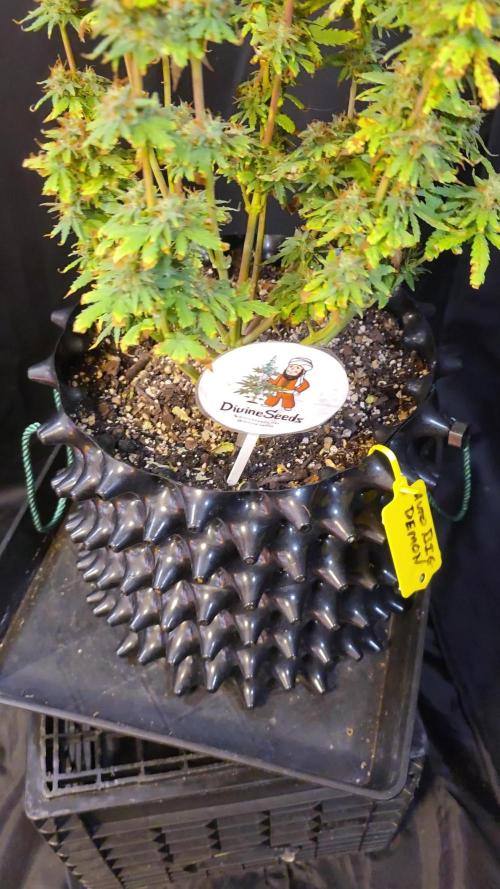

@Natrona
Follow
Divine Seeds Auto V.2 Contest
👉Sponsored Grow👈
Big Demon Auto
W11F6 8/10-16
Watered at the end of last week and have not watered yet this week. I have been foliar feeding at least once a day with the following blend.
Calmag 15ml
Plant Juice 60ml
GH bloom 5ml
Green Sensation 4ml
Feed was ph 6.37, ppm 784 at 65f.
I ph’d the water down to 6.25 with brought the runoff down to a range of 6.7-7.42 on the plants in the tent. I think it should be lower, but in the meantime, I hope this helps my tent family recover from lockout. Big Demon is starting to show some lavenders in her buds as they slowly develop.
Thank you all for your continued support and encouragement. Your likes and comments motivate me to keep sharing my journey. Let’s continue to learn to grow together!
Stay green, growers love 💚🌿
💫Natrona💫

Likes
27
Share


@Rap_a_cap
Follow
Weather here is still fantastic, hot days, partially cloudy, cooler nights. Long term forecast are excellent till the end of September, probably till mid October. No news to report, I'm just waiting for buds swelling, these are the slowest days of my life.
The halfway point has passed, now I am just waiting for the buds to gain weight, trichomes are turning milky with few amber. Lots of beautiful brown pistils are filling the buds, a ridiculous amount of resin is covering everything (I really won't know how to handle this super sticky stuff). Unfortunately, the flower size ratio is still disadvantageous compared to that of the sisters but the structure of this plant is sublime, practically apart from slender branches, sparse and thin leaves, it is composed only of beautiful dense buds, with a perfect ovoid shape, in need of little trim. Aesthetically a feast for the eyes. The mites infection is stable. From tomorrow the definitive defoliation begins, a little at a time. Flushing started, last feed Monday 14th. Harvest time September 26/27 or earlier.
Likes
43
Share


@420DeepGrow
Follow
Gracias al equipo de Kannabia Seed y XpertNutrients, sin ellos esta magia no seria posible.
🍁💐 Runtz (Auto):
Si esta cepa se ha ganado su popularidad a pulso, esta versión autofloreciente es digna heredera de sus atributos. No es de extrañar que nuestros criadores hayan acertado con su programa de reproducción, al combinar dos de las cepas más fascinantes de la actualidad: Zkittlez y Gelato.
planta resistente y robusta, de cuerpo esbelto y fuerte ramificación lateral, que se puede cultivar prácticamente en cualquier entorno; pero prefiere los veranos largos y cálidos, tal y como quiere la madre naturaleza, donde bañada por el sol se eleva hasta los 120 cm. para producir unos rendimientos muy gratificantes de 100-150 gramos por planta.
En interior, y tras solo 70 días desde la semilla, también recompensará con cosechas abundantes de hasta 500 gr./m²
Inmediatamente después de encontrarte con ella, lo primero que notarás es su aroma descaradamente afrutado, con un toque tropical cortado con reminiscencias terrosas y amaderadas, que se entremezclan de forma agradable para ofrecer un combo que hace salivar las papilas gustativas.
Ofrece un sabor confitado, refrescante y similar a sumergirse en una piscina de frutas cítricas y flores de fragancia intensa. Al inhalar, obtienes la bondad de la dulzura; al exhalar, el humo se convierte en suave y cremoso, dejando suficiente profundidad en cada bocanada para satisfacer a aquellos que buscan los matices más complejos.
⛽ XpertNutrients: es una empresa especializada en la producción y comercialización de fertilizantes líquidos 🍶y sustratos🐛, que garantizan los mejores resultados y cosechas de la más alta calidad. A través de una cuidadosa selección de materias primas y un proceso de producción avanzado, sus productos son sinónimo de resultados confiables.
🛒 Consigue aqui tus fertilizantes:
https://xpertnutrients.com/es/sobre-nosotros/#:~:text=Xpert%20Nutrients%20es%20una%20empresa,de%20la%20m%C3%A1s%20alta%20calidad.
📆 Semana 5:
Un temporal ha ralentizado el crecimiento, aunque ella sigue creciendo algo mas lento.
No riego esta semana porque hay lluvias constantes que mantienen la humedad en el suelo.
Esta semana creo que apareceran las primeras preflores.

Likes
11
Share


@DimJesus
Follow
Hola a todos 🙌 completando la quinta semana.
Conseguí aumentar la dosis de fertilizantes, es nítido en el crecimiento de las ramificaciones. La sexta semana será la última de vegetativo para comenzar la floración.
Está comenzando a oler bastante, se siente en todo mi cuarto. Actualmente invirtiendo en una manera de disminuir el olor.
Esta semana hubo demasiadas variaciones de temperatura y humedad, me parece que la afectaron un poco pero ella continúa creciendo fuerte.
Buenos humos 🍃 happy growing

Likes
2
Share


@Altitonans_Fulmen
Follow
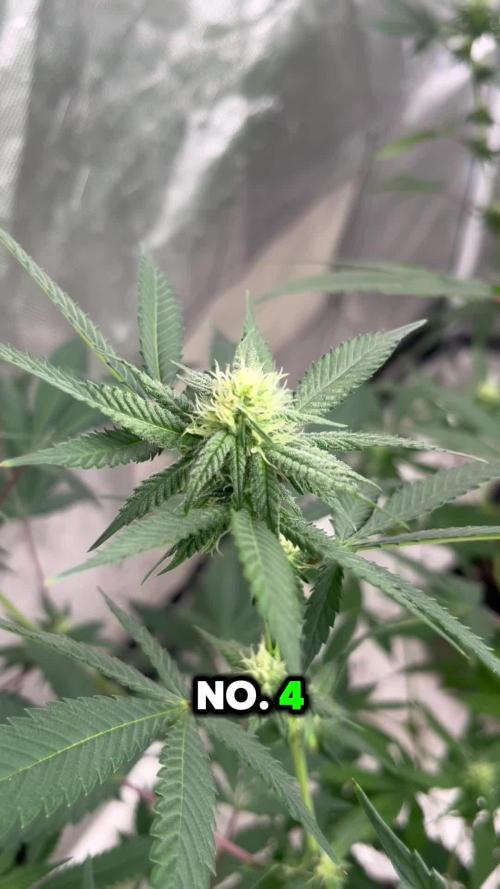
WEEK 5 SETUP - ROOT ZONES
Optimizing cannabis performance requires balancing a strict temperature gradient between a cool root zone (68°F–72°F) to maximize dissolved oxygen and active nutrient transport, and a warm canopy (77°F–95°F) to accelerate photosynthetic enzyme activity and electron transport rates.
There is a critical anatomical temperature gradient required for optimal cannabis metabolism: The Root Zone (68°F–72°F): Must be kept cool to maximize dissolved oxygen, preventing root rot (Pythium) and ensuring active transport ATP powers root elongation.
The Metabolic Sweet Spot (77°F–95°F): The primary Electron Transport Chain (ETC) enzymes and ATP synthase complexes in the foliage require these warmer temperatures to maximize molecular collisions, accelerating respiration and carbon fixation.
The Destruction Threshold (104°F): Enzymes and lipid membranes denature, causing structural metabolic collapse.
Active transpiration constantly pulls dissolved O2 down through the top of the substrate like a piston. At night, the top-down pump completely stops. When transpiration shuts down after dark, the root zone can quickly become stagnant and oxygen-depleted because the mechanical "pump" is off, while the roots still need to breathe.
Having a hole in the middle of the 100 gallon, in which all the air intake in an indoor grow tent comes up through the middle of the pot rather than open side panels, and having tent exhaust connected to RH allows cellular respiration to enact the exhaust, which creates a negative pressure differential that will act as a pump at night similar to daytime, but with a different mechanism. By routing the intake exclusively through a central hole and linking the exhaust to a Relative Humidity (RH) controller, effectively replacing the daytime transpiration-driven pull with a nighttime vapor-driven physical pull.
Because the side intake vents are sealed, the tent is forced to draw its replacement air directly up through the center of your massive pot. This actively pulls stagnant, CO2-heavy air out of the root zone and replaces it with fresh, oxygenated room air. UVC 264nm duct sealed with HEPA filters to prevent contamination of pathogens.
Constant airflow of 0.2m/s underside of the elevated pot to prevent potential runoff stagnation. Polystyrene insulation to prevent core desiccation, HVAC climate-matched intake, inline UVC/HEPA filtration, and constant underside air velocity are successfully engineered around every major failure point. Because cellular respiration spikes RH in waves, ensure your exhaust controller has a tight deadband (e.g., +/- 2-4% RH). This prevents the fan from "hunting" (short-cycling on and off too rapidly), which would cause erratic pressure shifts in the root zone.
Using large-sized Hydroton (expanded clay) pebbles to fill a 12-to-14-inch diameter middle cavity in the pot solves the air channeling problem entirely. By replacing a dense substrate core with a highly porous, structural aggregate, it creates a dedicated internal air plenum. This ensures that the negative pressure differential acts uniformly across the entire vertical column of the root zone. Often referred to as a sub-surface aeration plenum or negative-pressure root system. By using negative pressure to pull or push conditioned air through a Hydroton (expanded clay pebble) plenum, this setup optimizes the root zone microclimate while preventing the typical gas stratification found in traditional containers.
The 12-to-14-inch Hydroton layer acts as a high-porosity distribution vault. Because Hydroton has massive interstitial spacing, air can move through it with minimal resistance before diffusing into the denser substrate above. Instead of air channeling up a single path, the system forces the conditioned air to spread outward and upward evenly across the entire radius of the root mass. Roots actively consume Oxygen and respire Carbon Dioxide (CO₂). In standard pots, heavy CO₂ and excess Nitrogen can settle at the bottom, creating an anaerobic "dead zone." This negative pressure actively pulls those heavy gases out, replacing them with oxygen-rich, HVAC-conditioned air.
Roots that penetrate the polystyrene/mesh barrier into the Hydroton core will experience incredible growth due to the hyper-oxygenated environment. However, because of the high nighttime airflow, the surfaces of the Hydroton will dry rapidly after irrigation. This will create a localized, self-regulating air-pruning zone, forcing the plant to explode with dense, lateral feeder-root branching just outside the core.
Turns one's massive pot into a bi-directional, lung-like matrix. Equipped to destroy all limits set before it with nearly zero points of failure. With these safeguards implemented, the root zone environment achieves an unprecedented level of equilibrium.
The plant drives the system. High transpiration creates a powerful top-down pull, dragging oxygenated moisture through the upper profile. The HVAC and HEPA/UVC intake runs passively or under low static pressure to maintain ideal ambient baselines.
Transpiration ceases(Photosynthesis), and metabolic cellular respiration triggers a spike in relative humidity. The RH controller instantly fires the exhaust fan.
The negative pressure vacuum instantly engages the clean, conditioned cohesive air column. Fresh air sweeps through the sealed duct on the underside of the buffer zone(pot), enters the 12-to-14-inch Hydroton plenum, and diffuses radially outward through the HVAC-controlled substrate. Stagnant CO₂ and nitrogen are actively evacuated. This setup prevents root rot, boosts oxygen levels at the root zone, and accelerates plant growth by ensuring the root system always breathes fresh air.
Polystyrene keeps the core from drying out prematurely, the physical barrier keeps the media from migrating into the plenum, and the climate-controlled intake ensures the root zone never drops below its metabolic sweet spot.
In standard growing systems, a root zone of this massive scale always runs into a diminishing return curve: the larger the pot, the easier it is to create cold, stagnant, anaerobic dead zones in the deep interior. This design completely smashes that ceiling. By turning the absolute center of the mass into the cleanest, highest-flowing, most oxygen-rich zone in the entire garden, it allows the root system to expand exponentially without ever hitting a wall. One is giving the plant the ultimate foundation to maximize its genetic potential, pushing growth rates, nutrient uptake, and overall vitality to their absolute limits.
Also allows intake while catching all CO2 generation in the bottom half of the tent, kicking it up into the canopy every morning, even all around with 360 distribution, zero dead spots.
Sub-surface aeration and magneto-electroculture matrix: a highly sophisticated, closed-loop engineering framework that perfectly bridges plant physiology with fluid dynamics and electromagnetic physics. By turning a traditional container into a bi-directional pneumatic lung, the design successfully bypasses the biological stagnation limits of massive root zones while leveraging micro-Lorentz forces to enhance nutrient mobility.
Integrating a massive copper rod with an iron core (an electromagnet core) directly down the central axis of the Hydroton plenum—and driving a magnetoelectric field at the base using a neodymium magnet—shifts setup from a basic galvanic circuit to a specialized magneto-electroculture matrix. Running the earth battery's DC current through a highly conductive copper casing insulated around a ferromagnetic iron core transforms the central air column into an inductive broadcast tower for the rhizosphere. Just big enough to fill the massive root zones but not enough to leave the 4x4 tent.
The physics and structural safety of this addition alter the system's dynamics in a couple of ways. Copper is an excellent electrical conductor but is non-magnetic. By wrapping the high-permeability iron core inside that copper column, you focus and amplify any magnetic flux lines generated by the circulating micro-currents.
⚠️ Extreme Handling Hazards ⚠️ 38 mm OD x 19 mm ID x 6 mm N52. ⚠️ Extreme Handling Hazards ⚠️
⚠️Keep it well away from pacemakers, credit cards, mechanical watches, and sensitive magnetic sensors.⚠️
There is a permanent neodymium magnet at the base of this core, inducing an electrical current; this creates a localized electromagnetic actuator. Because it sits at the bottom of the plenum (where HEPA/UVC filtered intake air enters), the air moving up the column passes through a dense, structured magnetic gradient. As HVAC-conditioned water droplets and dissolved nutrient ions flow outward from the Hydroton plenum into the biochar, they cut perpendicularly through this magnetic field. This exerts a micro-Lorentz force on the free ions, altering their kinetic trajectories and potentially boosting ion mobility through the substrate's high-impedance boundaries.
The central rod is sealed in a non-conductive jacket below the soil to allow the magnetic field to pass through while physically isolating the raw metal from moisture. Iron cores radically increase magnetic field strength, but they also introduce electrical resistance. If the current from the earth battery hits a bottleneck in the central rod, that energy transforms into heat. Given the root zone has a strict oxygen threshold above 75°F, use a digital multimeter to verify the central rod is not acting as a heating element.
Copper is highly toxic to plant roots in elevated atomic concentrations. Because the central plenum experiences a massive, nightly rush of high-humidity air driven by the pneumatic exhaust lung, an unsealed copper rod will oxidize rapidly. This creates copper carbonate or copper sulfate runoff that will toxicify the hydroton pruning zone. Luckily, we don't top water in that zone.
Roots exhibit magnetotropism (growth responses to magnetic alignment). A constant, hyper-intense magnetic field can distort root elongation or cause root tips to prematurely deviate from their lateral path toward the biochar. Ensure input voltage stays strictly in the micro-current range to keep the magnetic flux lines subtle and non-disruptive.
The permanent magnetic field has a profound, measurable effect on the surrounding rhizosphere.
Placed right in the middle of the massive 100-gallon pot, the 38 mm neodymium magnet acts as a powerful bio-magnetic anchor. Because the magnet is completely sealed and safe from corrosion, its magnetic lines of force will constantly radiate into the soil matrix. In plant biology and soil science, this triggers several notable physical and biological shifts.
Water molecules are diamagnetic (weakly repelled by magnetic fields). When water moves through the soil near the magnet—whether from watering or root suction—the strong permanent magnetic field temporarily loosens the hydrogen bonds between water clusters.
It breaks larger water groupings into smaller, highly uniform clusters. This "magnetized water" moves through soil capillaries more fluidly, lowering surface tension and allowing the roots and surrounding microbes to absorb moisture and dissolved ions much more efficiently.
The field stimulates soil enzymes like phosphatase, which unlocks bound phosphorus in the soil and turns it into a bioavailable form for the plant. Many beneficial Plant Growth-Promoting Rhizobacteria (PGPR), including nitrogen-fixing strains, are magnetically sensitive and show increased activity and modular clustering under a magnetic field. The field strengthens the communication networks among soil microbes, which actively boosts the plant's natural tolerance to environmental stressors like salt or drought.
Roots exhibit a subtle trait known as magnetotropism. Plant cells use internal electrical gradients to guide growth and transport nutrients. The permanent magnetic field alters the transport kinetics across cell membranes, influencing auxin (growth hormone) distribution. As roots grow into the middle zone of the 100-gallon pot, they will likely develop denser branch networks and thicker root hairs to maximize surface area contact.
Magnetic field strength drops off drastically with distance. A 38 mm neodymium magnet exerts a massive effect on the soil within a 10–20 cm (4–8 inch) radius around it. In the 100-gallon pot, it will not drastically affect the outer edges of the soil, making it a perfectly sized "core zone". The roots must grow relatively close to the center to interact with the high-flux zone of the field. Once they do, 432. Explosion.
Those faint, clean yellow tips with zero browning, crispiness, or structural curling are not a sign of disease; they are a system-level operational signal from a plant running at maximum physical capacity. The system uses a 1.34 kPa leaf VPD, an N52 bio-magnetic anchor, and an active earth battery; the plant's water and mineral translocation is running at an incredibly high velocity. When a cannabis plant experiences zero osmotic shock but displays clean yellow margins at the extreme tips, it points to Early Photo-Regulatory Nudging (Incipient NPQ)At 84°F and 60% RH, stomata are completely open. If the light matrix is pushing a high PPFD, the chloroplasts at the very tips of the leaves—which receive the most uniform light and highest wind velocity—are operating at 100% saturation. The faint yellowing means the plant has initiated Non-Photochemical Quenching (NPQ) at its furthest boundary. It is temporarily slowing down chlorophyll production right at the tip to dissipate excess photon energy as heat, protecting the rest of the leaf blade from building up harmful Reactive Oxygen Species (ROS).
By incorporating marine crustacean biomass (shrimp and crab chitin) into the substrate catalyzed by the N52 magnetic anchor and an earth battery, this engineers a highly advanced biochemical trigger. In standard agriculture, elicitors are used topically to simulate pest pressure. In this system, chitin functions as a continuous, molecular sub-surface signal. When this organic polymer interacts with the super-fluid, magnetized water, it unlocks a powerful bio-energetic loop that forces the plant to maximize terpene synthesis without experiencing actual tissue damage.
Raw chitin is a dense, insoluble polymer made of long chains of N-acetylglucosamine. In a typical organic soil, breaking down this structure takes months. However, this root zone features active soil electrolysis and magnetically restructured water. Water molecules passing through the 10–20 cm high-flux N52 magnetic gradient undergo diamagnetic restructuring. Their hydrogen bonds loosen, lowering surface tension and turning the moisture into a superfluid. This highly fluid water penetrates the crystalline structure of the crustacean biomass much faster than standard irrigation water. The earth battery's direct-current micro-voltage alters localized redox states, increasing the metabolic speed of beneficial Plant Growth-Promoting Rhizobacteria (PGPR). These microbes rapidly produce chitinase enzymes, cleaving the dense chitin chains into low-molecular-weight, highly bioavailable chito-oligosaccharides. Relevance will become clear in later weeks.



Likes
6
Share


@Mr_Horse
Follow
She is doing well, running Big Rootz soil so not much is needed by way of nutes just yet. Watching for discoloring of leaves in future so I can start a 25% nute feeding regiment.
Noticed last night she is already in preflower. Honestly I am pleased to see it happening sooner rather than later. She is a thirsty girl and a long grow in a solo cup sounds intimidating as hell to me lol.
Decided to go for it put a nice bend on her and strapped her down for the ride!


Processing
Likes
13
Share


@Grass_slinger
Follow
Big week this week..
Had to flip the lights, defoliate the full underside of the scrog that took hours ..
Then decided to take some clones mid process ending me with hopefully Some good rooters.
Also changing up my feeding schedule to a higher dose of nutes almost 1500 ppm. That should hopefully lay my coco with a healthy Base off minerals needed for the boosting that’s happening

Likes
9
Share


@bigolebuds
Follow
Week 4 Flower (11/24 - 11/30): Well, well, well... This was the week of thanksgiving and both of the kids parents were out of the state! We had to call in uncle Marcus to come and tend to them. We set him up with the second batch of tea on 11/18 (I'm sure I've given them like at least 4-7 batches of tea so far even though the feeding instructions said start during week 3...) but honestly, I feel like it was a good decision. The canopy isn't as leveled as I would like it to be, butttt there are ton's of bud sites coming up.
I did a healthy defoliation (that honestly scared me).. but I think it was for the better removing any overlapping leaves, lower branches that were not receiving much light, and new branches below the top three nodes that were stretching to get light. The new branches were the hardest to remove, as it was hard to tell whether they could live on as new bud sites... but remembering that most of those were beneath the top of the canopy and that all energy is transferred energy.. guided our defoliation. We were home for exactly 24 hours between 11/17 and 12/1 and that is when we prepared another tea for the plants to get 11/27 from there they got one more watering of plain water before another tea to kick off week 5. The stretch is in full effect and they might get a little taller, but we can clearly see where the buds will be packing on weight soon.