


Likes
Comments
Share


@AsNoriu
Follow
Day 36. Girls got EcoThrive dry amendments, 3 handful of BioBizz Worm Castings , 2 ml of EcoThrive BioSys and 2 ml of Great White . All was mix and rubbed into top soil and watered after.
Before that girls got heavy training, worthless buds and branches were taken off. He lost two bottom branches on each, if would care - it would be extra mass.
Loads of last to expose, buds were form already and it was perfect time for such cruelty ..
Only 6.3 water for 3 weeks, then last top up before harvest.
I like simplicity of dry amendments.
Mars SP3000 is still delivering as you could only dream. She is on full blast.
Happy Growing !!!

Likes
8
Share


@CULTMEN
Follow
Bravo, I am surprised by the fast buds 420, quality seems
Both are 46 days old
Gorilla Zkittlez Auto
And Gorilla Cookies FF let's see what happens next week 🌲🌱💚🌵🌧️🌦️

Likes
12
Share


@SupremeJay
Follow
This plant has been pretty easy. No real problems throughout entire grow. Now waiting to cure for 4 weeks before i try it out.


Likes
119
Share


@Roberts
Follow
Divine indica is growing great. She is looking really healthy, and happy. She looks like she is getting ready to start bulking soon. I have not done any training this week. Nothing more to report. Thank you Spider Farmer, and Divine Seeds. 🤜🏻🤛🏻🌱🌱🌱
Thank you grow diaries community for the 👇likes👇, follows, comments, and subscriptions on my YouTube channel👇.
❄️🌱🍻 Happy Growing 🌱🌱🌱
https://youtube.com/channel/UCAhN7yRzWLpcaRHhMIQ7X4g

Likes
Comments
Share


@ORION1_1
Follow
Still lookin happy, water only around 6.5 ph. I will start some LST next week 👍🏼 I will also give a 1/4 dose of advanced nutrients sensi cal mag next week because that's one issue I've ran into, usually nearing flower and I feel weekly small doses helps negate any issues. LED lights seem to increase the need for cal mag at least in my environment. The auxiliary shoots off the main are interesting! It's definitely going to be more of a bushy structure and fun to LST! ✌️🏼 ♥️
Likes
8
Share

@Pennuts
Follow
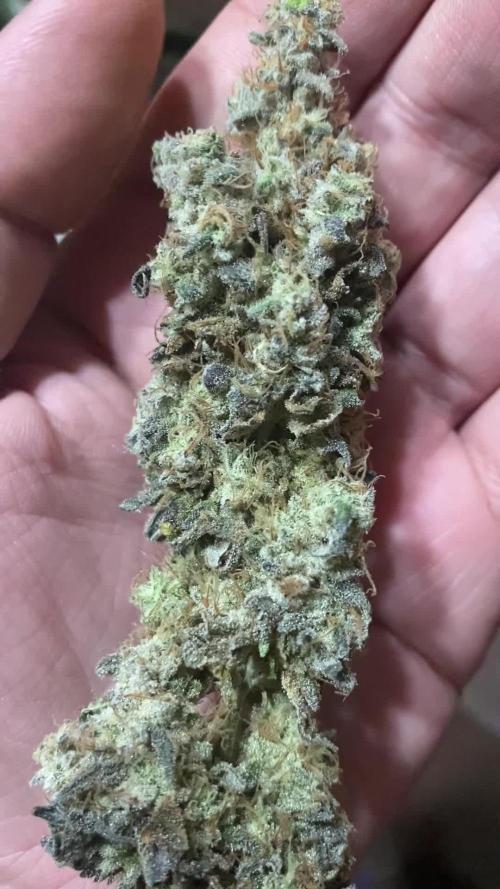
After a week of curing the flavour and aroma are already good, I imagine in a few weeks it will be the best.


Likes
30
Share


@TragicTerps
Follow
We are currently working on the recovery from the initial stem split on plant A. She's almost all the way recovered with only a slight crack still remaining. Hopefully that split and the overwatering won't disrupt or stunt the growth of this lady too much.
For the sake of experimenting I pulled off the first set of fan leaves that were stunted and discolored in hopes the energy used by the plant will be directed more towards the new growth.
Plant C is looking great and loving the increased Par values from our light as we are getting good vertical growth and the main stem is looking super healthy.
As we get through to the end of the week we will start transitioning plant A for LST in the form of tie down. The fan is currently applying pretty good stress to the already week stalk of plant A, but she again is almost 100% closed back up. The whole purpose of the fan is to strengthen the stalk with very light stress.
Plant C will see LST beginning in 2 weeks as she is 1 week behind Plant A.
Many people ask me about the LL on the guage and I will remind everyone, I live in a high climate desert around the 49th parallel so it's cold and dry. When the tent is closed I usually see rh values near 40% where the normal RH (Relative Humidity) is around 10%. It's just dry here. That said the grow community here and the quality of bud is top shelf as it gets. Rh doesn't necessarily impact the end results.
End goal is still 360g harvest out of this tent we will see if we get it.

Likes
9
Share


@Sato_Growing
Follow
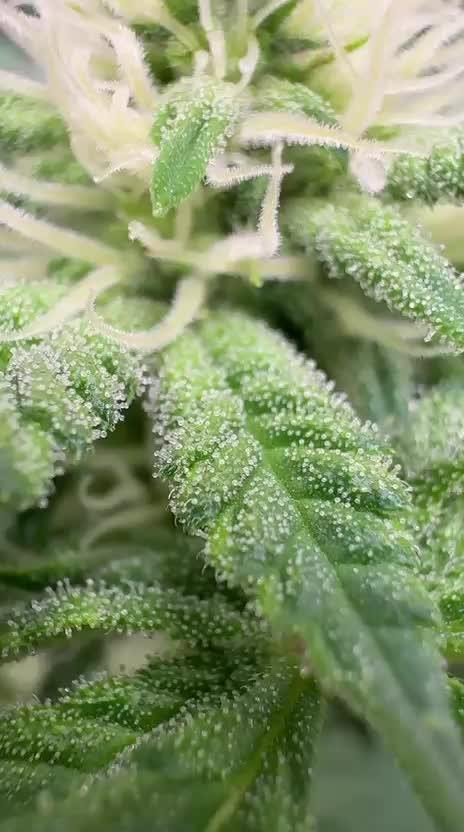
800 ml water every day
Ph 6.5
Guanogalong veg perls + Guanogalong flowering powder
4 times per week with nutrients
3 times per week clean water






Likes
14
Share


@grower1212
Follow
Ayer hice el primer transplante a un solo cup de litro.
Encontré un gusano, debe ser del humos que le pongo al sustrato que reciclo, lo bueno que ahora puedo decir literalmente suelo vivo.
Les puse de top dress harina de neem como preventivo de plagas, insect frass y harina de malta para los microorganisms.

Likes
19
Share


@Sergio_721
Follow
despite the maximum temperature with lights on she grows very well, drinks a lot and I hope she will produce dense and juicy buds soon. 😂
Likes
6
Share


@Young_agronomist
Follow
28.03.23- одна из девочек северного сияния в горшке 3 л начала цвести , вторая же из горшка 10 л активно ростки и не планирует останавливаться и получает лст до начала цвета .
Обе получают раствор ппм 850 и пш 6
Только для разных стадий !
Ждем дальше ❤️
01.08.23-обе девочки развиваются и кушают 👌🏻
Растение в 3 литра горшке активно цветет и получает раствор на цветение 850 ппм short flowering ph 6
Вторя в 10 литров горшке продолжает активно вегетировать получает раствор grow 850 ppm, ph 5.8
92.08.23-Обе девочки значительно выросли , та что находится в горшке 3 литра активно цветет и получает питание для цветения ! Ее размер примерно 40 см и она продолжает почти лол 😜
Девочка в горшке 10 литров набирает обороты в вегетативной стадии и получает лст ! Надеюсь она будет гораздо больше сестры
06.08.23-31 день жизни двух сестер !
Одна из них , та что в горшке 3 литра активно цветет и привыкает 60 см , вторая в горшке 12 л только вошла в предувет.
Обе выглядят очень хорошо и получают полную дозу раствора greenhouse feeding short flowering 1000 ppm,6 ph.
Сток стабилен и под контролем
09.08.23- Растение #1(в горшке 10 л) продолжает расти и получает лст тренировки , приобретая огромный размер . Растение #2 (горшок 3 л) сильно вытянулось и продолжает цвести .
Обе получают разное питание для своих стадий развития .

Likes
2
Share


@Aleks555
Follow
Everything is going great! On day 64 from seed and 16 days into flowering, our beautiful Golden Sands - 1 has been delighting us with her blooms for the third week now. She’s growing rapidly and noticeably before our eyes. We continue to feed her with fertilizers from Xpert Nutrients, and the results are truly impressive. She’s at least 60 cm tall, with the lower side branches spreading wide, while the main cola is tied to the side for support.
A huge thank you to Xpert Nutrients for their high-quality fertilizer, which is not only effective but also very easy to use. With such a reliable product, we’re confident that everything will turn out perfectly!
Likes
7
Share


@Ieiogrow94
Follow
Eccoci qui...
Tutto va per il meglio, questa settimana ho eseguito Lollipopping e Defoliation per far si che le cime principali sprigionino al meglio il loro vigore.
Siamo verso la fine del progetto ora bisogna solo aspettare la fine...
Grazie a tutti per il supporto🔥🌲❤️

Likes
25
Share


@Grower_Of_Persia
Follow
week intel:
its time to harvest top buds!
because my base nutrients and one of boosters was salt based, i'll do flushing this week to get some relieve to plants in the last days
stresses :
flushing
Drought stress via watering only one time with flushing this week
feeding:
day 1 : i flushed them with Advanced Nutrients Flawless finish and adjusted ph
day 3 : no more feeding from now on
day 5 : no more feeding from now on
guide of the week :
i harvest in 2 parts : first i harvest top of the branches and will let the lower buds to ripe another week then ill harvest the second wave.
its crucial to get uniformed buds in terms of quality that you let the lower buds to get some extra air and especially light! then the pop corn buds quality will reach the top buds.
my dry and cure style is this:
3 days of hanging upside down to get water activity lower to around 0.6 in 50% humidity and 26 C temp (i know its a little high but we are in a hot summer right now and i cant get it lower even with air conditioner) and then after 3 days of drying i remove leaves and stalks, trim buds and move them to jar for the rest of their life :D . and in the first 4 days of curing i open the jar door and let hem get some fresh air in the jar for about 5 minutes and close the jar door again, after 4 days of curing like that buds are smokable but they will get better as they getting cured about 1 month.
im happy as hell with this harvest :D.
Likes
13
Share

@squalino
Follow
Journal de Culture : Frost 1
(Début Semaine 4)
Génétique : Frostbanger (F2 Perso) | Système : Autopot 20L
📣 Remerciements
Un immense merci à toutes les personnes qui suivent ce journal depuis le début ! Un merci tout particulier à @Mia_BIOTABS et à @Mrs_Larimar pour leurs précieux conseils et leur accompagnement. Merci à tous pour votre soutien !
🛠️ Configuration Technique
Éclairage :
Lumatek ATS 300W Pro (réglé à 75%)
Distance lampe/canopée : 65 cm
Climat :
Jour : 25°C / Nuit : 21°C
Humidité (HR) :
50%
📅 Évolution & Entretien :
État de la plante :
La croissance reste foudroyante.
La plante a encore pris une belle ampleur et montre une santé de fer avec un vert éclatant et des tiges très vigoureuses.
Hauteur actuelle :
46 cm (après palissage)
Vigueur :
Le tronc principal est massif et les branches secondaires sont extrêmement développées, ce qui m'a poussé à intervenir pour optimiser l'espace.
Travail sur la plante :
LST & Structure :
J'ai décidé d'abandonner les clips de palissage dont je ne suis pas fan. Je suis revenu à mes bonnes vieilles ficelles pour un contrôle plus précis.
Optimisation :
le 04/05 ,Hier, j'ai effectué un gros travail de LST combiné à un léger effeuillage. L'objectif était de créer une structure beaucoup plus aérée pour laisser la lumière pénétrer jusqu'au cœur de la plante et favoriser les sites de floraison secondaires.
Observations :
J'ai l'impression que la demoiselle commence doucement à vouloir passer en préfloraison. Les sommets s'éclaircissent et changent de texture... on en aura le cœur net dans les prochains jours !
Gestion du système et nutriment :
je n'ai rien donné
Le substrat continue de travailler en symbiose avec les Biotabs. L'arrosage au Bactrex a visiblement boosté la vie du sol, la plante répondant parfaitement à chaque manipulation.
Résumé de la situation :
La plante occupe désormais une belle surface. Le palissage permet de maintenir une canopée homogène malgré la poussée verticale. Les ramifications sont solides et bien espacées, ce qui promet une circulation d'air optimale pour la suite des événements. On sent que le "stretch" est imminent !
À bientôt pour la suite !
Likes
7
Share


@OceanGrownLoc
Follow
Buds getting some swell on them now. Reek of sweet banana and some sour under tones.
Weather as usual has gone a bit shitty on the final week or so but other wise going well.
0 bugs issues, a few signs of dying leafs. Can't wait
