The Grow Awards 2026 🏆 








Likes
Comments
Share
@Capo420
Follow
Will update throughout the harvest, drying, and curing.
Great grow!!! I honestly could not have asked for a better first time growing experience. A few little bumps along the road, but nothing these ladies couldn't handle.
Very citrus smell topped with a salvating creaminess. Will definitely keep this lady in mind for all future grows. Maybe at least one plant. I can't wait until I can try this girl. Thank you to Fast Buds for these awesome genetics and thank you to the Grow Diaries Cimmunity for all your help along the way.
Happy Growing
💚💪🌱😎🌱💪💚

Likes
36
Share
@nonick123
Follow
Día 80 (19/08) Riego con 1 litro H2O pH 6,55
Día 81 (20/08) Riego 250 ml H2O pH 6,55
Día 82 (21/08) Riego 500 ml H2O pH 6,55
Día 83 (22/08) 💥Comienza la floración! 💥
No riego. Día nublado y de bajas temperaturas
Día 84 (23/08) Riego 500 ml H2O pH 6,55
Día 85 (24/08) No riego. Día nublado y de bajas temperaturas
Día 86 (25/08) Riego con 1 Litro de Té Floración de Lurpe Solutions. Preparación: 24 horas con bomba de aire (oxigenación) con ingredientes:
Healthy Harvest 8 ml/L + Insect Frass 16 ml/L + Hummus Lombriz 8 ml/L + Melaza 1 ml/L + Kelp Hidrolizado 0,25 g/L
💦Nutrients by Lurpe Solutions - www.lurpenaturalsolutions.com
🌱Substrate PRO-MIX HP BACILLUS + MYCORRHIZAE - www.pthorticulture.com/en/products/pro-mix-hp-biostimulant-plus-mycorrhizae





Likes
37
Share
@The_Projexx
Follow
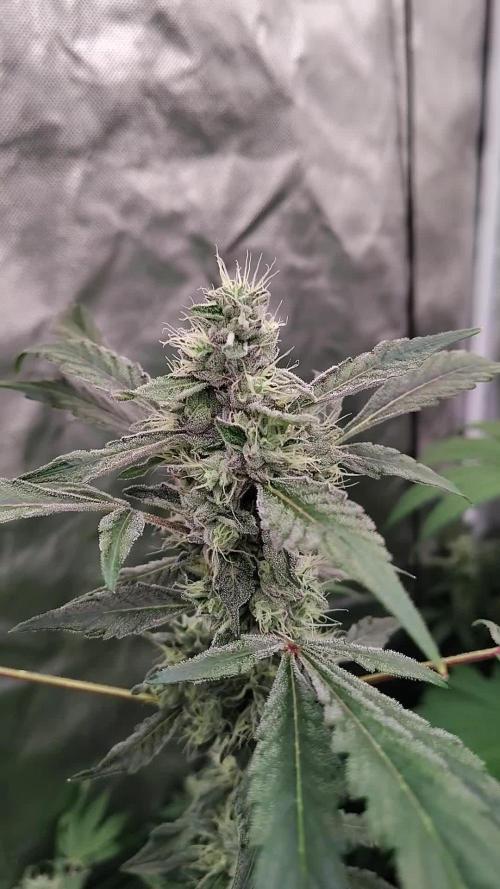
Welcome to week 8 of flower for this wild project! We will be looking to check trichomes over the coming days to see how things are coming along. I know for sure PGC#2 will be ready far before the rest but we will check all of them none the less. As we reach the race for the finish line Im very pleased with what i've accomplished with these plants this grow!
Huge shout outs go to @MarsHydroLED as well as @Seedsman for their outstanding gear and genetics to work with!
HUGE shout out goes to all my followers and people who stop in a like! Keep giving inspiration to grow!
-The Projexx
Day#50F Pictures N/A. Ladies are starting to slow down on new pistol growth and focusing on ripening up.
Day#51F Watered ladies 6L each at 160PPM. We've began flushing them.
Day#52F PGC#1 leaves starting to turn quite purple, Banana Krumble still has a while to go. Checking trichomes tomorrow.
Day#53F Pictures N/A. Watered ladies 6L each at 160PPM. PGC#1 trichomes are doing well mostly cloudy little amber, Banana Krumble still has lots of time to go and PGC#2 is almost ready displaying lots of amber and lots of milky trichomes gonna give her a few more days.
Day#54F Pictures N/A. Banana Krumble still thickening up , PGC#2 is looking quite ready and PGC#1 is far behind her sister!
Day#55F Harvested PGC#2. Watered ladies 6L at 160PPM. PGC#1 is turning more purple by the day quite the lovely show!
Day#56F Pictures N/A. Banana Krumble still thickening up but displaying more orange pistols , she's gonna be a 70 - 77 day girl but I'll get big rewards! PGC#1 ripening up daily!
Recap: Over all things went super well this week! We harvested the smallest plant in the room and ended up with almost 500G of wet weight roughly 6-7 ounces off that plant dry, she smells very very gassy with light hints of candy and fruit very pleasing combination to say the least. We are coming up on the finish line quickly for this project Im excited to see what the other plants will yield!


Likes
6
Share

Likes
18
Share
@ApothecAries
Follow
Girls are looking amazing and smelling amazing. Have been watering 2 - 2.5 L of water Daily. Weekly Feeding of Green Rush Beefy Bud still. Its day 45 should be a 60 day plant or so. Shes stacking nicely !

Likes
10
Share
@WEEDOOR
Follow
Hey 👋
I missed to upload week 3.
In week 4 I tooped the gorilla zkittlez and FIM the wedding glue.
The plants recover fast and nice.
I didn't know what to look for to see in the fiming proces but the plant looking good and width.
I don't know if I should make another FIM or top to them. One time is enough? They'll start flowering soon.

Likes
246
Share
@mcflow
Follow
Didnt wanted to trim too much so i only cutted leaves which were overshadowing buds completely, had to water nematodes one more time this week but besides that it looks really good so far, im happy with how they grow!


Likes
3
Share
@WeedWagon
Follow
Day49:
-cut away new lower nodes but keeper the fan leaves
-watering 1l/every 2-3 days
- LST correction every 1-2 days to keep an even canopy
- one branch of top branches grows at a faster rate
-looking healthy
-Day56 switch to flower phase
Likes
15
Share
@BruWeed
Follow
🍀25/04 - Empieza su primer semana en etapa de crecimiento.
🍀Por el momento viene de manera correcta sin ningún inconveniente.
🍀El Ph ya se lo estoy empezando a modificar en 6.3.
🍀Lo que pude notar es que de un día para el otro la plantula creció bastante, se encuentra tupida y bastante grande para los 20 días que tiene de vida.
🍀Los tres fertilizantes que utilice se los agregue directamente en el agua (1L) y la regué.
🍀Tengo pensado dejarla cinco semanas en total en esta etapa, así puede desarrollarse de manera correcta.
🍀En estos dias subiré más imágenes!
Podes seguirme en Insta gram como @bruweed_arg !😶🌫️☘️

Likes
19
Share
@Kirsten
Follow
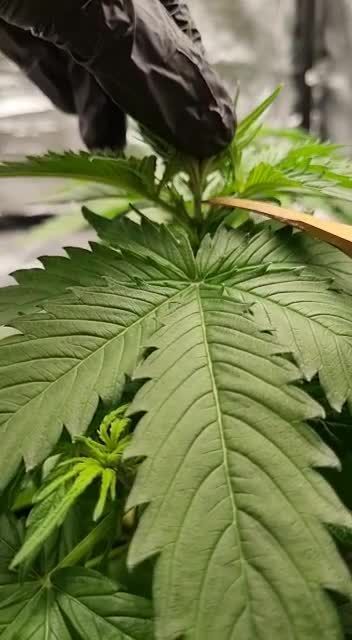
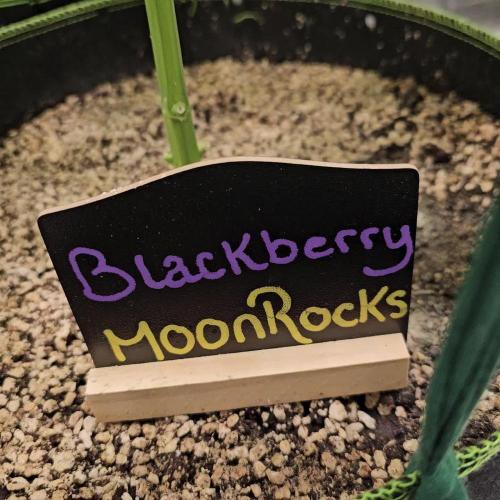
Blackberry Moon Rocks has become very tall and she is starting to flower now. And also stretching quite a lot.
I had previously topped the plant, and one top had grown larger than the other. So, with that one, I decided to use a fabric tie and tie it to the pot, to hopefully try and even things out a little.
There aren't really many branches on this plant.So hopefully that will mean that the colas grow bigger. Heres hoping, anyway!
I have gone through the tent this week, and I have removed a lot of the lower branches on the plants, as they're not going to grow into big colas or anything.
So it's better not to waste the plant's energy, developing those to hopefully redirect it into the larger flowers.
28.7.25:
I watered with 3ltrs of dechlorinated water PH'd to 6.3 with;
💜 2.5ml Ecothrive Trace
💜 1 TSP Ecothrive Biosys
PH: 6.3
PPM: 352
2.8.25:
I watered with 2ltrs of dechlorinated water PH'd to 6.6, containing the following nutrients;
💜 2ml Ecothrive Trace
PH: 6.6
PPM: 425
3.8.25:
Today I top dressed as follows:
🧡 1 Cup Worm Castings
💚 1.25 TBSP Ecothrive Bloom
💚 1.5 TSP Ecothrive Life Cycle
I watered the top dress in with with 2ltrs of dechlorinated water PH'd to 6.4, containing the following nutrients;
💜 1ml Ecothrive Trace
PH: 6.4
PPM: 363
That's all I did this week 😊 Thanks for stopping by and checking out my diary. Good to see you in the comments! 😊💚✌️🌱😁


Likes
21
Share
@Onlypotent420
Follow
This weeks update!
Grow tent- so I had a buddy do my res change I talked him through the whole process couldn’t make it to the grow this week. Number and everything where perfect but!. He didn’t close the valve all the way to the blue dream res tank and left the drain pump on🤦♂️🏾. So when I got there this week leaves where curling and brown thought it might be a nutrient issue. Opened the res to check it. And there was only about a gallon of water in there out of the usual seven. No major harm I was planning on doing my last defoliation to her this week anyway. But that could have been bad.
They are both receiving half strength nutes of the ripening mix GH recommends. Would have been a perfect week if not for that. No harm no foul tho. But def bout to start pushing them on the flower nutes and get back up to my 1000 ppm range buy adding extra bloom formula!
#Staykited


Likes
7
Share
@LoganatorDude
Follow
This is towards the end of last week.
The BB crosses are doing excellent. They have all gone through some extreme temps with intense temp and RH fluctuations. I’ve concluded that the plants 1 week behind experienced too much heat on this one day when some things came up and I wasn’t around to get them out of the hot sun in time, and they were stunted by excessive heat over 90F. The others didn’t show much signs of stress at all. I’m not giving up on the little ones, but I am giving them a large amount of grace and understanding. They can just continue to grow and do their best. Maybe they will come back into full speed in a week or so. Maybe not. At least I will grow them out to learn what happens. From now on I will be extra careful with all stimuli my seedlings are receiving.
Showing sone other plants of same age, some of which are photoperiods that began flowering about a month and a half early, with 15 hours of daylight! Why?
My first guess is some form of extreme rodelization. I did notice on both A-Trains that they each had a node with two pollen sacks developing as well as the burst of female bracts. So I nicked off the pollen sacks right away, and I’ve been putting them under a light for the nights to hopefully reveg them. Either way, a fun anecdote for some new knowledge and experience! I’m sure they would bud out Fat! Seeing how much they did in 2-3 days! But maybe there’s other elements at play.
Likes
11
Share
@Smokeitup091191
Follow
This week has gone exceptionally well!!
Already started the training process struggled with height last time but this time I am preparing early. (No bottom buds). These ladies are growing very well and fast. Fingers crossed 🤞🏼
Likes
176
Share
@Herbalize
Follow
Hello folks
Havest Day 53 of flowering ( Life cycle 93 days )
Drying with 59% RH--17/18°C since about 10 Days
it's the start for curing.
Overall everything went well
I learned a lot, and I must be close to 0.7 G / W which is good in my opinion.
6 Plant was way too much with 40 days of growth and my little square meter , next time 4 max!
I would also reduce the doses of fertilizer because Canna remains strong enough
Now it's time to invest and improve some things !!! Soon ™️ 😋
Thanks to all who comment / like either to encourage or give advice
see you soon guys 😘
Peace Love and Weed 000


Likes
61
Share
@DreamIT
Follow
👨💚🌴 Grower HageWeed is delighted to introduce his🌴💚👨
⚜️👑🌱 Autumn Cup Contest by Royal Queen Seeds 🌱👑⚜️
💚🏁✅⚜️🏆🏅Today, 2nd October, I received the Royal Queen Seed package. I was just expecting seeds and a lighter with their nutrients, but instead a roundup of very interesting stuff arrived. Hemp papers, normal, clipper signed royal queen seed, a magazine I can't wait to read, nutrients, stickers, a complete catalog with the new genetics, a Zamnesia booklet, 5 seeds Honey Cream fast flowering, a door joint (which I have photographed several times, I already love it, my walking joint will no longer suffer from the long walks in my pocket waiting to be consumed), grinder, fabric vase that I really like at the sight, and the starter kit for germination. Due to the current lack of space to germinate, I dipped 2 seeds in water, (I started with one but it seemed to suffer from loneliness: D). I can't wait for them to start growing, I'm very excited to be able to participate in a contest. Stay tuned: D 🏅🏆⚜️✅🏁💚
➡️04/10 Yesterday, examining the packet of seeds carefully, I noticed that one of them seemed split, and so it really was. I put it directly in the jar covering it with plastic wrap hoping it will grow anyway. Should it be born we have 3 honey cream seeds: D On one of the two seeds 2 mm of radicle begin to be seen, the other still shows no sign of opening but we are not in a hurry: D
➡️05/10 Today the root of the second seed has also begun to emerge: D we continue to wait impatiently: D
➡️06/10 Very well, both seeds are coming out well. probably tomorrow they will be put in the jiffy. I have great things in mind for these two seeds: D Come on, grow up !!!
➡️07/10 Today these sweets have lengthened the radicle a little, just enough to win a place inside the jiffy. The broken seed I put in the jar also seems to have taken root, but we'll find out more in the coming days. With one of the two suits I will start a solo cup diary, even if I am out of time for the contest. It will especially help me to better understand how to manage plants in different situations. Well so, Yeah!
.➡️08/10 We are already two centimeters away. Even the broken seed seems to want to get out but we wait patiently. Well so, Yeah!
➡️09/10 Today I helped the leaves to free themselves from the seed, as soon as I see some roots, they will be moved to the final pot without too many transplants. Today I also start counting the days. Day 1 from the emergence started. Well so, Yeah!
➡️10/10 Tomorrow the jiffy will be moved to the 11 l pot of royal queen seeds: D can't wait. The one in the jar doesn't seem to have caught, too bad :( the sprout is about 3 centimeters high. Well so, Yeah!
➡️11/10 Today this sweetness has been poured into its final jar, positioned near the rim for a future LST. I added 1l of corrected water to the new pot, away from where I put the seedling. Unfortunately, the broken seed didn't make it.
➡️12/10 Everything is OK. I will try to take 2 photos every day, horizontal and vertical, then I will see the results: D
➡️13/10 Wet with 0.4 of fertilized water vegetative pattern, today is the first 12/12 light day. Well so, Yeah!
➡️14/10 Nothing to report today, Well so, Yeah!
➡️15/10 The humidity gizmo says it's still pretty wet at the bottom, I'll wait to irrigate. Well so, Yeah!