





Likes
88
Share


@CBD_Sweden
Follow
Hi all the happy people here in GrowDiaries.
And hello to you who read my diary,
I just want to say that I am pleased that you have chosen to check in with me and in my diary.
I do this for myself and for a steady flow of my medicine.
Everything you read and see in my diary is 100% honest and I will never distort or beautify anything here.
I document my crops so that I can learn from my mistakes and also to look back at those different crops.
I try to update with pictures every day and with text if something special has happened in the garden.
This is my strainhunt for the best medicine and the beginning of my journey with cannabis and the cultivation of it.
This is my second feminised cultivation ever.
First, I'm just going to say something about my grow room.
The room is 2.14 meters by 1.7 meters and has a ceiling height of 2 meters.
It provides a floor area of 3.6 square meters.
I use a 54 Watt Lightwawe T5 for germination and 2 Pcs 400 Watt HPS lamps for bloom.
I have a channel fan that replaces the room air about 40 times an hour to get a comfortable environment in the room, the air enters a fresh air intake from the outside.
The air is purified through a carbon filter to then leave the room to the rest of the basement.
Then I use that heat to heat the rest of the basement.
I will use 15 liter Autopots to grow with and a 100 liter water tank that supplies the pots of water and nutrition.
I will grow completely organically in soil and will watercure my buds to get the best possible medicine for me.
Medical Mass is a new medical cannabis strain with a high CBD content and a low THC level that provides good medical properties without a strong psychoactive effect. This is a mostly indica plant that contains 40% sativa and 60% indica. Critical Mass and CBD rich strain were crossed to create this amazing valuable variety.
The plant suits both for indoors and outdoors, for beginner and experienced growers. The strain grows up to 60 - 100 cm tall and produces good yields for such height of about 500 - 550 gr/m2. The plant demonstrates great results even in small spaces. The flowering time takes only 7-8 weeks and the harvest comes in late September.
The smoke brings very strong, intense flavors with sweet notes of honey and skunk and an intense pleasant relaxation. Medical Mass is the great choice for each medical user due its small height, ease of growing, fast flowering and of course great medical potency.
2017-09-01. Started germinating.
------------------------------------------------------------------------------------------------------------
2017-09-03. 3 out of 3 seeds germinated today after 40 h, i planted them in soil and put them in my humidity dome under T5 lights. Added some pics.
KL 23.00. New video added, 2 of 3 girls is looking up from the soil.
----------------------------------------------------------------------------------------------------------------------------------------------------------------------------------
2017-09-05. New videos of the 3 girls. All is up from soil now and looking fine.
----------------------------------------------------------------------------------------------
2017-09-06. New pics.
-----------------------------------------------------------------------------------------------------------------------------------------------------------------------------------
2017-09-07. Kl 22.30. New pics.
-----------------------------------------
2017-09-09. Kl 21.00. New pics.
-----------------------------------------------
2017-09-12. Kl 12.00. New pics.

Likes
4
Share

@Enki_Weed
Follow
Week 6: Veg – Reset & Silicon Boost 🌿
System-Update: Komplette Reinigung der DWC (35L). Umstellung auf Osmosewasser + CalMag (Base EC 0,45).
• pH-Wert: Stabilisiert bei 6.0 (nach anfänglichem Silic-Rock-Jo-Jo).
• EC-Wert: Aktuell 1.24 mS/cm (Leicht steigend, Beobachtung läuft).
• Wassertemp: Perfekte 18,9°C – 20,3°C.
Nutrient Mix (pro 35L):
• Plagron Silic Rock: 35 ml (First in!)
• Hesi Hydro Wuchs: 175 ml
• Hesi Wurzel Complex: 175 ml
• Hesi Power Zyme: 70 ml
Strain-Check:
• AK: Absolut vital, tiefgrün, reagiert sehr gut auf das LST mit den Biege-Clips. Zeigt leichte Adlerkrallen (N-Limit erreicht).
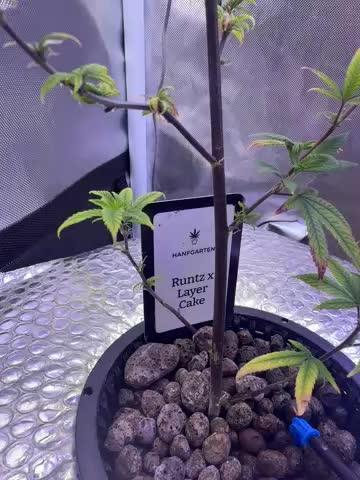
• Tuntz Lake Cake: Wurzeln sind da, aber der "Take-off" verzögert sich im Vergleich zur AK. Sie wirkt etwas nährstoffsensibler.
Maßnahmen: Lichtabstand leicht vergrößert, um Transpirationsstress ("Canoeing") zu mindern. EC wird durch Zugabe von reinem Osmosewasser leicht gesenkt, um der Tuntz Lake Cake den Start zu erleichtern.

Processing
Likes
6
Share


@DILLIGAF
Follow
Purple Crack from the Cali Connection
Moving into flowering now and she is growing very nicely , lots of potential bud sites developing and Ive done a full
Bucket rinse , wash and nutrient change . I also rinsed the roots with some nice clean water to remove anything unwanted.
I've also upped the nutrient strength to 4mls per litre and added Big bud to the regime.
Thanks for checking in see you next week 👊

Likes
170
Share


@Master_weeda
Follow
Bonjour à tous les padawans et maîtres jedis
Day91 arrosage avec 30 centilitres d'eau ph6.3
Inspection des Trichomes (30% ambrés) la sénescence ce voit nettement ce qui fait que je récolte jeudi au jour 95 après sa sortie du pot...
Le fait que la sénescence soit de plus en plus visible démontre que le planing mis en place de fendre le tronc ou jour 86 est impeccable. Les trichomes seront ambrés comme je le souhaite.
Je m'étais fixé un poid sec de 16g je pense en être relativement loin mais je suis tout de même satisfait de ce diarie qui touche prèsque à sa fin et qui m'a procuré beaucoup de plaisir.
Jour 92 arrosage avec 30 centilitres d'eau ph6.3 et ensuite je la plonge dans le noir 48h
Cette méthode est sujette à controverse au sein de la communauté des cultivateurs, et il n’existe que des rapports anecdotiques quant à son efficacité. La plupart des cultivateurs qui s’y sont essayé n’ont pas remarqué la moindre différence en termes de puissance des têtes. Certains argumentent même qu’étant donné qu’il faut plusieurs mois pour faire grandir la plante, 1 journée ou 2 avant la récolte ne permettront pas de transformer du tout au tout le processus. Mais bon, si vous êtes du genre aventureux, testez-la.
Que la force soit avec vous, 💪

Likes
17
Share


@ganzigunnu
Follow
runoff ec measured 2.0 this week. they went to bathroom and now they are around 1.5

Likes
11
Share


@Luv2Grow
Follow
She was a very easy strain to grow and took very well to all LST. I did have an issue early on where I snapped her main stem almost completely off. I used some plumbers tape to keep her together and she recovered like nothing even happened to her. Definitely recommend growing this girl, especially beginners.

Likes
8
Share


@DisTentAint4Campin
Follow
Everything chugging along even the kiwi bounced back a little prolly gna chop in a week trichs are where they need to be but now I jus invested in a whole separate setup for perpetual when I go back to photos but for now playing with the autos wich brings me too let me shout out to ganja farmer seeds for letting me do a partnership and them hooking me up with some beans to try so I am currently germanting 3 different cultivars (AUTOS) from ganja farmer seed Co. And I will be doing a diary on each of they're strains in my new system can't wait !!!!

Likes
361
Share


@Ju_Bps
Follow
Hello my friendly growmies 👩🌾👨🌾🌲🌲,
The #1 is my biggest plant ever, 100 cm, it's not a record lol, but for me it's tall 😊😊
The #2 start to turn purple, can't wait to see 💜🍌
Buds start to be formed and are biggest each days 🌲🌲
I'm totally in love with those cute ladies 🌲🌲🌲😁😁💜💜🍌🍌
I've continued to train a bit.
💦I give water each 3 days, 2.75l/plant
Water + RQS Bio Flowering Booster
Water + cannazym + Sugar Royal
@PH6
RQS Bio Flowering Booster - Week 3
THICKER 0.6 ml/l
BIGGER FLOWERS 0.8 ml/l
The RQS liquid kit, look doing the job, not overfert or deficiency sign for the moment.
Lamp @100% and start to be really close to the plant, but not burning sign for the moment.
Thanks community for follow, likes, comments, always a pleasure 👩🌾👨🌾❤️🌲
Mars Hydro - TS1000 💡💡
https://www.mars-hydro.com/ts-1000-led-grow-light
Mars Hydro - FC3000 💡💡
https://www.mars-hydro.com/fc-3000-samsung-lm301b-led-grow-light
RQS - Fat Banana Auto 🍌🍌🌲🌲
https://www.royalqueenseeds.com/autoflowering-cannabis-seeds/487-fat-banana-automatic.html
Likes
73
Share


@Roberts
Follow
Deep Forest Auto is growing great. She has started to show her first pistils for flowering. She should be doing a lot of stretching in the next few weeks. She git some defoliation and lst today. Everything is ready to go monster size. Thank you Doctor's Choice, Gen11, and Medic Grow. 🤜🏻🤛🏻🌱🌱🌱
Thank you grow diaries community for the 👇likes👇, follows, comments, and subscriptions on my YouTube channel👇.
❄️🌱🍻 Happy Growing 🌱🌱🌱
https://youtube.com/channel/UCAhN7yRzWLpcaRHhMIQ7X4g


Likes
7
Share

@therealgrowmie
Follow
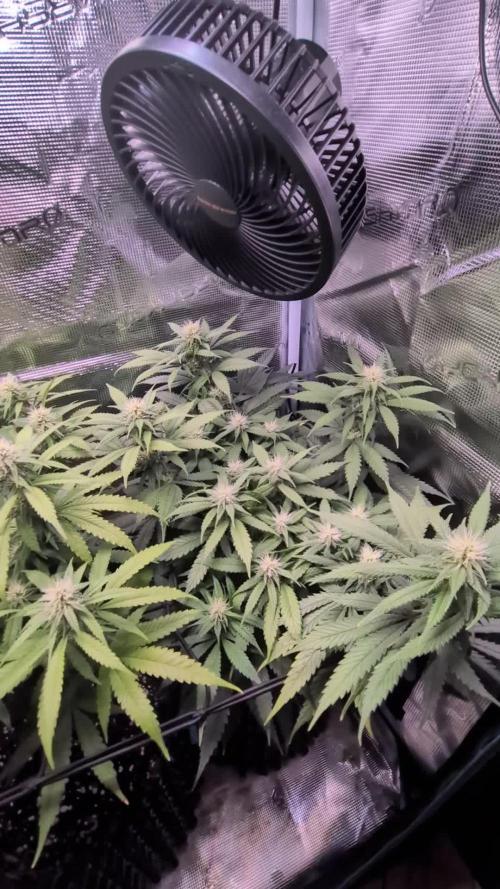
The stretch is officially over and the canopy has settled into a nice, even layer. Bud sites are stacking across the entire SCROG, frost production is ramping up, and the tent is starting to smell exactly how you'd hope at this stage. The training during veg is definitely paying off now with an even spread of developing colas.
The lower fan leaves continue to fade naturally as the plants redirect energy into flower, while the tops remain healthy and vigorous. Airflow through the canopy is still good, but I'll keep a close eye on humidity as the buds continue to bulk up over the coming weeks.
📊 Current Stats
Week: 15 (Flower Week 5)
Light Schedule: 12/12
PPFD: ~800 µmol/m²/s
Temperature: 28°C
Relative Humidity: 65%
VPD: ~1.35 kPa
Watering: 2 L per plant every 3 days
Overall I'm really happy with how the canopy filled out. The bud development is becoming more noticeable every day, pistils are exploding across every top, and now it's all about maintaining a stable environment while the flowers start putting on real weight.
Likes
9
Share


@Atom_x_Andromeda
Follow
Growing strong cut 13clones today and transplanted the two biguns loving how they are turning out


Likes
26
Share


@Earthy_Greens
Follow
🌸✨ Week 14 Update! 🎉🌿
Our girls are in their prime, and the transformation is truly incredible! 💎🔥 The buds are filling out beautifully 🌱🌸, coated in a thick layer of sparkling trichomes ✨💎, and the aroma is getting stronger and more intense 🍊🌿.
Everything is going exactly as planned 📈✅, and we’re getting closer to the moment we’ve all been waiting for—a bountiful, top-quality harvest 🌾🌟. The colors, structure, and resin production are proof that the power of soil and premium nutrients 🏆🌱 make all the difference!
Stay tuned for more updates, friends! 🚀👀 The best is yet to come! 💚👊🔥✨
Likes
21
Share


@PrairieFrostGrow
Follow
******** Week 3 of flower, Week 12 growth - Oct 3 to 9/20 ***********
It has been less exciting this week with respect to new issues👍😃
GG4 has reacted very well to the stem cracking but just leaving the area alone at the same time.
Really impressed with how the colas have been stacking. They are done their stretch now and will work on getting thicker🤞💪👍
Leaves are getting a little darker for my liking this week. It is one of the things I have often struggled with using AN Sensi Grow and Bloom base nutes.,,,,,,keeping the feeding at 1ml.L to maybe 1.5ml at max.....stopped using their CalMag Basie of nitrogen levels as well. Not sure where else to go and will just give her some time for now and stay the course and see what the next two weeks bring.......keep up, increase, the plain water feedings.
GG4 should have some nice size colas. At three weeks her tops are the size of a BIC lighter.......with 6 more weeks of swelling to go.....keeps you smiling😃💪🤞
Little more detail........
Oct 3/20, Day 15
- 4L
- 450ppm and 5.7pH
Oct 4/20, Day 16
- 4L
- 1025ppm and 5.8pH
Oct 5/20, Day 17
- 3L
- 100ppm and 5.9pH
Oct 7/20, Day 19
- 4L
- 1025ppm and 5.9pH
Oct 9/20, Day 21
- 3L
- 500ppm and 5.9pH
Sweet Seeds has a really nice cross in this strain👍😎 Great work Guys!!!
Working on the update for the week.........

Likes
22
Share

@Luv2Grow
Follow
Day 78 - Starting off week 12 and couldn’t be happier. Things are going good and just gave her a feeding today. This will be the last week of feed and will flush with Sledgehammer next week. Quite a few fan leaves are really starting to fade in color and die off, telling me she’s probably towards the end of life. Hopefully there’ll be some fattening these last 2 weeks before chopping. Attempted some trich pics but can’t hold steady enough so didn’t turn Putnam so well but we’re just about 100% milky from what I can tell.
Day 79 - Looks like a change in plans and most likely will chop this weekend. Overnight she popped a lot of amber trichs. Even the bottom buds with less light and are about 20-30% amber. I don’t want it going too much further than that so I’ll do a big flush tomorrow and most likely chop either Friday or Saturday.
Day 80 - Final day before chopping. Put 5 gallons of water with the Sledgehammer through for a flush and all is looking good. Put together a new drying box today so we’ll see how that works out for the drying process. Seen some videos on it and looks like it should work. Will be chopping tomorrow and so ready!
Likes
84
Share


Likes
12
Share


@2Stones1Bird
Follow
Checkout my Instagram @smallbudz to see the Small budget grow setup for indoor use, low watt, low heat, low noise, step by step.
08/11/2019 - Showing early flower development?
09/11/2019 - Gave her 0.500 ml plain water PH 6.5, she's starting to need more water and also due to 30c temps. She's also showing light green around the leafs maybe slight magnesium deficiency.
10/11/2019 - Yellow leafs showing up really fast so I 'flushed' the medium with 1l of 6.4 PH plain water, watered until some run off start to showing, change the watering plan again, now I only water when the pot feels light and dry at the bottom.
13/11/2019 - Pot was really light and dry at the bottom so I gave her 1.5l of water with 0,75ml of Grow, 1,5ml of Bloom and 0.75ml of Max BioBizz PH 6.5 until some runoff started to appear I think was too much again : also added a work-supplement led strip light.
14/11/2019 - Leaves looking pale raise the light to 45cm instead of the recommended by manufacture 25-40cm.
Likes
92
Share


@DogDoctorOfficial
Follow
Week 9 Flower Report: The Countdown to Harvest Begins! 🌼✨
As the ninth week of flower unfolds, the room is a symphony of colors and frosty brilliance—a true gardener’s dream! But as we approach the final stretch, it’s a delicate dance of vigilance and care to ensure a clean and bountiful harvest. Here’s a deep dive into this exciting and educational week:
The “Flush” in Full Swing
The flush continues as we prepare the ladies for their final days. While we’re a week or so away from harvest, the plants are responding beautifully, showcasing stunning fades that highlight their unique genetics. This fading process is a critical part of the journey, helping the plants naturally finish their cycle while preserving those complex terpene profiles we all love.
The Mold Incident: A Teachable Moment
This week brought a challenge—a few buds succumbed to bud rot (Botrytis), particularly on the Papaya Zoap and a single bud from the Gorilla Melon. While disheartening, it’s a reminder that mold can occur even in the most well-maintained gardens, especially with dense colas and a full canopy.
After a thorough inspection, all affected buds were removed and discarded to prevent the spread. A quick note to all growers: defoliation plays a massive role in airflow and prevention of such issues. This is why mid-flower defoliation is a game-changer, and I’m grateful it kept the rest of the garden healthy!
Papaya Zoap’s Unique Quirks
The Papaya Zoap continues to be a star of the show with its frosty buds and… albino tips! These tiny white tips are likely from being too close to the lights. While it’s a cosmetic detail that doesn’t affect quality, it’s a fascinating display of how genetics and environment interact.
A Frost-Filled Wonderland
The room is absolutely glistening with frost. Trichomes are piling up like snow, giving the entire garden a magical wintery appearance. I genuinely believe the ThinkGrow LEDs and TrolMaster spectrum control deserve a shoutout here. Running deep red, far red, and UV at 100%, combined with whites at 50%, is delivering incredible results. The ability to fine-tune the spectrum is a game-changer for resin production and terpene enhancement.
Environmental Mastery
Here’s a peek into the environmental stats keeping the ladies thriving:
• Room Temperature: 26°C
• Relative Humidity (RH): 53.2%
• VPD: 1.57 kPa
• CO2: 1067 ppm
• PPFD: 690 µmol/m²/s
This balance creates the perfect conditions for fattening buds and maximizing quality in the final weeks.
Nutrient & Soil Rundown
On the nutrient side, the solution measures:
• pH: 6.67
• TDS (Reservoir): 65 ppm
• Solution Temp: 18.3°C
Soil stats show a TDS of 695 ppm, indicating there’s still some nutrient reserve left in the medium—a perfect transition into the flush phase. It’s all about ensuring the plants have enough to finish strong without compromising flavor or smoothness.
A Garden of Many Colors
The fades across the room are a sight to behold. Each strain is showcasing its unique hues, with the Green Papaya leading the frost parade, and the Punch Pie taking the crown for bud size. Meanwhile, the Gorilla Melon is dazzling with red reflections, and the Papaya Zoap keeps turning heads with its white crystalline canopy.
Videos with TM+ Pro
This week, I’m also sharing videos straight from the TM+ Pro app. This tool has been a joy to use, offering precise control and insights into my grow environment. It’s simple for beginners and robust for advanced growers, proving once again that the TrolMaster ecosystem is a must-have in any grow room.
P.S. Ecosystem Excellence
I can’t emphasize enough how incredible the TrolMaster ecosystem is for growers of all levels. From intuitive configuration to seamless integration, it’s a system that simplifies growing while delivering professional results. Whether you’re just starting out or refining your craft, TrolMaster has your back.
Thank Yous & Shoutouts
As always, my heartfelt thanks to my sponsors: TrolMaster, ThinkGrow LEDs, Aptus Holland, Pro Mix Soil, Cannakan, and the amazing seed banks for their genetics. Huge love to the community—followers, haters, and everyone in between. And, of course, a special nod to Grow Diaries for being a platform where we can all share and learn together.
Let’s finish this grow strong, and here’s to an exciting harvest week ahead. 🌱✨ Stay tuned, stay positive, and as always, Growers Love! 💚
Discount Codes so you can save big on your next check out 💚💚💚
Kannabia - DOGDOCTOR 30% off
SeedsmanSeeds - DOGDOCTOR 10% off
CannaKan- DOGDOCTOR 15% off
terpyz.eu - DOCTOR 15% off
The Neutralizer - PORKIT5-DOG 15% off
Fast Buds - DOGDOCT 15% off
As always thank you all for stopping by, for the love and for it all , this journey of mine wold just not be the same without you guys, the love and support is very much appreciated and i fell honored and so joyful with you all in my life 🙏
With true love comes happiness 💚🙏 Always believe in your self and always do things expecting nothing and with an open heart , be a giver and the universe will give back to you in ways you could not even imagine so 💚
Friendly reminder all you see here is pure research and for educational purposes only
Growers Love to you all 💚💚💚


