




Likes
64
Share


@SmokingTiki
Follow
- The trichomes photos have been taken just before the harvest.
- Drying was made at 20°C and around 52% of humidity (4 days).
- Curing done with humidity in jar between 60-63%, temperature around 20°C (2 weeks).
Veg time : 46 days
Flowering time : 51 days
Total time from seed to harvest : 101 days
Height : 108cm
Pot size : 26l

Likes
5
Share

@connormcleod47
Follow
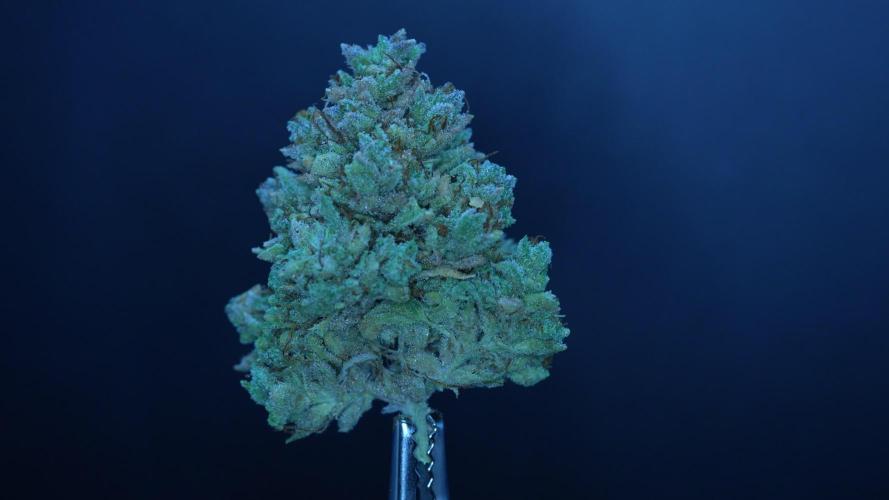
83 days from seed, soil was hot from day 1 & I ended up stunting the plants this run... Low yield at 7g but still enough I will atleast be able to test after the cure to see if I want to run again!
Smells like Grapes with a Gassy undertone!
Grown in Black Swallow living soil with Cronks PUUR Organics line!
Photos taken with the new Sony A7 V + 28-75mm F/2.8 Tamron Di III VXD G2 zoom lens, images are heavily cropped & could have been better, am still learning how to use the camera :P

Likes
11
Share


@Jacks_Pot
Follow
This week went without any problems. They're on scedule and next week I'll repot them.
I'm gonna keep 4 out of 5 because I have only room for 4 plants in 15 liter airpots.
On day 12 I removed the seedling that was making the least progress.
It gave me the opportunity to check the roots and they looked fine. I'll guess it will be the same with the other seedlings.
I've already filled the airpots and placed them in the tent so they can heat up a bit.
There's a large heating mat (RootIt 40 x 120 cm/ 15.7 x 47.2 inch) underneath the pots
to keep the substrate at 21 – 22 °C (69.8 – 71.6 °F)
I've given them 70 ml ph-adjusted tapwater + Plagron nutrients( amounts see above) each once this week.
Once a day I spray them with a solution of CannaCure and tapwater (15ml + 150ml tapwater, ph level = 6.1)
The cobs are at 68 watt with a distance of 49cm (19.2 inches) from the Pineapple Chunks giving a DLI of 19.
Temperatures fluctuated between 21.7 – 24.2 °C (71 – 75.5 °F) and humidity between 51 – 94 %
I've turned on the Airfan and the fan-controller is set at 30-35%.
Up to next week! 🤘
Do you want to grow this strain?
👉 https://www.barneysfarm.us/pineapple-chunk-weed-strain-15 👈

Likes
51
Share


@Waveform
Follow
Already week 7, and it’s starting with much better air humidity which makes it easier for me to stay in the recommended VPD range – currently 54% at 25 °C at canopy height. With 58, 67, 78 and 80 cm plants’ average height is about 71 cm.
Odour has increased, and sometimes, but only shortly, I get the feeling the coal before the blowers cannot eliminate all of it. While the smell was a bit strange sometimes one and a half week ago, it’s now absolutely yummy, sweet and promising. As is all the sticky stuff adhering to my folding rule when I measure their size.
I am a bit confused about the amount of yellowing leaves. That would indicate a nutrition deficit. On the other hand, last feeding (yesterday it was only calmagged water) brought some brown edges to their tips as I wrote. Which could indicate a slight over-nutrition. I am not *that* worried as leaves around the buds all look great (except for mentioned, but not youngest tips), and mature plants obviously tend to concentrate on bud production solely. But week 7 is quite early, or isn’t it? Any recommendations?
Maybe I should go with organic fertiliser next time to avoid being stuck between two options ;)
As they had run dry already, I gave each one another round of drink. Slightly less fertilised than last week. And I removed the lowest yellow branches and tiny buds that would not make it into the light in time. The Pineapples must have some mimosa genes crossed in. Each time I touch them they bow away their heads in deep dislike. The taller one looks like her head would be too heavy now … It is not, and usually they recover after an hour or so. The Sherbets are pretty unimpressed by all I do.
Meanwhile I’ve been working on the Raspberry Pi BoxControl that should help me stay in better VPD ranges in the future. I am not sure how to translate this all into a more stable solution than based on a breadboard, but the state so far (and how it is supposed to work):
Raspi runs headless with control software on autostart. Every minute temperature and humidity are received from a GY-21 I2C chip that should be hanging around plant tops. Data is saved in a database, VPD is calculated and signalled in form of a RGB LED color. Additionally, LCD display rotates through current stats. 3 relay modules can en- or disable misting, dehydration or an additional blower. Maybe I can add a CO2 sensor just for the fun of it (but I’d have to develop a device protocol myself), maybe even one or two soil moisture sensors. Theoretically you could also have a lighting control, but then, GPIO ports are all used. The display needs a lot of them, and while I can log onto the Raspi on my local network and view its desktop, I’d prefer to have a quick overview at place.
I am not really informed about current models. Are some GPIO extensions or Raspis with extended GPIOs on the market?
But so far, that’s all theory. I never had a PCB developed for my hobbyist projects, I am not the best with a solder station. Never had a Raspi run 24/7 for a really long time.
Did a bit more lollipop ping in the evening. Especially tallest Shepard had fun building some more very low buds and branches. I think it can investigate its powers better on different places.
Day 51: It’s getting hard to measure soil humidity with my low tech device. Soil must be full with roots and I don’t want to hurt them much. I can see them at the outlets of their pots too, sometimes a bit dry of course as these parts run dry earliest.
Experiments to include the CO2 sensor in my test setup failed. I can read and reset it, but setting measurement mode and reading values don’t work. Maybe because my I2C library cannot use ClockStretchLimit. Running out of GPIO ports anyway and seeing that the soil sensors are analogue devices, I’ll probably revive my Uno too and have discovered some clever Raspi heads that should make a more stable setup (and some cooling) possible while also adding a handful of PWM ports and an integrated display. I’d like to include a camera module too and it would be great to have some ports available. A final setup would obviously include a Raspi 4 or 5 to easily enable secure online access. But so far, all working nicely in test setup.
Day 54: Sometimes I wonder if they’re still growing at all, but then it’s good to have the daily pictures to compare bud width which now seems to be the main interest of the ladies, although differences are now clearer to tell between two day intervals. The taller ones look like they are one week ahead of the smaller plants, with even higher fan leaves turning pale now. Which at an estimated seed–harvest time of 8–11 weeks for both strains should be pretty common, I guess. Or am I wrong?
Summerly temperatures make the temperatures at canopy level sometimes reach 31 °C, but at least the simple ultrasonic diffusers arrived and I am getting closer to a better environment control. I can at least switch the diffuser inside the tent remotely from my phone, and a deep bowl of water with a lid so the "fountain" produced will not wet the tent floor and one of the fans placed at the bottom now to lift its mist upwards seems to do the trick. Humidity increases while temperature drops, getting the plants into a better VPD level, so all I have to do is wait for the evil A to deliver the necessary Raspi components to have this automated, maybe still while this grow runs.
At the end of this week, there was just a bit of height gain for the two smaller ladies who now approach their next 10 cm mark. Overall, I get the feeling it won’t be that long until harvest. Maybe with the taller ones a week earlier than the others. There’s really not that much bud growth anymore, rather refinements – like buds getting more nodes and color. I’ll investigate the trichomes every few days but would welcome your estimation.

Likes
6
Share

@eldruida_lamota
Follow
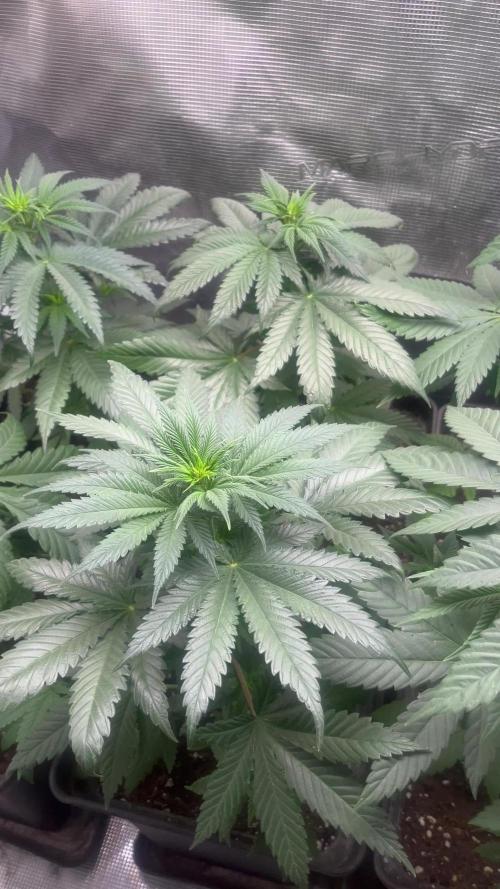
Que pasa familia, vamos con la primera semana de floración de estas Gorilla girl F1 de Sweetseeds.
Vamos al lío, las plantas se trasplantaron a macetas de 7 litros.
El ph se controla en 6.5, la temperatura la tenemos entre 24/22 grados y la humedad ronda el 50%.
El ciclo de crecimiento puse 12h de luz, el foco está al 50% de potencia.
Me gustaría estar más encima este cultivo pero la salud me está impidiendo un poco este 100% con el proyecto. Con suerte la semana que viene andaré mejor.
- os dejo por aquí un CÓDIGO: Eldruida
Descuento para la tienda de MARS HYDRO.
https://www.mars-hydro.com
Hasta aquí todo, Buenos humos 💨💨💨




Likes
9
Share


@HandsomeTerpz
Follow
🇺🇲 Week 6
---------------------
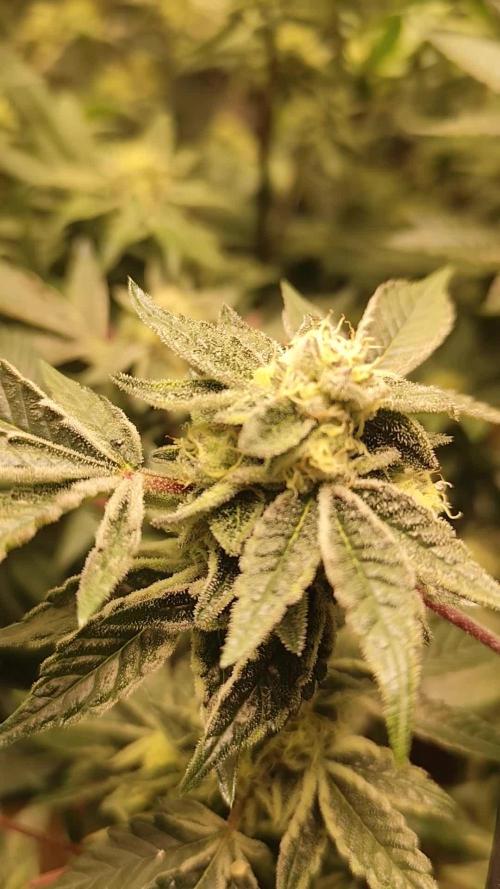
The Zamnesia Green Goblin is doing really well – it's growing and thriving. It responded perfectly to topping, and the LST training is working great too. It's becoming really bushy and is now starting to release the excess nitrogen, turning a lighter green. One branch broke on one of the plants, so I decided to cut the other branch as well to ensure it grows evenly. The next step will be to start defoliating the plant appropriately.
🇩🇪 Woche 6
---------------------
Die Zamnesia Green Goblin macht sich richtig gut – sie wächst und gedeiht. Sie hat das Topping super vertragen, und auch das LST-Training funktioniert einwandfrei. Sie wird richtig buschig und beginnt nun, den überschüssigen Stickstoff abzubauen, wodurch sie bereits heller grün wird. Bei einer Pflanze ist ein Trieb abgebrochen, weshalb ich mich entschieden habe, den anderen Trieb ebenfalls zu schneiden, damit sie gleichmäßig weiterwächst. Als nächster Schritt werde ich beginnen, die Pflanze angemessen zu entlauben.
Likes
54
Share


@GarciasGarden
Follow
PINK KOSHER#1 (keep in mind I have 2 other kosher)
I Am super happy with the outcome on this one ! the bright red /orange hairs on top of the light green/ purple frosty nugs really gave it great bag appeal. I ended up getting 4 OZ!! Out is this 1 plant! I was not expecting to get that much off of only one❤️ The smell on this plant is like cookies mixed with a jolly rancher... idk it’s just bomb / The taste is Of super deep Kush With a hint of caramel/ The effects will make you want to create your own dance while watching spongebob and laughing at the most stupid shit ! SORRY IVE BEEN SLACKING MY PHONE BROKE AND I JUST FIXED IT!!


Likes
40
Share


@KingSalomonsWeed
Follow
13.11
Hallo, Tag 48 Blüte 22.
Ja, dies ist hart. Ich weiß. Mir tut es irgendwie auch weh.
Sogar Spider Mites.
Mist, erstmal mit Wasser alles abspülen.

Likes
Comments
Share


@Dankmark420
Follow
Now it just a waiting game..😍
Girls are looking better and better for each goddamn day only thing I’m kinda meh about is they haven’t showed colour yet.. but we hope it will come in the next couple weeks
O.m.g is getting FROOSTY🤯
Likes
90
Share


@OrganicNature420
Follow
Both frosty and have big nugs. It did go into reveg in late flower but managed to save it before it went awol! Not as good as last time but hopefully tastes like it smells 🏆🌱💚

Likes
12
Share


@ZalySk
Follow
Buds aren't as big as the other autos, but she may swell up in the next week or two. That being said she has way more bud than the other ones with all her branches, and she smells so so good. I wish I could Harvest and cure this right now but I'm probably going to have to wait till December to get a fantastic, cured smoke from it.
I feel bad that she's been kind of yellow her whole flowering life and she would have appreciated a little bit more food. Definitely a heavy feeder in flower.
D81, she's leaning a bit now, the final weight is pulling her to the side. Four days until the official done date and I think she's ready, bit she'll have to wait. The berry will be drying next week, and the blue dream will be the week after. Chop on day 90 or 91 I think.

Likes
12
Share


@LucasHendrik
Follow
With 33 grams on such a small plant I can't complain. I was amazed on the many hours (3) to clean the buds before curring. Several buds had rotten places because of the yellow leaves, they died and caused this problem Luckily I stopped in time and dived a little bit earlier in harvesting here highness.
Processing
Likes
12
Share


@jennamontana
Follow
Growbox 100x100x200 cm // 900W VIPARSPECTRA LED // Biobizz light mix // 185m3 exhaust air system // FAN 40W
1-3 days // Germination and Planting into 0,5l Cups of Biobizz light mix
DAY 1 Plants coming out doing well

Likes
5
Share


@Major
Follow
I made a big mistake when editing my new week I erased my first weeks 😤😤 but I don't have to complain about everything is fine for my plants 🤗😂😂

Likes
4
Share


@Bimli92
Follow
harvest, flower length 64 days, total growth time 88 days. Now wait for it to dry.
Likes
19
Share


@GeOMaTTiC
Follow
Wk10
11/10/21: Day 64. 💧I have no idea what I should do. Should I chop it now, and use it to compare my next grow to, or wait another week and then chop? I think I'll let the pot dry out one more time, and then cut it down. Might as well have a baseline to go by. With plenty of cloudy trichomes, it's likely a good time to come down anyhow. Everyday I see more and more pistils dying back, but also a bunch of new hairs being pushed out, so it's confusing. I have a feeling that it's going to start foxtailing if I let it go much longer. Right now, buds are still very tight. If I do anything else before harvest, it will be a wet trim of most leaves.
11/11/21: Day 65. Pot is a bit lighter today, but not enough for me to say it's time. I've never been one to harvest just before the lights come on, and just chop it down whenever I felt like it, and had the time. I'm not sure if I will wait until early morning, or just go with what I've always done. I really don't feel like waking up at 4:30 and making a bunch of noise. I should really change my lighting schedule to make that easier, but I would be very unhappy if I couldn't check on, and take care of my plants during the morning and throughout the early afternoon. My thoughts on the plant came true. I opened the tent today, and saw some foxtails forming. Right now it's alright, as it's just a bit more bud to smoke, but if I left it to go for the entire rest of the week, it would definitely look like it had some lumps. So, that means it's time to wet trim, then chop down and hang it. Thankfully I have a small empty tent that I can use for drying. I have a fan in there still, so the air will be moving. Cannot wait to give this a test.
11/12/21: Day 66. 🌲Pot is definitely light enough to harvest today. As much as I'd like this to be my first dark harvest (chop 1 hour before light, or 5 hours after dark), I'll just stick with my usual plan and chop it down later, once I've taken care of a few other small things. I can see even more foxtails forming, and the old ones are now very prominent. I know there are several reasons for that to happen, with one being genetically predispositioned to growing them, but this is not likely the case. They are likely caused by my movent of the plant mich closer to the light, technically just a smidge too close. Oh well, I don't mind a few buds messed up, just as long as it's not the entire plant.
Plant is now hanging inside the upstairs tent with a fan for air circulation. I will monitor it's weight loss every two days, and then jar and cure some remaining buds for approximately 4 weeks in my auto cure. It may not last that long, but I'm going to try. I will do my best to keep the main cola separate and intact for a future session.
Chop: 88.1g or 3.11oz
11/14/21: Day 68. 35.5g or 1.14 oz
11/15/21: Day 68. Total dry: 20.7g. Bud is actually quite crumbly, so I'm sure once its brought back up to the 64% the Integra pack provides, it will have a better weight. Some smaller buds were smoked for testing, while a good portion is in the small auto cure, where it shall hopefully remain for the next 4 weeks. Updates will be provided once buds are cured for a true smoke report.
End Diary
As you can see, the plant did not finish on a desired colour. I do not mean a dark purple, but a high level of yellowing in the leaves. It started early in the flowering process, and continued to get worse. The plant however, persevered and finished strong. Even though the plant did not finish up looking like an ideal specimen, it allowed me to learn a lot about the genetics, and how to work with the dry amendments with this strain. Next round will be mich better, I guarantee. Don't believe me! Just watch! We will see it together.
Likes
17
Share


@CanadianFillmore
Follow
Welcome growfessors to week 4F in the 4x8.
LSD, Green Crack and Divine storm are showing the most discoloration, however the bud sites continue to bulk up and frost is showing.
Both Mandarin dreams strains, 4 of pheno 1 and 2 of pheno 2 all look good, with a bit of discoloration starting to show.
A bit of defoliation and removal of any dead leaves. Not much else to say, they look happy and a bulking up nicely.
Tune in next week growfessors for another episode 👽🌳💚


