


Likes
Comments
Share


@Growurownseed
Follow
What I did to germinate my seed was I soaked the seed in water for 12 hours and I gave it a tap, once it sunk to the bottom I then placed in a wet paper towel for 24 hours and that has work for me 100%

Likes
12
Share


@Northern_Ent
Follow
Aug 16: Mimosa Shot is progressing but it has been cool and rainy lately. There are indications of P deficiency because of the cool weather. The top dressing of malted barley and Power Bloom will do its thing so I’m not worried about it. Hoping for more direct sunlight though.
Aug 18: video shows use of far red light at dusk. To keep on a natural schedule, I use Civil Twilight as listed on timeanddate.com for my location. At this time of year it is getting earlier by 2-3 minutes every night. The far red 730 nm light puts the plant into dark mode two hours faster and is like getting a 26 h day. It works and is a good trick if you have daily access to your plants.


Processing
Likes
6
Share


@Jack_Greenstalk
Follow
in veg to allow humidity to be high I had plants on risers and left water in the bottom tray of tent after feeding. I cleaned the tent and reintroduced drip trays under pot risers and now I shop-vacuum all water out of drip tray to keep rh lower for flower. also increased exhaust from low to high and added a 4 inch booster fan to bottom of tent as intake to draw dry air in.
sour 76 #5 (fastest largest grower) was male got pulled out of tent but later eaten by my cats :( rip didnt get any pollen collected
Likes
1
Share


@hazemaze
Follow
Sie fangen so langsam an sich etwas mehr zu strecken nachdem ich sie zu den Seiten trainiert habe. Das netzt wartet schon die zu richten. Läuft super bisher. 🥦 Bin gespannt auf die Blüte


Likes
13
Share


@Corwinism
Follow
Week 2 (08.29.2021 - 09.04.2021)
Nothing much to report this week. The ladies are looking fantastic. The canopy is from wall-to-wall. The stretch seems to have slowed down quite a bit. However, I've raised my light up as high as it will go with the rope ratchets. If the canopy gets much closer to the light fixture I'm going to have to figure out a way to create some distance. Tying down some branches at this point would be a real pain in the ass, so I'm trying to avoid that.
Thank you for stopping by and checking out the progress as we delve deeper into the flowering stage. 2 weeks down, about 7 more to go! See you next week. 🙏


Likes
53
Share


@MistaOC
Follow
19.04. Day 83
Day 43 and things remain steady. The two overfed plants are still on pH-adjusted water only. The one in the front is starting to show signs of recovery – looks like the flush is working.
The one in the back right, though, is pretty far gone – necrosis has set in deep. At this point, it’s just about damage control. No real comeback expected, but I’ll keep it going.
All the other girls are thriving. Still getting 2–2.5 liters of nutrients every two days. Buds are swelling up nicely – and finally, the frost is starting to settle in. Winter is coming!
*******************************************
10L RO Water // ph 6,2 // 1ml/L Regulator // 2ml/L CalMag // 10ml Green Sensation // ph- // every second day
*******************************************

Likes
293
Share


@Ju_Bps
Follow
Hello growmies 👩🌾👨🌾🌲🌲,
👋 Girls still happy, I'm very happy and lucky with this beatifull , the smell is 🤪 💜💜😋😋
Will start flush next week
💧 Give water each 2/3 day
2 l Water + Bloom + Green Sensation + Sugar Royal (3.5 + 1 + 1 ml/l)
PH @6
💡Mars Hydro - FC 3000
50% 13 cm
Mars Hydro Fan kit
Setting 9
Have a good week and see you next week 👋
Thanks community for follow, likes, comments, always a pleasure 👩🌾👨🌾❤️🌲
Mars Hydro - Smart FC3000 300W Samsung LM301B LED Grow Light💡💡
https://www.mars-hydro.com/fc-3000-samsung-lm301b-led-grow-light
Mars Hydro - 6 Inch Inline Fan And Carbon Filter Combo With Thermostat Controller 💨💨
https://www.mars-hydro.com/6-inch-inline-duct-fan-and-carbon-filter-combo-with-thermostat-controller
Fast Buds - Gorilla Cookies FF🌲🌲
https://2fast4buds.com/us/seeds/gorilla-cookies-fast-flowering

Likes
26
Share


@PedroAndHisPlants
Follow
Day 99: New Week
We've decided against using additional nutrients and have completely stopped fertilizing. The light cycle has been reduced to 11 hours, and we're already starting to give them cooler water. Starting Monday, I will be watering with ice water to stress the plants further, aiming for higher yield, more terpenes, and increased frost. The adjustment to the light cycle should also help the plants ripen evenly.
The lights are hanging about 20 cm above the buds, which are getting thicker every day, soaking up the light intensely. In about a week, most of the plants should be ready for harvest. We plan to stop watering them for about 100 hours before harvest. During this period, I'll place ice cubes on the soil to shock the roots one last time.
48 hours before harvest, I will turn off the lights, giving the plants two days of darkness. After this period, the plants will be cut and hung to dry.


Likes
9
Share


@caspersaints1
Follow
Day 51-26
Fed 2 L till run off . She was thirsty from no feeding yesterday but humidity still fighting hard in the high 50s
Day 52-27-
Fed 1.5 L
Starting to lower nutes
Day 53-28-
Fed 1.5L
Day54-29
Fed 1.5L
Day 55-30
Missed
Day 56-31
Fed 2.5 L
Day 57-32
None
Day 58-33
Fed 2L
Day 58-34
No feed
Day 35
Feed2 L
Day 59-36
In one
Day60-37
Fed 2L
Day 61-38
None
Day. 62-39
Feed 3 L . 1st L plain ones water as no run off last few days
Then fed 2L with nutes
Day 63-40
None
Day 64-41
None
Day 65-42
Fed 2L
Day 66-43
Nothing - starting to see fading I think . Might start flushing in next few days
Day 67-44
Fed 2.5 L
Say 68-45
None
Likes
5
Share


@Leonweed10
Follow
Estos eran clones y muy conforme con lo cocechado,para otro cultivo seria mejor darle un poco mas de crecimiento antes de pasar a floracion y asi obtener flores mas grandes,pero muy conforme!


Likes
12
Share


@NorthernChemist
Follow
June 11: First week exposed to the full elements. Plants took a beating from the wind but othwise look strong and healthy albeit a bit small. No rain this past week, but soil moisture at 10cm is decent. Preflowers are showing already.
Likes
116
Share


@Kitties_and_Colas
Follow
~_~_~_~_~_~_~_~_~_~_~_~_~_~_~_~_~_~_~_~_~_~_~_~_~_~_~_~_~_~_~_~_~_~_~_~_~_~_~_~_~_~_~_~_~_~_~_~_~_~_~_~_~_~_~_~_~_~_~_~_~_~_~_~_~_~_~_~_~_~_~_~_~_~_~_~_~_~_~_~_~_~_~_
😺💡🌱 Start week 4!! Plants seem good but 2 are still looking a little hungry,.. there was little change in their color 3-4 days after their last feeding so we fed them again but set PH to 6.5 this time to see if this helps them take it., we also gave 2ml/gal bloom solution to all plants..these seem a little on the small side but we've had a few auto strains start out this way before, i guess time will tell! 😺👌...The MarsHydro is running super cool in that tent, temps have looked great since fixing the timer issue..we'll be sure to update again midweek..thanks for stopping by and happy harvests everyone!! ❤️❤️❤️
⚡Mars Hydro/SP-3000⚡ Specifications ⚙️:
Diodes: Samsung LM301B / Osram 660nm (960 total!)
Driver: Meanwell 300watt 🔌 (300W±5% @AC120V-277V)
PPF: 824umol/S ☢️
PPE: 2.8 µmol/j 〰️〰️
Lifespan: >50k hrs ⌛
Veg Coverage: 3 x 5 ft 🌱
Flowering Coverage: 2 x 4 ft 🌼
Weight: 10.1 lbs (4.6kg)
-The SP-3000 uses an aluminum heatsink (no fan) and the driver can be placed outside the tent 🌡️⬇️
-IP65 waterproof ratings, tolerant to high humidity grow environments 💦 ..
-Up to 30 can be daisy-chained together and all controlled from a single light!
💡~💡~💡~💡~💡
~_~_~_~_~_~_~_~_~_~_~_~_~_~_~_~_~_~_~_~_~_~_~_~_~_~_~_~_~_~_~_~_~_~_~_~_~_~_~_~_~_~_~_~_~_~_~_~_~_~_~_~_~_~_~_~_~_~_~_~_~_~_~_~_~_~_~_~_~_~_~_~_~_~_~_~_~_~_~_~_~_~_~
11/9/21
😺 We moved the MarsHydro again to approx 18inches, I think this is the sweet spot, all the girls are praying again..I found a PAR chart done by a different grower at 19inches using the SP-3000 and numbers are incredible (I included a pic if his results)...we've been giving all plants 2ml/gal grow solution with every watering, i know its trace but I've overfed way too many autos and just assume play it safe..one of the autos is further along than the rest and she's now showing a little calcium deficiency, we added 3ml/gal calmag with her last feeding and will just monitor for now..thanks for reading my novel lol and happy harvests everyone!!! 😽 💨
~_~_~_~_~_~_~_~_~_~_~_~_~_~_~_~_~_~_~_~_~_~_~_~_~_~_~_~_~_~_~_~_~_~_~_~_~_~_~_~_~_~_~_~_~_~_~_~_~_~_~_~_~_~_~_~_~_~_~_~_~_~_~_~_~_~_~_~_~_~_~_~_~_~_~_~_~_~_~_~_~_~_~

Likes
25
Share

@Kirsten
Follow
Permanent Marker has taken to the FIM last week. Looking nice and healthy, again a slight Nitrogen excess.
Which will resolve itself without intervention. Provided no N is added into the nutrient soloution.
I am actually considering super cropping the main stem on this one. Let's see next week how we are looking then.
Here's what I did this week.
Here is what I did this week.
12.9.25:
I watered with 1L of dechlorinated water PH'd to 6.5 with;
💜 2ml Trace
💜 2ml Flourish
PH: 6.5
PPM: 335
The fungus gnats have really incresed since I did a watering of the whole tent.
I have some more sticky traps set out, and I will not water for several days.
Once it has dried the top soil, I will add some more Diatomaceous Earth to the top 5cm.
Thank you for checking in this week, I'm very much looking forward to how she turns out. Sounds like a banger. See you in the comments 😁💚✌️🧡👌

Likes
7
Share


@Mokorelsare1
Follow
Hello this is week 8, week 4 of flower
4-5-6 weeks of flower are the most important because it's bulking phase, i have already see trichomes on sugar leaves are forming, which is a good sign! Wish me luck.
Day 51 i did a small defoliation to open up the canopy for better light penetration and airflow
Day 52 slightly lime green leaves on the top can be caused by low nitrogen in my water soo i decided to ise more Pro Organic Bloom nutrient, or it may can be just because of flowering stage, who knows😁
Day 55 plant is still yellow at the top, i don't know why, it can be either low PH in roots or nutrient deficiency, but PH is 6.8 at roots, so it must be PK lockout, i will stop using full disagree of Big Bud, for a few waterings. It also can be from genetics because i have seen many Wedding Cheesecake with the same issue, so i don't worry too much.
Likes
2
Share


@Balquaza
Follow
Day 39 - Gave 1.5l with half bloom nutes each
Day 41- Rotated the plants and swapped them to expose even light across the whole plant and watered 1.5l with water and calmeg @ph6.3
Day 44 - Defoliated and did some lst and watered with week 1 bloom nutes @5.8 ph
Likes
19
Share


@adam_pawloski87
Follow
Let’s Go Day 67 from seed !! So this week went real great! 2 Ogreberrys an Bruce Banner started getting flushed! The rest will follow up and start flush next week ! Today the 3 will continue getting flushed while the 3 others get there dose of nutrients, PHd at 6.5! Let’s grow lil ladies let’s grow!!! You all have an amazing productive day as well as a a great safe week !! Peace love and positive vibes to y’all Cheers 😶🌫️💨💨💨💨🤙🏻If there’s any questions please ask, I’ll be opened up to answer at best of my knowledge! Thank you all have a dank day !!

Likes
17
Share

@EllysGrow
Follow
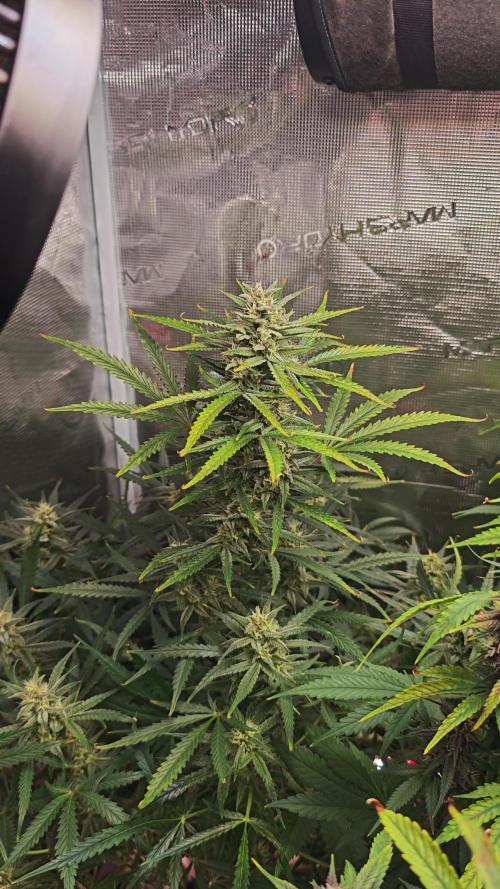
Auch in Woche 8 machen die Ladys bemerkenswerte Fortschritte. Die Pistel verfärben sich nun nach und nach 😍
Likes
52
Share


@HazeyBobby
Follow
The week ends Sunday Mar-1, being day 61 of flowering since flipping the light. From first pistils shown, it's day 45 which is a more accurate snapshot of where the plants actually are in their maturity.
The buds development is progressing albeit slowly and trichomes are still clear across the canopy with lots of frost on the sugar leaves.
The buds have beautiful structure and quite fluffy. Swelling has started on some calyxes.
Light is maintained at 30cm above the canopy, with single daily fertigation at lights on - watering 3L per day. Fertigation pH target is 5.9-6.2 whilst flowering. Stopped the practice of fertigating at lights off due to the springtales infestation. Need to allow at least 2-4hrs of lights on period after fertigation. The coco is not dry but still damp on the surface after 24hrs from fertigation.
Trying to maintaining an average RH in the space at 50% but it's getting harder now with all flowers.
-----------------------------------------------------------------------------------------------------------------------------------------------------------------------------------------------------------------------
The grow setup includes;
- Secret Jardin DS120W tent (120cm x 60cm x 180cm) placed inside the bedroom. Passive & active intake of air is from a closed off section of the room where the central heating boiler sits - the intake is warm air (20 degC.) and fairly dry (40% RH) during the winter months.
- Mars Hydro SP250 LED light
- extraction fan - AC Infinity Cloudline T6
- ventilation fans
- aquarium heater
- small oil heater
- small dehumidifier
- 20L Airpots and 3.5L general pots for seedling stage
- Canna Coco substrate and nutrients
- GHE Flora trio nutrients
- pH and EC/TDS meters
- 2x Govee Thermo/Hygro meters (one at canopy the other at the roots level)