




Processing
Likes
30
Share


Likes
3
Share


@PoshGrow
Follow
Welcome to GhostGrow Chapter One by PoshGrow!
🌳 Week #2
All strains look happy and healthy, growing very fast.
This week watering when needed, every other watering I used Fox Farm Big Bloom & Grow Big.

Likes
41
Share


@Reyden
Follow
Ecco qualche foto e video della 4º settimana di fioritura inoltrata per queste ragazze di Fast Buds che stanno alla grande! Stanno maturando molto velocemente, dalla settimana in cui sono partito sono cresciute tantissimo, penso che altre 2/3 settimane e si taglia anche quelle più indietro 😃💚

Likes
18
Share


@kingmcdaid
Follow
Ok guys week two went fast and easy on this Bruce banner auto from monster genetics. It's starting to show it's second set. I gave her her first dose of worm tea to the soil aswell as a foliar feed to prevent disease. Started incremental light increase this week this strain is very quick to respond to the light intensity it told me with her leaves very quickly right where she wanted that light and found her max without causing harm. Did have to back it down a hair though. Started pushing her around a little flexing her stem and giving light quick flicks as a result her stem is already gaining strength. She is all around healthy and happy and there are no early signs of deficiency. It's looking good and so far I'm really liking what I see. If you like auto grows or this strain in particular or if your interested in organic/living soil growing hit the follow button and watch her grow with me! Thank you for reading about my grow and all questions or comments are welcome happy growing

Likes
Comments
Share

Likes
12
Share

@DivineBuds420
Follow
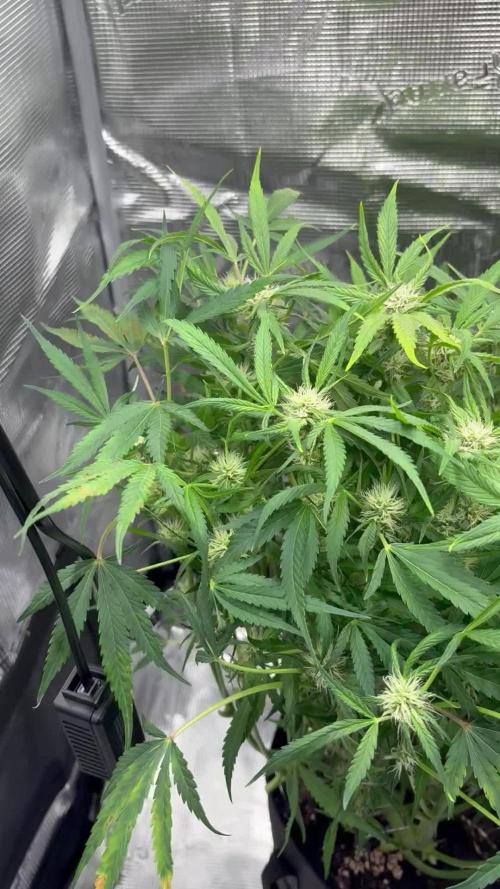
The plants are showing different levels of development and stress this week.
The weather has been quite unpredictable lately. We've had daytime temperatures around 28°C, while some nights dropped as low as 8°C. On top of that, we've had temporary dry periods, strong winds and heavy rain showers.
Basically, just business as usual in Northern Germany. 😂🌦️💨
Despite all of this, the ladies are pushing forward.
🌸 APPALACHIAN KUSH
One of the Appalachian Kush plants was the first to start flowering, and she's continuing to push ahead.
You can clearly see the buds getting larger and spreading further across the plant. 🌸
Her sister is also showing clear signs of flower production, although she is not nearly as far along yet.
Interestingly, she's already showing an obvious reaction to the cold nights, with some of her leaves starting to turn purple. 💜🌿
🌱 GREEN POISON
Green Poison has surprisingly caught up quite a bit, both in height and in flower development.
She's also developed a beautiful, strong green colour, which is great to see. 💚🌱
🌿 GOLOSA
Our little mutant Golosa has developed into exactly the kind of bushy plant we expected. 😂🌱
She's becoming a very interesting plant, and I'm really curious to see how she continues to develop over the coming weeks.
I'm especially interested to see how she forms her flowers and what the final result will look like with her two naturally separating main branches.
Definitely one to keep an eye on. 👀🌿
🖤 SIRIUS BLACK
Sirius Black has developed a good structure and is also looking strong in terms of height.
She's starting to form flowers as well.
Unfortunately her overall colour still looks a little weaker compared to the other ladies.
We may need to intervene again over the next few weeks if she doesn't catch up. 🌱👀
🌿 THIS WEEK'S FEEDING
This week, all plants received a top dressing of 15 g Silicium Flash.
In addition, they received a solution containing 1 g of Bactrex and 10 ml of Orgatrex.
Now we'll give them some time and see how they respond to it. 🌱
We're hoping for some good weather and, even more importantly, strong resilience from the ladies over the next few weeks so they can handle whatever Northern Germany decides to throw at them. 😂🌦️💨
We're excited to see how everything develops from here and will keep a close eye on how the plants react.
Let's see what the next weeks bring. 🤞🌱💚
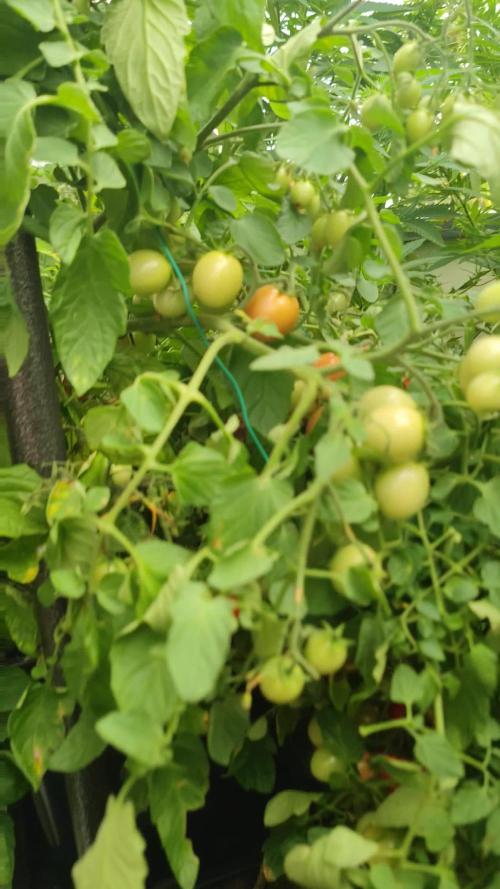
🍅 TOMATOES
The tomatoes are still keeping us supplied with plenty of incredibly delicious fruits. 🍅😍
We're honestly very grateful for this little bonus harvest from our balcony jungle. 💚🌱


Likes
21
Share


@Hashy
Follow
********************************************
Week 11 mid flower (week 5 flower)
********************************************
Light cycle=12/12
Light Power=160w 67%
Extractor controller settings (during lights on).
High temp= 26c
Temp step=0c
High Rh= 52%
Rh step=0%
Speed max=10
Speed min=3
Extractor controller settings (during lights off).
High temp= 21c
Temp step=0c
High Rh= 56%
Rh step=0%
Speed max=10
Speed min=3
Smart controller settings (during lights on).
Lights on=9.00am
Radiator on= -22.5c
Radiator off=+23.0c
Top fan on=
Smart controller settings (during lights off).
Lights off=9.00pm
Radiator on=-18.5c
Radiator off=+19.0c
Top fan on
VPD aim=0.9-1.4
DLI aim=35-40
EC aim=0.8-1.6
PH aim=6.0-6.5
💧💧💧💧💧💧💧💧💧💧💧💧💧💧💧💧
NPK= 9-18-28
Method= Automatic
Feed=Flower nutes
Neutralise=0.1ml/L
Plagron bloom=4.5ml/L
Plagron Power buds=1ml/L
Green Sensation=1ml/L
Easy Ph Up=0.035ml/L
(1ml=23 drops, each drop is 0.043ml)
Ec=1.6 PH=6.3/6.3
Runs=18
Run times=4mins (L/L each)
Gap times=16 mins
Total runtime=72mins(L/L each)
Total flowrate= ml/min(ml/min each)
Auto start time=10.00am
Auto stop time=15.44pm
💧💧💧💧💧💧💧💧💧💧💧💧💧💧💧💧
********************************************
********************************************
📅15/12/24 Sunday (Day 71)(flower day 31)
📋 removed support from snapped cola as its mended now.
Slight adjustments and defoliation.
💧
Automatic mid bloom nutes
Ph up=0.43ml, 10 drops
Ec=1.6 PH=6.3/6.3
Volume=12L
Volume left=1.5L
Volume used=10.5L(ml/min)
Volume each=5.25L(ml/min)
Runoff.
Total runoff=2.4L
Ec=3.4 PH=/6.2
💧
📅16/12/24 Monday (Day 72)(flower day 32)
📋
📅17/12/24 Tuesday (Day 73)(flower day 33)
📋
📅18/12/24 Wednesday (Day 74)(flower day 34)
📋
💧
Automatic mid bloom nutes
Ph up=0.43ml, 10 drops
Ec=1.6 PH=6.3/6.3
Volume=12L
Volume left=2.5L
Volume used=9.5L(ml/min)
Volume each=4.75L(ml/min)
Runoff.
Total runoff=0.4L
Ec=3.2 PH=/6.4
💧
📅19/12/24 Thursday (Day 75)(flower day 35)
📋
📅20/12/24 Friday (Day 76)(flower day 36)
📋
📅21/12/24 Saturday (Day 77)(flower day 37)
📋 Slight defoliation
H=92cm D=23cm Dli=46 8 ppfd=1080
********************************************
Weekly roundup.
📋 It's been bitter cold outside this week so the radiator has been in use a lot this week using 38.95Kw £9.73
She is loving everything so far, a little behind the other strain in development but not by much, got nice spacing between the flowers and great airflow around her.
Back soon.
Take it easy.
********************************************

Likes
12
Share


@cookingwithninja
Follow
day 49 just pure water phed down.
it is day 51, morning before lights on, I might chop today. I use a zero water filter pitcher got off walmart. My humidifier is only a sonic wave. If you use regular tap water it will get gunky in a sonic humidifier. If you have a heat humidifier that boils the water the mist should be clean. These are the 2 types of water humidifiers. Researching best water filters this "zero water" also comes with a free ppm meter! yay! Other water pitcher brands; the water still has ppm. So water misted will still have ppm contamination. You can easily used distilled water only, and reverse osmosis. I just fill a 4gal office water jug with the pitcher and fill my humidifier when needed. I do not use a humidifier in my entire grow up to this point when I chop, I need the perfect rh or this whole effort can fail. growing up to this point only requires 20% effort, chopping now for the 2 weeks dry is this 80% of crucial determination, succeed. A lot of tasks are required today for a clean chop. I feel confident, observed my cross seeds with pink paradise and one with a slightly open caylex looks dark enough for successful germination. I figured 8-16 seeds may be created, 3-4 buds were potentially pollinated. Many growers don't understand when creating genetics with female/female there is a slight chance of herm. You lose 50% of your genetic function. Just water last 2 days, no humic no folvic, 1st time entire grow ha!
There is a lot of cleaning to do, remove the trees, clean the entire tent and environment with bleach water, hacksaw.
I am very proud of my grow. I have sampled 3 of the strains, dr. thunder legit made my lips numb but it could have just been the terps removing my skin cells from the sticky filter, no lie. This is my best grow to date. I did this for you, and to document hype or not under the best conditions I could give my plants, full max potential, although I wish I had more lights, I am not looking for industrial lol, this is how I grow. Learn a lot on youtube and podcasts there is many good content and I may dab into it. You can have a room full of growers and you have 1 seed in your hand, they will all tell you that their way is correct ;) and the best way. Oreo is stinky AF, Bridal is just amazing glad its massive, just not into sativa but the test seemed slight sativa with majority indica, pink untested, dr, thunder just a lip numming plant aha, its very nice, all 4 amazing appeal like advertised, and excited for next run. Either crosses from this or other copycat genetics.
I will give you beautiful glamout shots today, the sizes of the plants, My guesstimate bridal 1lb, thunder 1lb, pink, 0.4lb, bridal 0.5, I am ambitious off 640w lm301h, and 4x 20w blurples daisy chained.
day 51 4 chopped see you in a few weeks :D

Likes
8
Share


@Growing88
Follow
Scusate se ho saltato delle settimane del diario ma ho altre 60 piante a cui stare dietro alle legature dei rami,ho applicato il fimming in fioritura e i fiori sotto si sono gonfiati provate per credere,non dovete tagliare molto ma solo i primi 2 mm del fiore,le piante orange sherbet sono state coltivate in contenitori diversi,uno air pot da 11 lt ed è la pianta già pronta per la raccolta,e l'altra in uno smart pot da 20 lt e la pianta sta ancora crescendo e formando i fiori,bellissima genetica,agli inizi pensavo male per via della grandezza,ma devo dire che è molto resistente e cresce molto se gli dai lo spazio. Grazie Grow diares
Likes
11
Share

@RBG
Follow
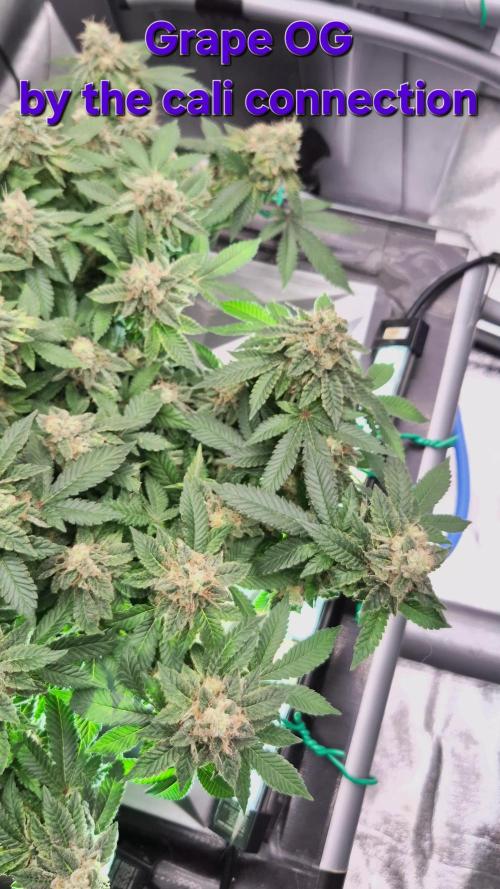
🌿 Grape OG by The Cali Connection 🌿
Week 14
Flower week 8
Flower-day 1
3/12/25
( pisitils showed 25th of October) im timing from pisitils showed but diary runs from 12/12 light flip
No nutrients change today, I'm thinking about 2 weeks or so of feeding, maybe 2 more horti rawk doses before switching out to new millennium winter frost then onto flush with plain water/ph
9/12/25
Dumped nutrients, winterfrost 500ml ( 10ml a gallon) will use for 7 days then flush for 10 or so
Not sure, not sure. Maybe even give LA and Grape an extra week to get Bellini over the end instead of pulling a little early or pulling her as shes finishing up.
Next horti rawk dose probably saturday (48hr run ) then dump then new nutrients.
This is currently week7 day 1 flower from 6/12/25 ( pisitils first shown )
8/12/25
Will be dumping nutrients tomorrow, using winter frost then onto flush

Likes
3
Share

@momothehobo
Follow
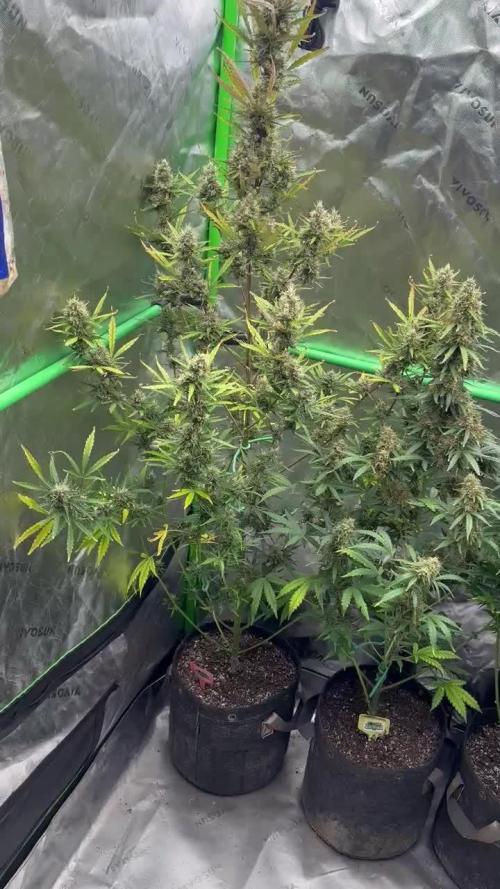
Still flushing this week, I plan on chopping this Friday! As always, the girls on GrowWithJane:
1) https://growithjane.com/growlog/fb420-original-gorilla-zkittles-yellow-342ve
2) https://growithjane.com/growlog/fb420-original-gorilla-zkittles-green-ubh4l
3) https://growithjane.com/growlog/fb420-original-gorilla-zkittles-blue-0wj77
4) https://growithjane.com/growlog/fb420-original-gorilla-zkittles-white-c6ovz
5) https://growithjane.com/growlog/fb420-original-gorilla-zkittles-pink-50csd
Likes
20
Share


@Bread_n_Buds
Follow
And here we are at our Zamnesia harvests, Northern Lights 1 - Born on 01.09.2024 - Harvested on 14.11.2024 precisely ten weeks and 4 days of life on this earth.
ATTENTION - The other plant was harvested and documented in the previous week, for convenience and to better distinguish them at harvest time I divide them for you.
Even though we are growers in our small intensive it is always a little displeasure to prune these masterpieces of nature and cannabis breeding but on the other hand the purpose for which it produced these buds full of resin is noble and if it remained there for a long time it would not come to a good end, so without further ado it is harvested.
We evaluated the harvest because the flowers seemed to have been ripe for a while, very mature pistils, rock flowers that seemed ready for about a week but I still flushed for the best possible result in terms of organoleptic cleanliness of the flower. Pistils ripe at 80-90% and trichomes mostly clody, quite a bit amber and in the violet shades of the leaves reddish and violet gorgeous, really a beautiful show of trichomes.
The scent is truly wonderful at the time of harvest I could not distinguish it well then slowly something sweet and fruity mixed with spicy came out a mix that always intoxicates me.
The results in terms of quantity are not bad at all we will be around 30-40 the first one already harvested and 50-60 this one.
We are very happy to be on Zamnesia's side and to show you what work they are doing with breeding.
Soil - The plant was grown with the 100% organic Plagron Promix soil, which I really appreciated for its fantastic absorption coefficient and for an airiness that would not even require perlite, which I added in some cases.
Fertilizers - From day one, fertilizers were calculated with the module on the Plagron website that allows you to calculate your customized fertilization schedule. I used: Alga Grow and Algra Bloom as basic fertilizers, Power Roots as a rooting agent, Sugar Royal amino acids, the very important Pure Zym enzymes that process the dead parts of the plant and transform them into fertilizer, Vita Race as a strengthening foliar, Power Buds that stimulates a very fast production of buds for real and the legendary Green Sensation booster without equal on the market.
They are all available on the Zamnesia website in convenient packs perfect for growing, just do a simple search if you use mineral fertilizers and you will find the line that best suits you //
At the link --- https://www.zamnesia.io/it/11457-plagron-easy-pack-natural.html
On the Plagron website instead you can find the info and calculate your custom growing schedule
At the link --- https://plagron.com/en
The DS120w Growbox and the fantastic DF16 ventilation / filtration system are from Secret Jardin, there was a change of growbox between autoflowering and photoperiodic at a certain point for a height emergency if you notice discrepancies on the light models and growbox it is for this but everything should be fine. Highly recommended and with an excellent quality / price all the fans.
At the Link --- https://www.secretjardin.com/
The light is from Viparspectra, always super reliable and productive,
At the Link --- https://www.viparspectra.com/
The seeds and an unmissable series of accessories from the world of ganja and not only on the best site of the situation,
At the link --- www.zamnesia.com

Likes
49
Share


@hawkeye_diesel66
Follow
She is truckin right along. I love this stage of flower when little buddlets are all over her. If the genetics of fast buds are all like this, I may have found a new autoflower place, I do want to try some memphosto genetics though. I'm always hearing and seeing those big plants they throw out. Not many picture's this week got busy and had to play catch up.


Likes
27
Share


@I_Identify_As_A_Dan
Follow
Start of week 5 for Kalini Asia
Shes really got a perform note to her scent!
And has a clear purple coming in too while new pistils are completely white.
Ive been able to bend her colas a bit outwards everyday to try get better light penetration to the buds and i think its working well. What do you guys think?
Still bottom feeding her everyday just water.
Likes
3
Share


@hillbilly705
Follow
week went we'll feed them molasses and Alaskan fish fertilizer. they seem happy the smaller one have made a big come back from almost loading it .i can't wait too see the flower start stacking. I also have been leaf tucking too get more light on side shoots
Processing
Likes
17
Share


@LockDownGrow
Follow
OK so update on this fantastic fast buds strawberry pie grown under the brittish company skyline leds
There skyline 1000 mk1
Using house and garden nutrients in soil at a light cycle of 20/4
This seed was simply explosive from the very slick fast buds packaging too the Soil,
Flowered around week 5 or 5,
And from the very first week was covered in thick frosting,
These two strawberry pies where like a powertrain from then on out packing on weight and frosting giving of a very skunky sweet gas smell that took over the whole enclosed area,
These where alittle sensitive too light intensity in the early stages so I recommend giving them a good supplemental light for the first 2 weeks before introducing them too there flower light,
They really do like too sulk if given too much light in the first 2 weeks,
But other than that no issues too report,
OK so now for the important part,
This frostie delight once dried and only had a very short cure so far,
But I do not sell anything I produce so they can cure for 12 months if its not smoked before,
But its a very sweet skunk smell with hints of fruit,
And the smoke is also very clean creamy friuty ice cream in fact its so smooth and creamy that even using my large chongz glass bong most of the time is very pleasant and easy on the lungs that even a novice smoker wouldn't cough,
The terpins on this girl is special and as soon as you spark your lighter your mouth comes too life with this experience that is fast buds strawberry pie,
The effect is instant and intense,
But the intensity is not unpleasant and is NOT one that will make you feel paranoid,
I am a medical grower and coming from me that's saying Alot,
The high is insane,
You breath out that terpin rich smoke and almost instantly
This feeling of well-being and a happy vibe sweeps over you,
And you can expect too zone out for a good 40 mins staring Into space without blinking,
Feeling like your whole mind body & soul has been felt too marinade in pure xtc,
I highly recommend this strain too anyone,
And by far one of the nicest autos I've ever experienced,


Likes
55
Share


@Theia
Follow
This week has flown by with no issues to report. She just does her thing. There is another 3 weeks to go for her flowering so we will just keep doing whatever it is we have done in weeks gone by..
There I go again with the "we". There is no we only I ...
I will increase the top max this week. 2 more weeks of feed then water for the last week.
Thanks for stopping by.
Stay safe 😷😷
Grow well 🌱🌿🌱🌼
