


Likes
Comments
Share


@BudsBanditUK
Follow
Well she looks ok but still no smell. Always looking hungry but still healthy. This will be my second tastbudz strain. The last one was peanut butter cookies. Lets just see what happens.


Likes
147
Share


@JamMAKEcan
Follow
There was a drive by shooting 4 houses over they hit a neighbor 2nd story wall..ahhh my neighborhood is a war zone lol.. An i still operating behind enemy lines lol lol.. That's a good neighbor too.. .. Have fun
Stay safe
Growers❤️💯💯
Likes
7
Share


@KannaKullektiv
Follow
Hiiigh friends 🙌
Welcome to week 4. 😍
They have grown well in size and the one on the far left has overtaken her two sisters although she shows signs of a deficiency. 😊
I have noticed a calcium magnesium deficiency because I only water with osmosis water. What to you think?
See you next week. 👋
Arturo for KannaKullektiv
🙏


Likes
54
Share


@RastaGrow
Follow
Greetings Rastamans, as you can see my girl is getting thicker and is growing weekly. Every used fertilizers have very good results. Slowly aproaching the time of harvesting, This is evidenced by the trichomes as well as the timing of the flowering cycle. I believe that the harvest from this plant will be great. Use of the necessarry techniques at the right period of times gave me the results that you see yourselves. It is the last day of lighting. It will be in dark for 36hrs. Also today defoliation will take its place and I have already splited main stalk. hope you get enjoyment and also knowledge from my diaries. Wish you all good luck.
Yours trully Rastagrow

Likes
16
Share


@eldruida_lamota
Follow
Vamos familia, hora de cosechar estas gorilla de RoyalQueenSeeds.
No veáis que pinta que tienen las flores están bien formadas y repletas de tricomas.
Estoy deseando probarlas.
El problema han sido las temperaturas las últimas semanas que excedieron los 30 grados.
Aun así salió todo para alante
Agrobeta:
https://www.agrobeta.com/agrobetatiendaonline/36-abonos-canamo
Mars hydro:
Code discount: EL420
https://www.mars-hydro.com/
Hasta aquí es todo , espero que lo disfrutéis, buenos humos 💨💨.
Likes
252
Share


@Tropicannibis_Todd
Follow
💩Alrighty then Growmies We Are Back At it 💩
Well folks we just finished up the last run and so we are back to do it all over again 😁
So what do you say we have some fun 👈And what we got here folks is a Strawberry Blast 🍓 🍓 🍓 🍓
Strawberry 🍓 Gorilla , Strawberry 🍓 Banana 🍌 and there new release 🍓 Ztrawberriez 🍓 from FastBuds
And we also got Strawberry 🍓 Cola from Exotic Seeds
👉 Well we are now around day 28 and well growmies its been a ruff week 👈
We had a huge storm roll in and we lost power for 4 days , this is where I had to get creative 😳 it's wasn't the best but they all came out out of it pretty good 👍
So 2 out of the 4 are preforming really well into the preflowering , where as the other 2 are taking there time 👈
So this week I've started her nutrients regiments 👌Just need to remind myself to take it easy 🤔
FC4800 from MarsHydro Lights being readjusted and chart updated .........👍I've added a RU45 to the mix 👍
www.marshydro.ca
👉I used NutriNPK for nutrients for my grows and welcome anyone to give them a try .👈
👉 www.nutrinpk.com 👈
NutriNPK Cal MAG 14-0-14
NutriNPK Grow 28-14-14
NutriNPK Bloom 8-20-30
NutriNPK Bloom Booster 0-52-34
I GOT MULTIPLE DIARIES ON THE GO 😱 please check them out 😎
👉THANKS FOR TAKING THE TIME TO GO OVER MY DIARIES 👈
Would you like to hang with the growdiary community 👉 https://discord.gg/gr4cHGDpdb 👈

Likes
5
Share

@sanibelisl
Follow
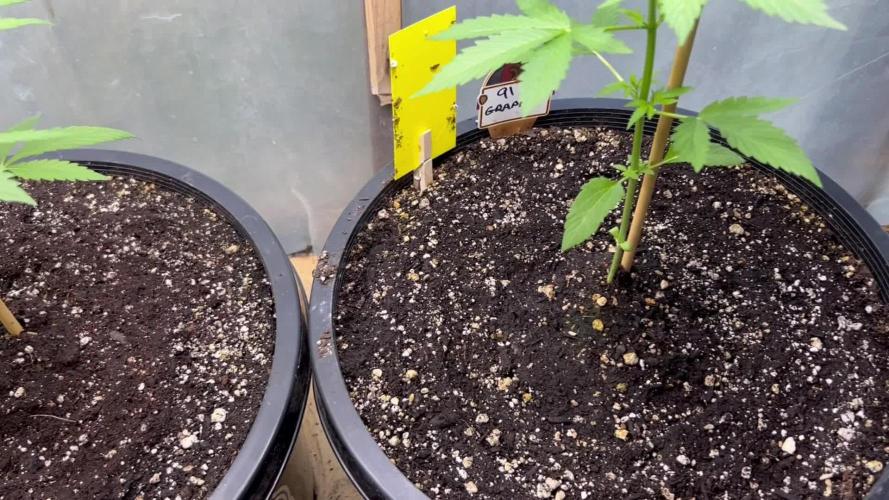
Girls had a great week at summer camp! Smiles are found everywhere regarding their new homes. Plenty of room to grow and wiggle their toes in the amended formula 707, which is doing what was expected retaining moisture nicely, bringing the watering to a minimum.
All three girls received merit badges for hiking(survived transplanting), water sports(2 liters), light tolerance(supplemental lighting), physical fitness(color and strength)and kite flying(added a fan). They are all looking forward to this weeks activities.
Girls seem to like what they’re getting at the chow hall, green and growing daily, strong and upright. Plenty of good stuff in the soil.
A fan was added and the benefits are three fold, dry out the top layer of soil, pest control, makes them stronger.
I will update as needed.
***update, the girls are looking good this morning, well rested, well nourished, vibrant. Their roots must be really liking the 707 as evident by the rapid growth. Measured them this morning with the H. W. At8 in. the V. F. at 8.5 and the 91 Grapes at 10 in. And at least an inch wider as well. No water will be needed today.
Note. The greenhouse may be better suited for growing mushrooms than cannabis. Pine trees and shade. No direct sunlight until after 2pm. Dappled sun all morning long, so installed a T-5 4 foot ArgroLed 6550(k) daylight led fixture above the girls. That was a bright idea!
***update, New Video includes new homemade lighting.

Likes
313
Share


@Tower84
Follow
🌿 Woche 26 – Mentha de Croco von Terpyz 🇩🇪
Die Entwicklung der Buds schreitet momentan wirklich hervorragend voran 🌸💚. Besonders bei der linken Pflanze sieht man inzwischen jeden Tag deutliche Fortschritte. Die Buds beginnen bereits wunderschön in der Sonne zu glitzern und die ersten Trichome machen richtig Lust auf das Endergebnis ✨☀️.
Auch der Geruch beim Reiben an den Zuckerblättern wird immer spannender 👃🌿. Ich würde das aktuelle Aroma als zitronig, minzig, leicht lösemittelhaltig und mit einer feinen Beerennote beschreiben 🍋🍃. Eine wirklich interessante Kombination, die sich hoffentlich in den kommenden Wochen noch weiter entwickelt.
Der Breeder erwähnt, dass es bei diesem Cultivar seltene Blaubeer-Phenos geben soll, deren Buds allerdings Unterstützung benötigen 🌸. Ich könnte mir durchaus vorstellen, dass sich die linke Pflanze in diese Richtung entwickelt. Natürlich ist es dafür noch viel zu früh, um das sicher zu sagen, aber die Kombination aus Aroma und ihrer bisherigen Entwicklung macht mich definitiv neugierig 👀.
Von allen drei Pflanzen in meinem aktuellen Grow riecht die linke Mentha de Croco momentan tatsächlich am besten 😍. Ich bin deshalb besonders gespannt, wie sich ihr Aroma bis zur Ernte noch verändert.
Die rechte Pflanze ist im Vergleich momentan etwas unspektakulärer 🌿. Dafür scheint ihre Struktur etwas unkomplizierter zu sein, sodass ich mir bei ihr wahrscheinlich etwas weniger Sorgen um die Unterstützung der Buds machen muss 🌸. Bei der linken Pflanze werde ich das Gewicht der Buds definitiv weiter im Auge behalten.
Beim Wasserverbrauch liege ich momentan bei ungefähr 2,5–4 Litern pro Pflanze und Tag 💧. Das hängt inzwischen stark davon ab, wie warm es tagsüber wird. Diese Woche soll es noch einmal etwas wärmer werden ☀️🌡️ – für die weitere Blütenentwicklung dürfte das durchaus hilfreich sein.
Langsam steigt bei mir wirklich die Vorfreude auf das Endergebnis 😍🌸. Gerade die linke Pflanze macht mich mit ihrem Aroma und dem zunehmenden Trichombesatz richtig neugierig. Jetzt heißt es weiter beobachten, das Wetter genießen und hoffen, dass die Pflanzen ihre Buds noch ordentlich weiter aufbauen 🤞🌿.
🌿 Week 26 – Mentha de Croco by Terpyz 🇬🇧
The bud development is progressing really well at the moment 🌸💚. Especially on the left plant, I can see noticeable changes almost every day. The buds are already sparkling beautifully in the sunlight, and seeing the first serious layer of trichomes is making me really excited about the final result ✨☀️.
The aroma when rubbing the sugar leaves is becoming more and more interesting as well 👃🌿. At the moment, I would describe it as lemony, minty, slightly solvent-like, with a subtle berry note 🍋🍃. It’s a really fascinating combination and I hope the terpene profile continues to develop over the next few weeks.
The breeder mentions that this cultivar can occasionally produce rare blueberry phenotypes, although those buds apparently need some additional support 🌸. I could definitely imagine the left plant moving in that direction. Of course, it’s still far too early to say that for sure, but the combination of its aroma and overall development definitely has me curious 👀.
Out of all three plants in my current grow, the left Mentha de Croco actually smells the best at the moment 😍. I’m therefore especially interested to see how her aroma develops by harvest.
The right plant is a little less spectacular for now 🌿. However, its structure seems somewhat easier to manage, so I’m expecting slightly fewer concerns about supporting the buds 🌸. I’ll definitely keep a close eye on the weight of the buds on the left plant.
Water consumption is currently around 2.5–4 litres per plant per day 💧. It varies quite a bit depending on daytime temperatures. It’s supposed to get a little warmer again this week ☀️🌡️, which should hopefully help with further bud development.
I’m getting more and more excited about the final result 😍🌸. The left plant in particular has me really curious with her aroma and increasing trichome coverage. For now, it’s all about watching the plants develop, enjoying the warmer weather and hoping they continue to stack up those beautiful buds 🤞🌿.


Processing
Likes
30
Share


@Canadian
Follow
Day 49 the blue amnesia are 44 and 41 inches and the Moby Dick are 39 and 33 inch tall the scrog net is at 29 inches tall from the base of the planters( meaning from the soil measuring upwards). the two plants that were shorter are starting to stretch very fast when the other two plants are just puffing there buds fatter every day and not so much stretching anymore. I thought that the other two that were not stretching as fast as their counterparts we're going to be shorter in size but seems to me they were just maturing at
A different speed. also the Moby Dick smells very sweet very nice. thank you for reading and I will continue updating have a happy grow.
Day 54 it looks like the plans have been struggling a lot with excessive nutrient inside the pot even after Flushing they're showing lots of ( 1000+ to 2300+)PPM per plant so i decided to buy General Hydroponics flushing product for the next watering cycle to clean them out . Unfortunately it takes some time for somebody to learn how to use properly nutrients and to read signs on the plant because of this it seems that one of the movie dick will be getting much less flower than the other plant because nutrient lockout for excessive nutrients that I didn't notice early on for lack of experience D2 blue anessia are pretty much equally growing despite all of them showing signs of nutrient burn they have to suffer in order for me to learn looks like they stop stretching as well and they're focusing only in become fatter what an incredibly resilient plants. Despite all this they are on the road to recovery and seems to be doing well I will continue updating thank you for reading and have a happy grow.

Likes
44
Share


@SooSan
Follow
12/12 + 35 jours
Vu qu’il y a 16 plantes mais que sur growdiaries on ne peut mettre que 8 variétés j'ai divisé en 2 diaries pour le bas de la tente
1️⃣
🏠 90x60x90
☀️ FC-E 4800 => puissance a 20%
🍁
1x Black Bomb / Philosopher Seed
2x Amnesia Lemon / PEV Seeds
1x Blueberry / PEV Seeds
1x Blueberry / 00 Seeds
1x Wappa / Paradise Seed
1x Dark Phoenix / Green House Seed
1x Quick Sherbet / Exotic Seeds
1x Mango Cream / Exotic Seeds
1x Banana Frosting / Sensi Seed
1x Hindu Kush / Sensi Seed
3x Fast Mix / Sweet Seed
📎 https://growdiaries.com/diaries/122084-grow-journal-by-soosan
📎https://growdiaries.com/diaries/124052-grow-journal-by-soosan
2️⃣
🏠 30x60x50
☀️TS1000 => puissance a 50%
🍁 4x Quick Sherbet - Exotic Seed
📎 https://growdiaries.com/diaries/122080-grow-journal-by-soosan


Likes
7
Share


@HIAZ_urbanbudfarmer
Follow
All has gone good this week topped #2, #3, #4 , for the 2nd time, continuing training.forming good flat canopy, switching them over to flower as it's the end of week

Likes
27
Share


@Smokepurple137
Follow
I'm happy with the progress they have made, all have responded well to defoliation and LST. I'll be adding a few more light nutrients at some point this week. The gorilla zkittles is shorter than the rest but looks very sturdy and has plenty of bud showing already, I think this is because it started flowering maybe 7days before the rest and in them 7days the rest shot up rapidly! I'll update daily and try get some nice videos with lights out.
Processing
Likes
12
Share


@Italianganya88
Follow
Alles läuft super buds fangen langsam an anzuschwellen hab eine 2 Lampe mit reingebracht um mehr lichteinwirkung in der Blüte zu haben. Die einzige Frage die bleibt sollte ich langsam anfangen zu entlauben. Bin mir bei autoflower unsicher.


Likes
55
Share


@budsfromthesix
Follow
Good start off to week 4. I did a 50 litre flush for pheno #1 and she bounced back real good. She is super happy and growth is really starting to pick up. A little more small in the tent now so I’m happy.
I’ve also added bamboo sticks for both plants since I’m not using scrog so no trellis net to stop the plants from falling over once they start to pack on weight. Excited to see how the next couple are gonna go. Hopefully no more issues :)
Likes
21
Share


@m0use
Follow
***Sponsored Grow*** = Medic || https://medicgrow.com || Grow = ***Sponsored Grow***
Everything is looking good on this plant this week, it has a different growth pattern then the others in the tent, its way more bendy and lengthy. When I place the steel forks on the stems to keep them from growing up this strain will go all noodle like and bend more fluidly then all the other plants. its like spaghetti or some other pasta related wet noddle thing. Still giving them a 2:1 or 2.5:1 grow vs bloom nutrient. Its helping with some of the pink stems from last week. Feeding strength is up .2 point to reach 900ppm or aorund 1.8EC will leave it here fro the remainder of Veg. Prob will do for 2 more weeks then flip to flower as I just topped them and want to give them some time to recover.
NPK ratio of 7-7-14 1:1 equal parts grow/bloom.
Grow=8-4-15
Bloom=6-10-14
Boost=1-15-30 "not yet used it yet"
Also took some clones from the plants as well, took two main cuttings from each plant, forgot to do the one so its not shown in the first video up the updated clone pics later in the week. If any of these impress me then the clones will go outside and grow there all year for a extra special harvest. Or I'll give them out to some friends and family maybe a little gorilla gardening project, but I will wait before getting ride of them all as I'm still kicking my self in the ass over the Blue Cindy loss. really liked that plant and wish its clones I gave out where still aorund.
Lights doing well. The V1 spectrum is good on the medic grow mini sun-2's 240w. No issues so far, dimmed at 80% till flower is initiated then up to 100%, Will test out 13/11 I think as the schedule to give them some more photons for an extra hour vs 12/12
.
Till next week.
***Sponsored Grow***
Official Website: https://medicgrow.com/
Facebook:
https://www.facebook.com/medicgrowled
Twitter:
https://twitter.com/medicgrow
Instagram:
https://www.instagram.com/medicgrow420/
YouTube:
https://www.youtube.com/channel/UCNmiY4F9z94u-8eGj7R1CSQ
Growdiaries:
https://growdiaries.com/grower/medicgrowled
https://growdiaries.com/grow-lights/medic-grow


Likes
10
Share


@Troy_Farms
Follow
This girl got delayed in flowering due to the neighbors outdoor lights. Didn't start flowering and it was coming to the end of September (time for early harvest for some outdoor varieties), so I was worried. Almost quit on her all together since she was not kicking into flowering. As a last ditch effort to stress into flowering I cut about half of the branches off. That worked and she finally kicking in and started flowering as September ended. She slowly got into flowering and the developing flowers looked nice. I used Bloom booster and Sweet and sticky to enhance flavor and flower. Curious to see how the end flower comes out. Colas didn't get super fat but looks quality. Should get around 2.5 ounces Dry I would guess. For an outdoor plant that is not that good but all things considered I am happy!
I am glad I found this site so I can more accurately log my grows, and I will only be growing seeds from seed banks now so I will have the legit strain and information beforehand.
Will update this harvest full when initial hanging is done in 10 days and I jar it all up.
Cheers and here is the next harvest 😎