


Likes
Comments
Share


@DrGreenbutterThumb
Follow
About to harvest was definitely a better experience than the first go unfortunately only 3 of 5 seeds popped and only 2 were the dolato I paid for

Likes
25
Share


@Kikiwindsurf
Follow
17/05/2020:
ENG: talking about the gorillas, they are 81 and 82 days of LIFE. Let me know your opinions... SHOULD I START THE FLUSH (SHOWER AND THEN JUST WATER) OR SHULD I CONTINUE THE FEEDING ONE MORE WEEK ?? THE CRYSTALS STILL QUITE TRANSPARENT, BUT I DONT KNOW IF I SHOULD FLUSH AT THE MILKY POINT OR DO IT NOW BECAUSE IF NOT IT WILL BE TOO LATER...
Despite of Lemon Haze , just let me know in the comments, I just want to give thanks to Luis from Eurogrow as he gifted me this seed when one of my gorillas dryed at the first stages (WEEK 2)
ESP: respecto a las gorilas...ESTOY TO RALLAO.
No se si hacer el lavado de raíces (meterla a la ducha y luego darle solo agua cuando la maceta se seque) o bien darle una semana mas de alimentación para que sigan engordando porque la verdad, no paran y los tricomas aun estan bastante transparentes. Pero tengo miedo de esperar al punto justo para hacer el lavado de raíces, porque se que despues del lavado deberé dejarla 10 dias mas aproximadamente...
Respecto a la Lemon Haze , dejarme que opinais vosotros. yo solo tengo que dar las gracias a Luís de Eurogrow, ya que me regaló esta semilla al morir una de mis Gorilla Glue.. Gracias ;

Likes
6
Share


@DogDoctorOfficial
Follow
🍒 Lemon Cherry Gelato — Week 4 Update
Autoflower · 12/12 from seed
Quick recap (for anyone joining here)
This Lemon Cherry Gelato has been grown 12/12 from seed, alongside photoperiod plants, under the same exact conditions.
At this stage, we’re still observing how modern autoflower genetics can blur traditional lines — and once again, this plant is behaving more like a classic photoperiod in structure and rhythm.
No rush. No force. Just observation.
⸻
🌿 Plant Development
She’s doing beautifully:
• Currently at 6–7 nodes
• Strong, even branching
• Internodal spacing is balanced
• Leaf color is a lush, healthy green
• Structure is open and expressive
No real training has been applied:
• Only very light leaf bending here and there
• No topping, no LST, no stress
• The plant is shaping herself naturally — and doing a great job at it
She looks calm, confident, and full of potential.
⸻
🌡️ Environment Log — Week 4 (Shared Conditions)
Same conditions as logged for all plants this week:
• Temperature: ~25.7 °C
• Relative Humidity: ~60%
• CO₂: ~666 ppm
• PPFD: 600–700 (adjusted naturally based on plant size and distance to light)
• Nutrition & watering: unchanged, consistent, identical across the room
This consistency is key — it allows us to clearly see genetic expression, not environmental noise.
⸻
🧠 Observations & Notes
What’s especially interesting here is how stable and photoperiod-like this autoflower appears:
• No sudden flowering push yet
• Vegetative structure continues to build
• Growth rhythm matches the non-autoflowers closely
At this point, labels matter less than behavior — and her behavior is excellent.
⸻
🙏 Thank You
A big thank-you to everyone following along, supporting, and appreciating the process.
This diary is about learning together, observing without ego, and letting the plant speak.
She’s shining — quietly, confidently, beautifully 💚
FOR DISCOUNT CODES AND MORE JUST FOLLOW THE LINK https://website.beacons.ai/dogdoctorofficial
📲 Don’t forget to Subscribe and follow me on Instagram and YouTube @DogDoctorOfficial for exclusive content, real-time updates, and behind-the-scenes magic. We’ve got so much more coming, including transplanting and all the amazing techniques that go along with it. You won’t want to miss it.
GrowDiaries Journal: https://growdiaries.com/grower/dogdoctorofficialInstagram: https://www.instagram.com/dogdoctorofficial/
YouTube: https://www.youtube.com/@dogdoctorofficial
⸻
Explore the Gear that Powers My Grow
If you’re curious about the tech I’m using, check out these links:
🔆 Lighting & Environmental Control
• Future of Grow — Advanced LED lighting technology
https://www.futureofgrow.com/
DISCOUNT CODE: DOG20
• Lumiflora — Under-canopy LED lighting
https://lumiflorade.com/
• TrollMaster — Environmental controllers and automation gear (past collaboration)
⸻
Genetics
• Zamnesia Seeds — Genetics used in this project
https://www.zamnesia.com/
⸻
🌱 Soil, Substrates, Boosters & Root Support
• Plagron — Substrates, bio mixes, and supportive products
https://plagron.com/en/
⸻
🎒 Storage, Curing & Preservation
• Grove Bags — Curing and storage solutions
https://grovebags.com/
⸻
📸 Photography Equipment & Tools
(Not sponsors, but part of my creative toolkit)
• Sony A6700
• Sony full-frame macro lens + few more
• Stacking photography workflow - learning
• iPhone (for behind-the-scenes shots)
We’ve got much more coming as we move through the grow cycles. Trust me, you won’t want to miss the next steps, let’s push the boundaries of indoor horticulture together!
As always, this is shared for educational purposes, aiming to spread understanding and appreciation for this plant. Let’s celebrate it responsibly and continue to learn and grow together.
With true love comes happiness. Always believe in yourself, and always do things expecting nothing and with an open heart. Be a giver, and the universe will give back in ways you could never imagine.
💚 Growers love to all 💚
📸 P.S. – The Eye Behind the Lens
All photos in this diary (for now — except for the ones showing the camera, which I took with an iPhone) are taken with a Sony A6700 paired with a Sony full-frame macro lens and a few more.
Photography is part of the story — it’s how we share the fine textures, the glow, and the quiet details that words can’t always capture.
I’ve also started experimenting with photo stacking — a technique where multiple images, each taken at a slightly different focus point, are layered together to create one perfectly sharp image from front to back.
It’s not digital enhancement or AI; it’s pure photography — a way to reveal the plant’s beauty in microscopic depth, from trichome to petal.
You’ll even see a few shots of "ghost me" capturing the shots — camera, lens, setup — because every grow deserves not just to be cultivated, but documented like art.
FOR DISCOUNT CODES AND MORE JUST FOLLOW THE LINK https://website.beacons.ai/dogdoctorofficial
NEW DISCORD - Official Server Invite Link : https://discord.gg/ksjAkA5T74
PS: A small heads-up — a few files didn’t make it into this update due to upload limits on Growdiaries (or simply her being a bit moody today 😄). We’ll try to upload the remaining photos next week. If possible, we’ll add them alongside the weekly update and clearly mark them as extra images.
Plenty of photos are already live though, so we hope you enjoy the update as it is. Thank you for your understanding and support.

Likes
15
Share


@Dunk_Junk
Follow
Her first week above ground!
I didn't do a very good job with this strain last time 😏
Lets see what happens this time.
Likes
51
Share


@kansasscott725
Follow
Little bit of a delay. Wanted to get climate perfect before the flip. Upgraded ventilation and have the tent dialed in well at 74 degrees and 60% humidity during day and 70deg/ 55% at night.
Started a second scrog on Day 42. Nervous about the stretch but hopefully I can maintain it (I wish T5 lights could flower...)
Did extensive trimming underneath clearing pretty much anything that will never reach the ceiling of green above it.
Day 45 marks last day of Veg
Day 46 marks first day of flower
AND.
HERE.
WE.
GO.


Likes
4
Share


@littlefoot
Follow
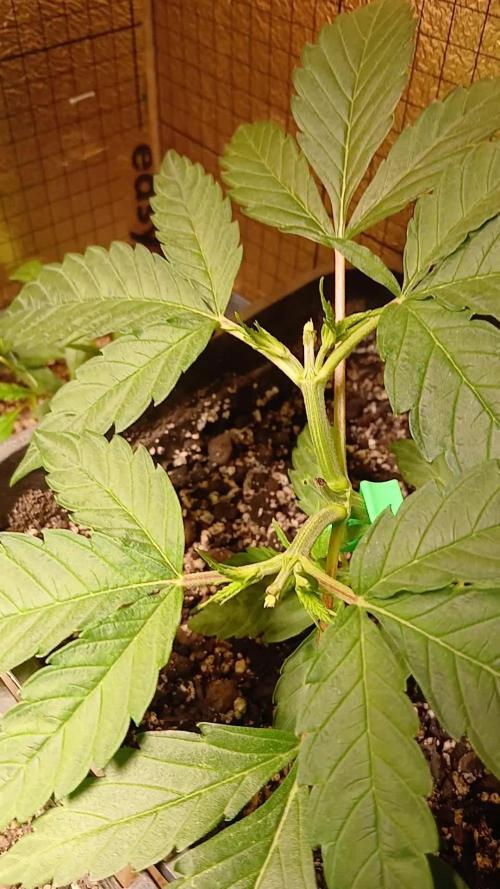
She is getting pretty and filling it well..been less than a week since I retopped her (properly) seeing g some good growth...
Dli is 42

Likes
5
Share


@Growin_Ish
Follow
Day 21
During lights out, I dialed up the light to 50% (200w).
Day 26
They are hungry and not growing. The moisture meter has only moved from really wet to wet since transplant on day 13. This new medium is much different than coco-loco. I'm going to top dress when the lights come back on. These plants should be a lot bigger. I feel like ripping them up and starting over. Ready to try my hand at photo-periods. One mistake with autos and the whole grow is phuked! SMH😡
Both these plants together will probably yield half ounce. Not worth the electricity. If I don't see miraculous response to top dressing, they are going in the trash!

Likes
Comments
Share

@PicoDeGallo
Follow
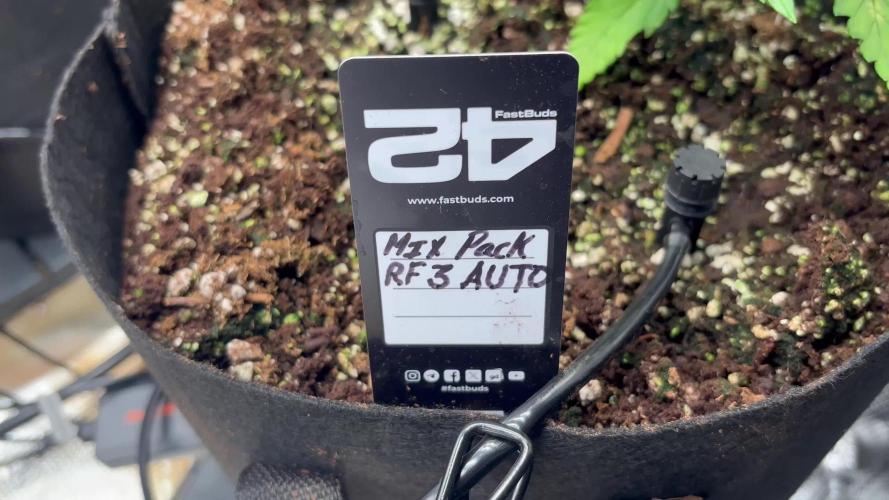
They’re all doing well. Seems like the #4 bag is using less water than the others.
I added the Spider Farmer Drip irrigation system. It’s set to trigger when the average is 25% water content.
Likes
2
Share
@Chrisandweed
Follow
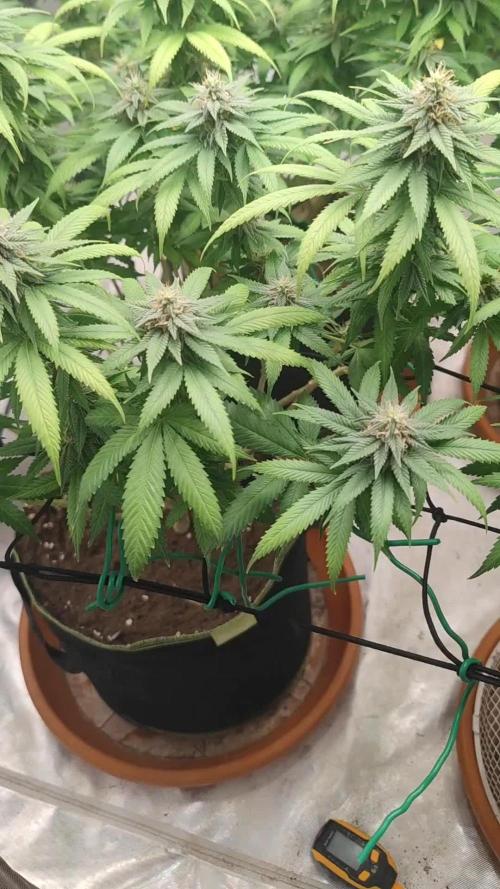
Puues ya va quedando meenos.
Todas estan sufriendo de sobrefertilización, por suerte, esta y la Pakistan lo están asimilando muchisimo mejor.
Las critical si están bien sobrefertilizadas 😅.
En el proximo riego, a todas les haré el riego solo de agua con una dosis media del producto Flush, de la marca que sigo usando. En el siguiente algo de comida y ya en el siguiente enzym y de nuevo a los riegos normales, no por na, siento que aún quedará un mes minimo para empezar con los cortes.
PD: IMPORTANTE, voy a poner datos que no solía poner por la "dificultad" entre muchas comillas ya que es dificultad por una situación especifica, de sacar y es que como antes comentaba, habían bloqueos y tal... Bien, he medido el agua de drenaje de cada planta. En esta los valores de ph estan mas o menos bien, peeero la EC era lejia viva! En esta planta el ph era de 6.33 y la EC era de 10.25 MILISIMENS! que no microsimens... Una toxicidad altísima! Muy similar a las otras 4. Básicamente mis riegos eran por lo general 2 a la semana, uno de fertilizantes base con el especifico de cada fase que toque, y el segundo riego era de encimas con normalmente calmag (fertilizante muuuy salino) y a eso le juntamos que normalmente los riegos eran justitos, normalmente no había drenaje, por lo que las sales en el sustrato se iban acumulando hasta estos puntos. Hoy, tras varios dias de dejar secar las macetas, incluso buscando un poco de estres hidrico, he metido un riego de 6L por maceta de agua con el producto Flush para hacer un arrastre y limpieza de sales, en esta ocasion los 6L han sido la medida perfecta para que drenase agua suficiente como para que estos niveles de ec bajen, y ademas en el plato pudiera medirlos y darme el resultado que he puesto anteriormente.
Todo comenzó porque en la Kritical GB sentí un bloqueo de pk y la planta empezó a comerse sus hojas para conseguir magnesio, si llego a verlo como una carencia de magnesio o calcio la hubiera cagado atrozmente!
Likes
27
Share

@Organic473
Follow
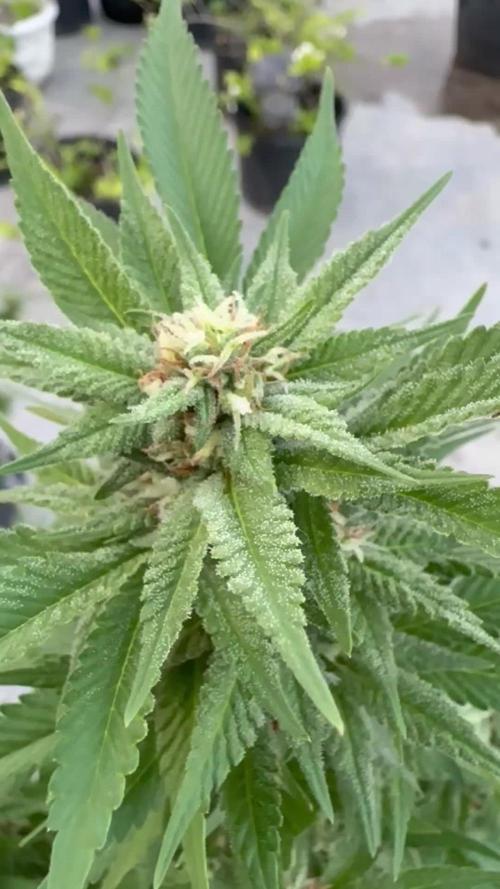
Just look at her isn’t she amazing. I am getting that pungent sweet smell also.

Likes
12
Share


@Terpyboyz
Follow
This grow should be coming to an end next 2 weeks or so some are looking to be in the last stages, only issue is having multiple strains is strains finishing at diff times.
There’s one exodus cheese that looks like she’s going to go 10/11 weeks but she’ll be cut well before that to start a new batch.
There’s 3 clones that were taken
1 being a big Buddha blue cheese that absolutely reeks of tangie/Clementine terps with a slight sour cheesey smell. This is getting revegged and cloned for the next run.
Ripper seeds - this is another strain I’m going to try to reveg as this is another keeper I should have taken cuts.
Platinum x harachata - 2 different pheno / one with rock solid nugs other is more Sativa.


Likes
56
Share


@Ganjagrandaddy
Follow
Day 21: . Wow these girls can grow fast. Having spent decades growing photoperiod strains and with only 1 Autoflower grow previously , I am astounded by the rate at which they grow daily. Watching the fan leaves gain so much size each day and the stems thickening alongside them shows their ability to rapidly cycle through their stages.
The Gorilla girls are doing so well and even the mutant#4 is starting to settlenin and gain a nice colour to her. I do think the up pot has affected her height and development initially but hope she will catch up now.
I have started to train the #2 GG with a 90° bend to her 5th node. I plan to keep them bent over like this until the lower nodes catch up and begin to develop as mains too. This is to avoid any topping at all as I want to see if this is a viable option with my room size. I used the forefinger and thumb method to gently crush the stem by rolling with slight pressure until I felt it soften enough to apply the bend but not too damaged to slow the growth to any note. Seeing how so many autos have a huge main stem that seems to form the upper part of the good yields from them , I thought I could keep it around but held down to still break the apical dominance. fingers crossed.
The Sweet cheese is getting herself set for a burst of growth too I think. she is a few days behind the others but looks happy enough. I am hoping to get to week 5 before they hit their flowering run to gain enough size to fill my space used and seeing their rapid speed , they just might do that.
Until next time Growmies , be safe and well.


Likes
98
Share

@THcHunteR23
Follow
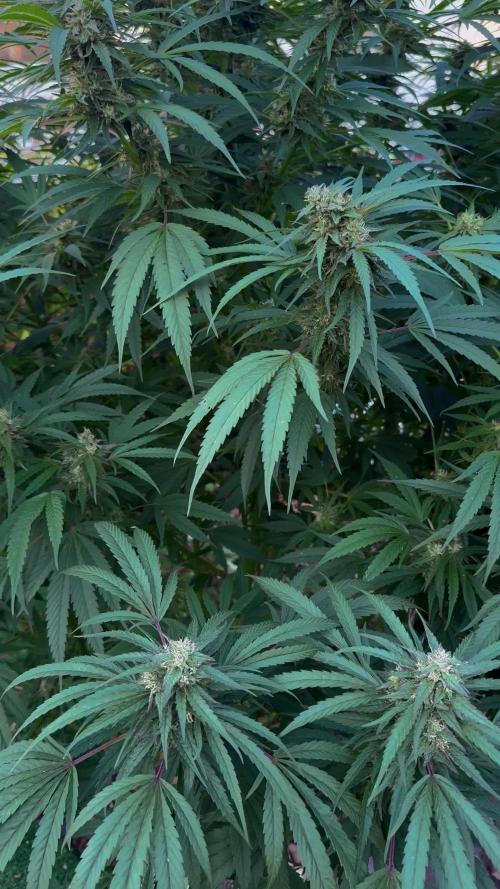
Presque elle porte bien son nom Des bonbon sucré avec légère touche crémeuse!

Likes
Comments
Share

@Olduffybastard88
Follow
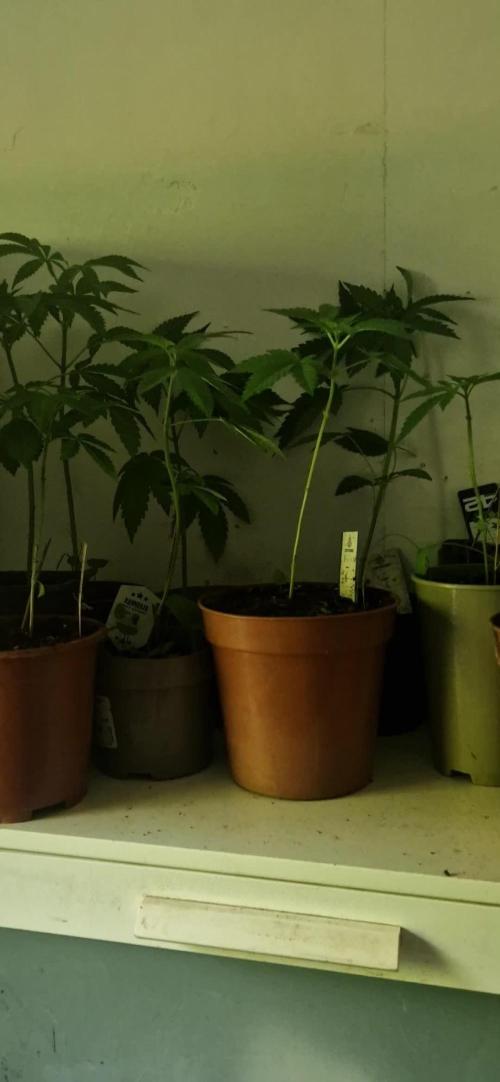
Moved back into the tent and had an explosion of growth same as the other tent going to veg them out another couple weeks and see if I can flip them after

Likes
1
Share

@Growfather1
Follow
Hello everyone,
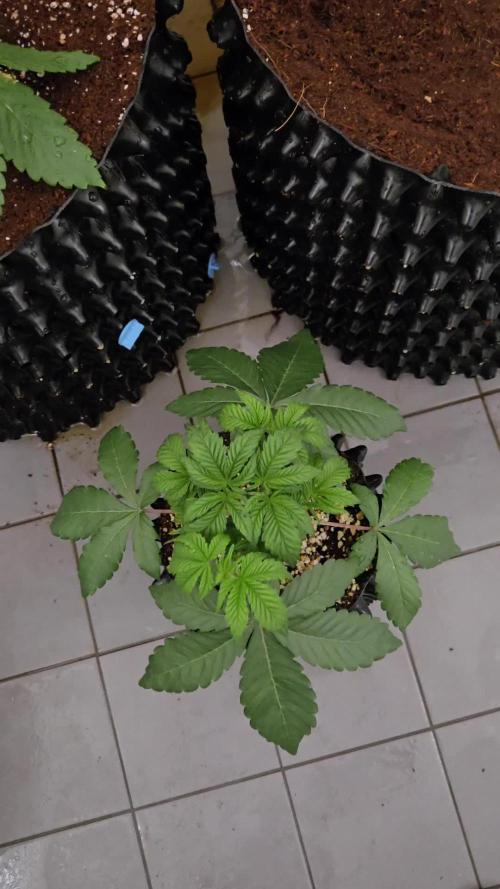
Finally finished transplanting 2 Mac1 F1 plants and i can tell you I'm exhausted and i still need to move them 25 meters to the tent OMG.
I have one plant that i will transplant within 48 hours.
I gonna give them a good defoliation and then they can enjoy their new pot for at least 4 weeks before flipping to flower.
Let's see how they look next week, thanks for stopping by and have a nice week.
Regards,
Growfather

Likes
18
Share


@Naujas
Follow
wow wow !!!! 404 gr ! from the suitcase!!!!!!!258 gr of wet dried buds!!!!!!! I am impressed with the result, and I don't really believe that I will ever be able to improve it :) It was a truly amazing journey with FastBuds Gorilla cookies auto, my house is filled with a wonderful sweet smell, the buds look really full and very very shiny :) I also collected a lot of sugar leaves from which I will make bubble hash:) the girl coped with high temperatures and high humidity throughout her growth, which is why I was afraid of rot, but everything went well!!!! She is amazing. smoke review and dry weight will be up very soon, good luck to everyone :)!!!


Likes
42
Share


@Grow420pice
Follow
Es blüht...
09.06.2021
Strawberry Pie ist in die Blütephase eingetreten.
Blackberry auch, knapp dahinter. Hat schwarze, violette Pistolen. Cool!
Forbidden Runtz kommt jetzt langsam in die Blüte. Wächst sehr schön und gut. Temperaturen sind im Moment optimal. Nächste Woche soll es so bleiben... Bin gespannt wie lange es noch dauert.
10.06.2021
Ich werd sie einfach wachsen lassen und nicht trainieren. Ich habe nur die unteren, schwächsten Triebe abgeschnitten und werde sie hin und wieder mal ein wenig entlauben.
Runtz scheint sich sehr gut zu entwickeln.
Strawberry Pie blüht schon. Fühlt sich auch wohl.
Blackberry hat sich erholt und sieht wieder sehr gut aus. Hat ein Sprung gemacht. Blüht auch.
11.06.2021
Super Wetter ist angesagt für die nächsten Wochen!!!
Blackberry hat Strawberry Pie eingeholt und überholt, ist jetzt 2. Knapp hinter Forbidden Runtz.
13.06.2021 Heiße Tage... 🌞🤩💚
Heute morgen gutes Futter bekommen, eine kräftige Lösung. Trocknen sehr schnell aus. Zwischendurch bewässere ich.
14.06.2021
Runtz ist jetzt auch komplett in die Blüte übergegangen.
Weiter geht's...
🌱🙏😎