


Likes
Comments
Share


Likes
143
Share


@SwissKush
Follow
Day 43 - she is growing very well
a. Blue Dream smells amazing, the most fragrant fastbuds strain i have ever grown
b. the flowering is going very quickly, there are sites everywhere
c. uploaded video
Day 44 - removed the under brush
a. this plant has a lot of very small branches that need to be removed
b. replaced 6L of nutrient solution, raised the ppms to 850
c. the flowering process is going very well
Day 45 - beast
a. the buds are growing exponentially by the day
b. there was 6L of nutrient solution missing from the DWC, replaced with plain water to keep ppms in check between 650 and 850ppm
c. the smell is very intense of this plant, it has a very interesting special smell for sure, unlike any other strain ive grown
Day 46
a. growing very well, the buds are expanding
b. drinking so many nutrients, she is a hungry variety
c. the stems on this plant are out of control!
d. added 6L to the DWC, raise the PM to 900
Day 47
a. buds are forming nicely
b. she is growing very well, still producing new stems!
Day 48 - beast
a. gave her a 6L shot of Cal-Mag + Mineral Magic booster, the plant is so large she needs more Calcium
b. the smell is quite intense, the resin is already forming on the sugar leafs and the buds
Day 49 - great
a. growing very well, still drinking 6L per day - just giving her spring water, PH 6 right now... once PPMs get down to ~600, I will change the DWC for fresh flower blend.
b. the stems are hard like wooden
c. she needs a little more LST
Likes
12
Share


@CannaDiaries420
Follow
30-01:
The first day of week 6 and I already saw a few small flowering hairs on every plant, which means that they are officially in the pre-flowering phase.
Now I have to say that I'm not super happy with how they look. I wanted them much bushier. So I started to google and landed in a rabbit hole of info about par, umol and leave light penetration.
So i ended up with an order of a Mars Hydro TS1000 and this will arrive next week. they will maybe not grow a lot in this phase but the budds should be wayyy bigger. In the last 3 weeks I will germinate 4 new brain damage seeds and start a 2nd grow report with the TS1000 from germination.
01-02:
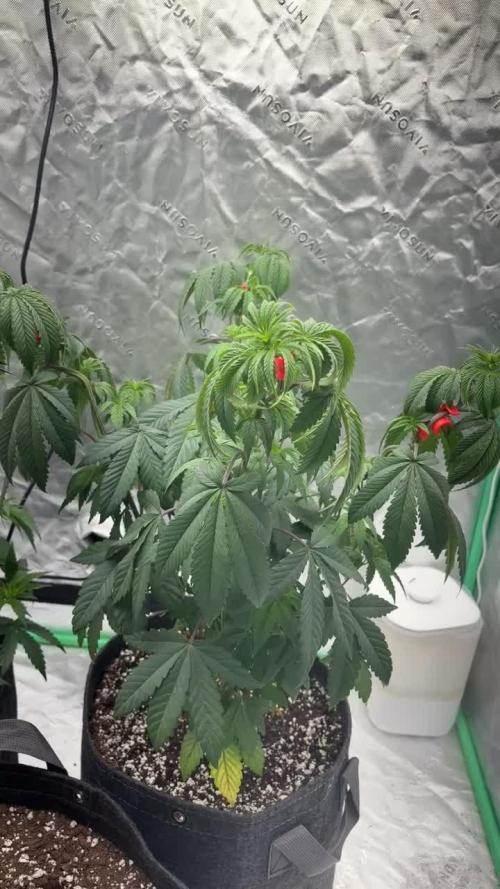
Today I removed some leaves to provide the heart of the plants with full light again.
As you can see the ''side'' bud area's are already stretching upwards to get even with the main tops, in theory I should have 8 bud area's on each plant.
When they are almost in full bloom i will add an scrogg net to keep al the buds sides even in height trough there last stages.
When it comes to nutrition they have today 1L water with 2ml orgatrex + 2ml plagron terra bloom each plant. This is half the recommended maximum dosage for terra bloom. I will increase the dosage as by week.



Likes
23
Share


@DeepRootsGrowTrees
Follow
MATARO BLUE by KANNABIA
Week #18 overall
Week #4 Flower
She's doing great this week looking good and her buds are starting to dense up she's getting nice trichome coverage as well. Stay Growing!!
Kannabia.com
MATARO BLUE

Processing
Likes
25
Share


@EelGrows
Follow
Week 8:
Day 50-53: Things are looking ok here, could be better. Still assuming my soil is too acidic certain nutrients to lock out. I now believe what I thought was a calmg deficiency on 4AM#1 was actually a phosphorous lockout in combination with the aforementioned calmg. Day 50 I watered with PH 6.5 and got runoff around 5.5 PH. 4AM#3 was visibly worse off, and no real improvements to the other 2 either(both had signs of calmg deficiency in combination with various other small deficiencies it seemed like).
Day 54-56: Seeing no real improvements in any of the 3 plants I decided I would flush them on with 6.5 PH'd water only with regulator until runoff read atleast 6PH. After about 4-5L the runoff was 6+PH, seemed to me like there was a slight build up in the bottom so the first 3L cleared that up quite nicely(runoff was around 5.7). I then fed them 2-2.5L feeding of calmg and regulator with some Biocanna Boost PD'd to 6.5 immediately after flushing. Runoff was pretty much 6.3-6.5 on all plants at this point. I think I am happy with the results of the small flush, this IS my first time indoors(last summer first time was outdoor and I never really dealt with deficiences), so not sure if what I did was correct, I just went with my gut feeling here. Anyway on day 56 now and they haven't gotten any worse, and the leaves feel healthier to the touch. Also seem to be liking the addition of the 150W COB, also decided to lower the lights and see if they could take it(they could).
End of Week 8:
I don't think I will get more much bulk on 4AM#1 but daaamn is she frosty as hell. 4AM#2 on the other hand is bulking up real nice, those are going to be some fat buds! And 4AM#3 seems to be a slower finishing pheno and seems like she will bulk up loads more, going to be a beast I reckon if the deficiencies didn't stunt her from the last 2 weeks(leaves felt dry and showed yellowing and spots, but are doing better and feel better after the flush).

Likes
92
Share


@DogDoctorOfficial
Follow
Week 13: Week 5 Flower—A Garden in Full Bloom 🌸✨
Hey, Grow Fam! 💚 We’re deep into Week 13, and this room is nothing short of mesmerizing. Each plant is unique, showcasing its trichome-coated beauty, with white hairs dancing in their distinct patterns. It’s the culmination of patience, hard work, and overcoming challenges. The two-layered canopy—thanks to some ambitious young ones—is a testament to adaptability and dedication. 🌱🌟
Feeding Update: Aptus Holland Breakout Powder
This week, we introduced Aptus Holland Breakout Powder into the feeding mix at 0.5g/L, alongside the nutrients already in use. This powerhouse additive is designed to promote robust flower development, enhancing both density and resin production. Breakout Powder brings that extra “oomph” to the table, helping the girls truly break out into their full flowering potential. 🌺💪
Combined with our existing recipe, the results are already starting to show. Buds are swelling, trichomes are shimmering, and the room smells heavenly. If you’ve ever wondered what a well-rounded feeding schedule can do, this week’s results are the answer!
TrolMaster Magic: Monitoring & Stability
I’ve included a few TrolMaster app prints to share my love for this system. It’s not just about controlling the environment; it’s about mastering it. The app provides real-time data, historical records, and an unmatched level of convenience. Whether I’m sipping coffee or working in the garden, the system keeps me in sync with my grow.
This week, I’m particularly thrilled about how stable the pH levels have become since transitioning to full mineral-based nutrients. Unlike the organic-mineral combo, which required frequent adjustments, the current setup is practically self-sufficient. This stability means happier roots, more consistent nutrient uptake, and ultimately, better plants. The data speaks for itself—check out the comparison print!
Comfort & Style: My Aptus Holland Pants
Oh, and can we talk about how comfortable my Aptus Holland pants are? These have become my go-to garden gear. Stylish, functional, and perfect for spending long hours among the plants. Let’s just say, my plants aren’t the only ones dressed to impress! 😂👖
Shoutouts & Gratitude
As always, a huge thank you to the amazing people and brands that make this journey possible:
• TrolMaster for the tech that keeps me connected to my grow.
• Aptus Holland for the nutrients that take my plants to the next level.
• Pro Mix for the growing medium that supports this foundation.
• Cannakan for ensuring my seeds get the perfect start.
• And of course, the seed banks for these incredible genetics.
A special shoutout to the community—followers, friends, supporters, and even the haters. You all bring energy to this space, and it’s all apprecialoved! Let’s keep growing stronger together. 💚
#TrolMaster #AptusHolland #GrowLife #CannabisCommunity #FlowerWeek4 #NeverGiveUp #GrowWithLove #IndoorHorticulture #Defoliation #PPFD #ControlledEnvironment #SCROGNet #DogDoctorOfficial
Discount Codes so you can save big on your next check out 💚💚💚
Kannabia - DOGDOCTOR 30% off
SeedsmanSeeds - DOGDOCTOR 10% off
CannaKan- DOGDOCTOR 15% off
terpyz.eu - DOCTOR 15% off
The Neutralizer - PORKIT5-DOG 15% off
Fast Buds - DOGDOCT 15% off
As always thank you all for stopping by, for the love and for it all , this journey of mine wold just not be the same without you guys, the love and support is very much appreciated and i fell honored and so joyful with you all in my life 🙏
With true love comes happiness 💚🙏 Always believe in your self and always do things expecting nothing and with an open heart , be a giver and the universe will give back to you in ways you could not even imagine so 💚
Friendly reminder all you see here is pure research and for educational purposes only
Growers Love to you all 💚💚💚


Likes
13
Share


@VeeDro203
Follow
These 2 have slightly different structures. One more purple and heavy jelly smell! The other a lot more pale green purple and a creamy jelly smell. Similar to one of my Miami Miami with the cream

Likes
14
Share


@Auto_lover
Follow
Day 22 Took off lower three nodes of side branches on each main branch. Removed 4 leaves
Likes
10
Share


@GrowingGrannie
Follow
Good week... she's grown a lot, is looking VERY strong - #1's stem is already pretty thick for such a young plant.... so I think I'm going to let her get a couple more nodes on her and then top and clone her... #2 is a little weaker so I think I might top her this week. I've put them both on an aggressive veg feed and they're both responding very nicely to it... such a difference from autoflowers! I find it fascinating..... so much so that I tend to rather ignore them... for example, I think I MAY have given them a drink of something only 4 or 5 times in their lives (they've just celebrated their 4th week from seed)... never any complaints, never saying "hey, fool - pay attention to me!" .... I glance at them once a day and move on.... Still trying to decide where in my yard they're going to be planted - but I've got at least 4 more weeks before I'll feel comfortable enough with the weather to go dig a hole for them... SHOULD also start some LST, I suppose.... going to be relying on LST a lot outdoors so I can hopefully avoid the bud rot that plagued me last year...
Great fun!
May 4 - I've decided I'm going to top #1 today and stick the top in Clonex, into a RootRiot and plunk it into a DWC bucket ... so while I'll have these two plants out in the yard waiting for an October harvest, I can flip the clone indoors for an earlier harvest to see if I like the strain at all.... Hmmm... maybe I'll do that to both of them and keep one in veg while I flip one of them... This is kind of cool - I'm learning about all the possibilities growing photoperiods gives you... just amazing! I'm like a kid in a candy store! LOL! I'll put up a video when I top and clone... but don't take it as gospel because this will be my first time and I don't REALLY know what the hell I'm doing... just having fun and experimenting!
May 5 - Happy Cinco de Mayo! Didn't get around to topping and starting a clone yesterday... but I've just now posted up two videos - the first where I'm determining where to top - and the second, longer one, where I place the top I've just cut off into DWC to clone... or ATTEMPT to clone! LOL! God knows if this is going to work... if you've got any comments on what I've done, hints for a better way of doing things PLEASE comment below! I could use all the help I can get! Should I, for example, chop off the lower fan leaves of the top? Or are they needed for the top to survive? I can't help but think they're a pretty big drain on the poor thing...
#1, which is the one I topped, is really showing me she needs to get outside in the yard... her roots are starting to peek through the drainage hole at the bottom of the pot.... I THOUGHT a 2-gallon would be big enough to last at least a month and a half but..... I'm going to have to get serious about where to put these ladies!


Likes
57
Share


@howie03
Follow
Removed a few leaves from 1st and 2nd lady which where covering some branches.
36: Some brown things in the flower. Is that normal?
1st lady is just growing in the lachuza pon granulate. it has ph 7.1 and i just watering her with pur water. maybe it will work but her developing seems to be behind 2nd lady.
37: Feeded 2nd lady with 1.5l water PH 5.8 and 2ml/l BioGrow and 2ml/l BioBloom, That cocktail had ec of 414ppm. the water had around ec of 180 ppm. I will try to optimize the mix of purified water and tap water. What should the proportion be between cal/mag? The tap water has a proportion of 7:1.
40: Feeded 2nd lady with 1.0l water PH 5.9 and 2ml/l BioGrow, 1 ml TopMax and 3ml/l BioBloom, That cocktail had ec of 580ppm. the water had around ec of 200 ppm. A few lower leaves look a very little bit turning into light green. At all she looks very healthy in my opinion. And they are really stinky 😂
The side branches grow fine. I counted 10 of them 😍 They reach nearly 30 cm. Main branch is over 40 cm I think. Need to buy a measurement think 😇 I think LST is good for dwarfs but I have to work on the technique a little bit in the future.
41: I can measure height now. 1st lady is only 28cm. 2nd lady is 38cm and side branches 28cm.
42: Same cocktail as week 40. 1.25 l
Processing
Likes
12
Share


@GrowGuy97
Follow
Day 42 - These ladies have a smell I can’t even describe but it definitely over powers my entire tent😍 they are looking nice & purple and starting to get extremely frosty! Thanks for following & happy growing friends!✌️🏼🌱
Likes
7
Share


@Brickie74
Follow
Pretty normal week. No issues or problems this week. The Green Tea strain from Mosca Seeds is doing very well. She is growing pretty much the way she should right now so really just watering, fertilizing and watching her grow. She will be big enough soon to transplant into a bigger fabric pot. She will also be ready to top soon. I will have to get some more info on this strain before I decide if I want to top her or not.

Likes
3
Share


@DudeGrowsWeed
Follow
August 18, 2024. I received a very kind package from Divine Seeds this week. THANK YOU!! Very excited to get started in this competition. I should have just enough time to grow, harvest and cure before the November 30 deadline. Started the seeds directly in Solo cups filled with ProMix BX and added 5g of Grow Dots with each cup. I'm hoping to see sprouts in around 5 days and will then transplant to their final containers once the leaf tips start extending past the edges of the cups. Game on!!!👍


Likes
14
Share


@Terpyboyz
Follow
So this grow came to a finshed but I had a. Few issues that’s held me up from finishing up the diary, but in due time I will reupload it all in order soon. But over all I will also update with a final weigh in of each strain produced so stay tuned 🤙🏻🔥


Likes
66
Share


@ButterfliesLittleFarm
Follow
Hello Diary.
A pretty stressful week is behind us. It is now clear that the plants do not respond well. I suspect the lack of Cal-Mag. It's also possible that I put in too much BioBizz. Royal Haze # 1 is the most affected, I get Epsom salt and start watering them with only water and epsom salt.
I am sad that this is what is happening right now, I hope to be able to recover them before the cycle is over.
--------------------------------------------------------------------------------------------------------------------------------------
12/12/2019. Day 43.
Watering. After adjusting the pH to 6.3, I added epsom salt. One tablespoon per 3.5 liters of water. I usually water the plants in the evening, but today I watered them in the morning.
13/12/2019. Day 44.
Watering. This time I watered in the evening, less than 48 hours since the last watering. I did the same thing as the day before.
15/12/2019. Day 46.
Watering and taking photos. Today I watered the same as the two previous times. Adjust pH to 6.3 with BioBizz pH- and add epsom salt.
I also measured the height of the plants and they may have grown 1 cm.
17/12/2019. Day 48.
Watering. Today I only watered with pH regulated water. For now I don't see any changes to recover, I plan to go to a grow shop for some advice.
18/12/2019. Day 49.
Photography.
---------------------------------------------------------------------------------------------------------------------------------------------------------------------
All three plants have grown differently but they grow beautifully, the smell is strong, the flowers are filling well. I have to put them back in balance and everything will be great.
Since Christmas is approaching and Grow Diaries has released a video contest, I have decided to celebrate my first grow diaries Christmas and made a video. I hope you will like it.
Merry Christmas everyone.