


Likes
Comments
Share


@Roberts
Follow
Mega Power plant auto grew great. I ran her a bit long and she foxtailed on me. I was aiming for more of a good night kinda smoke. Hopefully with the relaxing qualities of this strain, plus the extra ripeness I may have a winner. I won't find out likely for about 2 months. Between dry time, and others ahead of her with my schedule I am getting them done as fast as I can. Very frosty flowers. Has a sweet earthy fruity smell. I have a harvest video that would not upload. The video can be found on my YouTube channel. The Viparspectra P4000 light worked great, and is of excellent quality from my experience. Thank you Viparspectra, and Spliff Seeds.
Thank you grow diaries community for the 👇likes👇, follows, comments, and subscriptions on my YouTube channel👇. ❄️🌱🍻 Happy Growing 🌱🌱🌱
https://youtube.com/channel/UCAhN7yRzWLpcaRHhMIQ7X4g

Processing
Likes
43
Share


@Pisstank85
Follow
In all honesty I'm not sure if I got the nutrients dialed in . I tested runoff and it was all within range of soiless mixes , calibrated my ph meter every watering as I thought maybe that's why I was getting yellowing leaves . They are still growing and budding rapidly and seemingly on par with what I've seen with others in like mediums so I'm trying not to worry too much . My carbon filter shit the bed already so my Mrs isnt happy with me today as my whole basement wreaks . The plants went from not too bad to wicked bad smelling within a couple days . I've been defoliating but do you think I should do more ?

Likes
26
Share


@Myminigrows
Follow
Little summary of the last 2-3 weeks of Flower. Total off 70 days of 12/12 light cycle and 48H darkness.

Likes
3
Share


Likes
38
Share


@Wastent91
Follow
Eccoci qua ragazzi, le ultime 2 settimane prima del raccolto, spero che vi piaccia il risultato anche se putroppo ho avuto vari problemi e le cime sono rimaste piccole, ma vi posso assicurare che sono stra piene di resina e dure come sassi, anche a livello terpenico è qualcosa di eccezionale è dire poco! Ora sto per raccogliere, grazie a tutti voi che mi avete seguito e supportato, siete la mia più grande forza! Grazie a Mars hydro e ai nutrienti di Terra Aquatica per aver reso possibile tutto ciò! Vi adoro! Continuate a seguirmi e spero che vada tutto per il. Meglio! Un buon 420 a tutti voi 🙏💪😸🌱🌿😽💨❄️❄️❄️❤️

Likes
4
Share
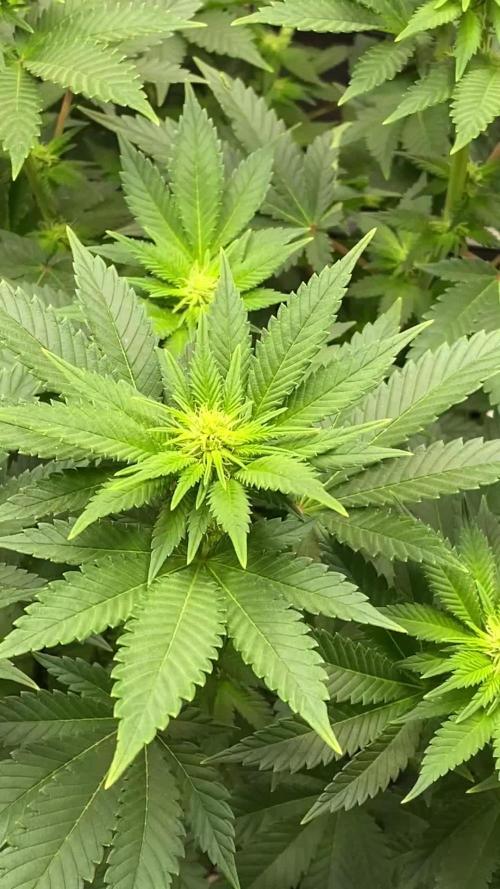

@Meckyman
Follow
Hallo Gärtner 👩🌾 wieder eine Woche vorbei ist das gießen wird immer häufiger und mehr 😅 ich denke hab das Fehler gemacht das viel Blätter 🍂 weggenommen habe wie sieht ihr das so? Würde mich sehr interessieren. Ansonsten sie wirkt prall voll saftig. Was mir sehr überrascht ihr Geruch riecht nicht so stark. Aber es macht nix


Processing
Likes
26
Share


@eldruida_lamota
Follow
Familia, estoy convencido de que esta variedad va a predominar del resto 🙈.
No ahora en serio una gran variedad para cultivadores novatos, puedes plantarlas directamente a maceta y no se espigarán 3/3 comprobado.
Parece muy sencilla de cultivar, controlamos ph , temperatura y humedad que estén en sus respectivos valores.
Se ven bastante sanas, pronto tocará hacer algún trasplante iremos viendo próximamente

Likes
19
Share


@Scandinavia
Follow
Spiders has taken over the pot of plant C but i guess they will keep the insects away, so they welcome. Pictures from day 42. I do not think they will be ready in one month but we will see. How long do you think they have left?
Im actually going on holiday in July so its a bit of a dilemma for me whether to harvest before or after and hope for rain in the 2 weeks i will be gone. Any ideas would be helpful!
Likes
13
Share


@MT420
Follow
Day 1: Paper towel method was used. Made sure plastic container stayed in a dark and warm place.
Day 2: Seed has cracked but no tail yet.
Day 3: Started to worry seed won’t germinate so top tissue paper was replaced with new dry one. Used warm water to wet the new paper towel. After 12 hrs crack in seed got wider little tail started to appear.
Day 4: Repeated method used in Day 3. Warm water used on new paper towel.
Day 5: Germinated seed placed in jiffy peat pellet and placed in propagator.
Day 6: no change yet. Put propagator in window for sunlight.
Day 7: no change so decided to intervene. Checked to see if seed cracked. Slowly removed the remaining shell. Covered with soil.
Day 8: Seed has sprouted. Put propagator under the sun for 9 hrs, and after it stsrted to open its first leaves.
Day 9: She’s enjoying the sun.
Day 10: Last day in the sun. Soil mix prepared and washed with water (ph 6.5). Transfer to 15L fabric pot tomorrow.

Likes
4
Share


@TeamQuality420
Follow
End of week two notes :
Created a gilly web to get everything nicely pulled in a way that is barely stressing the plants . Because all of thebsteings have specail knots as they grow in certain places , it will take stress off other parts of the plant in the webbing . Also increased out solution temperature From 21.6 to 23.8 also we were adding 150 mills of budjuice once a week and then the CO2 to breathe bag would be why we are increasing the temperature in order to get that CO2 to fully Digest it as much as possible without causing any burn or over temperature stress to the plants. They are on the floor , and it being -40C and colder I think that is to contribute to the plants not drinking as much . As you can see there is no sign of nutrient burn or really and disfunction I can see ? Let me know because as always I am always looking to bounce ideas !!
Likes
20
Share


@CityFarmer
Follow
Hello everyone,
Been busy but I shoot a little video for yall to see, also if growing is something you guys intended to do, I suggest you guys get yourselves a Digital Microscope or a jewlers loop.
I just got myself a Digital Microscope for under $20.00 on Walmart.com, I got me a cheap one to start with so I can learn how to use it properly. But for under $20.00 this one brings 8 led lights, a adjustable mount, comes with 3 different connection choices build in, magnifies from 50-1000x, can take pictures and also videos and my favorite part, it connects right to my mobile device, you download and install a Google app and your ready to go, ill work with it and add pictures next week...
See you guys soon 👊👊👊


Likes
10
Share


@mingokoon
Follow
week 5. oct 9
I believe I am getting the calmag deficiency corrected - none on new leaves.
one stretched to 23 inches by 10-16. growing about 1.5" a day. the middle plant is at 15.5" 10-16. growing over an inch per day. hopefully they stop next week when they are flowering.
the back plants definitely show signs of flowers with the hairs starting to grow. Interestingly the plants at the front seem a few days behind.

Likes
57
Share


@nonick123
Follow
Día 27 (20/05) Riego con 250 ml de Té de Compost
Auto Northern Dragon Fuel está creciendo exponencialmente!
Día 28 (21/05) Vuelven a tener sed! Las riego con 250 ml sólo H20 pH 6.2
Auto Northern Dragon Fuel se ha recuperado muy bien de la deficiencia de Mg
Día 29 (22/05) Riego con 750 ml H2O+ Regulator 0,15 ml/l + CaMg-Boost 0,25 ml/l + Startbooster 0,25 ml/l + TopBooster 0,2 ml/l- pH 6.2
Auto Northern Dragon Fuel vuelve a recibir aplicación foliar de sales de Epson (4 g/L) porque presenta de nuevo ligera clorosis
Día 30 (23/05) N/A
Día 31 (24/05) N/A
Día 32 (25/05) Las plantas no paran de crecer! 😍
Día 33 (26/05) Riego con 750 ml H2O + Regulator 0,15 ml/l + CaMg-Boost 0,25 ml/l + TopBooster 0,2 ml/l- pH 6.2
💦Nutrients by Aptus Holland - www.aptus-holland.com
🌱Substrate PRO-MIX HP BACILLUS + MYCORRHIZAE - www.pthorticulture.com/en/products/pro-mix-hp-biostimulant-plus-mycorrhizae


Likes
9
Share


@Bread_n_Buds
Follow
Now we've reached day 25.
We are in the transition phase, pre-flowering if you want, when the seedlings reveal their sex by showing the white fluff or the boyish balls. Here and in all F1 Hybrids you can be SURE, SURE as death that you will never see any balls.
If you have underestimated this aspect of the F1 Hybrid, go back and think about how many times you found the balls on the paint, full of pollen that fertilized your ladies.
Do you like having young ladies impregnate you? Absolutely not for me and this is a very valid reason why you can choose the F1 Hybrid. Really guys the seeds suck and the genetics of the various breeders if they don't do a job like this it means that they are super hybrid poles with genetic traces scattered here and there. Inglourious bastards.
Here we don't want to be Aryan but to cultivate healthy plants with safe results.
Our Pineapple Express F1 HYBRID goes very, very well, even with very slight signs of overfeeding but lighter than the others, almost non-existent. Nothing that affects the final quality and beauty, you will see in the end.
To fix this little thing we go to flush with pH 6.2 and only give Aptus Regulator which should rebalance the plant and soil before delicately moving on to fertilizers for flowering.
Site Description
ZAMNESIA SEEDS - PINEAPPLE EXPRESS F1 HYBRID AUTOMATIC: FRUITY FLAVORS AND ENERGETIC EFFECTS
Combining Trainwreck with Hawaiian, Pineapple Express F1 Hybrid Automatic brings a beloved strain to new heights. This autoflowering F1 hybrid cultivar ensures exceptional uniformity, reliability, and stability, making it well-suited to growers of all experience levels. If you've not checked out Pineapple Express F1 hybrid Automatic for yourself just yet, now is the time.
GROWING PINEAPPLE EXPRESS F1 HYBRID AUTOMATIC
All it takes is 8–9 weeks from germination before Pineapple Express F1 hybrid Automatic is ready to harvest. Thankfully, very little effort is required throughout the growing process, aside from a bit of maintenance, to ensure ample, high-quality harvests. Thanks to its F1 genetics, Pineapple Express F1 Automatic offers superb resilience and uniformity, meaning all plants will have a similar height and appearance, and will churn out comparably large yields. Reaching heights of 50–70cm, Pineapple Express F1 Automatic is not an overbearing plant and can effortlessly slot into any setup. Once ready to yield, growers can see a return in the region of 400–550g/m² indoors and up to 200g/plant outdoors.
AROMAS, FLAVORS, AND EFFECTS OF PINEAPPLE EXPRESS F1 HYBRID AUTOMATIC
Just one hit of Pineapple Express F1 hybrid Automatic treats users to a rich assortment of flavors and aromas. This strain offers strong pineapple notes alongside moments of citrus, spice, and pine, making for a mouth-watering blend that's extremely moreish. Bolstered by 21% THC and an array of cannabinoids, Pineapple Express F1 Automatic showcases an energetic and uplifting high that will have you feeling chatty in no time. So if you've been looking for a strain to enjoy with friends, Pineapple Express F1 Automatic could be just the thing.
As for fertilizers, I'm doing a small comparison experiment to finish off the fertilizers I had at home, it's not 100% indicative, it's only on two specimens but given the stable genetics I decided to try to compare the results of Plagron Vs Aptus , both excellent brands which they will certainly produce beautiful plants which are already of excellent stable genetics. In the next few weeks the comparison will be more evident now the seedlings are still very small and just potted.
So seeds of all brands, in addition to these great F1 Hybrids and the entire Zamnesia line, fertilizers and everything related to the world of cannabis, you should buy them from the best online store in the sector www.zamnesia.io
Likes
3
Share


@mad_scientist
Follow
I want to ask sorry from dinafem cause i made a discovery. My pack of seeds says dinamex and not auto dinemex as it should be. So i checked the order at my mail and it turns out the seed seller made the mistake and gave me the photo version.... Plants have been flushed with water at the start of the week and i will keep using plain water till the end. Looks like i can't upload a video...

Likes
16
Share


@ChewiesGrow420
Follow
Added Exhale c02 and top dressed in each pot with 1 tablespoon per gallon of growing medium my pots are 3.6. I added 3 tablespoons. It is my hopes that with adding the slow release dry amendments and once the c02 bag sarts growing my plants will finally grow. They are short but have 4 nodes at day 21. What is an exhale c02 bag? “The ExHale bag is a patented strain of mycelium that produces an abundance of CO2 without fruiting. This means that when our bag is activated, the mycelium grows, eating the substrate it comes with, giving off heaps of CO2 straight into your garden, and it does all this for 6 months - guaranteed!”
At day 25 I am not impressed with the size of these girls? Hope they hit a growth spurt soon? Their internodes are stacked very nicely.
At day 28 growth is very slow. Practically none existent since my top dressing at day 23. 2 plants have received a very minimal nutrient burn. As I do not have a soil ph tester? I will be watering with a ph of 6.0 rather than 6.5, hopefully that helps. ONWARD!
Likes
7
Share


@Annakonda
Follow
Je commence la deuxième semaine de strech
J'ai modifié la puissance de la led et la hauteur pour pouvoir changer le "dli" (dli week 2= 35)
JAI ENFIN RECU LE CALMAG après 10 jours🙄 wtf.
Cette semaine , j'ai fait une erreur , j'ai laissé mes plants 5 jours sans boire 😔😔 (je n'avais pas le choix).
J'ai changé ma manière d'arroser.
Les 6 premières semaines a chaque arrosage (additifs et/ou engrais)
A partir de cette semaine , j'arrose 1 fois avec les additifs et les engrais , 1 x juste avec le calmag et 1 x juste à leau.
Je suis à flo+13 , donc normalement la fin du stretch, mais je m'étonne de voir que les plantes sont petites. La plus grande fait maximum 70 cm.🤔🤔🤔.
Demain normalement le stretch devrait être fini.
Et puis on verra .
Le reste la semaine prochaine...
