


Likes
Comments
Share


@SWGuerrilla
Follow
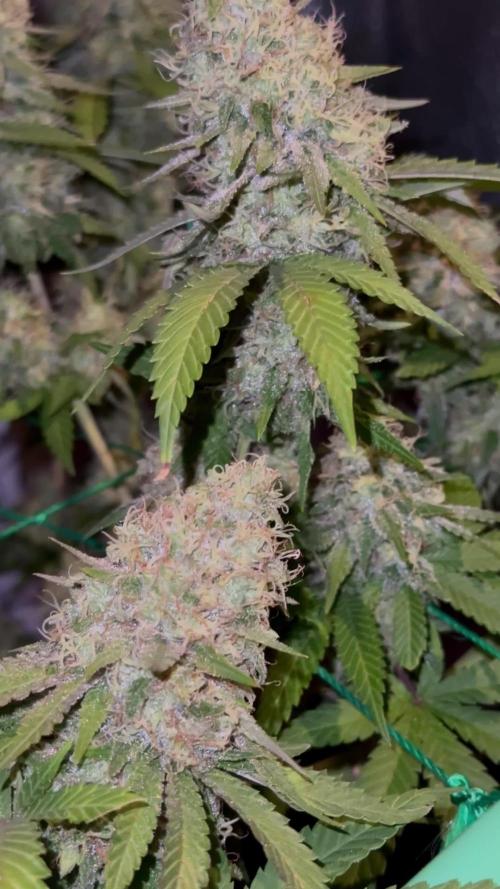
Another strong week. Away for a few days and he heat was back upto 28-30 so was a bit concerned but they came through fine with a heavy dowsing. Still stretching and lots of preflowers. Very happy that my first grow is still going and this decent!



Likes
12
Share


@balansa
Follow
well i do not know from where to start )) she is my Queen Green Gelato ♡♡♡ we had nutrition burns, spider mites an so and and soonbut! BUT, she turnedout tobe the most potnt autoflowering plant i have ever grown !!! cover in trichomes like diamonds. wonderfull flavor and great tast.
and on morehing i have never seen such neavy buds. the buds are not huge but thay are very very heavy ♡♡♡♡ my favorite auto strain so far

Likes
19
Share


@Weedfan
Follow
Thank you #2fast4buds for these strains . So i broke all my expert friends yield per 600w hps and i used half of nutrients that was written in advanced nutrients prescription. I also used air circulator very little. A total of around 850 grams +-20 gram . Definitely i will grow again Gorilla cookies ,tropicanna cookies , strawberry gorilla and also i like a red one that probably is cherry cola from smell . I also will give another try to wedding cheesecake .

Likes
34
Share


@AbroCadabro
Follow
Cindy has been flipped to flower! Both plants in my tent have reached their max veg height and width. I did a preflower defoliation and flush and have flipped to a 12/12 light cycle.

Likes
11
Share


@CrushedCana
Follow
La planta le encantó la nueva luz y empezó estirarse demasiado tanto que para controlar su altura apliqué una poda apical la cual respondió muy bien y empezo a sacar 2 puntas principales


Likes
20
Share


@FlavoursUk
Follow
Not much to say, we officially have take off. Leaf tucking and LST to expose the bud sites, trying not to take anything off if I can help it. These autos don't cope with much, glad I have my photoperiods in there. Can't wait to see some pretty flowers ;)
Day 42- one of the Stardawg girls has had a huge growth spurt. Added in a 400 watt side light to fatten up any lower buds. 660Watt Hps over the top. Considering adding CO2 and investing in another light.. Maybe LED. Thoughts?
-Day 42 Heights:
StarD-73
StarD-35
GSC-39
GSC-35.5 (Day behind other girls.)
Likes
22
Share


@FrostArg
Follow
So, here we are. From now on I'd be updating this regularly and with good pics.
As you can see it has changed very little. For me, the bud looks cool. Thanks to the defoliation and the lst y have grow another colas but smaller ones, definitely two techniques I will improve the best that I can. This journal is far for ending but it has giving me a lot of energy to get bigger and better. Lots of problems to overcome, but happy to do it!


Likes
20
Share


@eldruida_lamota
Follow
Esa familia vamos actualizar ya la segunda semana de floración de estas Lava Cake de Zamnesia.
Y es que me sorprende están increíbles tienen un color verde alien se ven bien sanas y ya la preflores salió.
O el pompón según escuché algunos cultivadores de la zona 😂.
Temperaturas máximas en 26.5 y mínimas en 24 y una humedad estable en torno al 50/55%.
Os comento que tengo un descuento y para que compréis en la web de Zamnesia de un 20%, el código es ZAMMIGD2023
The discount 20% and the code is ZAMMIGD2023
https://www.zamnesia.com/
Agrobeta:
https://www.agrobeta.com/agrobetatiendaonline/36-abonos-canamo
Mars hydro:
Code discount: EL420
https://www.mars-hydro.com/
Espero que lo disfrutéis, buenos humos 💨💨.

Likes
11
Share


@Dirtysouthgrower27
Follow
I super cropped the orange sherbet today & wedding cheesecake wish me luck


Likes
92
Share


@DogDoctorOfficial
Follow
Week 5 Veg Report: SCROG Netting, Massive Leafs & Precise Data Mastery!
🌱 Girls Growing Stronger Than Ever! 🌱
This week has been truly epic in the grow room—so much so that it’s time to bring in the SCROG net! With the canopy expanding and the younger ones still working to catch up, the SCROG net will help me achieve that perfect, even canopy. A well-placed SCROG not only ensures better light penetration but also gives the smaller plants a chance to spread out and thrive alongside their bigger sisters.
Now, let’s dive deep into the SCROG method.
The Screen of Green (SCROG) technique is a grower’s secret weapon for maximizing space, light efficiency, and yields. The concept is simple but powerful—train the plants to grow horizontally along the net, forcing them to expose multiple budding sites instead of just a single cola. This way, the canopy spreads evenly, improving light distribution and air circulation throughout the tent. As the plants grow, I’ll gently weave their branches through the screen, ensuring they fill every square inch of space. The end goal? A sea of buds all basking in equal light!
💪 Huge Leafs Everywhere! 🌿
One thing that’s really catching my eye this week is the size of the leaves—they’re HUGE! Honestly, they’re so big I couldn’t resist a little fun, so I made myself some fashion accessories: leaf earrings and a cap from the Super Sativa Seed Club Green Papaya! 😂 And, of course, I captured the moment. But seriously, large leaves at this stage are a great sign of healthy, robust plants. These “solar panels” are hard at work soaking up all the light, driving photosynthesis, and fueling growth.
So, what does it mean when your plants are showing off big, luscious leaves? It’s a clear indication that they’re happy, healthy, and thriving in their environment—big leaves mean lots of energy being produced and stored for future bud growth. Exactly what we want!
💧 Precision Feeding with Aptus Nutrients 💧
This week, I took a deep dive into my Aptus nutrient lineup and shared a video explaining how each product affects the water’s pH and TDS. Using the AMP-3 Precision Meter, I’m getting real-time water readings and keeping everything dialed in perfectly. Let’s break it down:
• pH: 5.83
• TDS in solution: 445 ppm
• Water temperature: 25.2°C
The Aptus products are incredible for balancing nutrients without throwing off the pH or TDS too much. I’m fine-tuning my feedings based on these readings to make sure the girls are getting exactly what they need. The precision I’m able to achieve with the AMP-3 is mind-blowing—I get immediate feedback on pH, temperature, and EC, allowing me to make real-time adjustments and ensure the perfect environment for nutrient uptake.
📊 Environmental Mastery Thanks to TrolMaster 📊
Speaking of control—let’s talk about the TrolMaster system! Between the DSH-2U Humidity Station and all the other sensors, I’ve created the perfect environment for my plants. Here’s where we’re at this week:
• Temperature: 26.2°C
• RH: 70.6%
• CO2 levels: 775 ppm
• VPD: 1.0 kPa
• PPFD: 423
Thanks to TrolMaster, I can monitor and adjust these metrics in real time, and the best part? I can do it all through the TM+ Pro app, even while I’m lounging in my green papaya leaf hat! 😆 Whether I’m checking the CO2 levels, adjusting the lights, or fine-tuning the humidity, it’s all in my hands with just a tap of my phone. Talk about convenience!
🌱 P.S. – Inline Sensors: Heavy-Duty Precision 🌱
Now, let’s talk about the heavy-duty players in this game—the (PCT-2) Heavy Duty Inline EC/Temp Sensor and the (PPH-2) Heavy Duty Inline pH Sensor. These bad boys are connected directly to the AMP-3 Precision Meter, and they’ve been absolutely crucial in giving me the most accurate readings on my water and nutrient solution.
The PCT-2 keeps me informed about the electrical conductivity and temperature of my solution, which is key for monitoring how well my plants are absorbing nutrients. Too high or too low, and we’re asking for trouble, but this sensor ensures I’m always in that perfect range.
The PPH-2, on the other hand, is all about maintaining the perfect pH balance. A fluctuating pH can mean nutrient lockout or deficiencies, but thanks to this sensor, I get a constant read on my pH levels, so the plants are always in their sweet spot for optimal nutrient absorption.
Together, these inline sensors allow me to run a super-tight ship—every drop of water and nutrient is dialed in to perfection, keeping the plants happy and healthy!
Shout Outs!
As always, huge thanks to TrolMaster and ThinkGrow LED for the amazing gear, to Aptus Holland for their top-notch nutrients and Pro-Mix for the best soil i have used so far. Big love to the seed banks, the amazing Grow Diaries community, and all my followers—you guys make this journey so much more exciting. Don’t forget to catch up on my social media, Instagram, and YouTube for real-time updates and exclusive content!
Stay tuned for more—next week is going to be epic!
DogDoctorOfficial Discount Codes so you can save big on your next check out 💚💚💚
Kannabia - DOGDOCTOR 30% off
SeedsmanSeeds - DOGDOCTOR 10% off
CannaKan- DOGDOCTOR 15% off
terpyz.eu - DOCTOR 15% off
The Neutralizer - PORKIT5-DOG 15% off
Growers Love to you all 💚💚💚


Likes
56
Share


@Wicked_Stix
Follow
First week of flower is over and the stretch is on. Already started crushing and bending some branches on the taller plants to keep them as short as possible. They are really starting to fill out and the sour sorbet was fast to start popping pistils. I started some defoliation and cleaned up a few of the bottom branches. They need some more work over the next few days. I started them on a little maxibloom. I will increase it as I lower the maxigro over the next couple weeks. No water change this week and the ph is holding steady with no adjustments. Nutrients pumping 24 hours a day. Should see some nice fuzzy tops developing by the end of next week. I got some clones rooting from all but the twisted helix. They will be getting dusted with sugar cane pollen.


Likes
2
Share

@EchoEcho77
Follow
This grow is weird yall, its all over the place. Plus it looks like 2 of my tags got mixed up. It's whatever at this point. I'm going to run these out and wash the whole tent when ready. I'll harvest in stages and fresh freeze until its good to go.
Likes
81
Share


@LockDownGrow
Follow
ok so everything has gone fantastic , no nutrient burns at all , and have been slowly creeping up the base nutrients , i have stopped the cal mag and now adding house and gardens bud XL at full strength these girls are now in full swing of flower the Cal mag has made absolutely no difference too the yellow colour of this blackberry so I suspect it is just how this strain is as meany diary's on here of the same strain are also on the yellow side , but it's certainly not affecting the speed of the growth of her , i also bought a new ph stick this week ,
i have found when PHing the feed bucket that its best too have air stones in the bucket , add all nuts and then ph but do not use the feed that day as if you check the next day the ph is off again so i left it 24 hours after i add more ph down , and it seems too make the measurements alot easier and stable , i have bent down the main stems " without damaging them onto my netting too A keep the canopy all the same high so my lighting is covering all plants at the same distance and also it allowed the side stems too reach up too ,
i also was sponsored another new led light by kingbo this week so have added another 600watt led too the grow , so now have two 600's and one 900watt , and temps are still fine sitting at 24c lights on and 19-20 off , so am pleased with that ,
I accidentally bend the main stem last week while I was putting them under the netting too try and control the stretch , luckily it did not crack or snap the branch at all and she didn't droop on that branch at all and has healed already , it may or may not be related but as soon as it happened the side branches thickened up too the thickness of the main stem , this plant has over taken the rest in size even being a full week too 15 days younger , it's certainly not ideal but it really does not appear too have slowed down the growth and may well go in my favour , this lady really did stretch out from week 4 into 5 and is showing no sign of slowing down , her side branches are very thick almost as thick as the main stem , her leaf production was minimal and I have only had too remove very few too expose the bud sites , the yellowing seems too be recovering now and most of the plant is green now ,
Update ,
Now gone a lush green colour instead of that horrible yellow , and the buds have already started too purple , she has also stepped up a gear with her nutrient intake almost drinking 6 pints since Thursday ,
She seems too have slowed down on the stretch and has so meany bud site scattered all over her with as the diary name suggests black roses everywhere , and note too any seed banks reading this if there is not a purple stain out there already called black rose now is your chance lol and Iwant a sample pack first kinda like the tester :)
Now defoliation , as you can see they really didn't seem too mind at all being stripped and within a couple of days they had all replenished the lost leaves and even this week olive had to pull the odd few off as they have grown out ,
Method , well all info now is simple ,
Anything I cannot tuck under something that is blocking a bid site with shade I remove too middle or bottom ,
Everything else stays , I just stand above the plant and pull off anything covering the sites , it's really as simple as that , I see some strip them until there is nothing left on but a few sugar leaves , but for me didn't like the look of the plants , for me the growing process is just as much fun as the fruits ,


Likes
10
Share

@Thedibber
Follow
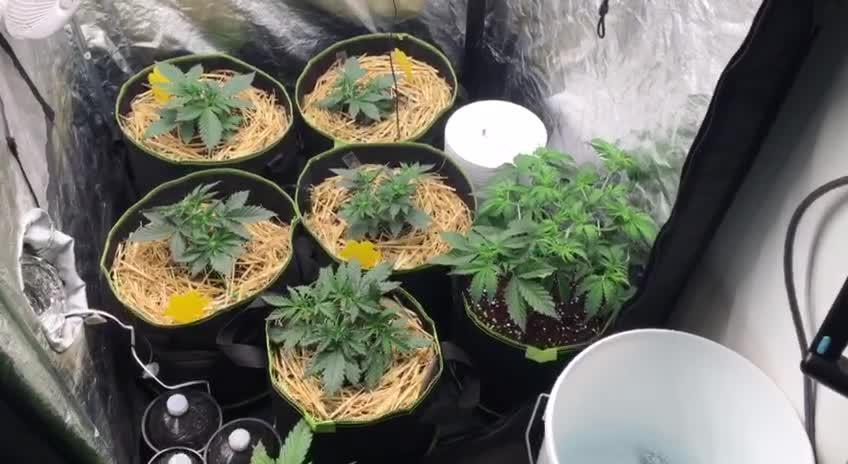
Week 3 starts Poundcake #1 is on Day 15 as of 25/07 the rest are between day 11 and 14
Poundcake #1 suffering slight light burn from me putting the se3000 power up to 75%. Its back down to 65% now 😅
The two smaller pots on the right are in coco not living soil. Just keeping them indoors for now why not 👌
Added a organic seedless straw mulch for more microbe friendly activity and help prevent the fast drybacks I'm getting with the current heat 😰
