
The Grow Awards 2026 🏆
Likes
16
Share
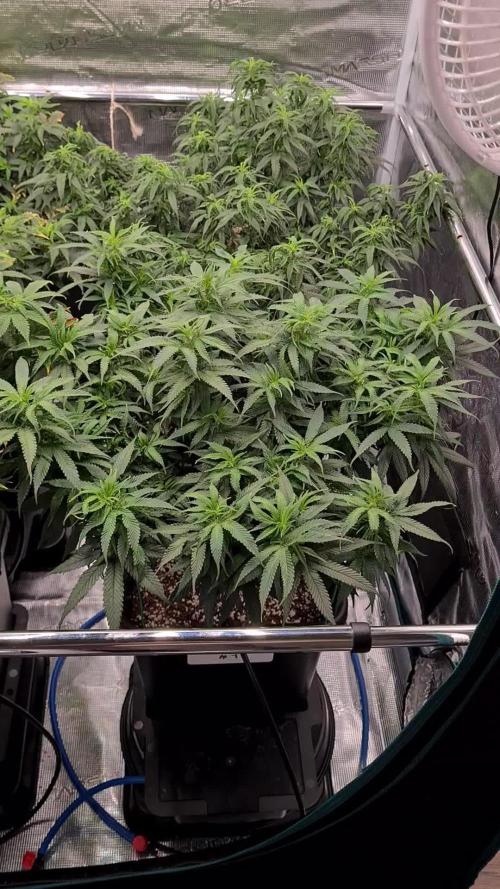
Finally the fattening of the nugs has started on my earliest plant, the purple punch. Great exhibition of purple colours, furtermore i harvested vast amounts of nettle for my homemade: Nettles, bonemeal, 300°c baked clay and charcoal mix. Will be used in my next round of 5 plants( organic round). Happy smoking bros and sistahs
Likes
22
Share
After 48 hours, these things are beast. I thought they needed more time, I couldn’t judge how long they were. I had to dig them out of the paper towel, learned that I need to use cheaper paper towels. 6 out of 6 germinated on my first grow. Let’s keep the same growth going. ******************************* 14 Hours After Potting ************** TEMPS The most recent video showing the domes is 14 hours after potting them. The temps have been very stable at 83F and 70% humidity. My ambient temp outside of the tent is 70F. AIR FLOW I’m currently only running a 6 inch fan above the light for circulation. I have not used the exhaust, I think the idea at this stage is to keep humidity high, any thoughts would be great. LIGHTNING I do have my TSW on max and lowered the height to 36 inches it was almost twice the height yesterday. I didn’t want to make the change so drastic and waited a bit before lowering the height. WATERING The top soil did feel a bit dry and a little moist under. Under the dome it still looks very moist. I sprayed the plastic domes, I’m using distilled ph’d water. I did some light watering on the soil but I’m not sure how much water I should be using . Now that I lowered the height soil should dry out quicker, any thoughts?
Processing
Likes
41
Share
This auto ghost of is at day 21 and she has been growing like crazy since she broke the surface. She has the potential to be a real work of art if I can keep her happy. I upped the maxigro to .5 tsp per gallon and started them on a little armor si so they can build some strong branches. Still running them on 24 hour light and 24 hour irrigation. They are going to stay under the blurple lights for a few more weeks until I can get them in the big room under the quantum boards. I'm hoping they will flower around 4 weeks but my autos seem to enjoy staying in veg so we will see what happens.
Likes
13
Share
Started to dial down the nutrients, can already see a slight colour change in the leaves as they start to turn autumn colours with the reduced nitrogen Did a flush/refresh of the roots using florakleen 0.5ml/Litre and left it in the reservoir for 2 days before dumping and adding fresh nutrients. The roots look bright white afterwards where they were nutrient stained a reddish brown before. I swapped the side light from the left side to the right side to promote some more bud development on that side lower down Happy with how the plants are looking but I had hoped that the buds would be a little fatter by this stage. Clear winner so far is the bruce banner which has by far the biggest and most dense buds, then the gorilla glue next, then the blue dream although her buds are tall and skinny, then the gsc comes next with the critical last, most of the buds on the critical are still very small (it's the shortest plant and furthest away from the light)
Processing
Likes
5
Share
I don't think she is in full flower yet but well on her way. She has taken all the lst and defoliation I throw at her. I added a silica additive since I want this lady to have superman stems to take my torture. Day 32 - She is really drinking a lot right now. I had to water earlier than expected and will also increase the amount I am giving.
Likes
14
Share
@Terpyboyz
Follow
Final product is been absolutely amazing on these clones - the jungle came out about average but the clones definitely exceeded expectations there absolute fire in comparison but still just as good hopefully I can just improve a few issues we had on this run and dial right in 100% will be so much better, next few run is going to be special I’ve got a few things lined up. From tester packs to breeders packs I can hunt from. So lots to choose from but what to keep to run will be interesting
Likes
4
Share
@Purkle
Follow
Thats week 6 of flower in the bag. 3 (maybe 4) go! I wont lie I have been visiting the tent more often these days thanks to the beautiful aroma tempting me to have a look at their progress. The last 24 hours has been quite satisfying for me because the bud growth is now steaming ahead. I wish I had taken photos last night but I showed the girls to a friend yesterday and we could see all the bud sites peeking through but when I checked on them this afternoon the buds are exploding through with vigor! Ive taken another video and a fair few bud shots but next week I will be taking more photos to show you more than just top bud growth as these girls are stacking up! Ive always been really envious of other growers who top their plants multiple times and take the time to ensure the canopy is as level as possible but Im quite proud of my girls canopy and multiple top colas! Anyway, so all I have been doing is continuing with a water and seaweed extract feed, still about 5litres each and they had their last top amendment feed last weed which will last them to the end now and I want them to use up as much of the nutrients available in the soil before I start flushing in the next couple of weeks. For anyone reading who doesnt know about flushing, Ill explain. Flushing is a technique used by growers to get rid of as much of the added nutrients in the medium by 'flushing' around 3 times the volume of the pot the plant is growing in with normal tap water (ensuring the water is at the right PH). Essentially you want to flush the plant in 3 batches so that the medium has time to settle between each flush ensuring you get all the nutrients and minerals out of the medium. You will notice that the run off will get lighter and lighter with each batch of flushing which is the nutrients being flushed out. We do this so that the plant is forced to use its own nutrients which in turn I have found also fattens up the buds. This is the time when you start to notice a change of colour in your plants as they start to use up the nutrients stored in the leaves. Dont panic as these deficiencies are just a sign that the nutrients are being used up and you will end up with bud that will dry better and be less prone to mold issues as well as a smoother smoke and better terpene profiles. Just look at that frost... Thats it for this week! ✌️
Likes
22
Share
Likes
47
Share
What's in the soil? What's not in the soil would be an easier question to answer. 16-18 DLI @ the minute. +++ as she grows. Probably not recommended, but to get to where it needs to be, I need to start now. Vegetative @1400ppm 0.8–1.2 kPa 80–86°F (26.7–30°C) 65–75%, LST Day 10, Fim'd Day 11 CEC (Cation Exchange Capacity): This is a measure of a soil's ability to hold and exchange positively charged nutrients, like calcium, magnesium, and potassium. Soils with high CEC (more clay and organic matter) have more negative charges that attract and hold these essential nutrients, preventing them from leaching away. Biochar is highly efficient at increasing cation exchange capacity (CEC) compared to many other amendments. Biochar's high CEC potential stems from its negatively charged functional groups, and studies show it can increase CEC by over 90%. Amendments like compost also increase CEC but are often more prone to rapid biodegradation, which can make biochar's effect more long-lasting. biochar acts as a long-lasting Cation Exchange Capacity (CEC) enhancer because its porous, carbon-rich structure provides sites for nutrients to bind to, effectively improving nutrient retention in soil without relying on the short-term benefits of fresh organic matter like compost or manure. Biochar's stability means these benefits last much longer than those from traditional organic amendments, making it a sustainable way to improve soil fertility, water retention, and structure over time. Needs to be charged first, similar to Coco, or it will immobilize cations, but at a much higher ratio. a high cation exchange capacity (CEC) results in a high buffer protection, meaning the soil can better resist changes in pH and nutrient availability. This is because a high CEC soil has more negatively charged sites to hold onto essential positively charged nutrients, like calcium and magnesium, and to buffer against acid ions, such as hydrogen. EC (Electrical Conductivity): This measures the amount of soluble salts in the soil. High EC levels indicate a high concentration of dissolved salts and can be a sign of potential salinity issues that can harm plants. The stored cations associated with a medium's cation exchange capacity (CEC) do not directly contribute to a real-time electrical conductivity (EC) reading. A real-time EC measurement reflects only the concentration of free, dissolved salt ions in the water solution within the medium. 98% of a plants nutrients comes directly from the water solution. 2% come directly from soil particles. CEC is a mediums storage capacity for cations. These stored cations do not contribute to a mediums EC directly. Electrical Conductivity (EC) does not measure salt ions adsorbed (stored) onto a Cation Exchange Capacity (CEC) site, as EC measures the conductivity of ions in solution within a soil or water sample, not those held on soil particles. A medium releases stored cations to water by ion exchange, where a new, more desirable ion from the water solution temporarily displaces the stored cation from the medium's surface, a process also seen in plants absorbing nutrients via mass flow. For example, in water softeners, sodium ions are released from resin beads to bond with the medium's surface, displacing calcium and magnesium ions which then enter the water. This same principle applies when plants take up nutrients from the soil solution: the cations are released from the soil particles into the water in response to a concentration equilibrium, and then moved to the root surface via mass flow. An example of ion exchange within the context of Cation Exchange Capacity (CEC) is a soil particle with a negative charge attracting and holding positively charged nutrient ions, like potassium (K+) or calcium (Ca2+), and then exchanging them for other positive ions present in the soil solution. For instance, a negatively charged clay particle in soil can hold a K+ ion and later release it to a plant's roots when a different cation, such as calcium (Ca2+), is abundant and replaces the potassium. This process of holding and swapping positively charged ions is fundamental to soil fertility, as it provides plants with essential nutrients. Negative charges on soil particles: Soil particles, particularly clay and organic matter, have negatively charged surfaces due to their chemical structure. Attraction of cations: These negative charges attract and hold positively charged ions, or cations, such as: Potassium (K+) Calcium (Ca2+) Magnesium (Mg2+) Sodium (Na+) Ammonium (NH4+) Plant roots excrete hydrogen ions (H+) through the action of proton pumps embedded in the root cell membranes, which use ATP (energy) to actively transport H+ ions from inside the root cell into the surrounding soil. This process lowers the pH of the soil, which helps to make certain mineral nutrients, such as iron, more available for uptake by the plant. Mechanism of H+ Excretion Proton Pumps: Root cells contain specialized proteins called proton pumps (H+-ATPases) in their cell membranes. Active Transport: These proton pumps use energy from ATP to actively move H+ ions from the cytoplasm of the root cell into the soil, against their concentration gradient. Role in pH Regulation: This active excretion of H+ is a major way plants regulate their internal cytoplasmic pH. Nutrient Availability: The resulting decrease in soil pH makes certain essential mineral nutrients, like iron, more soluble and available for the root cells to absorb. Ion Exchange: The H+ ions also displace positively charged mineral cations from the soil particles, making them available for uptake. Iron Uptake: In response to iron deficiency stress, plants enhance H+ excretion and reductant release to lower the pH and convert Fe3+ to the more available form Fe2+. The altered pH can influence the activity and composition of beneficial microbes in the soil. The H+ gradient created by the proton pumps can also be used for other vital cell functions, such as ATP synthesis and the transport of other solutes. The hydrogen ions (H+) excreted during photosynthesis come from the splitting of water molecules. This splitting, called photolysis, occurs in Photosystem II to replace the electrons used in the light-dependent reactions. The released hydrogen ions are then pumped into the thylakoid lumen, creating a proton gradient that drives ATP synthesis. Plants release hydrogen ions (H+) from their roots into the soil, a process that occurs in conjunction with nutrient uptake and photosynthesis. These H+ ions compete with mineral cations for the negatively charged sites on soil particles, a phenomenon known as cation exchange. By displacing beneficial mineral cations, the excreted H+ ions make these nutrients available for the plant to absorb, which can also lower the soil pH and indirectly affect its Cation Exchange Capacity (CEC) by altering the pool of exchangeable cations in the soil solution. Plants use proton (H+) exudation, driven by the H+-ATPase enzyme, to release H+ ions into the soil, creating a more acidic rhizosphere, which enhances nutrient availability and influences nutrient cycling processes. This acidification mobilizes insoluble nutrients like iron (Fe) by breaking them down, while also facilitating the activity of beneficial microbes involved in the nutrient cycle. Therefore, H+ exudation is a critical plant strategy for nutrient acquisition and management, allowing plants to improve their access to essential elements from the soil. A lack of water splitting during photosynthesis can affect iron uptake because the resulting energy imbalance disrupts the plant's ability to produce ATP and NADPH, which are crucial for overall photosynthetic energy conversion and can trigger a deficiency in iron homeostasis pathways. While photosynthesis uses hydrogen ions produced from water splitting for the Calvin cycle, not to create a hydrogen gas deficiency, the overall process is sensitive to nutrient availability, and iron is essential for chloroplast function. In photosynthesis, water is split to provide electrons to replace those lost in Photosystem II, which is triggered by light absorption. These electrons then travel along a transport chain to generate ATP (energy currency) and NADPH (reducing power). Carbon Fixation: The generated ATP and NADPH are then used to convert carbon dioxide into carbohydrates in the Calvin cycle. Impaired water splitting (via water in or out) breaks the chain reaction of photosynthesis. This leads to an imbalance in ATP and NADPH levels, which disrupts the Calvin cycle and overall energy production in the plant. Plants require a sufficient supply of essential mineral elements like iron for photosynthesis. Iron is vital for chlorophyll formation and plays a crucial role in electron transport within the chloroplasts. The complex relationship between nutrient status and photosynthesis is evident when iron deficiency can be reverted by depleting other micronutrients like manganese. This highlights how nutrient homeostasis influences photosynthetic function. A lack of adequate energy and reducing power from photosynthesis, which is directly linked to water splitting, can trigger complex adaptive responses in the plant's iron uptake and distribution systems. Plants possess receptors called transceptors that can directly detect specific nutrient concentrations in the soil or within the plant's tissues. These receptors trigger signaling pathways, sometimes involving calcium influx or changes in protein complex activity, that then influence nutrient uptake by the roots. Plants use this information to make long-term adjustments, such as Increasing root biomass to explore more soil for nutrients. Modifying metabolic pathways to make better use of available resources. Adjusting the rate of nutrient transport into the roots. That's why I keep a high EC. Abundance resonates Abundance.
Likes
2
Share
@PalmaGrow
Follow
8 - 14 septiembre Se inicia quinta semana de floración buena formación de cogollos y excelente aroma se percibe por todo el patio de mi casa
Likes
11
Share
FORBIDDEN 🚫 RUNTZ by FASTBUDS Week #4 Overall June 22nd-29th Week #3 Veg She's looking good this week she's a busy plant with side growth no issues this week. Stay Growing!! Fastbuds FORBIDDEN 🚫 RUNTZ
Likes
4
Share
Did LST and topped Pheno 1 & 2, 3 is too funky to mess with. I think PH was just my issue and possible too high intensity light as I lowered to 60%, but also brought my PH to 6.5 so I'm guessing that helped too.
Likes
10
Share
@Bud_vista
Follow
Welcome to week 8! She’s still looking great and healthy. It seems that she’s still making some height but slowly also the buds getting bigger and bigger from day to day. At end of week 8 I probably have to adjust some branches to give them more light disposal and maybe doing some light defoliation. At the mid of week 8 I can see that the buds gaining weight. More and more orange pistils are showing up and she starts to smell just a bit. At the end of week 8 she’s still doing Great! The buds getting bigger and i decided to a last defoliation to ensure better airflow and also removing some of the smaller popcorn buds to redirect energy flow. The roots already decided to grow outside the pod 😄 they’re looking snowwhite, which is a good sign. I’m still very happy with this strain and also with the performance of the growbox. Can’t wait to see how she’s producing nice, dense and thick buds
Likes
2
Share
Used royal queen seed fems popped 4 and 3 where successfully. Through veg stage no problems quite sturdy plants growth rate was the same on all round, had abit of nitrogen deficiency. Flower stage everything changed plants started to grow at different weeks and need separate feeds which became annoying, think this was done to pheno types being different. Drying stage: I used this new herb dryer called wedryer for to plants and hung the other in the tent. Wedryer works if you have small yield as can’t fit a lot, drys within a week though but also looses flavour. Have to wet trim bud and then leaves bud flat in one side due to them sitting on the dryer netting. Has fan with carbon filter which stops smells. (But myself prefer hang drying). Used trimbag to finish the buds off love this product and recommend to others to buy.
Likes
12
Share
@FreakShow
Follow
Her roots are boosted amazing and i transplanted her to 7 galon smart pot And fed her first time 😍😍 Lets see what will happen 🤔🤔
Likes
2
Share
Super lemony smell with hints of berries kinda like a berry lemonade
Likes
4
Share
Hey y'all week 8 in 3 days and things seems to be going not half bad. There's yellowing going on and I think that's due to me not checking my runoff and not correcting but they are in ranges of 6.4 to 6.8 ehhhh I know. But won't let that happen again. Besides that have you seen the frost on these lady's so far, especially for Pheno 1 she is super frosty and has a nice 🍇 🍋 smell that keeps getting better by the week. Pheno 2 smells like lemon citrus and Pheno 3 has a nice 🧀 🍇 smell going for her. Pheno 4 on the other hand is very subtle at the moment but I'll keep my fingers crossed. Till next week growmies Happpy growing y'all 🤙✌️