The Grow Awards 2026 🏆
Likes
Comments
Share
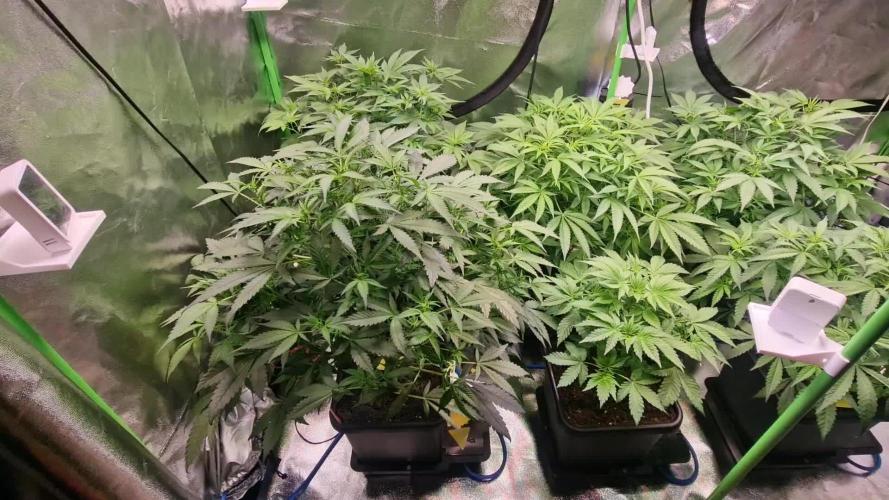
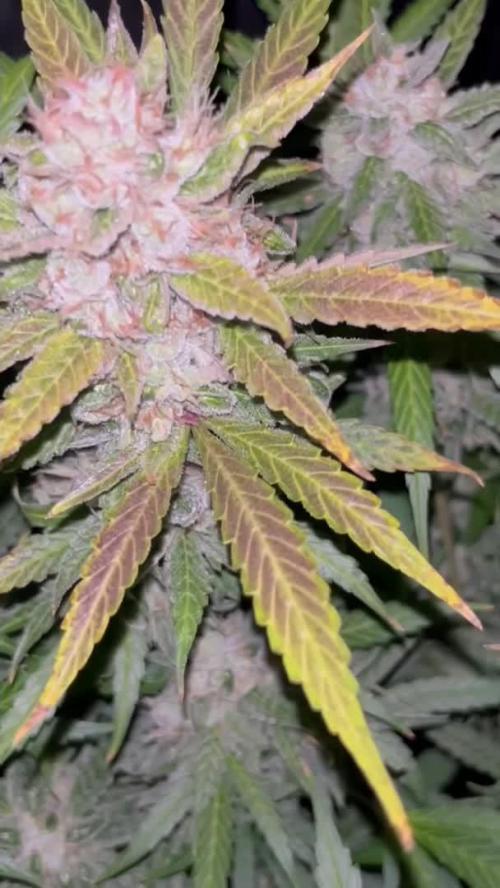
Sept 10th She was ankered to the fence with rope. Notthing to report really. Looking great no sign of mould. Heads are yellow looking. Pretty bizarre. From a distance its is really striking...does'nt show in pictures sadly She is next up for defoliation, together with Killer Kush. Few more days rain till sunny period..fingers crossed. Happy growing everyone
Processing
Likes
14
Share
TUESDAY 7/23: The FIM'ing seems to have only doubled her main, but that's okay. She's going from Hawaii conditions to Arizona conditions every day...8-10 hour of 72f/70+%RH to 12-14 hours of 96f/35%RH and taking it like a champ. I foliar fed her after taking her outside today and started training her a little bit. Gonna try to get those tiny lower branches to think they have a shot at "primary cola" status. I had no wire with me, so I just used a pliable length of dead-ish vine that was lying on the ground. I'll use some wire and binder clips when I can find it.. Evening...same day: She broke the vine I was using to hold her down, so I dug around and found some clips and wire. WEDNESDAY: She was just about 4 inches beneath 120w of LED last night with tons of blue spectra, 69f temperature and 80% RH. Those lower branches gained another half inch each and the top colas have turned to face the sun. I foliar fed her and gave her a little douche of Bactrex this morning when I took her outside. Had a cool front come through today, so the high will just be 87f and it's dropping to the mid to low 60's tonight..hooray! They're forecasting another day or two like this before the return to "oven-like" conditions.👍 I carried my pole saw down to the site at daybreak and removed a few smaller branches above them and to the West. I'll see if it is allowing some evening sun to reach her when I go down there to fetch her home to the LED's for the evening. THURSDAY: I was somewhat successful with getting a little bit more direct sunlight to her while outside during the day..about another 20-25 extra minutes. She got a sip of compost tea today with a little kelp me kelp you and big bloom. I tweaked her indoor domain a bit..she's now got 2 x 12w Miracle LED veg bulbs (cool white with 475nm peak), 1 x 75w cool white/460nm 225LED panel, 1 x 40w Sansi daylight grow bulb, 1 x 50w 460nm/cool white flood, and 1 x 18w 18" pinkish grow light bar. None of the lights are more than 5 inches from her, so she's incredibly well lit. I'm estimating that it's about 5,000 micromoles an hour, but I'm keeping the temp at her canopy under 80f with 90+% RH. It's not direct sunlight, but I think she's happy. I'm still undecided as to whether I'll keep her on a 24/0 schedule or if I'll cut it back to 20/4 when she starts flowering. Since I can provide her with a cool and humid environment for a third of the day, I'm leaning towards running 24/0 the whole grow. FRIDAY: I accidentally burnt her up a little bit today..one of the overhead LED's slipped and was about an inch from her top leaves...oops..I put her outside and misted her with some boom boom spray and kelp me kelp you.. SATURDAY: She's got a few crispy leaves, but she perked up and is growing again...whew...😓 SUNDAY: I tweaked her indoor environment today. She's now got a 120w quantum board (3500k) overhead, a 24w panel with 225 x 660nm red LEDs, the 40w Sansi light, one 9w 2' bar grow light, and one 12w Miracle LED blue.
Processing
Likes
14
Share
@WeedMannz
Follow
All in all everything is fine, the only problem is these very small forms of life that do not go away, I have sprayed neem oil in the soil and they seem much less, now I have a small problem, I find myself original amnesia too high compared to the others, but the lamp has reached the end of the stroke, how do I solve it? and one last thing you advise me to do a defolation in the bottom of each plant or I leave everything like that.
Likes
3
Share
This week was a little rocky. Two girls on the outer edges are good, but the middle one is drooping and foxtailing already. It's weird because my middle plant was larfy last run as well. I might push her to the corner and let her do her thing with less attention... because I just got a photoperiod runtz clone that's gonna need some space and perhaps its own light. LST seems to be going well for the other two though. Sometimes with autos, it's just a genetic thing. They can be temperamental girls sometimes.
Likes
6
Share
So far I’m hang drying after 48 hours of drying on the stock!
Likes
31
Share
@AsNoriu
Follow
Day 43. All is good, but she is so stretchy that all top buds stay in shade, I still have 20-30 cm of height left, but maybe I'll SuperCrop one more branch here too. Big feed and after that I'll decide what to do. Girl is showing colours !!! Happy Growing !!!
Likes
7
Share
@Brickie74
Follow
Well this is actually where i started. I had already germinated the Green Tea (Forbidden Fruit x Gelato) seed. Now i think i am caught up. I will try to post as many videos as possible. I suck at typing and with the dictation it takes longer to fix the f_ck ups than to just type what I wanted. I can just explain what I'm doing or what I've done for the week. This is my first ever grow journal so it may be all over the place....we will see..... I have multiple grows happening at the same time....sometimes I get carried away...lol....and might have a few more than I expected to have. I will do my best to keep things up to date and current. I definitely want to start running right out of the gate and make a pretty decent journal.
Likes
52
Share
Its time to prepare for war. *Blows bagpipe* FISH SH!T THE ORGANIC SOIL CONDITIONER (used twice before and always noticed instantly) Fish Shit is a living product! It provides a complex Microbial profile that includes thousands of different species of bacteria, fungi, and protozoa. This profile is closer to a natural ecosystem than anything you will find on the market. Fish Shit helps release essential oils and terpenes which contribute to the building of a myriad of flavonoids. Flavanoids play a key role in the development of the most potent aromas and tasteful flavors of a plant and its fruit. Fish Shit contains beneficial microorganisms that help plants maximize nutrient uptake. It does this by transforming nutrients into more usable forms and keeping these nutrients in the soil longer. During photosynthesis plants naturally produce exudates (chemicals that are secreted through their roots). Through these exudates, plants can attract the types of good bacteria that are beneficial to them at different points in their growing cycle. These good bacteria cover the roots and act as a barrier to the invasion of disease-causing organisms that may harm the plant. What Are Enzymes? Before we dive headfirst into how, exactly, enzymes can benefit cannabis plants, it helps to understand a little about what these microscopic proteins do. Essentially, enzymes facilitate chemical reactions. They do so by binding with a substrate and forming or breaking molecular bonds. In this context, the substrate is the molecule upon which an enzyme acts to boost the efficiency of a reaction. •substrate /sŭb′strāt″/ •noun •The material or substance on which an enzyme acts. A surface on which an organism grows or is attached. An underlying layer; a substratum. Enzymes are proteins with complex 3D shapes that feature regions called active sites. When the substrate binds to these active sites, it forms an enzyme-substrate complex that causes a chemical reaction to take place, temporarily changing the structure of the enzyme and ultimately causing molecules to either come together or break apart. As a result, molecular products are released, and the enzyme returns to its original shape. Specific enzymes are capable of binding with certain substrates, as the substrate fits into the active site more or less via a lock-and-key principle. Although, new research suggests a more accurate theory of "induced fit", in which enzymes and substrates undergo structural changes to facilitate the reaction. If you take the human body as an example, we have an abundance of enzymes in our saliva and digestive system. These molecules bind with substrates in these regions (food particles), working to break down the food we eat into usable parts before converting them to energy. Enzymes in cannabis work in a similar way to the example highlighted above. Typically, enzymes occur in soil naturally, but if your soil mix is lacking organic material, or you're growing hydroponically, then adding enzymes directly to the substrate is crucial. By using them in cannabis growing, enzymes not only help break down essential nutrients into smaller, more readily available pieces, but they also support the digestion of dead root cells, clearing a direct path for nutrients. Overall, enzymes make it easier for your cannabis plants to absorb all the elements they need to reach their full potential. For growers, a plant that reaches its full potential means a bucketload of juicy buds come harvest. This is essential if you want to reuse a pot with old systems left over like mine. Common plant enzymes include: •Cellulase •Xylanase •Beta-glucosidase •Hemicellulase •Amidase Amino acids are a crucial, yet basic unit of protein, and they contain an amino group and a carboxylic group. They play an extensive role in the gene expression process, which includes an adjustment of protein functions that facilitate messenger RNA Nitrogen, phosphorus, and potassium are the three main pillars of nutrient solutions and fertilizers, but there are countless other nutrients that your cannabis plants need to produce the best possible harvest. Amino acids are one of them. You may have noticed that amino acids get a lot of attention from bodybuilders and other athletes. That’s because they play a key role in the synthesis of protein, which, as you probably know, is super important for sports recovery and muscle growth. Amino acids are the building blocks of protein and the foundation of both plant and animal life. But what do amino acids do for cannabis? WHY IS PROTEIN IMPORTANT FOR CANNABIS? Just like proteins are important for the human body, they are equally important for the growth and development of plants. For example, proteins help plants: •Facilitate the growth of intracellular plant structures •Promote energy generation •Stimulate metabolic processes •Facilitate the absorption and transportation of nutrients So, where do plants get these vital proteins from? Well, unlike humans, plants can’t source proteins or amino acids from other organisms. Instead, they need to create their own amino acids, and then use these to build protein. That's why gardeners, much like athletes, go wild for amino acid supplements. Amino acids help plants by… • Increasing their production of chlorophyll, which ultimately improves their ability to photosynthesize • Serving as an easily absorbable form of nitrogen • Stimulating the synthesis of key vitamins • Improving their resistance to pests and diseases • Boosting the strength of their cells Amino acids also serve as the precursors to auxins, a group of plant hormones produced in the meristems—the apex of the stems where new leaves and stems are born. Auxins play a key role in the plant, activating genes for plant growth and development by triggering a multitude of vital plant functions. In other words, they determine what its size and architecture will look like. Auxins influence the development of branches, flowers, and roots, and even help to regulate the photoperiod response of the plant. Some amino acids, like cysteine, also work together with antioxidants like glutathione to help cannabis plants deal with oxidative stress, which can be caused by high-intensity lighting, some nutrient solutions, and high levels of CO₂. Unlike humans, plants can synthesize all the amino acids they need to survive and develop properly. Unfortunately, however, amino acid synthesis is a really high-energy process, and plants may struggle to produce enough amino acids when exposed to stress. WHAT FACTORS AFFECT A PLANT’S ABILITY TO SYNTHESISE AMINO ACIDS? Any kind of stress can affect a plant’s ability to produce enough amino acids. This includes: • Drought • Temperature extremes • Poor soil health • Pests • Diseases • Poor lighting • Lack of space • Poor root health WHAT DOES ALL OF THIS MEAN FOR WEED PLANTS? If you want to push your plants to their extreme in terms of floral growth and resin production, you should look into amino acid fertilizers. By making amino acids readily available to your plants, they’ll be able to use crucial energy to grow and bloom, rather than focusing on synthesizing amino acids themselves. Game of Inches, this is another Plants can absorb amino acids via their roots and leaves. They can also benefit from amino acids during both their vegetative and flowering phases. The fastest way for plants to absorb amino acids is via their leaves. The foliar application of amino acids is believed to improve the transportation of nutrients, increase transpiration, and boost photosynthesis. Hence, I recommend feeding your plants with foliar amino acid fertilizers. When doing so, however, carefully measure the amount of fertilizer you use, as—like with any nutrient—overfeeding can damage your plants. FOLIAR FEED AND SOIL SOAK • 1 crushed queen anne carrot • Add 2 tbsp of NPK Raw powdered water-soluble cane molasses • 20ml h2o2 • 1 crushed radish • 0.25 tsp NPK Enzymes • 0.25 tsp NPK Amino Acids • 50ml coconut water ( nature's own amniotic fluid packed with amino, enzymes ) + The sound of songbirds. Onto the predators 1250 -Green Lacewings Lacewings are extremely voracious predatory insects that feed on several pests. In adulthood, it feeds on pollen and nectar. In the larval stage, it feeds on aphids, thrips, and mealybugs at all stages of growth. It can also attack spider mites in moderate quantities. It is initially an aphid predator, but very effectively controls thrips and mealybugs infestations. It is so voracious that in the absence of prey, it will feed on its congeners. Lacewings are cannibalistic if there is no food available for them. It is therefore important to introduce them into an infestation situation, and not just preventively. •congener /kŏn′jə-nər/ •noun •A member of the same kind, class, or group. •An organism belonging to the same taxonomic genus as another organism. •A thing of the same kind as. or nearly allied to, another; specifically, in botany and zoology, a plant or an animal belonging to the same genus as another or to one nearly allied. Ideal temperature 20°C – 26°C Ideal humidity 60% – 70% Predatory stage life cycle 21 days Introduction rate 4 weeks Storage Refrigerator Use Immediately Are there any specific instructions on how to use this predator? Lacewings are available on small paper cards that you can hang to plant stems. On the cards are dozens of eggs ready to hatch. There are also sterile eggs they can feed on once they have hatched before they are ready to disperse in the foliage. It is important to use them quickly upon receipt to avoid cannibalism. If you don't use them right away, you can store the cards in the refrigerator for 24 to 48 hours to prevent the eggs from hatching too quickly. Avoid storing them for longer than this or you risk losing eggs. 1250 eggs are divided into 7.5 cards, 2500 eggs on 15 cards, and 5000 on 30 cards. The application rate is one card per square meter of growing surface. Is this predator best used for preventive or curative treatments? Lacewings are used as a curative solution. Anything else I should know? Lacewing eggs hatch approximately 24-72 hours after the cards are exposed to room temperature. When they emerge, the lacewings are just 1.5-2 mm long. They are very small so they are difficult to see. Once hatched, they will stay on the cards for a few hours and then disperse in the foliage. You quickly lose sight of them if you have not witnessed the hatching. They then live in the foliage for about 3 weeks. Often, you will see them towards the end of their larval cycle. After feeding for 3 weeks, they will triple and even quadruple in size. At that point, they are easier to see. But they remain very discreet insects, it is not abnormal not to see them. Egg carcasses left behind on the cards do not disappear after the hatching has happened. It's normal to see eggs still on the cards. Visually it is very similar before and after hatching. Also, on the boxes, there are sterile ephestia eggs which are used to feed the lacewings once hatched. Not all lacewing eggs are viable either. Only a certain percentage of lacewing eggs will hatch. Once hatched, the eggs are white. You can observe this using a magnifying glass. With, 5000 Stratiolaelaps Scimitus It is used to prevent or control thrips pupae, fungus gnats larvae, and root mealybugs in the soil. It can also be used for red mites in bird farms or hen houses. The adult is about 1 mm long and is medium brown with a beige triangle on its back. Another fun fact about them is they can survive without prey. They can eat algae and plant debris. This is why they can reproduce and stay in plants for long periods. Ideal temperature 15°C – 23°C Predatory stage life cycle 18 days Introduction rate 2 weeks Storage Room temperature Use Within one week Are there any specific instructions on how to use this predator? Sprinkle directly on the growing media. They can live in all types of substrates like potting soil, coconut fiber, rock wool, cedar mulch, etc. Stratiolaelaps establish easily so they are permanently fighting pests. One introduction is generally enough unless you have an infestation. In this case, introduce them at least twice at a 2-week interval for best results. If you grow your plants in a 100% mineral substrate, it will have to be released more often since there is less organic matter than in traditional soil. Do I need to take any specific precautions? Stratiolaelaps breed in the top layer of the soil. So it is important not to disturb them in the first days following their introduction. They don't like temperatures below 8 ° C. So be sure not to introduce them in a water-saturated or cold environment. Release them 24-48 hours after your last watering. They are very sensitive to chemical acaricides and diatomaceous earth. These methods are incompatible with their use.
Likes
10
Share
@Thibaut
Follow
weather is insane hot ladies are loving it all started to show nice pistils with beatifull colors the bloody skunk looks redish its nice keep updating these for sure
Likes
19
Share
Day 55 ( corrected) : Wow these ladies like to grow. This last week has them all packing their bud sites , ready for the burst of building them. I have included the pk warrior to the Mc feeds to see how it affects them. It is a complete feed bit you can add things if you balance them properly. I am hoping about 4 weeks left but think they will be done by mid January , day 77 mark. Their bud development is where I would expect it to be in a photoperiod grow so i dont feel so out of my zone now. They smell amazingly like their names says they do and at this early stage , i cannot wait to smell them near their finish. The odd girl who was mottled green has gone crazy for bud developments and has them from base to her whole 1.2m heights. Their look doesnt seem to be affecting her ability to grow buds. The small girl is looking cramped in and when I take the 2 finishing strains out , she will get prime position and a staking out for her last 3 weeks of pure light. The LOS girl is the clear leader with this strains side by side and I wonder how much the damage to number 2 has impaired its keeping up with the LOS.
Likes
28
Share
@No_Clout
Follow
First time feeding her some bloom nutes (C4), Mills nutes having been great so far so it will be good to see what their bloom nutes are capable of as I think mills is very underrated and I’m anticipating a great harvest. I have also put the OG onto a 20litre air pot to raise up and try and level the canopy and also defoliated the bottom 1/4 of the plant.
Likes
22
Share
@EelGrows
Follow
Week 6 Summary: First off, Happy New Year! May the new year filled with peace, love, joy and dank buds! 😄😉 Day 36-39: Despite my heavy defoliation they seem to bounce back quite quickly every time, but this is my first grow so I could be completely wrong and slowly murdering my plants... 😅 WC1 starting to frost up, the two double buds are starting to split themselves up while stretching: WIN! WC2 and WC3 really starting to show their size compared to just a week or 2 ago, really spread out now, and starting to stretch. Day 40-42: WC2 and WC3 really stretching now. WC2 almost catching up to WC1's height, and has probably spread out the most out of all plants when you compare it to a few weeks ago. Maybe defoliating is a good thing for Autos after all? I'm stoked about these. Although WC2 and WC3 are a few days behind of frost production it's definately starting to show itself by the end of week 6. Stoked for these!! These are stinking aswell, but for now the 4AM in the tent is sweetening it up! On to week7!!!
Likes
2
Share
@MNGROW
Follow
She is getting real frosty and has a real strong Blueberry smell now. The buds and sugar leafs are super sticky and starting to turn purple.
Likes
38
Share
Boax plants coning along strong. Grew about 2 inches this week. One plant is 19 inches, the other is 17 inches, I averaged the height as 18 inches for this weeks update. I'm going to take cuttings for clones from these girls soon. If you check the pics you should see that the taller of the 2 plants has a "Y" where the main stem split for some reason. I'm thinking cutting at the bottom of the Y would give me a good cutting/clone. But I'm open to any other advice/input on taking cuttings and cloning. I've done it once before successfully, but I'm no expert. Thanks all!
Likes
36
Share
@Salokin
Follow
Week went again very uneventful, she is not very hungry anymore and had to constantly refill the reservoir with water to keep the ec in check. Trichomes are all cloudy and start to turn amber. She has developed that amazing purple hue and is sticky to the max, so definitely showing her glue heritable ;) I will continue to feed her until Wednesday this week and then start the flushing and darkness. Harvest will be next week end.
Likes
42
Share
Semana 17 - Semana 1 de FLORACIÓN 14 al 21/02 *Luna llena 16/02* Según el Banco SILVER RIVER SEED, esta genética tiene una floración de 10 semanas. Contaré ésta como la primer semana de floración. 14/02: hoy aplique 30L agua con fertilizante Top Bloom. 2.5ml/L. Se empezaron a ver los primeros pistillos blancos. 17/02: hoy aplique Big One de forma radicular, 1,5ml/L en 30L de agua.
Likes
4
Share
Se uso la tecnica de ScrOG y planta C presenta clorosis, podría ser un exceso de nutrientes, por lo que se le lavaran las raíces. Cambio a horario 12/12
Likes
7
Share
Que pasa familia, vamos con la cuarta semana de floración de estas Black muffin F1 de Sweetseeds. Vamos al lío, me quede con 3 por espacio, siempre pongo alguna semilla de más por si no abriese alguna por no perder ese hueco del indoor. También se trasplantaron a su maceta definitiva, en este caso de 7 litros y el trasplante se realizó correctamente. El ph se controla en 6.2 , la temperatura la tenemos entre 20/22 grados y la humedad ronda el 50%. Las jodidas han estirado bastante, ya veremos que ocurre como va todo. Hasta aquí todo, Buenos humos 💨💨💨
Likes
10
Share
@CervantiS
Follow
Feb.2 Diy Growbox: 60*60*160 cm Light: 150w led Light Cycle: 18/6 Soil: CocoPerlite in diy Hydrobucket Extractor: 120mm PC vent Running 24/7 Dear Growdiary, She is loving the new light, very nice progression, I keep all new growth away, so i only have 8 strong branches. Its a small space, and its sharing it with my brothers Cheese.