





Likes
2
Share


@Zulus
Follow
Como no me gusta cómo queda el recuento final de las plantas en el diario he optado por poner todas juntas


Processing
Likes
17
Share


@Easygrower
Follow
Hello growers I’m back with sweet seeds genetics I must say a massive shout out to @sweetseeds for sending me these seeds it’s very much appreciated iv never tried sweet seeds before and the fact they send me seeds to try for free with free p&p is banging 2 big thumbs up from me👍🏻👍🏻 Now it’s day 7 and the girls are looking good just keeping them moist with tap water I will continue to do so for the next week after that I’ll hit em with some juice until next week be safe and happy growing ✌️
Likes
5
Share


@SirBudAlotts
Follow
This collaboration is going splendid 🙌!
This lady is performing like a star athlete...
Her true leafs has popped and at times I do catch her praying lol..
In 1 week I am really surprised at the growth she has taken on...
So on the the last day of the week she grew exponentially I must say

Likes
6
Share


@MrPipi
Follow
Day 91: Tuesday , start of the 14th Week.
nothing crazy happened the last Days.
Day94: Gave her some Molasses. next watering maybe some liquid N , cause leafs start yellowing but i think she´s not close to harvest yet...so just a little bit, before we flush in about 1-2weeks

Likes
27
Share


@420
Follow
Das kleine 150 Watt Licht macht sich bemerkbar.
An Tag 40 sind sie schon etwas zu sehr ausgetrocknet. Dann mit 2L pro Pflanze gegossen.
Likes
23
Share


@NorwegianNugs
Follow
Week 16!
Week 8 of flowering.
She is foxtailing on the topmost buds due to light stress. I measured 90k lux(!) at some buds, which is way too much (she got a little out of hand during the stretch, and grew way too tall)
She is drinking less and less water and eating less nutrients. I think she is in the harvest window now, even though she is sprouting lots of new pistils.
I will cut down and hang to dry next week, in about 5/6 days.
Excited!!
EDIT: BANANA ALARM
Found a banana. There is probably more of them that I can't see because the lower canopy is so packed. Unsure if to harvest now or not. As it is late in flower I don't know if quality will suffer because of a few more days with herming. Opinions?
EDIT II: BUD ROT
As I inspected the plant today I saw a dead leaf on one of the tops, which I was able to pull right off. Turned out there was bud rot inside the bud. I cut the bud off. Will harvest later today or tomorrow.
Processing
Likes
8
Share


@weed_gastro
Follow
unstoppable :p
Day 29: on the video, the 2 on the right side are the Ayahuasca Purps, the other ones are Peyote critical.
getting real bushy, need to defoliate soon
day 32: they got their first feeding, I only use a minimal amount of blooming nutrients.
day 33: plucked some leaves , cuz there was no airflow at all, also installed a new ventilator.
day 36: had to pluck some leaves again


Likes
6
Share


@StoneyCoconut
Follow
5/4/21. Day 64.
WR is beefing up. Drinking about 12 ounces a day, water only. I'm still seeing some clear trichomes. Not much amber. I'm thinking she'll be done in less than a week. Still hoping she lightens up a bit. I want her to burn up whatever nutes are left before the cut. We shall see, patience is a virtue!
GC is a beast! Still uptaking a half gallon of water daily. I cut back just a bit yesterday and she let me know by pouting (droopy) this morning. I top fed her about 1.5 quarts and bottom fed a half quart or so. Then gave her a few ounces of Reharge water. I use a hand pump sprayer and water a bit at a time to prevent roll off. Thiink of light rain on dry soil. She looks happy and lush now. She'll get full bloom nutes tomorrow plus some top dressing, her roots are growing up and out of the surface of the soil 😳. Details on the the top dress will be noted in my next update.
These two girls were planted on the same day.
5/6 Day 66.
GC came out to play today😳 Stll shots just dont do her justice. She's still drinking heavily. Half gallon of 5 part bloom + Cal-mag yesterday morning, this morning dry. I'm gonna botom feed her at night, just a pint or so. I feel bad when she pouts 😟 She's 22 inches at the peak and 22 inches round. Next time I woud choose 5 gallon bags, 2 per this size tent. I LSTed a bit with pipe cleaners to even up spacing. The I gave her another pruning. So much leaf! @Hawkbo on his GC grow for for showing me the way! She also got a top dressing of 1/2 quart of Happy Frog with worn casings, dolomite lime and bone meal. She just eating all these nutes up! The tops are building girth now. Very firm! No oder yet.
WR is ready! I'm drooling, no really. She'll get a nice video too 😉 Might do a selective harvest. They dont always finish evenly. To be continued.
5/9 Day 69.
WR went dark. I'll chop her on day 70, 10 weeks. Trichs are mainly milky. Big and bold! Looking into a scope that connects to the tablet so I can get some shots of these these divine pearls 👊😌 Sorry to report I cant upload the the video I made, corrupted file or some nonsence 😒
GC is chugging along building buds! She's a jungle of bud and leaf. I continue to work the canopy relieving her umbrella leaf and of the scub from underneath. Who wants all that fluff anyway? Still drinking almost a half gallon a day. I'm gonna keep the bloom nutes on the hot side unless she says stop.
Likes
18
Share


@Earthsower
Follow
I have not fed this lady all week she has received just natural sunlight. I will wait for the pot to almost completely dry before I feed her again. She is showing good signs of recovery with further growth and a healthy emerald green colour to her leav


Likes
12
Share


@Ferinky
Follow
Estamos con el lavado de raíces y esperando al ámbar.
Hubo unos días de mucho viento pero aguantaron perfectamente gracias a la red de scrog.

Likes
4
Share

@Ninjabuds
Follow
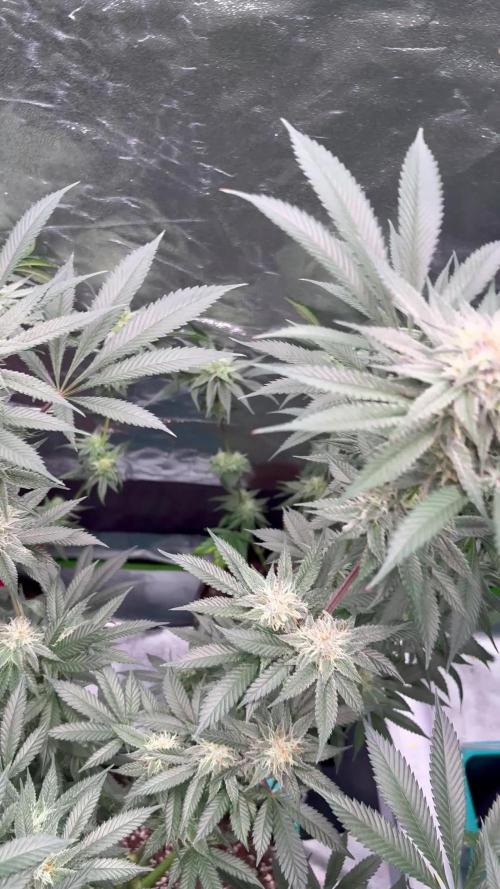
The little lady is turning out to be a pretty good plant I wish I had the plants in smaller pots so I could prop the smaller plant up higher and get them closer to the light. The under lights are helping a lot with having shorter and taller plants at the same time


Likes
9
Share


@garchol
Follow
Getting closer but not quite there yet. Still looking for some more amber trichomes. At least the clear ones are becoming fewer while the amount of white ones raises. Buds are very thick now and the smell is amazing! After the daily trichome check the magnifying glasses smell deliciously sweet and creamy like blueberry ice cream. Gonna leave her in her normal light cycle until I‘m happy with the trichomes.
Likes
2
Share


@UrbanBoer
Follow
Transplant successful and my babies are thriving, even braved the cold this week, however we are not out the woods yet, I think not having a fan is hindering my plants, conditions are favourable for my babies, let me not stress, I will make a plan, sacrifices must be done… for the greater good. The positive is my grow medium mix looks like it was well balanced, I need to buy 20 bags this time, and add it to my veggie patches, and I will not be defoliating anyone this month, fan leaves’ green colour is lovely and uniform, she is happy with her diet, and you will see the uniform green colour on all these ladies, except for Monday’s Blue she had a lot of nutrients in the beginning, but all is bright and right.
Likes
11
Share


@Dendegrow
Follow
Radical Juice – Week 5 of Flowering
The Radical Juice is thriving! 🌿🔥 The buds are stacking up beautifully, and the trichomes are becoming more visible day by day. The difference in the experiment with my homemade fertilizer is still clearly noticeable—the plant that received it during the vegetative phase is visibly stronger and healthier than the control group.
I’m really excited to see how this continues to develop! Stay tuned, like & follow to keep up with the progress. 😎
---
Radical Juice – Blüte Woche 5
Die Radical Juice entwickelt sich prächtig! 🌿🔥 Die Buds stapeln sich schön, und die Trichome werden von Tag zu Tag sichtbarer. Der Unterschied in der Versuchsreihe mit meinem selbstgemachten Dünger ist weiterhin deutlich zu erkennen—die Pflanze, die ihn in der Wachstumsphase bekommen hat, ist kräftiger und gesünder als die Vergleichsgruppe.
Ich bin gespannt, wie sich das Ganze weiterentwickelt! Folgt mir, um nichts zu verpassen. 😎

Likes
2
Share

@JVKdopegrow
Follow
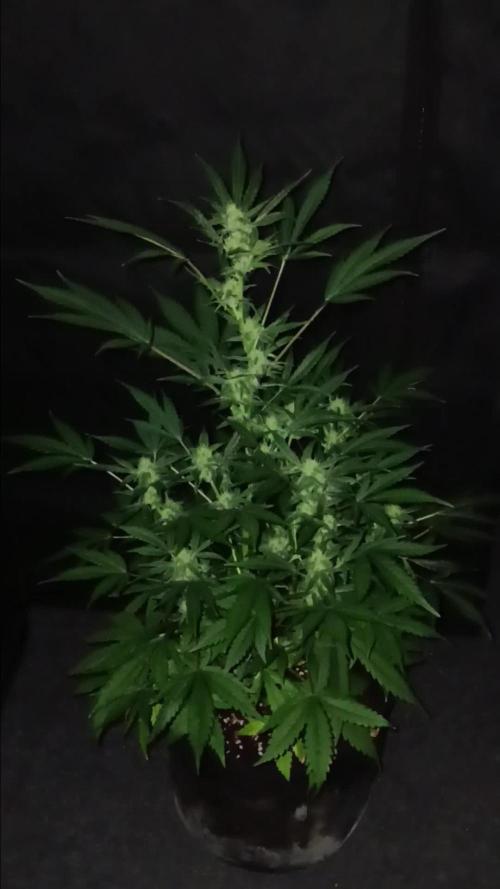
Stacking on all bud sites! Still stretching, drinking a bit more. This plant is a testament to the just leave 'em alone and let her grow style.
Likes
26
Share


@Melloganja
Follow
For now, everything is going okay. Some nutrients shortage, but they are fixed.
Likes
1
Share


