Likes
Comments
Share


@SkunkyDog420
Follow
Hallo zusammen 🤙. Sie wächst immer weiter so eine Dehnung hatte ich lange nicht.
Das ist das letzte mal ohne Training 🤙😠🤪.
Habe die Lampe nur auf 50% laufen hoffe das das gut geht.
Trotzdem geile Pflanze 🤤

Likes
7
Share


@Learntogrow818
Follow
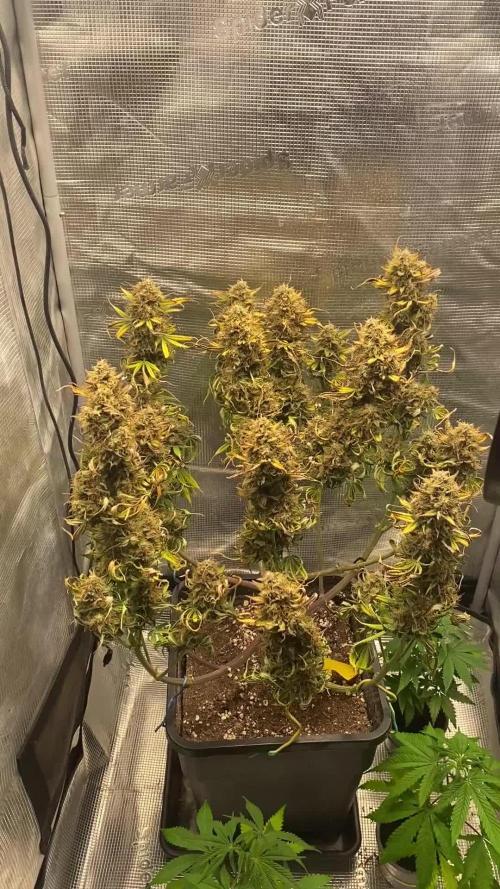
Ready for harvest in 3 days.. Going for 30 hours of darkness before bringing them down. Hoping for good smoke, buds look a bit small.🌱🎋 Oh well, better luck next time, lol..🧐


Likes
15
Share


@OrganikTek
Follow
The summer is here.
Black cream showing some colors but not what i imagine. But with out a dought some of the best buds i Have seen. Shes know senescence. Just let the lower buds get some power in 2 more weeks shes done.
Im liking a lot the way CoshKush is going Very promissing branchs and a inner purple color to the picilis. Lets se as she fatns.
Weeding Cake its looking like shes reduced grow speed. Like the tick piscilis now starting to go orange
Bomberry looked so promessing in vege and now not so much. Late as allways.... Shes late but very hairy.....Promessing again :D
Chear BrotherHood


Likes
8
Share


@ApothecAries
Follow
Quick Update, ill give a full one come Sunday! just wanted to share the growth spurt video. NO POWDERY MILDEW what so ever for last 2 weeks. confident my decontaminations and PPE measures paid off ! Shes a big eater, im happy with what im feeding them right now. Weekly feeds of the INDO line giving full doses. every two weeks new top bedding of black earth and GO GUANO Bloom. Weekly half dose of Monkey Juice and pumping full doses of Sticky Bandit Carbohydrates
Likes
7
Share


@Pete_vs_Nature
Follow
Week 4 started pretty great, the plants were finally exploding in ways I did not see coming. They also grew up nicely into the high lights that used to be at ~65cm, so PPFD adjustment was not necessary for the big girls as they grew into the range by themselves,
ACJ (9 days younger) had her "cloud" to slightly shield her from the sun.
Nutrients:
Work on the plants was fairly limited. I did notice some early burn on Orange (not surprising), accompanied by a lot of deep green, slightly wrinkled leave borders. So this was my nitrogen curve shooting up way too early, expecting vigorous branching and foliage creation for 10 week Hybrid averages, when this strain can take it easy for up to 13 weeks.
I wonder whether the N-toxicity caused the burned tips for Orange as well, but I am convincing myself this can't be the only factor.
Guess what we can learn from this? I'll tell ya: Cinderella Jack with 9 days younger is receiving that same ramp 9 days -ahead- and is showing absolutely no signs of excess N or burn. When I read: "N-tox" and "nutrient burn", I should read: "Sativa / Landrace" and "likes lighter feed" amongst other things.
Train decisions:
Once again, I did try to employ leaf tucking in order to expose shoots and perhaps prevent super-cropping entirely. But I just cannot find a way to do it as long as everything is stretching out nicely.
The internodal stretching on well fed and tended for Autos on Haze / Sativa genes with protocols supporting stretch, leaves me with leaves that are way too high up to tuck down without breaking them. The shadowing fan-leaves are always 2 nodes up and provide just some shade for those young nodes to stretch.
Those nodes seem to have two modes to me: stretch out high and shoot up -in between- their shadowing fan leave petioles and stem (those will be big); or bend outwards and kinda stop stretching, as they are "thankful" as low priority shoots.
Nothing else to add, trucking on, the scrog-net is looming over their heads. I am loving their heights but I have a confession to make: First day week 5? Those beautiful plants will receive their single HST "training" session and will be VERY upset for a day or two (during which I will also lollipop cleanly).


Processing
Likes
14
Share


Likes
26
Share


@ButterfliesLittleFarm
Follow
Hello Diary!
The third week of vegetation and plants on my small farm are entering the pre-flowering phase. The Hulkberries have reached a height of 45 cm, and are much taller than their roommate, Green Gelato.
Due to the high summer temperatures, the temperature in the box is also high. As I mentioned earlier, my small farm is located in a small room in the kitchen so it’s hard for me to keep the heat out of the space. But given the LED light (MIGRO 200+) that doesn’t produce too much heat, everything is still within acceptable limits. Humidity is also good, given the third (last) week of vegetation and ranges around 55-60%.
I noticed small bumps on one of the Hulkberries, right at the bottom of the stalk, I don’t know exactly what caused them. If anyone reading this post knows, feel free to comment below and help me find out :). Also the tips of the leaves on the upper branches have become brighter, almost yellow, I guess this is due to a little stress due to the higher temperature, but it does not develop further into anything of concern. If I am wrong, I also ask for a comment with information as to why this is happening.
The distance between the branches is much larger than that of their roommate Green Gelato, it stretches in height more than in width.
Due to the higher temperature, they didn’t drink as much water as I expected, so watering is a little less frequent than usual. I don’t have some default watering schedule, I give them water when I see the pot is lighter and the surface is dry. And I always water all three plants at the same time.
All in all I am very pleased with how they are progressing, the plants look satisfied and healthy. I still add Cal / Mag preventively at each watering, 1.5 ml/L.
Also in the third week the vegetations showed their sex.
06/07/2020. Day 18.
Watering. I prepare 7-8 liters of water, I think this is the optimal amount for watering all three plants in the box. I added BioBizz as scheduled for the last week of vegetation, Bio-Heaven, Fish-Mix and Acti-Vera 2ml / L each. P. H. I regulate with Plagron, Lemon Kick.
09/07/2020. Day 21.
Photographing and measuring plant height. After taking regular photos in the box, I take a few more photos on a black background.
Hulkberry Automatic # 1 - 45cm
Hulkberry Automatic # 2 - 45 cm
Vegetation is over, starting tomorrow I will change the light regime to 20 hours of light and 4 hours of darkness. Given the temperatures, I will put it dark in the middle of the day when the outside temperature is also the highest, I hope that in this way I will prevent the temperature from rising to an undesirable height.
That’s all for this week, see you soon.🙌


Likes
41
Share


@BOMbolenath
Follow
Plant is growing fast now. The hot days are back, but we are still going strong.

Likes
3
Share

@Philhsy
Follow
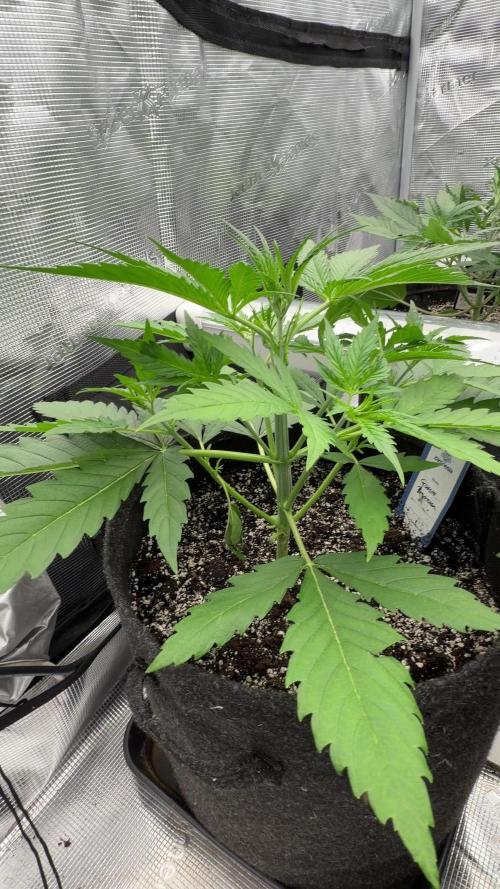
🍌 Guava Banana Auto – Week 3 Update
Week 3 and Guava Banana Auto is moving along beautifully! 🌱💚
Growth has been steady with strong branching, healthy leaf development, and a nice compact structure. The canopy is beginning to fill out, and the plant is showing excellent vigor as it heads toward the next stage of growth.
-light feeding athalf strength
-little defoliation done
Conditions have remained stable, and the plant has responded well with lush green foliage and plenty of new growth emerging every day. So far everything is running smoothly with no major issues to report.
Really excited to see how this one develops over the coming weeks. If the early growth is anything to go by, this should turn into a fantastic producer with some seriously tasty flowers. 🍌
Looking forward to the stretch and the first signs of flower soon. Until then, it’s all about keeping things dialed in and letting the genetics do their thing!
Likes
102
Share


@Zurban_Poison
Follow
Hello everybody!
everything is just great! even there is nothing to say so much everything is good)))
I think it's not long left to wait for the harvest .. 2-3 weeks maximum!)

Likes
20
Share


@Santica_Garden
Follow
So this is how things are looking for the ladies at the end of Week 5 of Veg, I have uploaded a video for you guys with all the information, any questions just ask away 👍🏾👊🏾😎

Likes
10
Share


@sam_doze
Follow
my method of cultive was the germination based from a simple kitchen's sponge and a tupper glass
lately...
my girl is 1 day old
lately...
my girl is 6 day old

Likes
142
Share


@MadeInGermany
Follow
Hi everyone 🤗
This week it looked more and more astonishing after opening the box a wonderful sweet smell wafts through the room 👍.
A few days ago the Blue Cheese Phenotype 1 was harvested and placed in the dark room :-).
This week both Kosher Tangie Kush phenotypes will be harvested 👍.
Next week the Blue Cheese phenotypes 1 and 2 will be harvested ;-) everyone else needs a while 😀.
I wish you all a nice week, stay healthy 🙏🏻 and let it grow 🌱👍


Likes
20
Share


@Ultraviolet
Follow
Not particularly growing for speed or any dedicated reason this time round, just adding water and a abundande of positivity, gotta admit I do like the autoseed logo. Off we go again into the magical forest.
(Arthrospira platensis) cultivated in high-alkaline, mineral-rich water in Kailua-Kona, Hawaii. It is renowned for having a higher nutrient content, including more carotenoids and essential fats, compared to other spirulina brands. It is frequently cited as a "complete food" due to its dense concentration of proteins, vitamins, minerals, and pigments.
The nutritional profile of standard dried Spirulina platensis biomass. 3kg of spirulina powder has an approximate NPK ratio of 10-2-1 (or 10% Nitrogen, 2% Phosphorus, and 1% Potassium).
Here is the breakdown of the nutrient content for 3kg of powder:
Nitrogen (N): ~300g (10% of total mass)
Phosphorus (P): ~60g (roughly 2% of total mass)
Potassium (K): ~30g (roughly 1% of total mass)
3kg of spirulina powder is more than enough nitrogen for 4 cannabis plants in a 100-gallon pot—in fact, it is likely excessive and could cause severe nutrient burn or toxicity if not properly managed. Spirulina has a very high protein content (46% to 63% dry weight), which translates to a significant nitrogen source. It is often described as a 5-1-1 NPK fertilizer.
3kg (3000g) of powder in 100 gallons means 30g per gallon. General organic recommendations for potent amendments (like frass) are often around 1–3 tablespoons per gallon. 30g of powder is roughly 2-3 tablespoons, making this a very high-strength application rate if added all at once. Balance this with calcium/magnesium, and organic nutrient delivery in soil growing can lead to deficiencies in these nutrients.
Not all of that 100 gallon is used, so figuring out precise measurements was ballpark, but there is about 10kg of engineered biochar in that pot. Mostly in the top half. Ideally, I'd have 25kg in a full active 100-gallon, but......... don't mess with something that is not broken. Roots do not utilize the entire 100 gallons. This has been a couple of years of trial and error, mostly error. The amount of cations you can add in grams depends entirely on the specific cation exchange capacity (CEC) of your biochar and the type of cation being added. Biochar CEC values vary widely, typically ranging from 4 to over 300cmolc/kg. Multiple Biochars in use, ranging upwards of 100cmolc/km.
Different cations have different atomic weights
Potassium K+ 39.1g/mol.
Calcium Ca2+ 40.1g/mol.
Magnesium Mg2+ 24.3g/mol.
Nitrogen NH4+ 18.04g/mol.
You get more nitrogen bang for your buck. It all depends on the CEC of the biochar you use, but brrrrrrrrrr roughly I'm looking at 500-600 grams worth of elemental cation exchange capacity, give or take. That's just for the biochar alone. Elemental cation exchange capacity refers to the ability of materials—such as soil, minerals, and biochar to adsorb, hold, and release positively charged ions Ca2+, Mg2+, K+, Na+, Al3+, and Zn2+. This capacity is a critical measure of nutrient availability in soil and energy density in electrochemical systems.
Added calmag 2:1 to complement spirulina.
Calcium (Ca): Approximately 150g - 300g of elemental calcium.
Magnesium (Mg): Approximately 75g - 150g of elemental magnesium.
So long as pH stays in 6.3 to 6.7 ish, the plant will unlock hydrogen. Plants will be able to cycle CEC for their own needs. Hydrogen ion pumping (proton pumping) is a fundamental mechanism used by plant roots to facilitate the cycling of nutrients within a medium's Cation Exchange Capacity (CEC), directly increasing nutrient availability. A growing medium's Cation Exchange Capacity (CEC) does not contribute directly to Electrical Conductivity (EC). CEC represents potential nutrient storage, while EC represents active nutrients in the water/soil solution. A medium with a high CEC can hold many nutrients, but if there is no water present, the EC will be low.
98% of plant nutrient uptake comes directly from the soil solution.
2% of nutrient uptake is directly from soil particles.
Nutrients held on exchange sites (CEC) are not directly measured by EC until they are released into the soil solution through exchange with other ions (e.g., hydrogen ions from roots or fertilizer).
Plants source the H+ ions (protons) used in cation exchange primarily by exuding carbon sugars into the rhizosphere, then microorganisms perform root respiration, which reacts with soil water to form carbonic acid H2CO3 that dissociates into H+ and bicarbonate. Roots also actively pump out H+ ions directly to acidify the rhizosphere, plants trade hydrogen produced through metabolism for essential nutrients held by the soil.
In plant cells, the H+ (protons) used in proton pumping across the plasma membrane come primarily from the cytoplasm (cytosol). The protons are derived from internal cellular sources, including metabolic processes that release H+, and the regulation of intracellular pH homeostasis.
Distilled water is highly useful in managing the electrical conductivity (EC) of a growing medium by allowing for precise control over nutrient concentration and assisting in the mobilization of nutrients from the cation exchange capacity (CEC) into the active, plant-available nutrient solution.
Just add water & positive energy.
Potential hydrogen. pH. + - , potential charge balance for hydrogen.
So long as there is adequate oxygen in the soil and air and water moves at a decent interval, its practically impossible for the pH to skew in a soil that is taking in oxygen and releasing CO2 and nitrogen, I say practically, but meh, even with plenty of oxygen, the process of converting ammonium NH4+ to nitrate NO3- by bacteria releases hydrogen ions H+, which directly causes acidification (lowering pH). While water movement is necessary, consistent water moving through the soil can leach away basic cations Ca2+, Mg2+, K+, Na+, leaving behind acidic hydrogen and aluminum ions, causing pH to drop, especially in humid regions. High levels of CO2 in the soil (from intense respiration) dissolve in soil water to create carbonic acid, H2CO3, which lowers the pH. (barometric pumping removes that possibility) The pH in a cannabis cultivation environment, particularly in hydroponic or soilless setups, will often naturally drift towards acidic (lower pH) over time. Understand how to know when to lime the pH back up. Complex but critical. Once I understood this it helped ease the pain of understanding pH.
Base saturation directly reflects the percentage of CEC occupied by base cations. Generally, as base saturation increases, soil pH increases because fewer acidic cations, H+ and Al3,+ are present on the soil colloid surfaces.
At a pH of 7 or higher, the soil colloids are saturated with base cations, resulting in a base saturation of 90+%.
While many sources include Sodium Na+ as a base cation, some calculations focused specifically on plant nutrients (like in some nutrient management contexts) may focus solely on the "Big 3": Ca2+, Mg2+, and K+. However, in soil science and CEC (Cation Exchange Capacity) measurements, sodium is usually included in the definition of total base cations, making it the "Big 4" base cations.
At a pH around 5.5, soils often have a 45–55% base saturation, while a soil with a pH between 6.5 and 6.8 generally has an 80–90% base saturation.
Base saturation is considered a reliable, albeit complex, indicator of soil fertility and the degree of soil weathering, acting as a crucial metric in soil classification and management.
Once you take full control of the pH, so long as there is oxygen, and one keeps tabs on base saturation levels. Its near impossible for anything to go wrong. All you are essentially doing is adding water and waiting for any sign of deficiency. Not so much growing as eliminating the possibilities of things going sideways. Can't over or under water, can't skew pH, can't go anaerobic. Everything runs in optimal cycles, watering every 2 to 3 days or as required, depending on the rate of combined ET. A little warmer, a little drier, but never short on water. All the nutrients are already there in the medium, we still focus on the water, just not adding salts, but to mobilize nutrients held in the Cation Exchange Capacity (CEC) and move them into the active soil solution for plant uptake, the best supplements to add to water are fulvic acid, humic acid, or seaweed/kelp extract. Liquid solutions with high concentrations of essential trace elements. Distilled water has no alkalinity or minerals to help buffer or release nutrients. Adding these supplements turns the "empty" water into an active agent that forces nutrients off the CEC colloids into the solution for plant uptake.
When to water? When Electrical Conductivity of soil gets low. No water, no conductivity.

Likes
11
Share


@Hix57
Follow
La semaine 5 s'est déroulée plutôt bien, même si on a eu un petit excès d'azote.
J'ai décidé de stopper complètement l'apport d'azote et de passer à une alimentation exclusivement dédiée à la floraison pour le moment.
Mes plantes ont fini leur phase d'étirement et se concentrent désormais sur la formation des fleurs.
En douceur, je commence à retirer une à deux feuilles par jour.
Un grand merci à louloutre pour son précieux coup de main !
🌱
Likes
5
Share


@Jays_Not_Here_Man
Follow
Started the seeds by soaking in Distilled water for 12 hours. After that, directly into the soil which is a Promix HP and Worm Castings mix. Seeds we’re planted on different days as I discovered the others I had started weren’t going anywhere…
First seed Day 1 was Jan 8, the Second and Third seed sprouted Jan 12. Keeping the RH as high as it can be, and temps consistent with a 24 hour light cycle. Misting the plant with distilled water very sparingly, trying not to overwater and let the humidity keep the plant going. Happy Gardening 🇨🇦👊❤️
Likes
27
Share


@RDWCGrowing
Follow
3/25/2023
Week 6- Day 1 of Veg (Day 52 overall)
Added my first between changes SILICA Top offs. Was worried that when you add it to pre mixed Nutes that it can make the whole thing turn into a gummy looking substance. I was ready to drain the system and start it over for the week if needed, but no issues adding it to the tank. the Silica going into the Res didn't gummy the system up, it did drop my PH by quit a bit causing me to have to bring it back in balance.
36 Gallons in the Tank
Silica
Add .5mil/Gal = 18Mil
I topped some that needed to be topped, I defoliated some that needs to be defoliated. Since I have moved into Week 6 I have increased the light intensity up to just over 500 maxing it out for Veg Cycle. Next increase will be Week 1 of Flower.
3/26/2023
Week 6- Day 2 of Veg (Day 53 overall)
All conditions looked great. Other than me not putting one of the humidifiers back right which means it didn't work last night so Humidity was lower than I like. But got the Humidifier back on it's stand correctly and it is now pumping away. With that I decided to give the plants a day off from any stresses, no topping, no FIMing, no Defoliation for today. Just some good old soaking up the light rays and the ability to get all the Nutes they would like..
3/27/2023
Week 6- Day 3 of Veg (Day 54 overall)
Looking kind of Bushy today, so I defoliated some, and topped some.
3/28/2023
Week 6- Day 4 of Veg (Day 55 overall)
PH was a little lower than I like 5.74 so I added a few Mil of PH UP and brought it back up to 5.94.
Not much else at this stage, just I topped a little and I defoliated a little.
3/29/2023
Week 6- Day 5 of Veg (Day 56 overall)
Topped a little, Defoliated a little Watched them grow!!
3/30/2023
Week 6- Day 6 of Veg (Day 57 Overall)
Main action today was breaking down my old tent and setting up a new tent and getting my second RDWC system setup and ready for clones. I Topped a little, I Defoliated some and started taking a good look at what I would like to take for clones in the coming days. I have a few bottom branches that look every promising for my clone material on each.
3/31/2023
Week 6- Day 7 of Veg (Day 58 overall)
#3 is at 16" Tall
#2 is at 13" Tall

Likes
10
Share


@StonedFarm
Follow
09/21/24 - Purple Punch 👊 & Green Crack 💚
Both these girls got the lollipop 🍭. All the winners stayed 🏆 😂. They got a bump up in the PPM, and we also increased the TPS Signal for the 3gallon dunk to now 3ml. 100% Bloom juice now. Runoffs are in the 6.3-6 4. So they thriving.
09/24/24 - Purple Punch 👊 & Green Crack 💚
Both these girls are drinking heavy, and already starting to see frost on the PP. We have them a top feed of just pH 7.2 water, to hit the 6.4 runoff.

Likes
13
Share


@Pennuts
Follow
The drying process lasted 14 days and I'm in the 2nd week of curing, I've already tried some buds and neither the smell nor the taste are great, the taste and smell of both phenotypes is lemon.