


Likes
Comments
Share


@SooSan
Follow
90x60x140 (Mars Hydro)
FC-E4800 (Mars Hydro)
Easy2go Aquavalve5 (Autopot)
Living Soil (Demetearth)
Bruce Banner (PEV Seed)
Gorilla GG4 (Ganja Farmer)
Cream Caramel (Sweet Seed)
Gorilla Gelato (Ganja Farmer)
Blueberry (00 Seed)
Kalini Asia (Zamnezia)
Biscotti Mintz (Barney's Farm)
Blackberry Cake (Sensi Seed)
Amsterdam Amnesia (Dutch Passion)
Gelato Cookie (Ganja Farmer)
Purple OG Punch (Ganja Farmer)
Sweet ZZ (RQS)
Rainbow Road (Paradise Seed)
Substrat ~50L:
30L Super Light Mix Biotechnologie
18L coco
2L perlite
1,7kg lombricompost
350g guano de chauve-souris
350g Zéolithe
350g Basalte
170g guano vers de farine
170g biochar
0,7g Endomychorise glomus intraradices
0,7g Bacillus Amyloliquefaciens
Paillage de luzerne alfalfa
Arrosage avec 2ml/L de mélasse de canne 1x par semaine
Pulvérisation avec 1% d’huile de neem jusqu'à la 2eme semaine de floraison


Likes
22
Share


@bypado_farm
Follow
Day 79:
Watered the gorilla cookies with 1.5L with nuts
1481 ppm, 3151 us/cm, 3.1 EC (last week before flush)(same feeding as last week on the diary)
283 ppm, 591 us/cm 0.5 EC (3 strawberry banana, 3 purple punch and 3 wedding Cheesecake) (2L each)
Harvested 2 purple punch
Day 82:
Watered the gorilla cookies with 1.5L with nuts
1605 ppm, 3414 us/cm, 3.4 EC (last week before flush)(last feeding with nuts)
268 ppm, 561 us/cm 0.5 EC (3 strawberry banana, 3 purple punch and 3 wedding Cheesecake) (2L each)
Day 84:
Watered all the plants with 2L each
259 ppm, 551 us/cm 0.5 EC
Day 86:
Watered all the plants with 2L each
272 ppm, 578 us/cm 0.5 EC

Likes
13
Share


@Stork
Follow
Day 30 Wed
PH 5.7
EC 0.6
DLI 18h
PPFD
Water 24c
Day 31 Thu
Add Ph Up
PH 5.4 - 5.8
EC 0.6 - 0.7
DLI 18h
PPFD
Water 20
Day 32 Fri
Add water PH Up
PH 5.5 - 5.8
EC 0.6 - 0.5
DLI 18h
PPFD
Water 22c


Likes
9
Share

@DogDoctorOfficial
Follow
💜 Purple Haze by Zamnesia – Pheno B Week 8 | The Bush With Her Own Rhythm
Welcome back to another chapter of the 8×8 Adventure!
Last week I talked about how remarkably similar the two Purple Haze sisters had been looking.
Well...
That story has changed. 😄
This week, Purple Haze Pheno B is making it very clear that she has her own personality.
While her sister has developed a different structure and expression, Pheno B has settled into something completely different:
She's a bush. 🌿💜
Compact.
Dense.
Lush.
Full of life.
And absolutely comfortable being exactly what she is.
This is one of the reasons I love growing multiple phenotypes from the same genetics. You can give two sisters exactly the same environment, exactly the same nutrition and exactly the same light...
And eventually, genetics starts whispering:
"Let me show you who I am."
And this girl is definitely talking.
🌱 One Project. One Environment. Twelve Unique Stories.
If you're new to the diary, welcome!
This plant is part of my ongoing 8×8 Adventure, where twelve different cultivars are being grown together using the 12/12 From Seed technique.
From the beginning, every plant has received the same opportunity:
• The same lighting schedule
• The same Plagron nutrition
• The same AutoPot irrigation system
• The same Future of Grow lighting
• The same TrolMaster-controlled environment
• The same temperatures
• The same humidity
No individual feeding.
No special environmental treatment.
No different light schedule.
The genetics are the variable.
And now, eight weeks into flowering, those genetic differences are becoming increasingly obvious.
That's the beauty of this project.
One environment. Twelve stories.
And Purple Haze Pheno B is writing hers in a very different handwriting from her sister.
🌿 The Compact Purple Haze
If I had to describe this phenotype in just a few words, I would say:
Compact. Bushy. Lush.
She's not trying to become the tallest plant in the room.
Instead, she's building herself outward.
Her branches are packed closely together, her foliage is abundant, and flowering sites are appearing throughout that dense structure.
Looking at her now, I can see why she has developed into such a compact plant.
There is simply a lot of plant packed into a relatively small space.
And I love it.
She has created her own little ecosystem.
Everywhere I look, there are leaves.
Behind those leaves, more branches.
And behind those branches...
flowers. 🌸
This is a phenotype that seems much more interested in building density than chasing height.
And that's perfectly fine with me.
🌸 Week 8 – The Flowers Are Taking Shape
The flowering sites are becoming much more established now.
The delicate little clusters from the earlier weeks have developed into recognizable young flowers, with pistils continuing to emerge from the developing calyxes.
There is still plenty of time for these flowers to swell and mature, but the direction is becoming very clear.
She's flowering.
She's stacking.
And she's doing it everywhere.
One thing that really stands out in the photographs this week is just how much healthy foliage surrounds the flowers.
The plant remains intensely green and full of vitality.
There is no shortage of leaves here.
In fact...
there may be a few too many. 😄
Which brings me to what's coming next.
✂️ The Defoliation Is Coming
Until now, I've deliberately allowed this girl to keep her healthy foliage.
I wanted to see how she developed naturally before deciding how much intervention she actually needed.
And I'm glad I waited.
Because now I can see exactly what I'm dealing with.
She's lush.
Very lush.
The canopy is becoming increasingly dense, and as flowering progresses, I want to make sure the developing flowers have enough space, airflow and light penetration.
So I believe next week will probably be the right moment for some selective defoliation.
Not a dramatic haircut.
Not stripping the plant bare.
Just a thoughtful cleanup.
Removing selected leaves that are:
• Blocking developing flowering sites
• Creating unnecessary layers of foliage
• Restricting airflow inside the bush
• Sitting in places where they provide little additional benefit
The goal isn't to change who she is.
The goal is to help her express what she's already built.
And honestly...
I think she's going to shine after it. ✨
🍃 Keeping the Plant Healthy
One thing I continue to appreciate about this phenotype is the overall quality of her foliage.
The leaves are broad, healthy and strongly developed.
The plant has maintained excellent colour and structure, and there are no major signs that she's struggling with the demands of flowering.
This is particularly important at this stage.
A plant can be large and impressive while still being stressed.
That's not what I'm seeing here.
Instead, she looks comfortable.
She's growing at her own speed.
She's building flowers at her own speed.
And she's maintaining her own balance.
That's exactly what I want to see.
💧 Feeding for Week 8
As flowering progresses, the feeding program continues to support the plant through this important period of flower development.
This week's Plagron feeding consists of:
• Terra Bloom – 2.2 ml/L
Supporting the nutritional demands of flowering and continued flower development.
• Power Buds – 1 ml/L
Supporting the transition and development of the flowering sites.
• Green Sensation – 1 ml/L
Providing additional support during the flowering phase as the flowers continue developing.
• Sugar Royal – 1 ml/L
Part of the flowering nutrition strategy supporting the plant as she progresses toward maturity.
• pH Plus – 0.03 ml/L
• Lemon Kick – 0.03 ml/L
Used as required to bring the nutrient solution into the desired pH range.
The current nutrient solution is sitting around EC 2.0 mS/cm, with a solution temperature of approximately 24°C.
And, as always...
every plant in this project receives the same recipe.
The phenotype decides how she responds.
💡 Light From Above and Below
The combination of the main Future of Grow lighting and the Lumiflora under-canopy lighting continues to be particularly interesting with this phenotype.
Because Pheno B has such a dense, bushy structure, the additional light lower in the canopy becomes especially relevant.
The upper canopy naturally receives the strongest illumination.
But with a plant this compact, there are flowering sites developing throughout the interior and lower portions of the structure.
The under-canopy lighting provides another layer of illumination in those areas.
Again, I'm not expecting miracles.
It's simply another tool in the ecosystem.
And as I selectively remove some of the excess foliage next week, I'm particularly curious to see how the combination of improved airflow, better visibility of the flowering sites and additional lower-canopy light affects her development.
🌡️ A Stable Environment
The room continues to provide a consistent environment for all twelve phenotypes.
Current conditions for this update:
• Flower Week: 8
• Height: 111 cm
• Light schedule: 12/12
• Day temperature: 20°C
• Night temperature: 25°C
• Relative humidity: 60%
• pH: approximately 6.0
• EC: approximately 2.0 mS/cm
• Solution temperature: 24°C
• Substrate temperature: 21°C
• CO₂: 636 ppm
• Watering: approximately 1.2 L per plant / 24h
• Pot size: 15 L
Note: the temperature values are recorded exactly as shown in this week's GrowDiaries data.
Consistency continues to be one of the most important parts of this experiment.
The environment stays consistent.
The feeding stays consistent.
The plants don't.
And that's exactly what we're here to observe.
📷 This Week's Gallery
This week's photographs really tell her story.
The wider shots show a plant that has become incredibly dense and compact, with foliage filling almost every available space.
The closer photographs reveal something even more interesting.
Behind that wall of leaves are flowering sites developing throughout the plant.
The pistils are fresh.
The flowers are forming.
And the resin production is already becoming visible across the developing structures and surrounding sugar leaves.
She's not trying to be her sister.
She's not trying to be the tallest.
She's not trying to follow the same path.
She's simply being Purple Haze Pheno B.
And I think that's beautiful.
🔮 Looking Ahead – Time to Let Her Shine
Next week may be an important little turning point for this girl.
After allowing her to develop naturally for so long, I think she's finally reaching the point where a selective defoliation will benefit the structure she's created.
I'll be looking for the leaves that are doing more blocking than contributing.
I'll open some of the interior.
I'll improve airflow.
I'll give those developing flowers a little more breathing room.
But I won't take away her personality.
That bushy structure is part of what makes this phenotype interesting.
The goal isn't to turn her into her sister.
The goal is to help this phenotype become the best version of herself.
And I have a feeling that once we open her up a little...
She's going to surprise us.
💜 Different Doesn't Mean Less
One of the biggest lessons from this 8×8 Adventure continues to be that there isn't just one definition of a great plant.
Purple Haze Pheno A and Purple Haze Pheno B may share the same genetics.
They may share the same room.
They may share the same nutrients, lights, irrigation and environmental conditions.
But they're telling different stories.
And that's exactly what makes phenotype hunting so fascinating.
Pheno B has chosen a different path.
She's compact.
She's dense.
She's incredibly lush.
She's building her own little world instead of reaching for the ceiling.
And honestly?
I'm loving her for it. 💜
Every phenotype deserves the opportunity to shine in its own way.
And next week, when we carefully open this beautiful bush and give those flowers a little more room to breathe...
I think we're going to see just how much potential has been hiding underneath all that green.
💚 Thank You
Thank you so much for following another chapter of the 8×8 Adventure.
This project continues to remind me that growing isn't about forcing plants to become identical.
It's about creating the right conditions...
Then stepping back and watching genetics tell its story.
A huge thank you to:
💚 GrowDiaries — for providing the platform where growers from around the world can document, share and learn together.
🌱 Zamnesia — for the Purple Haze genetics that are giving us these fascinating phenotype differences to explore.
💜 Plagron — for supplying the nutrition supporting the plants throughout this journey.
💡 Future of Grow LED — for providing the lighting powering this project.
🌿 TrolMaster — for helping maintain the stable environment shared by all twelve phenotypes.
✨ Lumiflora — for bringing the under-canopy lighting into this experiment and giving us another variable to observe.
And finally, thank you to everyone following these diaries, leaving comments, asking questions and enjoying this adventure with me.
Last week, I thought these two Purple Haze sisters were following almost the same blueprint.
This week, Pheno B looked at that blueprint and apparently said:
"Nah... I'm doing my own thing." 😂💜
And you know what?
That's exactly what I wanted to see.
Different phenotype.
Different rhythm.
Different story.
Same beautiful genetics.
Growers Love! 💜🌿
Processing
Likes
11
Share


@weedisdegenerate
Follow
Besides a few leaf spots here and there everything is going smoothly, 2 waterings this week, one with just PH'd and 3ml of cal-mag water, the other with the mentioned nutes, around a half gal each watering( first time I actually used my growbig). When I've been watering, I've been going off pot weight, so no set schedule. Doing half strength compared to what fox farm suggested because of the soil still holding nutes. Going to bump it up to normal strength the coming week. I turned the light intensity down for a few days to 70%ish. I thought this might help with some stretch and the discolored tips. I went ahead and did some major defoliation this time around compared to last time as well with the goal of narrowing down my bud sites/colas. I also ended up just snipping off the FIM'd tip as it was very scrawny and funky looking.
So far I'm very happy with this strain(I have nothing to compare it to lol), but I know it's time to switch to flowering in a week, two tops. Just going to keep taking my time with her and making sure we have a happy plant, not a rushed one. As always I'd love to hear from the community on what you guys think. Thank you and God Bless

Processing
Likes
10
Share


@xanado18
Follow
Well it’s looking like it’s time to flip these girls are Losing their shit on this run. Huge props to MSNL so far, I mean, we’re talking 8/8 seeds popped, fast healthy growth like nothing I’ve had(and I put these girls through some shit-stripped them down to nothing almost weekly and they just bounce back.
Seriously, if this run continues to go anything like the veg then I’m 100% a believer in MSNL’s quality. They’re hardy, put up with some crazy shit that happened with circuit breakers cutting the lights off early on, a lot of supercropping, defoliation and lollipopping... And you don’t even need to rub the stems for scent... I just walk into the room and it’s like a sweet peppery gas smell. Straight fire.
Catch you guys next week, can’t wait to see some pistils!

Likes
22
Share


@CanarianGrow92
Follow
Wonderful tangerine smell, all strains are looking and smelling more or less the same, some buds are a bit bigger and some other showed some more stretching when we switched to flower but in general wonderful strain, lets see if the buds taste as good as they smell 😜
Week 4 already! We start to see a small nutrients deficiency, time to add some more organic stuff, i didn't applied too much so it seems it was food for 4 weeks, great as i dont want to give too much nutrients, I heard that organic nutrients gives a better taste and avoid salt accumulation in the roots, i always have been a typical grower using bottles but lets see, at the moment very happy, buds are looking good, i do need to add some sugars I think 🤔

Likes
19
Share


@adam_pawloski87
Follow
Let’s Go Day 22 from seed for these 5 Ogreberry Autos from @twenty20mendocino and Bruce Banner from @fastbudsgenetics !! Today we turned the Scorpion up to full power and raised it to 38 1/2 inches above pots and getting a reading of 520 - 530 par ! gonna let the babies grow into the light now over the next few weeks till they hit into flower an keep a steady eye on it Incase I got to raise the light higher or lower !! Air temp an humidity has been great , stayin from 70-75 degrees through the day an humidity is staying around 58% ! So far so good Let’s grow lil Babies let’s grow!!! Hope you all enjoy an are ready for another amazing week ! Peace love an positive vibes to all you Growmies out there Cheers 😶🌫️💨💨💨💨💨🤙🏻keep them eyes peeled for next week y’all !! If there’s any questions please ask me ! Thank you all. 💚💯

Likes
5
Share

@Permanentmarker88
Follow
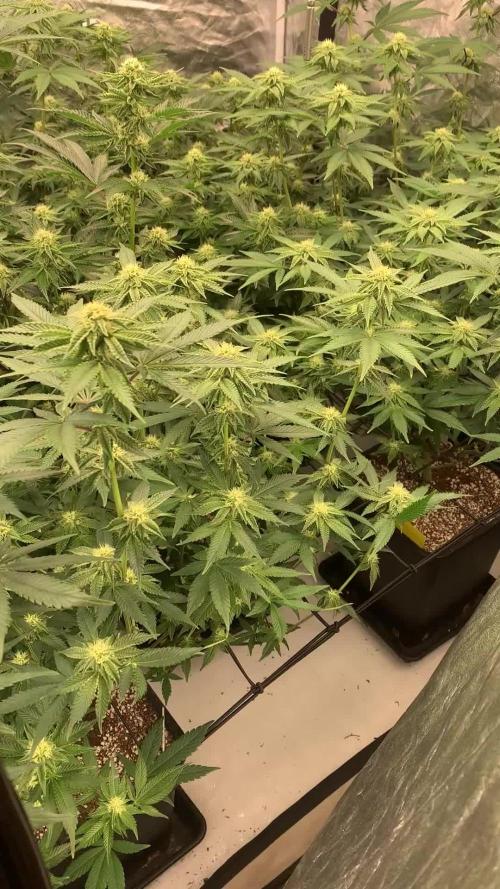
Heute ist der 22.Tag der Blüte.
Die Buds schwellen gut an und werden immer harziger.
Temperaturen sind momentan bisschen hoch aber noch ihm Rahmen bei 26-28 grad.


Likes
5
Share

@Shivashamboom1
Follow
ultima settimana di flush....una delle 3 grape,quella toppata, è forse un pochino più indietro delle altre. tutte e tre hanno un profumo delizioso, mi fa venire l'acquolina in Bocca 😂😉💪💚💛❤️
Likes
82
Share


@TheFoxFarmer
Follow
Week 7 Flower
We've finally started flush 💦 on Day 43. I still run EM1 at 1ml/ltr as it goes a long way once activated/stretched. It's always going to be a benefit to keep any microbes you can in the coco. You can also use Mammoth P throughout flush, but due to its price I just stick to EM1 in flush. There's plenty of other microbes that can be used too.
I flush around twice the pots' volume at 6pH. But before flooding the pot I slowly pour water through the centre of the pot, around the stem, in order to take a true reading of the ppm and pH of the run off. If the ppm/ec reads a lot higher than your average feeding throughout bloom, then there's been issues such as a lockout, incorrect pH, over feeding etc. This wasn't the case, as this girls' was at the right level. If the pH is too high or low, I adjust the pH of the rest of the water that'll be flushed to try to fix it. Again, this wasn't the case with this girl as she had a perfect pH 👌👍
Just before all of the water has gone through the pot, I take one last reading from her last bit of run off. The ppm should be down to no more than 100ppm for the first flush (+starting ppm of water if using tap water). After the first flush the ppm value of the run off will quickly go all the way down to 0, or at least below 50ppm (+tap water ppm). I use tap water that is between 150-190ppm, but I'm looking to switch to RO as soon as I can. I still get a very good flush, but I think using RO water will be the next step in getting a more thorough flush as it won't contain even the small amount of nutrients and metals that tap water contains (along with any harmful chemicals). Always remember to bubble or let the water sit for 24-48hrs before feeding to your plants. That goes for all feedings in every stage of growth if using tap water.
Because I keep fairly low temps in the Den she's starting to turn a beautiful dark purple. Her buds are still swelling and smelling like a nice gassy OG, with hints of citrus/tropical fruits. I'm really looking forward to taking this girl down, but after at least another week!
Thanks for following and happy growing! 🐺
Likes
14
Share


Likes
30
Share


@SqwshKush
Follow
Absolutely love the colours. Deep purples all over - gorgeous! The aroma is outstandingly strong; minty, sweet and refreshing. Grew very easily. A very strong pheno/strain. Has brought a lot of joy! VERY UNIQUE.


Likes
75
Share


@GODSGIFT_2005_JM
Follow
🍼Greenhouse Feeding BioGrow, Bio Enhancer & BioBloom
⛺️MARSHYDRO
The ⛺️ has a small door 🚪 on the sides which is useful for mid section groom room work. 🤩
☀️ MARSHYDRO FC 3000 LED 300W
☀️Also special thanks to VIPERSPECTRA P2000 (200W) & XS2000(240w) LED growlights
🌱GANJA FARMERS
Processing
Likes
34
Share


@DudeGrowsWeed
Follow
Sour Diesel Haze is coming along nicely, lots of upward growth and node development. I gave her a FIM pinch this week. Expect the flowering stretch to start at any time. 👍

Likes
7
Share


@Adam22
Follow
Getting ready to transplant in a couple of days. Today on one of the short plants I half snapped one of the fan leaves near the top of the plant! I've also gone and knocked over another one when feeding earlier today 😔 tent should be up by now but can't put up yet ATM


Likes
77
Share


@Basementganja
Follow
The final Week, before harvest! She has some massive towering buds!
2.5 gallons of water is lasting this plant 5-6 days before drying out, and ready for more.. She was harvested instead of being watered!


