


Likes
Comments
Share


@BongRip
Follow
UPDATE AFTER A LONG TIME, i'll post more often.
I only recovered a few videos from last couple years to share.
Mango is dense, but doesn't give out much trichome as I expected. So, I took a risk and poke a hole in the stem to gave a lot of stress to the plant, so the plant gave out a lot of trichomes and the bud becomes a bit bigger.


Processing
Likes
4
Share


@DrStrains
Follow
Hello everyone im still a bit noob on everything even on posting here and staff. ill figure it out in a couple of days hopefully!
Lets start by saying that big bang had an issue because ........ i was growing it and i didnt see that my flores was empty and until i received a new it was almost a week had a lot of yellow on the leaves dying and falling out like doing full defoliation on the plant. have no clue if im lucky or something i do right but when i started feeding couple of days i saw signs of buds getting bigger so i continue. now we are at week 13 and from what i have seen from my previous 2 plants bb and king Tut autoflowers will not forgive when u stun them nut they will forgive slow growth or deficiencies and stuff when they are close to maturity at least for my garden.
Whatever i did to them and i monitored closely everyday made them move on a slower pace but didnt stop them from being huge the only downtime i saw was more time to be ready for harvest.
ill update by the end of the week with pics with the lights out (hps) . The pics are a bit shaky but cant do anything about it atm sorry!
Any advice welcome the first red spots in some of the sugar leaves should i start flush? or wait to see on almost every bud?


Likes
22
Share


@takecua
Follow
Por fin llego su día, a sido todo un reto
Ahora estara secando entre unos 7 o 10 días mas o menos
Espero sacar calidad ya comentare .. saludos y mucho verde


Likes
6
Share

@DogDoctorOfficial
Follow
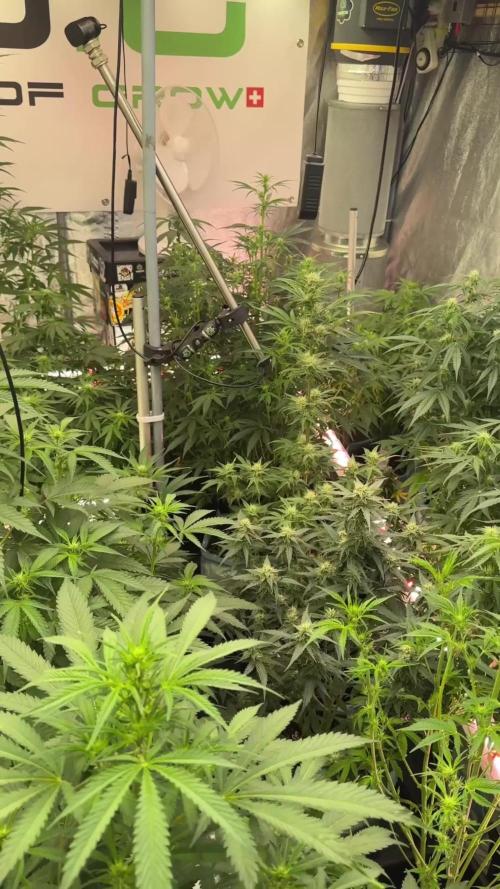
🌿 Amnesia Skunk Automatic
Week 8 From Seed
≈ Week 4 Flower (12/12 From Seed Run)
She may be 8 weeks old, but biologically she’s in her fourth week of active flowering — and she’s behaving exactly like a plant that has found her rhythm.
After defoliation?
She bounced back like nothing happened.
No stall.
No stress signals.
Just structure, stacking, and deep healthy green.
That’s not luck. That’s environment + balance.
And she’s beautiful.
⸻
Environment — Playing on the Edge (But Controlled)
Room Conditions
• Canopy Temp: ~28°C
• RH: ~70%
• CO₂: 1000+ ppm
• PPFD: 800 → 1300 µmol/m²/s
On paper, 28°C + 70% RH sounds high.
But numbers without airflow mean nothing.
Massive Airflow
We’re running:
• Strong horizontal movement
• Vertical air displacement
• Active air exchange
• Under-canopy circulation
Airflow changes everything.
Stagnant 70% RH is dangerous.
Moving 70% RH behaves very differently.
⸻
🍃 Leaf VPD vs Room VPD
Room VPD says one thing.
Leaf VPD tells the real story.
Under strong light, leaf surface temperature runs slightly above ambient.
That increases transpiration.
Add 1000+ ppm CO₂:
• Stomata don’t need to open as wide
• Photosynthesis rate increases
• Plants tolerate higher humidity
• Metabolism stays high
That’s why they’re not just surviving.
They’re pushing.
⸻
💡 Lighting Strategy — Scaled to Structure
We are not blasting everything equally.
• Larger tops: up to 1300 µmol
• Smaller plants: ~800 µmol
Light intensity is matched to plant size and leaf mass.
No ego lighting.
Only usable photons.
⸻
🔦 Under-Canopy Lighting — Why?
This isn’t a gimmick.
Purpose:
• Illuminate lower bud sites
• Reduce larf
• Stimulate lower-zone photosynthesis
• Improve uniformity
• Keep lower canopy metabolically active
We’re not replacing top light.
We’re filling in where dense canopy blocks energy.
Active lower buds stay healthier.
Healthier lowers improve airflow.
Better airflow stabilizes microclimate.
Everything connects.
⸻
🔴 End-of-Day Red (15 Minutes After Lights Off)
We run a 15-minute red pulse at lights-off.
This is phytochrome management.
Plants operate with two main phytochrome states:
• Pr (red-absorbing)
• Pfr (far-red absorbing)
Red light pushes phytochrome into the active Pfr state.
In darkness, Pfr slowly converts back to Pr.
By giving a short red signal:
• We influence phytochrome equilibrium
• Support flowering signaling
• Encourage structural consistency
• Potentially stabilize transition timing
It does not extend photoperiod.
It manipulates light signaling — not day length.
And as always:
We experiment.
We observe.
We document.
No magic claims.
⸻
🌱 Feeding & EC — They’re Hungry
• Soil EC: 0.9
• Feed EC: 2.4
This tells us something important.
They’re eating aggressively.
As long as runoff EC stays stable and does not climb:
We maintain strength.
High metabolic demand requires high input.
If soil EC rises?
We adapt immediately.
No rigid formulas.
Only feedback-based decisions.
⸻
📸 Visual Observations
From the traditional full-plant shots to the macro work:
• Tight stacking beginning
• Strong pistil development
• Leaves praying under high PPFD
• No signs of stress after defoliation
• Structure clean and symmetrical
She is balanced.
And balance is power.
Oh that topping was an accident wen moving her 🙏
📡 DELETED @ 1K Please stay tuned.we never quit https://www.youtube.com/@DOGDOGTHEDOCTOR NEW
🙏 Thank you for your patience and continued support.
FOR DISCOUNT CODES AND MORE JUST FOLLOW THE LINK https://website.beacons.ai/dogdoctorofficial
📲 Don’t forget to Subscribe and follow me on Instagram and YouTube @DogDoctorOfficial for exclusive content, real-time updates, and behind-the-scenes magic. We’ve got so much more coming, including transplanting and all the amazing techniques that go along with it. You won’t want to miss it.
GrowDiaries Journal: https://growdiaries.com/grower/dogdoctorofficial
Instagram: https://www.instagram.com/dogdoctorofficial/
YouTube: https://www.youtube.com/@dogdoctorofficial Deleted by Youtube
Vimeo : https://vimeo.com/dogdoctorofficial Under construction stay tuned ⸻
Explore the Gear that Powers My Grow
If you’re curious about the tech I’m using, check out these links:
🔆 Lighting & Environmental Control
• Future of Grow — Advanced LED lighting technology
https://www.futureofgrow.com/
DISCOUNT CODE: DOG20
• Lumiflora — Under-canopy LED lighting
https://lumiflorade.com/
• TrollMaster — Environmental controllers and automation gear (past collaboration)
⸻
Genetics
• Zamnesia Seeds — Genetics used in this project
https://www.zamnesia.com/
⸻
🌱 Soil, Substrates, Boosters & Root Support
• Plagron — Substrates, bio mixes, and supportive products
https://plagron.com/en/
⸻
🎒 Storage, Curing & Preservation
• Grove Bags — Curing and storage solutions
https://grovebags.com/
⸻
📸 Photography Equipment & Tools
(Not sponsors, but part of my creative toolkit)
• Sony A6700
• Sony full-frame macro lens + few more
• Stacking photography workflow - learning
• iPhone (for behind-the-scenes shots)
We’ve got much more coming as we move through the grow cycles. Trust me, you won’t want to miss the next steps, let’s push the boundaries of indoor horticulture together!
As always, this is shared for educational purposes, aiming to spread understanding and appreciation for this plant. Let’s celebrate it responsibly and continue to learn and grow together.
With true love comes happiness. Always believe in yourself, and always do things expecting nothing and with an open heart. Be a giver, and the universe will give back in ways you could never imagine.
💚 Growers love to all 💚
📸 P.S. – The Eye Behind the Lens
All photos in this diary (for now — except for the ones showing the camera, which I took with an iPhone) are taken with a Sony A6700 paired with a Sony full-frame macro lens and a few more.
Photography is part of the story — it’s how we share the fine textures, the glow, and the quiet details that words can’t always capture.
I’ve also started experimenting with photo stacking — a technique where multiple images, each taken at a slightly different focus point, are layered together to create one perfectly sharp image from front to back.
It’s not digital enhancement or AI; it’s pure photography — a way to reveal the plant’s beauty in microscopic depth, from trichome to petal.
You’ll even see a few shots of "ghost me" capturing the shots — camera, lens, setup — because every grow deserves not just to be cultivated, but documented like art.
FOR DISCOUNT CODES AND MORE JUST FOLLOW THE LINK https://website.beacons.ai/dogdoctorofficial
NEW DISCORD - Official Server Invite Link : https://discord.gg/ksjAkA5T74
Likes
12
Share


@CannaDiaries420
Follow
22-01
Already in week 5 and the topping is taking off its results.
*I ended the grow of nr: 3, just bad genes.
but more light for the other 3 plants.
24-01:
Applied another round of LST today. This time to create 4 main coala's and a wide and full deck of leafs.
When the plants start to get more busy i will add an scrogg technique and do a little defoliation at the bottom of them
to take even more profit of the LST.
26-01
I added Mega worm from plagron to the soil to give the plants a big boost so that they are ready for a strong flowering phase.

Likes
3
Share

@Lontra
Follow
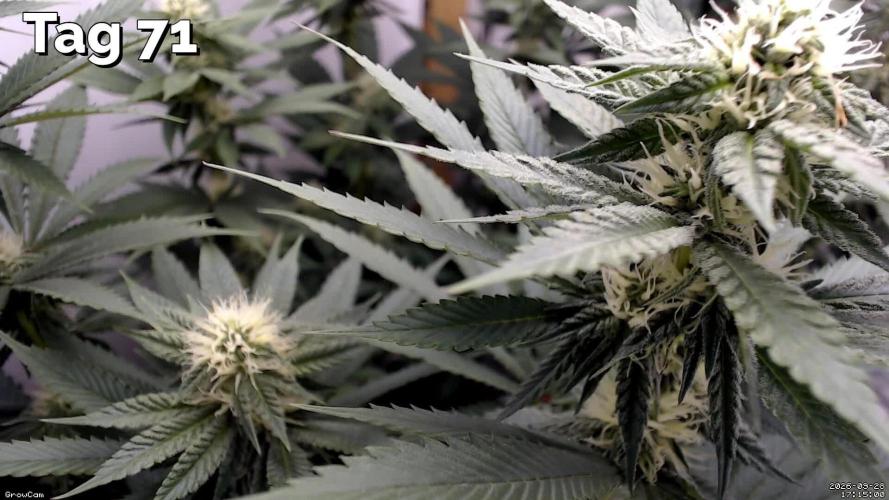
Diese Woche war wieder entspannter als die vorherigen. Nach dem Lollipopping und dem Wechsel der Stammfixierung letzte Woche habe ich bewusst keine größeren Eingriffe mehr vorgenommen, damit die Pflanze sich vollständig auf die Blütenbildung konzentrieren kann.
Der Stretch scheint zum Glück weitgehend abgeschlossen zu sein. Die Pflanze legt kaum noch an Höhe zu und wirkt nun klar in der frühen Hauptblüte angekommen. Am Ende der Woche liegen die 5 höheren Haupttriebe bei ~61-62cm und die 3 kürzeren bei ~53-54cm. Trotz des geringen Abstands zur Lampe zeigen sich bisher zum Glück noch immer keine deutlichen Anzeichen für Licht- oder Hitzestress.
Die 8 Haupttriebe entwickeln sich sichtbar zu einzelnen Colas, und auch einige der stehen gelassenen Nebentriebe bekommen nach dem Auslichten nun genug Licht, um brauchbare Blütenansätze zu bilden. Die Blütenstände werden zunehmend dichter, und die einzelnen Budsites beginnen sich entlang der Triebe miteinander zu verbinden. Insgesamt wirkt die Pflanze vital, gut versorgt und stabil. Auch die beschädigte Stammstelle scheint weiterhin keine negativen Auswirkungen auf die Versorgung der Triebe zu haben.
Gegossen wurde diese Woche zweimal:
1. Gießvorgang: Tag 73, insgesamt ~4,5 Liter (2ml/l Bio-Grow, 3ml/l Bio-Bloom, 3ml/l Top-Max, 5ml/l Bio-Heaven, 0,81ml/l CalMag, ca. 0,24g/l Bittersalz, pH-Wert ~6,1, EC-Wert ~1,95mS/cm, Topfgewicht vorher ca. 4,2kg, nachher ca. 7,7kg)
2. Gießvorgang: Tag 76, insgesamt ~4 Liter (2ml/l Bio-Grow, 3ml/l Bio-Bloom, 3ml/l Top-Max, 5ml/l Bio-Heaven, 0,81ml/l CalMag, ca. 0,24g/l Bittersalz, pH-Wert ~6,3, EC-Wert ~1,95mS/cm, Topfgewicht vorher ca. 4,3kg, nachher ca. 7,6kg)
Die Lampe läuft weiterhin dauerhaft mit 100% Leistung.
Die Luftfeuchtigkeitsregelung ist momentan wie folgt eingestellt: min. rF: 50% | max. rF: 60% | min. VPD: 1,1kPa | max. VPD: 1,6kPa
Likes
9
Share


@MuzzFuzz
Follow
Running out of space with the GSC 1 of the GSC is looking great with some really nice flowers coming along the other 2 seem to have a-lot less bulk in the flowers and seem to be stretching a fair amount. I have had to do some super cropping to keep the top of the flowers from getting too close to the light. Had a problem with the nutrient tank filter getting clogged and al, the auto pots drying out! One of the plants had started to wilt. Ended up taking the reservoir out and cleaning it before adding fresh nutes. Have been using professors gold terpintine for flower but have had this problem before the additive ends up causing build up of growth in the tank and this build up blocks the hoses. For now have stopped using and just using:
GT FLOWER FOR COCO A & B
GT FLUVAIC ACID
GT CAL MAG
GT POTASSIUM ADDITIVE
PPM at around 600 down from 800 as I was getting a bit of tip burn on the shade leaves.
Not really happy with how a couple of the plants are progressing, the buds seem way undersized for week 5 but will carry on
Processing
Likes
55
Share


@Tazard
Follow
She looks very healthy but two of her 20 tops had to go. So she now has 18 tops. Her sister still has 6.

Likes
21
Share


@BruWeed
Follow
☘️12/04 - Empieza su décima semana en etapa de floración.
☘️Ya comencé con su lavado de raíz, le agregue 25L de agua y 6ml en total de Top Wash.
☘️Yo creo que un lavado más igual al que realice y ya esta lista, se notaba bastante limpia el agua.
☘️La humedad que estoy teniendo en el indor es máximo de 55% y 22 grados de temperatura.
☘️La planta en total ya tiene 109 días en total desde la germinacion hasta ahora.
☘️La planta estaba largando demasiado olor a weed y tuve que comprar un filtro de carbón ya que el olor era muy invasivo, hasta el momento funciona de forma perfecta.
☘️En estos dias subiré más imágenes de como viene.

Likes
5
Share


@beer420
Follow
Were getting there!
Plants looking beautiful and swelling up.
Two questions below!
Thanks for reading and happy growing.

Likes
29
Share


@elevensixty6
Follow
B2 is stacking on some serious weight and continues to grow.. it wild. B1 is forming buds similar to my last run which turned out nice. Excited to try these buds out already. About another month or so until harvest.

Likes
28
Share


@m0use
Follow
SPONSORED DIARY===SPONSORED DIARY===SPONSORED DIARY
Seeds finally popped up and out of the medium, giving them 24hr lighting till week 3 then will reduce it down to 18/6. Added in a few pics this week of the tent and light. nothing much else to report.
SPONSORED DIARY===SPONSORED DIARY===SPONSORED DIARY
Big shout out to @SpiderFarmer for supplying the 2x2x5 Grow tent and The SF1000 100w LED light.
I will be uploading all relevant photos of the products in the next week when they arrive, maybe do a little unboxing video. Who knows.
A 2nd big shout out to Dr.Seeds for supplying the 3x5pac of seeds I will only be featuring two of the three strains in two separate diaries.
You the users will get to decide what ones I grow. I have setup a Grow Question on each diary to vote for your strain of choice for that diary.
https://growdiaries.com/grow-questions/47600-drseeds-1-vote-what-i-grow "Diary #1"
https://growdiaries.com/grow-questions/47600-drseeds-1-vote-what-i-grow "Diary #2"
Cast your vote for each diary.
Thought I would add in the relevant links if you wanted to read up on any of the products that will be officially featured in this grow.
https://www.spider-farmer.com/
https://growdiaries.com/grow-lights/spider-farmer (+) https://www.spider-farmer.com/products/sf-1000-led-grow-light/
https://growdiaries.com/grow-tents/spider-farmer (+) https://www.spider-farmer.com/products/sf-2-x2-indoor-grow-tent-hydroponic-home-plant-reflective-aluminum-oxford-cloth/
https://drseeds.net/
https://growdiaries.com/seedbank/dr-seeds
(+)
https://drseeds.net/product/cherry-pie-autoflowering-cannabis-seeds/ (+) [No relevant GD affiliated link]
https://drseeds.net/product/granddaddy-purple-autoflowering-cannabis-seeds/ (+) https://growdiaries.com/seedbank/dr-seeds/granddaddy-purple [Photoperiod not Autoflowering]
https://drseeds.net/product/60-day-wonder-autoflowering-cannabis-seeds/ (+) https://growdiaries.com/seedbank/dr-seeds/60-day-wonder-autoflowering

Likes
16
Share


@Mrg7667
Follow
About day 38 i am just realizing that i am stupid and been feeding the biogrow for cocoa coir 🤦♂️ way iver nuting with soil it says never to go over 1ml/L
So i will be flushing for at least 1 or two waterings. Looking for the tip burn to stop spreading and the tips to not look like there clawing

Likes
14
Share

@pinknite
Follow
=============================
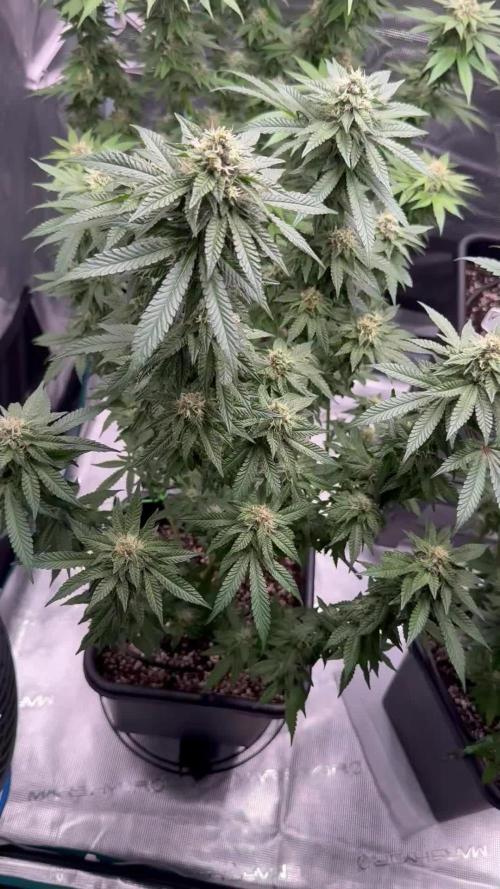
📅 Week 13 – Flowering
Days: 85–91
Dates: 03/07–09/07
Strains: RQS Critical (3x), RQS White Widow (1x)
Likes
8
Share


@chellin420
Follow
so it's a first for me this week I try to fim the top instead of topping it and I have video and pics if anyone can let me know I got it right but beside that I trimmed up the leafs a lil and let it grow it's on like it 6th node jus waiting for it to get tall agine any tips is helpful
Likes
6
Share

@PrinceOfHerbs
Follow
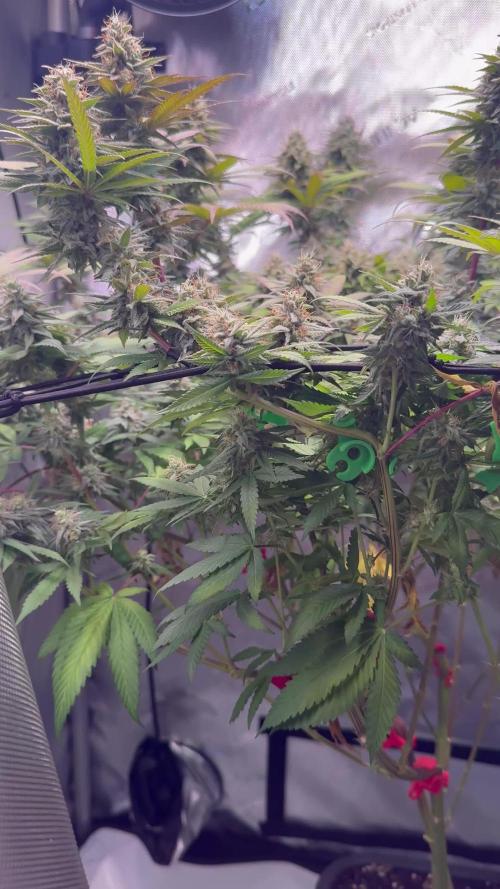
The plant grows slowly in terms of flower size. However, the flowers are very resinous.
Flowering day: 41

Likes
45
Share


@SherbGrows
Follow
Time for another update!
During Week 9
Light defoliation on bottom canopy
Added 1 heaping tbsp of GEO Bloom dry amendment 3-12.5-9 with regular PH'd water
Watering every 3 days with 1/2 liter of water or more. Trying to keep soil moist without drying out. Seems to be improving the plants
Plan week 10
Installing ViparSpectra XS2000 light to help with better light coverage in the 4x4 tent
Going to keep RH around 45% and keeping up with airflow
Planning to put in dehumidifier in upcoming week if necessary
Weaning down on light defoliation at this point.
Happy with how these girls are doing! Hoping the new light set up with the ViparSpectra XS2000 will make a difference in yield this far into flower. Trying to combat a little bit of light burn happening at the moment as well.
Thanks for checking in! See you next week

Likes
19
Share


@DreamIT
Follow
Sponsored by:
🌸SUPER SATIVA SEEDS CLUB🌸-💡VIPARSPECTRA💡-💐GREEN BUZZ LIQUIDS💐-🛠️WEDRYER🛠️
28/7 it grows very long and with few internodes, it shows an evident N deficiency and I will do a soil check in these days
2/8 this too remained in a corner over the weekend and received little light in the lower parts, so much so that the leaves fell. also I have to increase the fertilizer because it requires more than the other. but it already gives off a sweet lemon scent. now the flowering is approaching
__________________________________________
Personal advertising (contains affiliate links)
__________________________________________
🦄Super Sativa Seeds Club, creators of premium and legendary genetics since 1985! Anonymous shipping!
✅https://bit.ly/Supersativaseeds
__________________________________________
Did you know that Green Buzz Liquids fertilizers are 100% vegan? A complete line of products ready to give the best to each of your plants! Visit the site and see my journals to see how they work 🦄
🤯 And with the code "dreamit" you will immediately receive a 15% discount on your purchases
✅https: //bit.ly/GreenBuzzLiquidsPro
__________________________________________
👀 Are you looking for a good lamp to start with? 👀
🌞Viparspectra has something more than the others, take a look at their site.
⏩ Use "GDVIP" for an extra discount or "DREAMIT3" for an extra 5 %% discount
👀 Search for it on Amazon
✅Amazon USA: https://amzn.to/30xSTVq
✅Amazon Canada: https://amzn.to/38udUVe
✅Viparspectra UE: bit.ly/ViparspectraUE
✅Viparspectra USA: bit.ly/ViparspectraUS
______________________________________________
🌈 Tired of blowing on your weed hoping it dries quickly? Check out the Wedryer website! You will find a well-made accessory that will help your weed dry in just 8-10 days without the annoying risk of finding mold or other annoyances! (no affiliate links)
✅https: //bit.ly/Wedryer_
______________________________________________
📷🥇Follow the best photos on Instagram 🥇📷
https://www.instagram.com/dreamit420/
Backup
https://www.instagram.com/dreamit4200/
🔻🔻Leave a comment with your opinion if you pass by here🔻🔻
🤟🦄💚 Thank you and enjoy growth 💚🦄🤟

Likes
6
Share


@HappyOne
Follow
Flowering is now obvious. We are in first week of july, so hopefully I will get very nice buds in september already!😛I really like this express plant!
