


Likes
Comments
Share


Likes
4
Share


@Peloxiraptor
Follow
Temperatures this whole week:
MAX - 25.8ºC
MIN - 18.5º C
MAX HUMIDITY - 90%
MIN HUMIDITY: 44%
Aprox Plants Height Sunday 26:
Persian Pie 1 - 23cm
Persian Pie 2 - 18cm
Persian Pie 3 - 21,5cm
Persian Pie 4 - 20,5cm
All Gas OG - 14cm
Irrigation:
21/3 - 2L (400ml each) of alkaline tap water (6.9 Ph, 127ppm) with 0.1 ml/L of silic boost, 1ml/L of Terra Leaves and 1ml/L of Atazyme.
24/3 - 2L (400ml each) of alkaline tap water (6.72Ph, 117ppm) with 0.1ml/L of silic boost and 0.2ml/L of Rootbastic. (last alkaline irrigation, last dose of rootbastic)
-The stains seems to be drops of water from the humidificator, probably they're falling there when i move the deposit to refill it. Next week i should put the light closer, make apical pruning and pull in the tent a scrog web to put a limit to the plants height because they're starting to grow willowy and the tent is only 1.80m tall. I should also make an abundant irrigation to check earth's Ph and PPM again and get the A/C ready to be plugged to the tent because temperatures are rising up exponentially outside and some local growers are starting to have issueswith that.
Cheers guys, have a great week and good luck with the outdoor season. Good luck with the harvest to those on the other side of the equator 🙌🙌


Likes
7
Share


@RizlaZA
Follow
1st major defoliation end of week 1 flower.
Girls are looking all kinds of healthy.
#1 is leaving #2 behind now in the stretch, root mass and overall look.
Streching very nicely, almost doubled in size over 2 weeks.

Likes
9
Share


@Atom_x_Andromeda
Follow
Plants doing fantastic add your opinion.. stay till the end im sharing my medical grow pics with everyone thank you all for the happy comments and encouragement this is my first indoor, also first Autoflower, and first organic


Likes
46
Share


@Seedler
Follow
Holy fucking shit. I upped the E.C. to around 1.9 and it seems she LOVES it. Since the change (from 1.2 to 1.8) she suddenly draws 5L of water a day and the buds are starting to form.
I can clearly already see the typical "cali" US genetics on this plant and i'm very excited to see that develop!
Pretty sure i could have achieved the same state with only 6 weeks of veg, but i had to veg her longer for some other plants.
Im curious, what she will yield, if someone can guess, i would be happy
Take care of yourself, this will be a banger grow!

Likes
4
Share


@DogDoctorOfficial
Follow
🚂 8×8 Adventure — Cash Express by Zamnesia | Pheno A | Harvest — Part 1 🌸💚
👑 The Harvest Begins! Beautiful Flowers, One Setback, and a New Drying Experiment 📸❄️
Welcome back to another chapter of the 8×8 Adventure, my friends! 🌱💚
Well…
Here we are.
Harvest time has arrived for Cash Express Pheno A! 🚂🌸✂️
And before we get into this beautiful girl, I owe everyone a little explanation.
🙏💚
We're dividing this harvest into two parts.
Not because we're trying to drag the story out, but because there's simply too much we want to share, and GrowDiaries has its limitations on the number of photographs we can include in an update.
With the newer posting restrictions, we have to work around the 30-photo limit for the final report, including the trimming photographs, post-harvest observations, and smoke review.
And if you've been following my diaries, you already know that I have a small problem…
😂📸
I LOVE taking photographs.
I take photographs of the plants.
I take photographs of the flowers.
I take macro photographs.
I stack photographs.
I take photographs of the equipment.
And then, when I think I've finished, I find something else worth photographing!
😂🌿📸
So, rather than squeeze everything into one report and leave important parts of her story out, we're splitting the harvest documentation into two parts.
💚 Part 1 — Harvest and Drying: We're celebrating Cash Express, documenting the harvest stage, showing the photographs, and introducing the drying setup and our DryFerm comparison.
✂️ Part 2 — Post-Harvest and Final Review: We'll return with the next stage of her journey, including the trimming, final observations, and smoke review when they're ready.
This way, we can give her the attention she deserves without trying to fit an entire harvest into one overcrowded update.
Thank you for bearing with us, everyone! 🙏💚
Now, let's get back to our girl.
Because despite one unfortunate moment earlier in the run, this has been a beautiful journey.
Cash Express has given us some lovely flowers, some fantastic photographs, and plenty to appreciate.
She's now in the drying stage, and we're moving into the next chapter.
🚂💚🌸
────────────────────────
🌱 A QUICK RECAP — HOW DID WE GET HERE?
For anyone joining this diary for the first time, welcome to the 8×8 Adventure!
The idea behind this project is to document individual plants and phenotypes sharing the same overall growing environment, while observing how differently they express themselves.
Same room.
Same general environmental strategy.
Same lighting ecosystem.
Same overall nutritional approach.
Different plants.
Different structures.
Different personalities.
And sometimes, very different journeys.
🌿🌸💚
Cash Express Pheno A has been part of this adventure from the beginning. We've documented her development week after week, watched her flowers form, photographed her progress, and followed her individual story alongside the other plants in the room.
This run has been a genuinely enjoyable experience overall.
Of course, no grow is guaranteed to go perfectly from beginning to end.
And this girl had one unfortunate setback.
We lost her main cola to bud rot.
💔
It was disappointing, especially because it was such a beautiful flower. But we caught the problem in time, removed the affected cola, and no other colas were affected by that incident.
That's an important part of her story, and I'm not going to pretend it didn't happen.
But I'm also not going to let that one moment define the entire run.
Because there is so much more to this plant than the flower we lost.
The remaining flowers continued developing, and now we're looking at a harvest with beautiful colours, dense flowers, and plenty of details worth documenting.
That's what I want to celebrate today.
The whole journey.
The good moments, the difficult moments, the lessons, and the final result we're now preparing to document.
💚🌱
────────────────────────
🚂 CASH EXPRESS — THE JOURNEY CONTINUES!
One thing I really enjoyed about this girl was her pace.
Throughout the flowering period, she seemed to move along with a different rhythm from some of the other plants in the room.
While some of our girls were happy taking their time, Cash Express kept giving us reasons to return with the camera and see what had changed.
😂🚂💨
And that's one of the things that makes a multi-plant project so interesting.
The calendar can be the same, the room can be shared, and the overall environment can be consistent, but individual plants don't necessarily develop in identical ways.
We have to observe what each plant actually shows us rather than expect them all to follow the same script.
Cash Express had her own rhythm, her own structure, and her own flowering story.
And now, after all those weeks of observation, we've reached harvest.
💚🌸
I'm genuinely happy with this girl.
The lost main cola was a setback, but it doesn't erase the rest of the work, the flowers that remained, or the experience of documenting her throughout the run.
We're here to show the journey honestly.
And that's exactly what we're doing.
────────────────────────
🌸 LET'S TALK ABOUT THOSE FLOWERS!
Now, my friends…
Let's appreciate what we have in front of us!
💚📸🌸
The photographs show the individual character of Cash Express Pheno A, from the broader views of her flowers to the closer details that make macro photography so enjoyable.
There are beautiful colours throughout the flowers, intricate structures, and plenty of detail to explore.
And that's one of the reasons I wanted to give her a proper harvest report rather than simply announce that she'd been cut down and move on.
The final flowering photographs are part of the record.
They capture her at this particular moment in the journey, before the drying and trimming stages change the way we observe and document her.
Once this stage has passed, we can't go back and recreate it.
So we photograph it.
We document it.
We appreciate it.
And we share it with all of you.
💚📸✨
────────────────────────
📸 A LITTLE LOVE FOR THE CAMERA
If there's one thing this adventure has taught me, it's that the camera can reveal a lot more than we initially notice when simply walking through the room.
You look at the whole plant.
Then you look at an individual flower.
Then you get closer.
And closer.
And suddenly, you're discovering little details that you might otherwise have walked straight past.
😂🔬📸
That's why I enjoy taking the time to photograph each phenotype individually.
The photographs aren't just decoration for the diary. They help preserve a visual record of the plant's development and give us something meaningful to compare when we look back at earlier stages.
For Cash Express, this final flowering session gives us a chance to appreciate the flowers that made it to harvest and preserve their appearance before we move into the next phase.
The main cola we lost is part of the story.
The flowers we harvested are part of the story too.
Both belong in an honest grow diary.
And this week, the spotlight belongs to the girl who brought us all the way here.
🚂🌸💚
────────────────────────
💔 A QUICK WORD ABOUT THE MAIN COLA
I want to address this one properly, because I think honesty matters more than trying to make every diary look perfect.
Earlier in the run, we discovered bud rot affecting Cash Express's main cola.
We caught it in time and removed the affected flower. No other colas were affected by that incident.
Naturally, losing such a prominent flower was disappointing.
But it happens: even when a grow is progressing well overall, problems can occasionally appear, and no grower can honestly promise that every plant will make it through a run without an issue.
The important thing is to document what happened accurately.
We're not going to hide the loss.
We're not going to pretend it was part of the plan.
And we're not going to suggest that it represents the entire outcome of the run.
It was one unfortunate event in an otherwise enjoyable journey.
The remaining flowers continued through the run, and we've now harvested the plant.
💚🌱
That's the reality of growing.
Sometimes you get everything you'd hoped for.
Sometimes something unexpected happens.
And sometimes you learn to appreciate what remains while being honest about what didn't go as planned.
Cash Express deserves that honesty just as much as she deserves her beautiful photographs.
────────────────────────
🌬️ HARVEST COMPLETE — WELCOME TO THE DRYING STAGE
Now we move into a different part of the journey.
Cash Express has been harvested, and we're documenting the drying environment as part of this update.
One important detail about the setup is that there is no light schedule running in the drying zone.
The lights are not operating on a flowering photoperiod. We're now documenting the drying area and its environmental conditions, rather than continuing the flowering-room routine.
The current conditions are approximately:
🌡️ Temperature: Around 19–20°C, remaining stable between day and night with the help of air conditioning.
💧 Relative humidity: Approximately 60% at the time of this report.
🌑 Lighting: No scheduled light cycle in the drying area.
🌬️ Environment: Temperature and humidity are being monitored while the plant material dries.
During the first days, I temporarily brought the relative humidity down to approximately 45% to help manage the initial moisture in the drying environment. After that initial period, the room returned to the conditions we're documenting now.
These are observations of our setup, not a guarantee that every plant will dry in exactly the same amount of time.
The plant material itself, its density, how it's arranged, and the actual conditions throughout the drying period all matter.
For this girl, we're allowing the process to unfold and documenting what happens.
We'll provide the next update when we have the next stage of her journey to share.
⏳🌿
────────────────────────
A NEW SIDE-BY-SIDE TEST — INTRODUCING DRYFERM
Now, here's something I'm particularly interested in documenting!
💚📦
DryFerm kindly sent us some of their drying bags to test, and we're running a side-by-side comparison with our usual drying setup.
👉 DryFerm product page:
https://dryferm.de/collections/dryferm/products/dryfermbag
Thank you to DryFerm for giving us the opportunity to put these bags into our ongoing comparison!
The idea is straightforward: we're comparing different drying approaches while keeping track of the plants and material involved.
Some of the flowers are being placed inside the DryFerm bags, while other flowers from the same plants are being dried in the drying rack alongside them.
That gives us a way to observe the different approaches side by side, rather than simply relying on assumptions about how they might perform.
We've been doing this comparison with material from different cultivars over a period of weeks, and we're continuing to document the experience.
For Cash Express, the flowers in this report are being dried using the rack method.
The bag comparison is part of the wider experiment, with flowers from the same plants being divided between the different approaches where applicable.
We're interested in documenting the differences we actually observe, including the drying experience and the eventual condition of the flowers.
And importantly, we're not going to declare a winner before we've finished the comparison.
😂🔬
We need to let the process run its course, document the results, and share our observations honestly.
That's the whole point of testing something new.
Not simply saying a product is fantastic because it arrived at the door.
Not claiming a particular result before we've observed it.
But actually using it, comparing our experience, and reporting what we find.
💚📦🌿
────────────────────────
🌿 DRYING RACKS — ANOTHER PART OF THE EQUIPMENT STORY
Alongside the DryFerm comparison, we're also using the Zamnesia Herb Drying Rack.
And I want to give this piece of equipment a mention because it's been a useful part of our post-harvest setup.
The rack has multiple compartments, giving us separate spaces to arrange material during drying.
One thing I appreciate about this style of rack is the way it allows us to organize the flowers while keeping the setup compact.
Different plants can be harvested at different times, and having a dedicated place to arrange the material helps us keep the drying process organized.
We're using the rack for this Cash Express comparison, while other plants in the room may be hanging as whole plants or being handled using a different arrangement.
That's part of the reality of a multi-plant run: not every plant is necessarily at the same stage, and the drying setup needs to accommodate the material we have.
The rack is one of the tools helping us manage that stage of the adventure.
🌿💚
A big thank you to Zamnesia for the Herb Drying Rack and for supporting the wider journey with their genetics and equipment.
────────────────────────
🔬 WHY WE'RE DOCUMENTING THE DRYING PROCESS
Drying is not simply a period where we stop paying attention to the plants.
It's another stage worth documenting in its own right.
We've spent weeks observing the plants during growth and flowering. Now, the way the harvested material is arranged and the conditions surrounding it become part of the record.
That's especially relevant when we're comparing different drying approaches.
If we want to learn something useful from the DryFerm side-by-side test, we need to keep track of what we're doing and avoid jumping to conclusions based on one photograph or one observation.
The bags and the rack are different approaches.
Our job is to document the experience accurately.
We'll share what we observe as the comparison progresses, rather than promise that one approach will automatically deliver a better outcome.
And we'll keep the final trimming and smoke-review discussion for the next report, once those stages have actually taken place.
💚🔬📸
────────────────────────
⏳ HOW LONG WILL SHE TAKE TO DRY?
At the moment, we're allowing approximately two weeks as our working expectation under the conditions we're observing.
But that's an estimate, not a deadline.
The actual drying time may vary depending on the material and how it progresses in the environment.
So we're not going to announce that Cash Express will be ready on a particular day simply because a calendar says so.
We'll continue monitoring her and document the next stage when it's appropriate.
The important thing is that this report records where she is now.
Harvested.
Photographed.
In the drying stage.
And waiting for the next chapter.
🌿⏳💚
We'll have more to share in Part 2, including the post-harvest observations and trimming details.
For now, the camera can take a little break…
Although, knowing me, it probably won't be a long one.
😂📸
────────────────────────
💚 THE 8×8 ADVENTURE — ONE MORE MILESTONE
There is something satisfying about reaching the harvest stage with another plant from this project.
Every individual diary represents weeks of observation, photographs, changes, surprises, and decisions.
And Cash Express Pheno A has been no different.
We've seen her development.
We've documented her flowering.
We've had the disappointment of losing the main cola.
We've continued observing the remaining flowers.
And now, we've reached the point where her flowering chapter is complete.
That is a milestone worth celebrating.
The 8×8 Adventure has never been about pretending every plant will behave in the same way or produce an identical result.
It's about documenting individual plants honestly within the wider project.
Some chapters are straightforward.
Some include unexpected problems.
Some leave us with questions we want to explore further.
And sometimes a plant gives us the perfect opportunity to compare equipment or document a different part of the process.
Cash Express has given us a little of everything.
And now, her story continues into drying and post-harvest.
🚂🌸💚
────────────────────────
💭 FINAL THOUGHTS — THIS IS PART ONE, NOT THE END
Cash Express by Zamnesia.
Pheno A.
Harvest report — Part 1. 🚂🌸💚
First of all, thank you for bearing with us while we divide the reports.
With the 30-photo limitation, including the photographs we want to share for trimming and the smoke review, we need to organize the material carefully.
I'd rather give you two useful reports than squeeze everything into one update and lose the details that make this diary worth following.
And this girl deserves those details.
Overall, this has been a beautiful run.
We had one unfortunate issue with bud rot affecting the main cola, but we caught it in time, removed the affected flower, and no other colas were affected by that incident.
The remaining flowers continued through the run, and now we've harvested the plant and moved into the drying stage.
The drying environment is being monitored, with temperatures around 19–20°C and relative humidity around 60% after the initial period when I temporarily lowered it to approximately 45%.
We're also documenting our side-by-side comparison between DryFerm bags and the drying rack, with this girl's flowers being dried using the rack method.
There's more to come.
We'll return with the next chapter when we're ready to share the post-harvest details, trimming, and smoke review.
For now, I want to appreciate Cash Express for what she has given us.
The photographs.
The flowers.
The lessons.
The experience.
And another individual story completed within the 8×8 Adventure.
🚂💚🌸
Thank you, Cash Express.
You've earned your spotlight.
And this is not goodbye.
It's simply the end of Part 1.
────────────────────────
🙏 A HUGE THANK YOU TO EVERYONE!
First, thank you to GrowDiaries for giving us the space to document these individual journeys and share them with growers around the world.
Thank you to Zamnesia for the Cash Express genetics and for supporting this adventure. 🌸💚
Thank you to Plagron for supporting the nutritional side of the grow. 🌱
A massive thank you to Future of Grow for the Black Series lighting and especially for supplying the additional fixtures that expanded our lighting capabilities throughout the 8×8 Adventure. 💡☀️
Thank you to LumiFlora for helping illuminate the deeper areas of the canopy.
Thank you to TrolMaster for supporting the environmental-control side of the room.
Thank you to Zamnesia for the Herb Drying Rack, which is helping us organize this post-harvest stage.
And a special thank you to DryFerm for sending us their drying bags to test and compare with our existing drying setup.
We're looking forward to continuing the side-by-side documentation and sharing our observations as the comparison progresses.
💚📦🌿
And finally, thank you to every person following the diaries.
Every comment.
Every question.
Every message.
Every person who takes the time to look at the photographs and follow these individual stories.
Your support means a lot, and it makes sharing the journey even more enjoyable.
────────────────────────
💚 COME JOIN OUR DISCORD COMMUNITY!
If you're not already part of the community, you're more than welcome to join us!
👉 https://discord.gg/dogdoctorofficial
The DogDoctorOfficial Discord is an ongoing community built around people, shared experiences, conversations, learning, and having a good time together.
We talk about our projects, share photographs, ask questions, exchange ideas, and help each other along the way.
And yes, we also run two giveaways every month, alongside contests with prizes! 🎁🏆
But honestly, what makes the community special isn't just the giveaways.
It's the people.
It's the conversations that continue long after a particular post has gone live.
It's the familiar names, the shared jokes, the help people offer each other, and the friendships that develop along the way.
That's what makes a community feel like a community.
So whether you're experienced, just starting out, or simply interested in seeing what everyone is working on, come and say hello.
We'd love to have you there.
💚🤝🌱
────────────────────────
🌱 GROWERS LOVE, MY FRIENDS!
That's Part 1 of Cash Express Pheno A's harvest story.
One more plant harvested.
One more chapter completed.
One more drying journey underway.
And plenty more to document.
🚂💚🌸
We'll see you again in Part 2, where we'll continue her story with the next stage of the post-harvest process, the trimming, and the smoke review when they're ready.
Until then, thank you for being here, thank you for the support, and thank you for following the 8×8 Adventure.
The main cola may have been lost along the way, but this girl's story is much bigger than that one setback.
And we're not finished telling it yet.
Growers Love, my friends. 💚🌱
See you in the next chapter of the 8×8 jungle…
where the plants keep teaching us, the cameras keep clicking, the drying experiments keep going, and there's always another story worth sharing.
🚂🌸💚✨

Likes
8
Share


@LokalGrenz
Follow
have some type of deficiency have some spots on leaves but besides that things look okay they both need more water now not sure how long I can veg in the containers I’ll probably try get another week or two then up pot to 7 gallons
I broke a branch and new growth from topping today smh trying to bend it for training and was to rough so i put some tape on it hopefully they grow back in a week or two
Feb 25 getting one of them ready for transplant I’ll probably do it in two days I’m going to let the one with the broken branch heal for another week probably before I transplant
Feb 28
Did some trimming of the lower leafs
Almost time for one to be transplanted the cover crop have not grown in the 7gal yet I seen some growing but not a lot


Likes
62
Share

@wolfvb
Follow
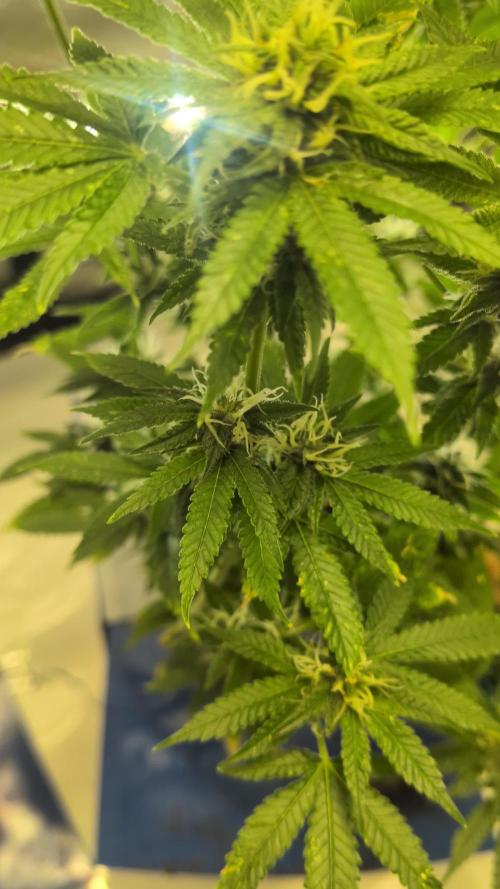
🌿 Devil Cookie - Bouncing Back and Frosting Up! ❄️🍪
Let's go! Welcome to the new week. Hopefully, she is fully recovering from the pest stress and the heavy defoliation from last week. Judging by how these buds are looking, I think it's safe to say she is on the mend and pushing hard toward the finish line! ❤️?
📈 The Details / Progress Report:
Resilience & Recovery: She took that massive haircut like an absolute champ. With all the old, damaged foliage out of the way, the airflow in the tent is perfect, and she is putting 100% of her energy right into those bud sites.
Trichome Explosion: Just look at those macro shots! The sugar leaves and calyxes are completely buried in a thick, sticky layer of frost. The resin production is going crazy as she matures. ✨
Maturing Pistils: We are seeing a lot of those white hairs starting to turn a beautiful, fiery orange and curl inward. The colas are getting dense, swelling up perfectly, and really starting to look like finished flowers. 🔥
Clean Canopy: The lollipopping from last week is doing its job beautifully. The lower section is clean, the baby head is still holding down the soil, and the top canopy is totally optimized for light penetration. 👶💡
💧 Next Steps:
The thrips seem to be a thing of the past, and she is recovering beautifully. The main goal right now is to keep the environment perfectly stable and start keeping a really close eye on those trichomes. We are getting into the late stages of flower, so it's all about coasting, letting her swell up even more, and waiting for that perfect harvest window.
Let's keep it growing! 🌱💨
Likes
2
Share

@LST420
Follow
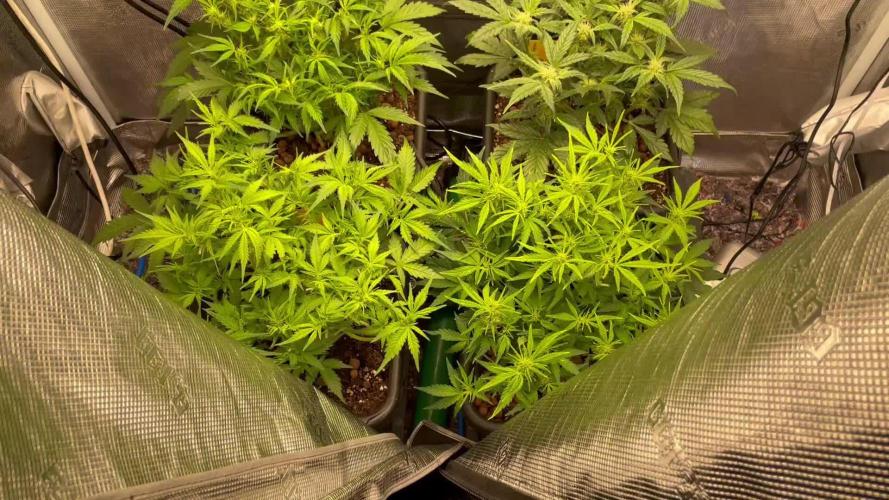
Week 5 The OG Kush and the Night Queen in the front are having some nutrient deficiencies (probably mostly Nitrogen and likely some Calcium and Magnesium) so I've been giving those some extra Orgatrex and CalMag.
Also 'oops I did it again', this time while trying to bend it I partially snapped the main stem of the Mimosa x OP and I immediately fixed it with a few small strips of duct tape. 🍀🙏
Btw the broken and taped stem of the OG Kush from week 3 (last two photos) appears to have recovered nicely.



Likes
17
Share


@420DeepGrow
Follow
📆 Semana 5:
La Blue Zushi está entrando en su mejor momento. Los cogollos empiezan a formar unas colas gordas y compactas, y el aroma ya se vuelve más complejo: mezcla de frutas dulces y un punto funky muy interesante.
Los Adlite de Mars Hydro están sacándole todo el potencial, con una luz muy homogénea que hace que incluso las puntas más alejadas estén produciendo resina. Se nota cómo mejora la estructura y la densidad de las flores bajo estos paneles, ¡una pasada!
La nutrición sigue de la mano de XpertNutrients, y el resultado salta a la vista: hojas bien verdes, tallos fuertes y sin signos de bloqueo o deficiencias. La planta se mantiene sana y empuja con fuerza hacia el final.
Ahora toca seguir mimándola para que termine de explotar en las próximas semanas.

Likes
15
Share


@Solarcradle
Follow
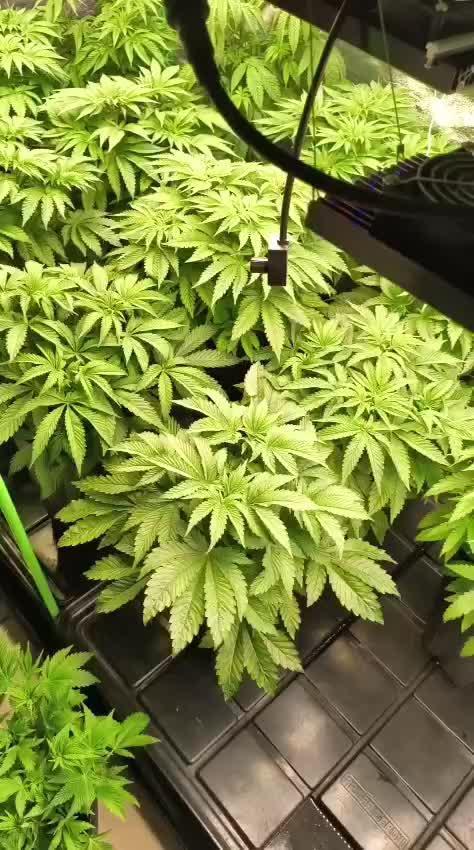
Dec 12 @1am: Her light schedule was been bumped down to 14 hrs. I have a photoperiod in the tent that needs a few days for harvest. Haze is now under the 1000W Phlizon/245W power draw lighting.
Dec 12 @2:30am: New pot has been amended with approximately 65% fresh coco coir, about 20% worm castings,15% perlite and 17 tablespoons/51 teaspoons (12.75 teaspoons per gallon) in a 4 gallon pot. The pot will be thoroughly rinsed to rid salts from the old coco coir used in the pot.
Dec 12 @6pm: Approximately 1" tall
Dec 12: I think my dog got ahold of one of her cotyledons, unless it just disappeared. :)
Dec 14 @2am: Transplanted to the newly amended pot. I watered her and the fresh coco coir mix she was transplanted into.
Dec 14 @11:30pm: Her lighting went from 14 hrs to 24 with both veg and bloom lights on. (Photoperiod in tent harvested)



Likes
8
Share


@CanabisLoverHobbyGrower
Follow
Well into flower, not stretched much at all quite small but will be a couple of big colas because of topping,.. won't be topping next time I don't think, will stick to lst and tie down method,... looking good tho, roll on next week 👌
Likes
1
Share

@FlowerOasis420
Follow
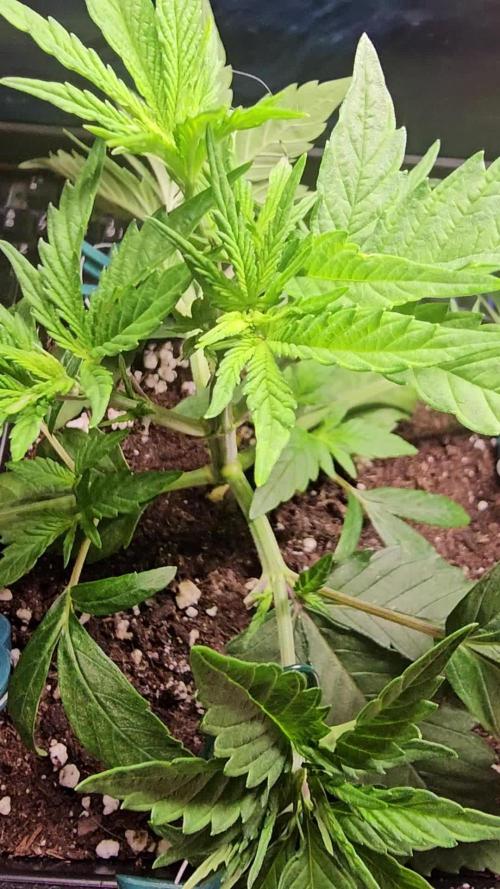
Sie haben noch einen kleinen Schnitt bekommen. Unteren Triebe wurden entfernt und die Haupttriebe sortiert. Jetzt haben sie noch Tage und dann geht's auch schon in die Blüte.
Likes
71
Share


@Krisis
Follow
05/22/24. Going into week 3 flower
Everything seems to be going pretty good so far. Finally got a bit of stretch and definitely have some bud formation.
As things are still so freaking dark with these ladies leaves I am still not giving a feeding. Have given them water with silica and calmag when things seem dry.
Plant 1 seems much more leafy and with many more bud sites than plant 2. Most of plant 2’s growth has not made it up to the trellis sadly.
I will be doing some cleaning up of the stuff underneath the trellis and some selective defoliation today or tomorrow.
Lights now about 75% at about 20 inches up. Temperature has been 73-82 with around 50% humidity.
I think I covered everything for now. Thanks for lookin

Likes
45
Share


@HinduGod
Follow
THE SUN GOD HAS BEEN VERY VERY BAD!!!😡 ONLY 2 DAYS OF SUN DURING DIS WEEK LONG STRETCH. TOOK A COUPLE OF THE BIG FAN LEAVES OFF ON DAY 46. DID SOME LST ON A COUPLE OF LOWER BRANCHES ON DAY 48.
PLEASE COME AGAIN!!!!!!
Likes
10
Share


@MG2009
Follow
11/16/2020
She's growing, roots are nice and healthy, so time for flowering.
Switching to 11-14 and flower dose will start today. Full bucket switch to
Grow, Micro, Bloom flower week one
Raised level of water to 16 liters just touching mesh pot, she used about 1/2 her water (6liters)
And do not want her to go hungry lol


Likes
5
Share


@CuriosityWebster
Follow
Got the tent set up to try to dry
Going to keep it as close to 60 humidity and 60°F
Monitor moisture level using a moisture meter, and will pull when