


Likes
12
Share


@CheeRz
Follow
The buds slowly gettin' bigger and some trichomes started to gettin' milky but I can't see any amber ones.


Likes
18
Share


@DeepRootsGrowTrees
Follow
PURPLE KUSH / KANNABIA SEEDS
WEEK #8 OVERALL
WEEK #7 VEG
This week she was transplanted to a 1 gallon cloth pot all is going well she didn't have any issues with transplant or the training she has been given!! Stay Growing!!
Thank you for stopping by and taking a look it's much appreciated!!
Thank you KANNABIA!!!
FOOP. COM
BUDTRAINER.COM
KANNABIA.COM PURPLE KUSH

Likes
15
Share


@crystal_garden_0
Follow
Great week. No problems. Plants ready to harvest. Flushing is done plants smelling incredible Orange mango fruits going to be delicious forsure. Dense buds one is big. Thanks everyone

Likes
2
Share

@Amboss
Follow
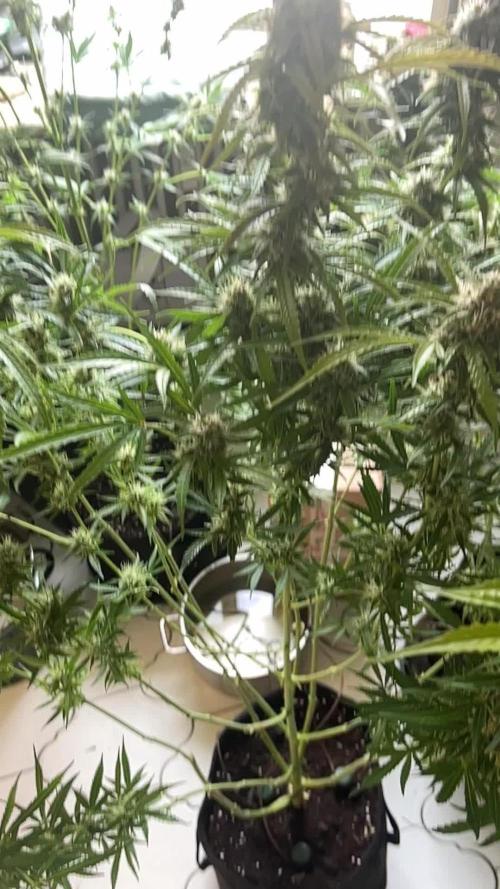
Shape Day … take many Leafs off
Think 2 Weekend maybe
I made a big mistake with her
Her neighbour plant is 30cm bigger and Gas Late veggie period. I give the bigger plant water on the leafs and it fall ob the Main Cola of the smaller plant. Budrod. I Must cut 1 Cola off

Likes
10
Share


@Prop207
Follow
15 cm
15 sb
30 PBPB
K2 clones going into flower next week. K3 clones clipped 3-13-21.
Last run for Khalifa
Likes
4
Share


@m0use
Follow
***Sponsored Grow*** = Medic || https://medicgrow.com || Grow = ***Sponsored Grow***
Ok, so bigger news this week, I got rid of one of the plants in the tent as it was an auto vs fast flower :/ and I performed a bunch of LST and some Defoliation to all the plants. This plant was quite bushy and I had to get rid of a lot of lower growth, leaves and mini shoots, gave it a pretty aggressive stripping and half ass lollipoping. This will be the last week they are in Veg and switching to flower cycle next week with a 12/12 photoperiod. I was going to try a 13/11 but I wanted to test out the automatic light functions on the Medic Grows Minisun-2, So this will be relieved next week.
Been having issues with PH in the medium again and some nutrient uptake. I am thinking I will switch to another brand I have to use up, trip tonic from my last grow on the balcony. Its a bit more complex and not as easy as mix into water and feed but I think its going to help me solve a lot of the issues I am getting. Given this update is a few days late some of these pics are not from today. the clones in the photos above are from the beginning of the week when I potted them up. They have not done well at all and may not make it. can only hope for the next few weeks they pull through.
Till next week.
***Sponsored Grow***
Official Website:
https://medicgrow.com/
+
https://seedstockers.com/
Facebook:
https://www.facebook.com/medicgrowled
+
https://www.facebook.com/SeedstockersBarcelona/
Twitter:
https://twitter.com/medicgrow
+
https://twitter.com/seedstockersb
Instagram:
https://www.instagram.com/medicgrow420/
+
https://www.instagram.com/seedstockers_seeds
YouTube:
https://www.youtube.com/channel/UCNmiY4F9z94u-8eGj7R1CSQ
+
https://www.youtube.com/channel/UC4GiFYrIWeNtwtXjcivCmfw
Growdiaries:
https://growdiaries.com/grower/medicgrowled
https://growdiaries.com/grow-lights/medic-grow
+
https://growdiaries.com/grower/seedstockersofficial
https://growdiaries.com/seedbank/seedstockers

Likes
8
Share


@jaydee702
Follow
bubba cheesecake
tiny pot grow is doing very well its growing fast and thick still no sign of gender yet after 2 weeks in 12/12 tent should see what gender soon im sure its female because its was a femenized seed planted.

Likes
5
Share


@Grow_for_Happiness
Follow
So at start of week i raised the three smaller plants and evened out the canopy. That lasted maybe two days and then back right took off and is again 6-8" taller than any other plant hahah. Was able to raise the reservoir and the water lines to maintain flow to all the pots. Rest of week was hands off as I had family in town for a few days so just kept the reservoir filled. Last day of the week gave the girls a decent defoliation and adjusted the ties, attempting to fill every spot in the tent. Now there is a slight space in the center, but it will fill in as the girls grow.
Starting to get a little worried with how big these girls are getting. Already they are 8-10" bigger than the Night Howler autos I grew last year, and those were my biggest ever with two plants ending ABOVE the lights!! Hope the big one stops soon, but as a precaution I have removed the filter and placed on end of exhaust, gaining another 8" of room to raise the light. Driver also outside tent this run, so will gain 2" over previous ones.
Plants are needing a bit more defoliation than normal, with their enormous leaves they fill the tent very quickly! Before defoliation was full shade under canopy, now getting light/air through.
Let's see what happens this week, I'm expecting some decent growth from left two plants, hoping to get them off the Milk crates soon and nice to have an even canopy for more consistent bud quality and whatnot.
Lights 80% 8-18" averaging 700-750 umol/s
4" Intake 50% + 1 passive vent open
6" Exhaust 40%
Upper Oscillating fan 30%
Lower oscillating fan 50%


Likes
5
Share


@Foxtrotoscar
Follow
Small harvest but was due to the over feed of CAL-MAG I had quite early on but still pulled through and flowered almost and OZ. Really nice Sativa from Barneys Farm.
Likes
8
Share

@Stacy_smokez
Follow
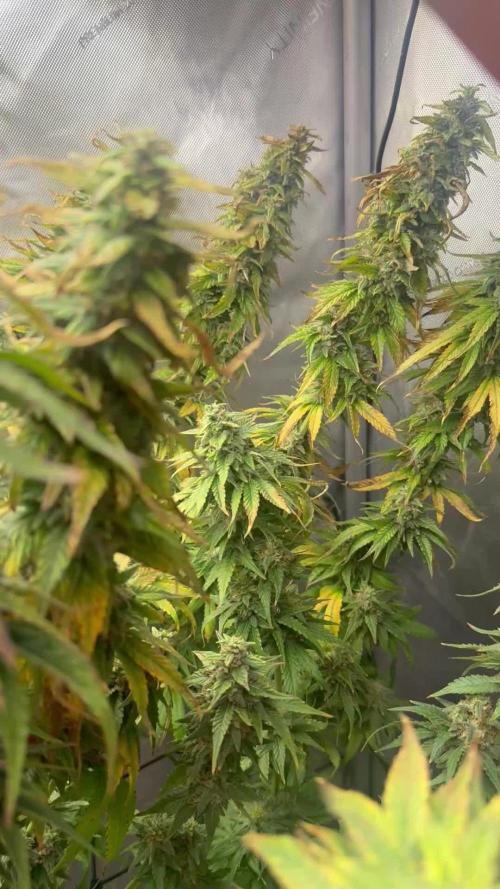
I light broke but got it replaced faced a little damage nothing to major. She is recovering overall she is looking well and smelling amazing . Need to defoliate the damaged leaves some more
Likes
78
Share


@1Right_Angle
Follow
May 12th,
- Starting the 5th week above ground. She looks strong and healthy
- building a Tea this evening for Dinner tomorrow
- transplant to 3 gal pot tonight. Root pics
May 14th
- fed this morning. Big changes again for this lass. Pics tonight
- foliar has been on Odd days…
-transplanted to a 3 gallon pot finally after being forced into a 2gal bcuz of no space. That tight. With 2 males gone; welcome to 3 gal Purple Dawn.
16th
- growing and looking stronger day after day
Processing
Likes
43
Share


@SleepyWillow
Follow
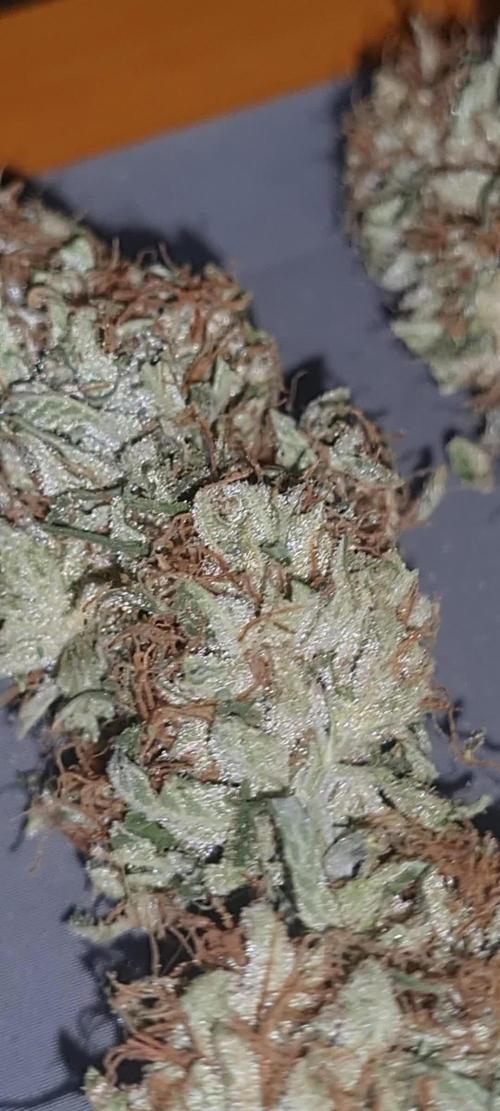
Smells amazing! I really can't say that enough! Love the way she smells. She is coming along nicely. Doing alot more defol than my first grow hoping to see a difference. Just love them Indica looks 😋


Likes
19
Share


@emeraldlabs
Follow
The struggle is real as we continue limping to the finish line... A few more feedings this week and then on to the flush. Struggles aside, she smells great and is packing on.
Photos/video taken 119 days after breaking soil, day 42 of flower.

Likes
7
Share


@Bingbings_garden
Follow
Dry condition
20°
40-45% RH
After a 14 day hang, she gifted a 72g + 20g worth of trim. My largest yield for one plant. Small buds but there are lots of them. Very good smoke from the early test before throwing the into the jar.
Likes
4
Share


@GODAXE
Follow
27.08.2024
D48 since cutting,
lady starting to bush like their mother, as i did nt have place for 8 massive bush in the tent i proceed to some pruning and set some bud clip.
overall look
GBC #1
16 inch, flowering
GBC #2
16 inch, flowering
GBC #3
16 inch , still in veg, 😰
GBC #4
18 inch, full bud mod 😍
GBC #5
18 inch , full bud mod 😍
GBC #6
19 inch, flowering
GBC #7
20 inch, start flowering👍
GBC #8
18 inch, flowering
i will not weekly uptade, but keep you tuned

Likes
15
Share


@AllieO
Follow
1/12: impatiently waiting for lemon auto to finish up. Still not sure what the northern lights is trying to do, but..the little buds are slowly growing. S l o w l y...
1/14: things are getting out of hand in here. Northern lights is bushy AF again but the budlets appear to be increasing in size. Lemon is getting closer every day. Looks like I've got milky trichomes and the pistils are darkening. Still a bit early, but I'd be lying if I wasn't anxious for the space..
1/15: I've accepted that I have at least a week ish left on Lemon auto,but she's getting there! I did some rather risky defoliation on northern lights and holy shit, she's got potential. I'm hoping she's just a slow grower and those buds will really fatten up! Perhaps lemon is just a really fast growing plant? I've also decided that since space is limited, my best bet is to probably rotate the plants every other day to allow all bid sites an opportunity for direct light. I'm reigning myself in. Once lemon auto is harvested I need to NOT immediately plant another. I've got some mephosito seeds I want to get going, but I've learned my lesson. This tent fits two 5 gallon mature plants... Uncomfortably. Three is too many 😂
1/17: wondering if northern lights has is it her to fatten up. Gave her a good flush &feed. Popcorn buds or not, I'm invested (#forscience). Lemon auto is still finishing up. Can't get good enough pics with phone to see trichomes. Clearly, I have a minimum of a week left, but I got a digital microscope so I can keep track! Should be here for next update.
Processing
Likes
10
Share


@GIJOSE
Follow
Hello everybody! Hope everyone is doing well with all its going on in the world. Today's week 5 of my clones. They all seem to be doing very well except one leaves her kind of showing signs of lockout. All the others are rooting very well there's a couple of more the roots are coming up the bottom of a cup. My next weak I'll go ahead and up pot all the plants into .5 gal pots. Until next time Cheers! -G.I.JOSE


