




Likes
53
Share


@MistaOC
Follow
**************
17.03. Day 50
Flower Day 10
**************
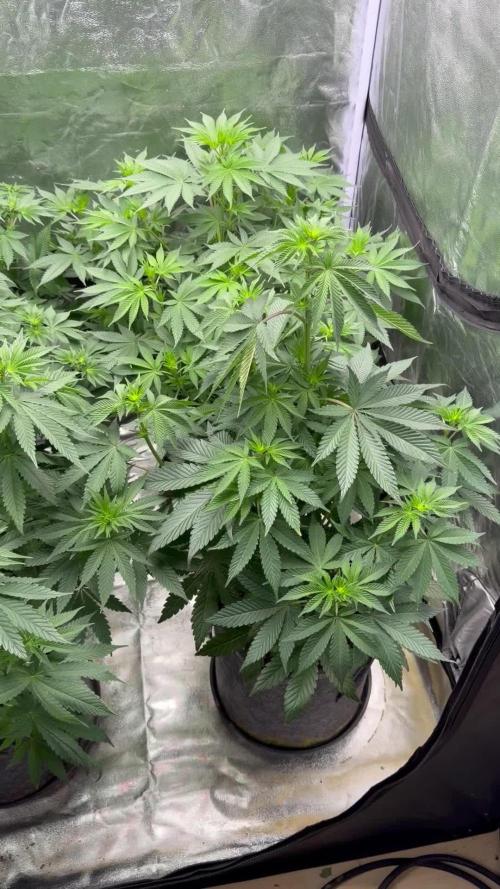
Now I've stretched the scrog net, which has stretched the plants out nicely. They look incredibly healthy. Flowering is starting.
// RO Water // TEMP 20C // PH 6,4 // CalMag 2ml // 0,1ml Regulator // 0,6 ph- //
**************
20.03. Day 53
Flower Day 13
**************
Flowering is in full swing. Today I added 3g/L of biobloom.
// RO Water // TEMP 20C // PH 6,4 // CalMag 2ml // 0,1ml Regulator // 0,6 ph- //
**************
23.03. Day 56
Flower Day 16
**************
// RO Water // TEMP 20C // PH 6,4 // CalMag 2ml // 0,1ml Regulator // 0,6 ph- //

Likes
Comments
Share


Likes
13
Share


@Ukulele47
Follow
25th May - just updated pics , and to start of week 11 , it smells nice and looks alright think I will be pleased with the outcome ✌️

Likes
28
Share


@AlpAge_Cino
Follow
2024/01/13 : not much new here... the height is about 8 cm now, very slow grow. Temps were too low so I added a flat 250W radiant heater and with DLI set to 20 now, it's about 24°C by day and 23°C by night : much better for vegetation! I water every 2 or 3 days with 1 L (about 300 mL runoff) and alternate elycitor/molasses.
Anyway, the seedling is now a plant so I made a quick video to celebrate!
2024/01/16 : it seems blueberry liked the hotter temp, buying this flat heater was best thing i've done this run... The height is 10 cm now and 4th node is here. I'm waiting for the 5th one to top it. I checked runoff pH and found 6.78, hoping it's OK.


Likes
12
Share


@2Stones1Bird
Follow
Checkout my Instagram @smallbudz to see the Small budget grow setup for indoor use, low watt, low heat, low noise, step by step.
17/02/2020 - Fed her 1.5l of 6.4PH water with 0,2ml of each: Cal Mag (Atami), Grow, Bloom and Max, and 0,5ml of each: Heaven, Alga-mic and Vera, noticed some run off, I use about 1/4 of the nutrient dosage on the chart, to achieve about 100/150PPM (500 scale).
She's starting to smell like smelly feet.
22/02/2020 - Last feed, gave her 1.5l of 6.5PH water with 0,2ml of each: Cal Mag (Atami), Grow, Bloom and Max, and 0,5ml of each: Heaven, Alga-mic and Vera, noticed some run off, I use about 1/4 of the nutrient dosage on the chart, to achieve about 100/150PPM (500 scale).


Likes
31
Share


@AsNoriu
Follow
Day 36. Girl is a stretcher, will have to do something, but most damage is behind and I think next watering I'll give her food again.
Couple leaves taken off, couple branches bended , thinking to put support after main stretch will be over.
Happy Growing !!!

Likes
3
Share


Likes
21
Share


@Fullmeltalchemist
Follow
Alright I've updated this postmortem and cure just to give an idea of what I was up to during the dry and cure weeks. This grow was a ton of work and I'm very please with the results. I learned a ton about soil and environment control and really feel like I'm gaining confidence and coming into my own as a cultivator.
I've been playing a lot with ice water hash and rosin and have set some neat goals for the future like hunting ice water hash cultivars, going perpetual and expanding the amount of canopy I can work with by building a network of remote-operated satellite flower tents in friends' and family's abodes . I'm not sure I'll go through all this effort of documentation here again, but please follow along on my instagram, stay in touch and chill out with me sometime @Fullmeltalchemist.00
All in all, I was running 1000w of quantum board across three tents and pulled just over 1100 grams, which was a big goal of mine.
Thanks for all the advice and love growmies! And thanks growdiaries for the platform. It's been coo.


Likes
6
Share


@HIAZ_urbanbudfarmer
Follow
Everything going well buds continue to develop & put on size, starting to get frosty with trichomes & buds are sticky to touch & smell a bit aswell
Likes
127
Share


@DreamIT
Follow
🎃👹👽MONSTERCROPPING RED MANDARINE 👽👹🎃
____________________________________________________________________________________________
💀 5.2 ...
💀 6.2 ...
💀 7.2 All regular, Today we add the latest product from hesi to fertilization and wait for the last few weeks, yeah !!!
💀 8.2
💀 9.2
💀 10.2 I love this plant 😍
💀 11.2
_______________________________________________________________________________________________________
📜👀 A look at the details of what I'm growing 👀📜
🍊💚 Red Mandarine F1 🍊💚 by 🌱🍭 Sweet Seeds 🍭🌱
📋 Details
⚧ Gender
▪️ Feminised
➰ Genes
▪️ 55% Indica / 45% Sativa
🎄 Genetics
▪️ Red Poison Auto (SWS39) хCalifornia Orange x Skunk hybrid)
🚜Harvest
▪️ 400 - 500 g / m²
🌷Flowering
▪️ 49 - 63 days
✨THC
▪️ 16%
✅CBD
▪️ 0,2%
🏡Room Type
▪️ Indoor
🌄Room Type
▪️ Outdoor
🕋Room Type
▪️ N/D
🎂Release Year
▪️ 2019
__________________________________________________________________________
👀📷🥇 Follow the best photos on instagram 🥇📷👀
https://www.instagram.com/dreamit420/
🔻🔻🔻Leave a comment with your opinions if you pass by here🔻🔻🔻
🤟🤗💚Thanks and Enjoy growth 💚🤗🤟

Likes
43
Share


@Coopmc
Follow
Good for sure
Might be 7 week flower to finish such great indoor plants!!
The shortest FruitWalker I have found with s Short SVF !!
Processing
Likes
7
Share


@420keef
Follow
Ran into some problems with this one but it turned out pretty decent, it already smells fire i can't wait to smoke it, i'll keep you guys posted when i get a taste!


Likes
30
Share


@SubliminalSociety
Follow
Week 12: Pineapple Poison - Flower Power & A Towering Princess Emerges!
Yo growmies!
Flowering watch is officially over, and guess what? The Pineapple Poison is throwing a bud party! We spotted the first signs last week - tiny white hairs like a shy hello from the flowering fairies. This week, those hairs are getting bolder, multiplying like rabbits in a magic hat! Flower power, activate!
The excitement doesn't stop there. This girl is on a vertical vacation, stretching another 17cm to a whopping 155cm! That's right, she's practically taller than my 12-year-old at this point!
Speaking of growth spurts, we've been blessed with a sunshine and rain tag team this week, and the Pineapple Poison is loving it. New shoots and leaves are popping up like popcorn kernels, which is why I did a little more mainlining magic. Gotta keep those popcorn nugs at bay and focus on the main event: frost-covered colas the size of pineapples! (Okay, maybe not that big, but you get the picture.)
Now, the burning question: support systems. Anyone got tips on how to keep this towering beauty from toppling over? Comments are open, growmies, because this girl might need a trellis or some kind of ganja-gardening Eiffel Tower to support her future weight!
Stay tuned for next week's update, where we'll see how the Pineapple Poison's flowers develop and maybe even get a hint of that legendary pineapple aroma.
High fives all around!

Likes
8
Share


@Hoso_sake1
Follow
Grateful Seeds here we go! Preparing my compost tea from LURPE for the first time.
CherryBerryBanana and GoldenPussy showing some serious LOVE 😍 enjoying the mykos.

Likes
37
Share


@Aleks555
Follow
🏆 Eternity Grow Cup 2025 with Plagron and Zamnesia 🏆
Zamnesia – Runtz
93 days from seed | 62 days in flower
The time has come — harvest day is here, and our incredible journey with this beautiful Runtz from Zamnesia has come to a fragrant, frosty end. For the past two weeks, she’s been enjoying pure, clean water as we prepared her for the finish line. Her leaves gently faded to gold, signaling her maturity, while the trichomes turned from cloudy to amber — with about 15% showing that deep golden hue we were waiting for.
She grew strong and vibrant thanks to the outstanding genetics from Zamnesia Seeds, and we’re beyond grateful for this opportunity to cultivate such a top-tier strain. Her structure, aroma, and resin production were truly impressive.
A massive thank you to Plagron as well — your nutrients have once again proven to be the perfect fuel for our grow. Easy to use, reliable, and effective — we couldn’t ask for better support for our plant’s development.
Stay tuned — soon we’ll share the dry weight and a full smoke report. But for now, it’s time to celebrate the harvest!


Likes
9
Share

@HIAZ_urbanbudfarmer
Follow
Week 6 of flower all is going well, buds are very frosty & sticky & continue to fill out has a hint of mango smell , sweet smelling,