Likes
24
Share
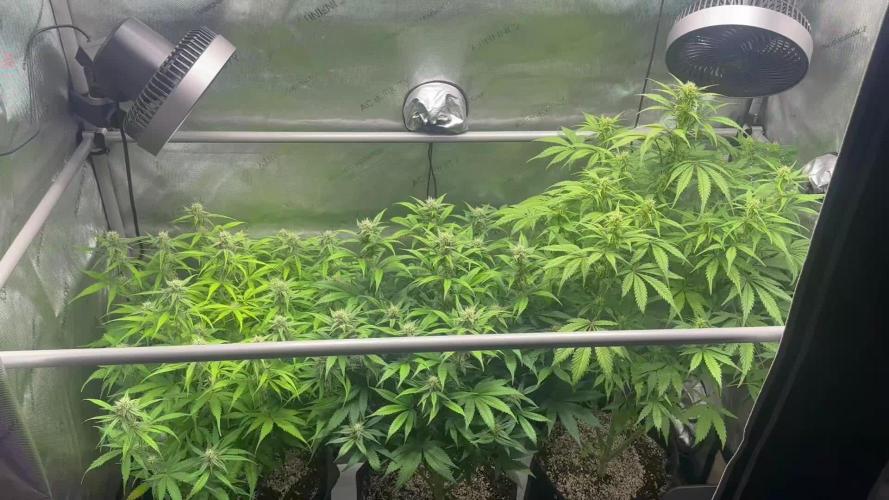
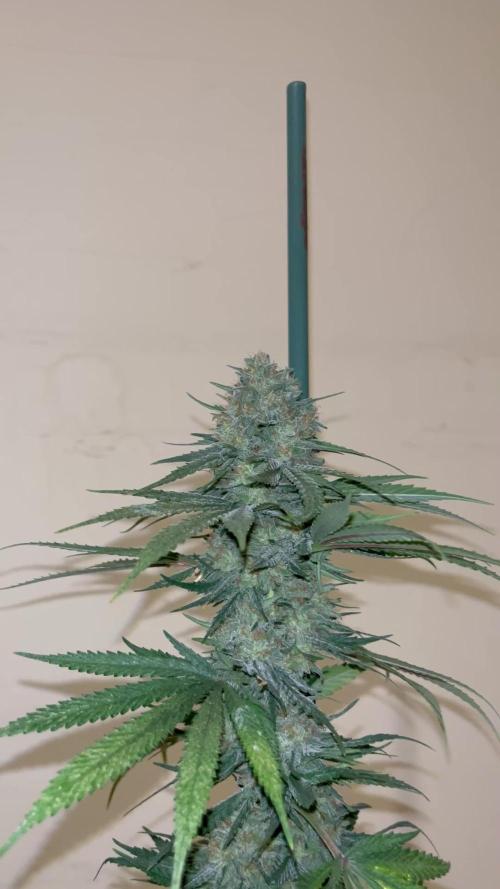
What a week. They turned purple and I thought they were stressed.... But I had smoothly forgotten that purple punch was in it.😅🤣Also, thanks to hesi Bv. I can show you how good their products are. Keep following me on growdiaries insta and youtube. Green greetings CaptenSmokey haha 🙏🍀
Likes
11
Share
15.08 Second week going great. The mimosa pheno I hunted is a true monster. Thick stem already nearly as big as the 1.5 inch rockwool cube. Easily over 1 m high. Stacking beautifully. I have a new setup for the 5x5 tent. Vevor EC fan 150mm. With temp and humidity controller paired with prima clima 900m3h carbocone filter which is huge. Also new Mars hydro fc e 8000 light with Bluetooth controller. So far very cool. We will see how it performs. Since I have co2 boosted we will have it cranking at max when the girls hit the bulk phase.
Likes
31
Share
@Ghost2022
Follow
Done a load of defoliation this week. Buds are looking strong. Im thinking just another week or 2 before we harvest.
Likes
209
Share
@BioBuds
Follow
They are going slow but steady. Holding back on watering to help fight the gnats. They were with too many last week. Some yellow points because of an 'on the limit' foliar feed. Nothing to worry about. Still very lush greens. I'm thinking the main reason for their slower growth, is the fan that is on high. My mission from the start s to get thick stalks and branches, to facilitate larger buds. Also, I'm pushing the SP 3000 to its max for the age of my plants, they don't have to reach for the light, resulting in shorter, bushier plants. I don't mind, I think the flowering stretch will make up for that and fill the tent. Still very happy with the SP-3000 from Mars Hydro, a much more constant and manageable climate in the tent, a dream to work with. I made a thank you video for @MarsHydroLED, of course, to also show off my music. I'm thinking one or two more weeks before resetting the light schedule for flowering. I'm already late and if another week will deliver bigger and more buds, I will give them what they need. For those living in Europe, wanting to try super soil, see my recipe in the images. Thank you for following and your likes and support! It really keeps me motivated. Big Hug Bud
Processing
Likes
27
Share
Week 8 begins, the final feed! Mandarin dreams 1&2 are both looking good, MD2 I find is the bigger of the two and smells like a chemical cleaner with a lime zest. MD1 is the only one of these two plants with any purple in her leafs. Thanks for stopping by, tune in next week for the flush 👽🌳🔥
Processing
Likes
21
Share
Day 55 - 18/11/19 i still think another 1-2 weeks for this one, getting a jewelers loupe for the beginning of week 9 so i can tell exactly where were at in terms of harvest :) anyone got any thoughts on this little plant? have a look at the photos and videos and let me know in the comments below :) oh and i finally nailed what this strains smell is - tropical hubba bubba gum with cheese :'D Day 59 - 22/11/19 Got my jewelers loupe 2 days ago and ive been having a look at them. its pretty hard to see for a newbie grower. ive looked at harvest guides online and seen pictures of clear, cloudy and amber trichomes. mine look mostly cloudy (60%) and slightly glassy (40%) with barely any ambers. i may be wrong but the reason i think its cloudy is that it looks white against the leaves instead of see through or like glass. so going on this for my first trichome inspection im gonna harvest in the middle of next week. Smell is getting strong enough to stink out a room, still that tropical cheese smell, although its just so pungent it lingers in the rooms after bringing it out of the tent to inspect it. smell isnt a problem if you put it back in the tent and spray some air freshener stuff in the next room. the carbon filter is doing its job exactly as described along with the fan. The fan leaves started to get yellow patches and sugar leaves starting to curl. and a friend thinks its nearing the end of its life. I flushed yesterday and will flush again today to drain out any excess salts and nutes. Thanks for following along. im excited for week 9! Happy Growing!
Likes
2
Share
Remember that, however you are played, or by whom, your soul is in your keeping alone. Even though those who presume to play you be kings or men of power, when you stand before God, you cannot say, 'But I was told by others to do thus,' or that virtue was not convenient at the time. This will not suffice. Remember that. Day:18 84°F and 65% RH (VPD) for the vegetative stage. Approximately 1.15kPa(assuming leaf temperature is about 2°F cooler than the air), which falls right into the ideal vegetative sweet spot (0.8kPa to 1.2kPa). At 1.15kPa, plants can draw water and nutrients efficiently without risking stress or wilting. It keeps the leaf pores (stomata) open, allowing for ideal carbon dioxide intake and maximizing vegetative growth. VPD is determined by the leaf's temperature, not just the ambient air. Because leaves usually run 1° to 3°F cooler than room air under bright grow lights, my actual VPD will be slightly lower, closer to the 1.0kPa mark. As she transitions from vegetative growth to flowering, one can gradually lower the humidity (to around 45–60%) and drop temperatures slightly to prevent disease from settling inside dense buds when they appear. Night:6 At 70°F and 60% relative humidity, Vapor Pressure Deficit (VPD) is 0.86 kPa. This is right on the cusp of whats optimal for the vegetative stage. During the nighttime, plants generally close their stomata and undergo cellular respiration rather than photosynthesis. Transpiration slows to a near stop, making VPD less critical at night than during the day. However, maintaining a nighttime VPD between 0.8 and 1.0 kPa is highly beneficial in that it ensures the air is dry enough to prevent powdery mildew or bud rot, but moist enough to keep the plant from undergoing unnecessary stress. This range keeps the environment comfortable for cellular processes and prevents large atmospheric swings. Keeping it all flowing. (Not pushing them yet, these are photoperiods) The optimal soil (root zone) temperature for cellular root respiration and nutrient uptake in cannabis is between 68F & 72F This narrow range balances biological energy production (cellular respiration) with the dissolved oxygen levels in the soil, maximizing plant growth and health. Warmer soils hold significantly less dissolved oxygen. When soil temperature exceeds 74F oxygen depletion occurs, inhibiting cellular respiration almost entirely, At 68-72F root cells generate optimal adenosine triphosphate (ATP) via respiration to power root-tip elongation and the active transport of water and nutrients. Too Hot (Above 78F) Root respiration increases, demanding more oxygen, while the water's oxygen-carrying capacity drops. This creates a prime environment for anaerobic pathogens and Pythium (root rot). Too Cold (Below 60F) Root metabolism and cellular respiration slow to a crawl. This severely impairs nutrient and water absorption, leading to yellowing, wilting, and phosphorus deficiencies. A lot depends on whether it's automatic or photoperiod; with photoperiod, there is not as much of a need to push "hard" as the real countdown only begins once the flower is initiated. Automatics, on the other hand, the chronological "clock" begins ticking the moment the seed germinates. It is of critical importance that the seedling growth gets off to the races, understanding that early growth is like compound interest, which will pay off come harvest. This reality is why getting autoflowers "off to the races" early on yields such exponential benefits. The "compound interest" is directly related to the surface area of the leaves. Larger, faster-growing seedlings process more light and build bigger root networks early on, which translates into an explosion of vertical and lateral growth during their short vegetative window. The margins for error are so thin with autoflowers; this early-stage momentum depends on several critical practices. Seedlings exposed to increased atmospheric CO2 levels early in life will develop at an increased rate. To effectively "extend" or optimize the capacity of Photosystem II (PSII) for increased photosynthetic efficiency. In standard oxygenic photosynthesis, Photosystem II (PSII) is naturally limited to the red-light spectrum, peaking at 680nm. Extending its light-harvesting capacity past 700nm into the far-red region requires bypassing the natural limits of standard chlorophyll a. Adding 730 nm (far-red) LEDs alongside standard red/blue lights has been shown to increase canopy photosynthesis by 20–30% in several crops by acting synergistically with shorter wavelengths. However, the limitation is that excessive, pure IR/Far-red light (without accompanying red light) can trigger the "shade avoidance response," causing plants to grow tall, weak, and spindly rather than robust. Utilizing infrared light (specifically the 700-750 nm far-red range) is a viable method to boost photosynthetic efficiency. It acts as a bridge to allow PSII to utilize a broader spectrum of light, breaking the traditional 700 nm barrier. UVR8-mediated signaling (often in conjunction with CRY proteins) triggers protective mechanisms that maintain the stability of the photosynthetic apparatus (including LHCII and reaction center proteins), thus ensuring that the efficiency of Photosystem II remains higher in UV-B-exposed plants compared to plants lacking this receptor. ΦPSII indictates the rate of electron transfer from water to plastoquinone, which drives the production of ATP and NADPH. There is a close link between ΦPSII and the true rate of CO2 fixation (Φ*co2). ETR stands for Electron Transport Rate. It measures the speed at which electrons are moved through the thylakoid membranes in a plant's chloroplasts during the light-dependent reactions of photosynthesis. Infrared light (particularly Near-Infrared or NIR) improves cellular energy by interacting directly with the electron transport chain (ETC) in mitochondria. This process boosts adenosine triphosphate production, which acts as a metabolic coefficient multiplier by accelerating enzyme activity dramatically. Extend then multiply. Far-Red photons interact with plant photoreceptors to accelerate the plant’s biological "clock" or trigger a shade-avoidance response. Autoflowers don't use the plant's biological clock, although the IR will initiate a shade avoidance and make them stretchy. You can just add equal measures of 660nm-680nm to negate the shade avoidance effect. Replacing nights' "darkness" with a combination of IR+ and 660nm. Because autoflowers don't require a dark period to flower, many growers just blast them with light. 18/6 24/0. However, this ignores the plant's metabolic rhythms, where daytime photosynthesis (light reactions) must be perfectly balanced with nighttime carbon fixation and assimilation (Calvin cycle) to avoid bottlenecking plant development. Cellular respiration is a 24/7 process, but it can only function while the plant has the free oxidative capacity to do so. A 100% photosynthetically active leaf cannot perform cellular respiration. The viral trend of defoliation of every leaf that isn't "getting enough light" is of great detriment overall, putting 100% of the cellular respiratory "workload" and responsibility on the 0/4/6 hours of darkness in sub-optimal conditions for enzymatic activity. Photosynthesis captures nearly 100% of the initial energy as carbon, while cellular respiration is the process that unlocks 90% of that captured energy into usable ATP so the plant can use it. Respiration is considered only roughly 30% to 40% efficient. It captures enough of the potential energy in glucose to synthesize around 30 to 38 ATP molecules per glucose molecule. The remaining 60% to 70% of the energy in the sugar is not captured in ATP; instead, it naturally escapes into the environment as heat, which helps regulate plant temperature. In plants, the primary enzymes of the Electron Transport Chain (ETC) and the ATP synthase complexes are typically adapted to function optimally in warmer temperatures (roughly 77°F to 95°F, depending on the specific plant strain). As temperatures rise within this physiological range, molecular collisions increase, speeding up respiration and ATP production. The cannabis plant has a branched respiratory pathway. During heat or cold stress, plants activate Alternative Oxidase (AOX). AOX burns sugars to dissipate energy as heat rather than coupling it to ATP production. This pathway actually functions optimally at elevated temperatures to help protect the cell from the damaging build-up of Reactive Oxygen Species (ROS) during heat stress. Enzyme activity generally scales with heat; there is a strict biological limit. If canopy temperatures in a grow room exceed 104°F, the enzymes and their supporting lipid membranes lose stability. Not saying you need to go crazy, just optimize nights the same as we optimize days. Phosphorus is the driving force behind early seedling development. It acts as the "energy hub" of the plant, directly driving cell division, robust root growth, and the creation of DNA. Without an adequate, easily accessible supply early on, the plant's overall growth potential and final yield can suffer permanently.
Likes
Comments
Share
@Azo420
Follow
The speed of this phenotype is insane, we're only 5 weeks after the first 12h day and she's already getting close to harvest. The smell is super fruity, super sweet, it's like a candy and by far the best smell I've had on a plant. The buds are not that big (probably cause of the 100W lamp) but they are beautiful and super dense, the pink colors with the light green and orange pistils it just looks delicious. The trichome density is also really high, it's super sticky.
Likes
4
Share
day 42: LOTTA leaves, had to defoliate 2-3 times. they started to show their first pistils a couple days before the Ayahuascas, hope I can do a harvest before May,(the Peyotes) but it seems really tricky..unfortunately I need to leave them for a week in April. I'm pretty scared to leave them alone at the end of flowering... Day 43: do you think the leaves on 2 plants might be too dark green? Thanks! day 46: defoliating
Processing
Likes
13
Share
@Hawkbo
Follow
Pics and video were taken a few days ago been busy as shit lately so the update is a little late. I'm gunna put the video up first on all of them then go back and upload the pics so if come back if the pics arent up yet.
Likes
3
Share
Tag 34 - 03.01.2025 Es gibt keine Veränderungen. Tag 40 - 09.01.2025 Es wurde etwas enlaubt, die Pflanze wächst weiterhin sehr kompakt.
Likes
Comments
Share
I couldnt expected the buds on some of the plants to be tbis big we around 2 weeks to harvest i have a few different strains growing in the same tent and the smells are amazing
Likes
17
Share
Harvest time, both divine storm ladies did amazing under the Mars-Hydro TSW2000. Pheno 1 was an absolute monster! Huge dense buds!! Pheno 2, while the runt of the grow, also produced impressive buds. Will update in 7-10 days with weight and initial smoke report. Update - April 16 - dry weight of 47 grams on DS2 and 77 grams on DS1. Results are close to round 1 grow, very impressed with the TSW2000 light!
Processing
Likes
18
Share
Esta la pasaremos junto las 2 Runtz x Strawnana y la tiger bomb al armário grande, cuando acabemos el seguimientos de Royal Queen Seeds! Entrenaremos el Scrog por primera vez.🤙🏻
Likes
13
Share
@gr3g4l
Follow
Visto que el agua de base sale con unos valores muy altos he decido obtar por mezclar el agua de riego con agua destilada mitad/mitad. De esta forma le podré aportar mayor cantidad de nutrientes sin que los valores suban excesivamente. Por otro lado también le añadiré ácido cítrico para bajar el PH. Os presento como voy regando, es un inventillo que hace años hice y sigue dando guerra. Va muy bién para repartir el agua y relentiza el riego haciendo que el agua vaya filtrando mejor por el sustrato. El embudo lleva una malla donde se quedan los restos más grandes y así no se atasquen los abujeros. Alguno dirá que pierde agua pero no es así, el agua que cae fuera es por que no tube punteria al llenar el emudo y casi lo tiro todo fuera. No se puede hacer tres cosas a la vez, soy hombre hehehe. no podia rellenar el embudo, regar y filmar con el movil al mismo tiempo. Y a más el video está reducido a cámara rápida por lo que parece que pierda aun más rápido.
Likes
119
Share
Hello, fellow growers I thank you for having dedicated your attention to my garden and I hope that the contents are to your liking and help for your growth. The white mykoriza powder is like cocaine for my roots.... they shoot like crazy 😄😎