Likes
26
Share
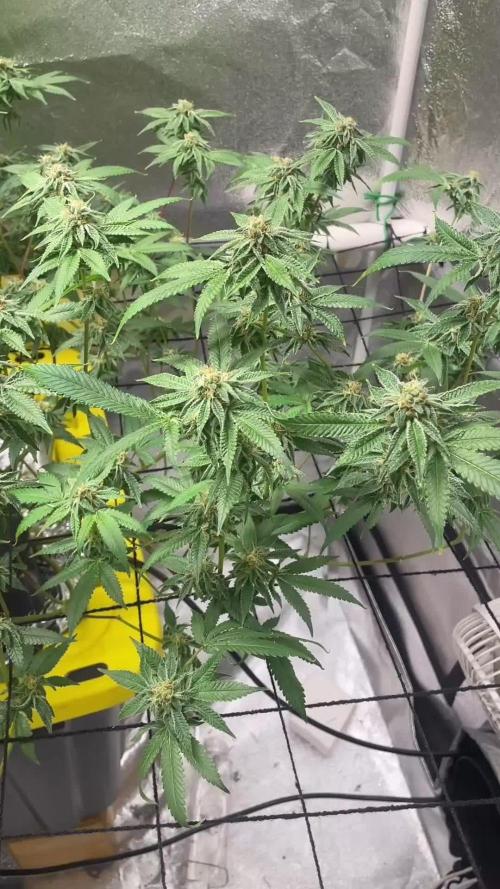
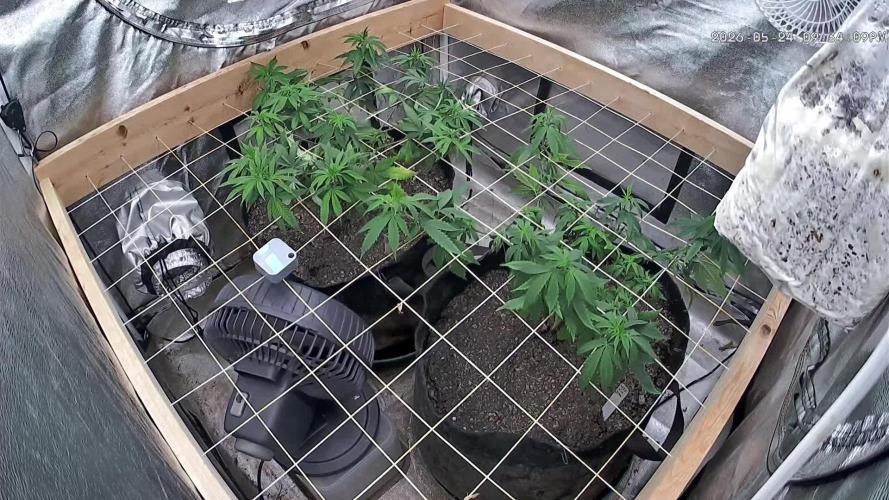
Gracias al equipo de Seedsman y XpertNutrients sin ellos esto no sería posible. 💐🍁 Bubba Cheescake: Bubba Cheesecake es un cruce de Bubba Kush anterior al 98 con Cheese Cake (Wedding Cake x Exodus Cheese). Se trata de un híbrido 70% índica con muy buenos rendimientos, alto en THC y bajo en CBD. Bubba Cheesecake prospera en interiores y exteriores. En interior se aconseja un corto periodo de crecimiento vegetativo debido a la cantidad de estiramiento que presentan las plantas. Las plantas pueden crecer hasta una altura de 250 a 350 cm. cuando se deja crecer naturalmente al aire libre. En interior, la floración dura entre 60 y 65 días, con rendimientos entre buenos y altos, de 400 a 550 gr/m2. Las plantas de exterior son capaces de producir entre 700 - 800 gr. peso seco. En las latitudes norteñas, en exterior, los productores pueden esperar cosechar a principios de octubre. Los cogollos son grandes y duros como piedras. Las plantas maduras muestran atractivos colores púrpuras y azules y brillan con una resina pegajosa que cubrirá las manos del cultivador si no tiene cuidado. El componente Wedding Cake agrega dulzura al sabor del regaliz y el aroma es terroso y musgoso. La producción de THC es muy alta con un nivel bajo de CBD. El efecto es intensamente narcótico, fuerte y duradero. 🌻🚀 Consigue aqui tus semillas: 🍣🍦🌴 Xpert Nutrients es una empresa especializada en la producción y comercialización de fertilizantes líquidos y tierras, que garantizan excelentes cosechas y un crecimiento activo para sus plantas durante todas las fases de cultivo. Consigue aqui tus Nutrientes: https://xpertnutrients.com/es/shop/ 📆 Semana 8: Se aprecian unas lindas preflores hembra, comienza a estirar de forma acelerada. Todo sigue su ritmo y ellas comen bien todos los nutrientes, comienzo a aplicar sugarshot, silica force y enzimas.
Likes
34
Share
Servus Moin! Die Pink Poochie ist fertig, sie bekommt jetzt nochmal 2 Tage Licht, dannach 2 Tage Dunkelheit. Sie wird dann zum trocknen im Zelt aufgehangen.
Likes
68
Share
hello guys it's the 3 last week approximately and i go to put the maximal dosage of my flowering fertilizer today. we can see that the buds have already swell well 😀👍
Likes
5
Share
@AxlWeed
Follow
2019-06-07 to 2019-06-13 - F1 to F6 Flipped to 12/12 on june 8th Defoliated it, and LSTed it more every day. Added scrog on F4 after applying the lollipopping method
Likes
72
Share
@BodyByVio
Follow
Day 65 : officially 1st day of flush . Changed the reservoir with fresh water and 1.2g/5 gallons of Yucca extract and 5ml/gallon of Cleanex from Botanicare . Day 68- I did some defoliate. Few more days until harvest.
Likes
21
Share
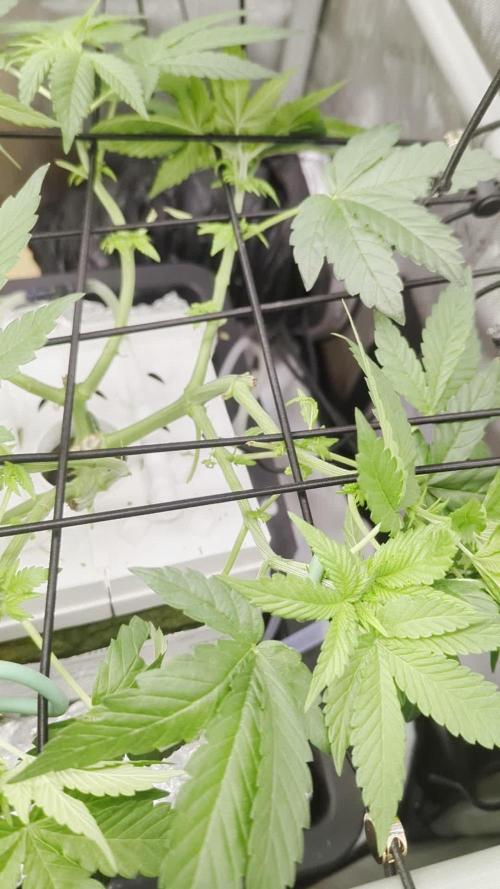
Fast Buds Run Light at 75% and will stay like this for the coming week. Scrog net will also be installed this week. 09/04/24 - 2L RO Water with Cal Mag Xtra per plant. 11/04/24 - 3L RO Water only per plant. 14/04/24 - 3L RO Water with Nutes per plant. Notes : 08/04/24 - Scrog net was installed, will continue to adjust branches this coming week. 11/04/24 - Was seeing leaves a little bit on the dark side so fed only plain water 6.5ph, next feeding will be with nutes again. Re-arranged scrog net a bit more to open up the canopy a little bit more. Overall plants looking happy and all of them have now gone into the pre-flowering stage. 14/04/24 - Plants are doing really well in the pre-flowering stage and are really streching now. One last strech befor they go into full flower.
Likes
10
Share
10-14 days into flower.. all is good so far plants are healthy happy etc changed from 400w MH to 600w hps, I expected more stretch during the first week of 12/12 but so far its minimal..
Likes
5
Share
@Grow4ever
Follow
Hier auch werden die sauren zitronigen Noten deutlich.
Likes
10
Share
Voltage, also known as electric pressure, electric tension, or (electric) potential difference, is the difference in electric potential between two points. In a static electric field, it corresponds to the work needed per unit of charge to move a test charge between the two points. In the International System of Units (SI), the derived unit for voltage is named volt. The voltage between points can be caused by the build-up of electric charge (e.g., a capacitor), and from an electromotive force (e.g., electromagnetic induction in generators, inductors, and transformers). On a macroscopic scale, a potential difference can be caused by electrochemical processes (e.g., cells and batteries), the pressure-induced piezoelectric effect, and the thermoelectric effect. Since it is the difference in electric potential, it is a physical scalar quantity. A voltmeter can be used to measure the voltage between two points in a system. Often a common reference potential such as the ground of the system is used as one of the points. A voltage can represent either a source of energy or the loss, dissipation, or storage of energy. Dropping the temps will slightly raise the humidity, air holds less % water the colder it is. Lights on 25-35rh% the same water content will spike to 50rh% + at night just by dropping the temps. At night all the juice photosynthesis has been storing up is mashed and mixed up to make all the goodies we need for bud, water is used to transport all these things everywhere, like little solvent transport devices, once a nutrient/protein has been delivered to destination the plant needs to get rid of all this excess water molecules it was using to transport. The only solution at night is to spit it back out into the air at night. During the peak of flower, this can catch a grower unaware, with a 4x4 full tent it can be a challenge to control all that moisture exhaust overnight especially if you're really pushing the limits. We live in a water world, above or below, our misconception is we live on dry land, we don't live in less watery conditions than above or below. We fit into a very narrow band of moisture that just so happens to be full of lots of air and everything else required for life. Got my first full whiff of the smell of purple lemonade, always surprises me how accurately the smell fits names, the dominant terpenes in the Purple Lemonade weed strain are carene, linalool, limonene, and myrcene. Carene gives this strain its sweet, citrus flavor and some woody notes, whereas the linalool I recognize so well from Granddaddy Purp. Myrcene has been shown to have sedative qualities while bringing musky, earthy elements to the flavor profile. Trichome production started to ramp up, and the plant that grew taller/closer to UV showed noticeably thicker coatings. The taller plant shows slight yellowing of lower leaves, and the smaller plant is green and lush but the buds are slightly less progressed, interesting. I super-cropped the main stem of the tall one just over a week ago (clean). I expected it to be the one slightly behind in development. The plant has roughly 10-15% "Total resources" that it keeps in case emergencies arise. Reserves if you will. My rationale behind breaking anything goes hand in hand with slowing things down as production is lost due to the time it takes to repair damage. I recall watching a YouTube video, where a curly hair gentleman would super crop in a manner to damage but not disrupt using a twisting method, using fingers and thumbs placing them close together one goes clockwise other counter clock this varies a lot depending on the thickness of stem but what you wait for is a tiny snap, it may take several rolls to weaken if walls are tough I found. No snapping or bending of the stem, you want just to fracture it but not puncture this way the xylem and phloem channels remain flowing,the damage is repaired almost instantly and the 10-15% is dispatched with very little repair time. Everything in the general vicinity of the stress will now grow stronger so as to prevent further similar damage. This is why I had expected the tall one to lag behind in development once I had cropped it but low and behold it worked and the tall one has slightly more developed buds. The effects of birdsong on plant life may at first glance be far-fetched. Nigh on ten years ago an article appeared in Nexus Magazine on the discovery or invention of a method of growing plants using bird sounds. Christopher Bird and Peter Tompkins describe the development of Dan Carlson’s Sonic Bloom in their book The Secret Life of Plants. Many others have, it seems, recognized the role of birdsong in the growth of plants, and influenced or directly helped Carlson to develop his invention. Dan Carlson’s desire to see that no one need be hungry through shortage of food sought to understand the optimum growth of plants. He discovered that plants also feed from ‘the top down’ as well as the roots. Underneath all leaves are pores called stomata which open to take in nutrients and moisture from the air. Carlson’s observation that the more bird life there is on the farm, the more abundant is plant life, has been echoed by farmers throughout history, except in modern times. Where there is little bird life, plants are stunted, and dwarfed. Nature has the birds sing at dawn and dusk, which dilates the stomata, and so feeds the plants. One can immediately see the importance of trees. The development of Sonic Bloom was to create birdsong, which is played to the plants, while a foliar nutrient is sprayed onto the plants at the same time as they are being stimulated by the sound, to enhance their growth. This method produced fantastic results in the amount of abundantly nutritious produce from one plant, often in poor soils and in drought conditions. Carlson showed that the breathing leaves of plants are the source of the nutrient intake for growth. This of course is also true for humans—the breath is food. We shall discourse on this on another occasion. Plants transfer nutrients to the soil via this breathing, and Carlson showed that his plants improved the soil and helped earthworms proliferate. The secret of Sonic Bloom was the development of the music of the same frequency as the dawn chorus of the birds. With the help of a Minneapolis music teacher, Michael Holtz, a cassette was prepared. It seems that both birds and plants found Indian melodies called ragas delightfully suitable. This is actually quite profound, although the American farmers, especially women, who had to endure this music whilst it was played to the plants, found it irritating. Holtz found the “Spring” movement of Vivaldi’s The Four Seasons appropriate and concludes: “I realized that Vivaldi, in his day, must have known all about birdsong, which he tried to imitate in his long violin passages. Holtz, it is related by the authors Bird and Tompkins, also realized that the violin music dominant in “Spring” reflected Johann Sebastian Bach’s violin sonatas broadcast by the Ottawa University researchers to a wheat field, which had obtained remarkable crops with 66 percent greater yield than average, with larger and heavier seeds. Accordingly, Holtz selected Bach’s E-major concerto for violin for inclusion on the tape. “I chose that particular concerto,” explained Holtz, “because it has many repetitions but varying notes. Bach was such a musical genius he could change his harmonic rhythm at nearly every other beat, with his chords going from E to B to G-sharp and so on, whereas Vivaldi would frequently keep to one chord for as long as four measures. That is why Bach is considered the greatest composer that ever lived. I chose Bach’s string concerto, rather than his more popular organ music, because the timbre of the violin, and its harmonic structure, is far richer than that of the organ. Birdsong has long been loved but also studied with reference to the musical scale and harmonics. As Holtz deepened his study he said, “I began to feel that God had created the birds for more than just freely flying about and warbling. Their very singing must somehow be intimately linked to the mysteries of seed germination and plant growth. The spring season down on the farms is much more silent than ever before. DDT killed off many birds and others never seem to have taken their place. Who knows what magical effect a bird like the wood thrush might have on its environment, singing three separate notes all at the same time, warbling two of them and sustaining the others. Tree and bird life are essential to Earth's existence, which Carlson, Holtz, and others have shown, but indeed others see and feel. “Plants”, says Steiner, “can only be understood when considered in connection with all that is circling, weaving, and living around them. In spring and autumn, when swallows produce vibrations as they flock in a body of air, causing currents with their wing beats, these and birdsong, have a powerful effect on the flowering and fruiting of plants. Remove the winged creatures, Steiner warns, and there would be stunting of vegetation. Nothing more needs to be added here. It has been said that you cannot hurt the humblest creature or disturb the smallest pebble without your action having a reaction upon something else...You cannot think of an evil thought, no matter how private, without it having an effect upon somebody else. Whatsoever you do in life sets up some form of resonance. When I say the morning chorus of the birds awakens the earth I mean that the characteristic song of the birds sets in motion a series of vibrations which react upon other forms of life. Remember, the soil of the earth is full of living microorganisms. The plants are also living organisms. You, yourselves, are living organisms. Now, this is the beauty and wonder of it all—when one aspect of nature has been moved into a state of resonance it immediately relays its vibrational motion to something else. So when I say the dawn chorus awakens the earth I literally mean what I say. I do not suggest that the earth would come to a standstill without the bird song, but I do mean that life on earth would be sluggish and ineffectual without that first instigating outburst of vibrational power poured forth at just the right pitch and tone to set off a chain effect. I know some of you will say, what happens in those parts of the world where there are no birds? Well, what does happen? Very little, I assure you. The hot deserts and the polar regions where there are few, if any, birds are not renowned for their wonders of nature. It is as though they are asleep. Nothing grows, few things live. Little resonates and there is a great stillness over everything. You see, that outburst of sound just before dawn is like the little lever that works the bigger lever which turns the wheel which moves the machine…and so on. Never underestimate small things. Animals are blessed with instantaneous and unthought-out wisdom. They are in direct contact with God and they act and live as though they are fully aware of it. Men are also in contact with God, but most of them act as though they have never heard of God because they are largely veiled from their divine center by their own thinking minds of which they are so proud.
Likes
4
Share
10days of flower🌸🌼 Small bushy pheno
Processing
Likes
4
Share
8th week , 4th of flora They are tall, strong and healthy Using the same fert proportions as vegetative stage. They reached 77cm tall
Likes
6
Share
@RzDreams
Follow
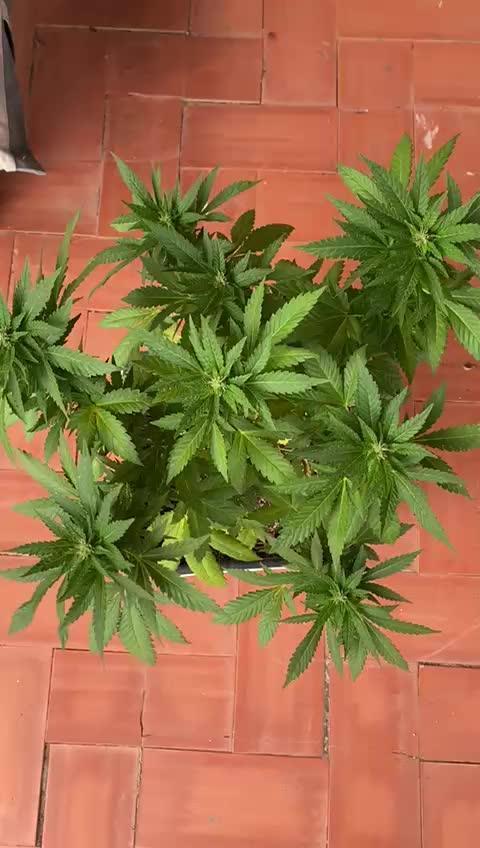
24/10/2022 Todo va muy bien el crecimiento acelerado me preocupa por el poco espacio, 0.5m2 25/10/2022 Se baja a 15hrs de luz para aclimatar cambio a floración se empieza a descontrolar un poco el tamaño Fl26/10/2022 Día de riego, se nota poca actividad en time lapse, este día comienza ciclo 12/12 se añade un poco de Triple 17 como abono 27/10/2022 Continúan creciendo se notan nuevos brotes en la parte baja y aceleración de crecimiento se adiciona nuevamente tierra diatomea para continuar con el tratamiento. 28/10/2022 Crecimiento acelerado, preparándose para comenzar a florar, se notan brotes nuevos en ramas bajas. Se hace amarre en 02 para que aprovechen más la luz las hojas que le quedan y se acomodan plantas a nivel de plástico reflectante para aprovechar más la luz 30/10/2022 Se hace poda de bajos para fomentar el desarrollo de las ramas superiores, El crecimiento ceso, al parecer comenzara a florecer...
Likes
19
Share
@Pitchplus
Follow
Little Stress for me as I see the oldest leaves have a problem. I read a lot on forum and website and it look like it was Septoria. I check everyday but the sickness don't go fast, and I'm about 3 weeks of the cut. I decided to try to manage this with more air circulation by adding a fan. As it goes up I will cut the leaves that are too much impacted by Septoria and will see. Anyway, everything looks fine and better from week to week. Trichomes comes more and more. I begin to be very exited by the smell and the look of the buds.
Likes
56
Share
@Aedaone
Follow
The temperatures, humidity, height, and watering volume(if measured) in grow conditions are all averaged for the week. The pH is soil pH. Any watering done by me is well water which is 7.6 pH and 50° F. Any listed nutrients are ml/gallon of soil to be spread evenly on top of the soil. Day 1 we had a high temperature of 88°F. We had on and off rain and thunderstorms throughout the day. The rain took care of the watering. The #1 and #2 plant responded well to defoliation and treatment. The #3 plant will have some more leaves stripped and everyone will get treated with Growers Ally again tomorrow. Day 2 we had a high temperature of 94°F with clear sunny skies. I watered about 5 gallons from the well. I treated these again with Growers Ally fungicide. The warmer nights, blazing sun, and this fungicide have really cleared up that powdery mildew. They've also decided to go all in on flowering. Day 3 we had a high temperature of 94° with sunny skies. Heat index was over a hundred. It was super hot today. I watered twice about 8 gallons total. Everything looked good after treatment. Day 4 we had a high temperature of 95 and partly cloudy skies. I watered twice about 4-5 gallons each time with well water. Day 5 we had a high temperature of 91°F with partly cloudy skies. I watered twice today 4-5 gallons each pot, each time. The #3 plant is still having some pm on a few of the lower leaves. The other two look great after treatment. Day 6 we had a high temperature of 88°F with sunny skies. I watered 5-6 gallons each pot. Day 7 we had a high temperature of 93°F with sunny clear skies. I watered 4-5 gallons each pot twice, from the well. This week was a success. The girls survived the powdery mildew outbreak. The Growers Ally worked great. They're continuing to grow tall. I can get my tape up there, but they're so tall I can't reach it with my step ladder to take the pictures. The super hot weather this last week just turned them on. They are loving it.
Likes
8
Share
@Kirsten
Follow
26.12.24: These are my 2 best plants P1 and P2 Purple Punch, they are looking great! Not sure what happened to P3. They are in early flower/ pre-flower with the pistils clearly seen on P2. I am also hoping to tie some of the branches down to help light penetration on the lower canopies. I have noticed light stress on my plants. I had moved the lights further away and increased the light intensity to 70%. Unfortunately that created some issues. Namely severe palour of the leaves. To try and rectify the situation, I've dimmed the lights to about 30%, staying at the same distance, about 30 inches away. I measured the par levels, after I did this. They should a reading of anywhere between 40 and 150, at the canopy of the plants. They are all different sizes. This seems to have improved the colouring on all plants. After this evenings watering, I will monitor recovery and increase lighting intensity again slowly. I am also using the light cycle of 21/3, so the plants have many hours more light to absorb, than for example 12/12 or 18/6. I am pleased with the progress, considering all of my mistakes! 29.12.24: So I finally gave LST a shot, it's probably a bit too late, however I really want to get the most of the triploid pheno, and I went a little crazy and LST'd all plants except 2, as they're too small. I did that late last night, this afternoon I was amazed to see the plants turn their leaves back to the light source. I'm glad I overcame my fear of trying it. I'm very excited to see them adapt and progress! 😁 there are videos above with before and after of my LST process. Thanks for checking out my diary 🍃 ✌️
Likes
1
Share
Watching this plant grow has been really fun and taught me a lot about taking care of a plant and what to watch out for. Can't wait to see what i can do on my next grow already!
Likes
11
Share
Day 66 : This lady continues fattening, faster now. Also crystal production increased. The breeder suggests 70-75 days. For now all crystals are almost milky with some cloudy. So she need 1 week for sure, maybe a bit more. That gum smell is so attractive, you want to eat it. Reduced bio grow and removed Calcium. Edit 70 : I saw the first ambers, very little. So i watered for last time with juices Next watering will be flush to reduce the juices in the soil. So if initially has 1200-1300ppm i want to reduce it to 350-500ppm. After flush continue pure water until chop chop. This is my approach for all ladies always.