


Likes
Comments
Share


@AustinRon
Follow
20 Weeks Total
12 Flower Weeks
Harvest
HARVEST - 12 Weeks, 4 Days - 2022-11-21T20:00:00-0600
Today (chop) is the 14th day since moving to 18/6. The Foxtailing of the top flowers indicates 1) light stress, 2) Reveg . . .?
Even with 18/6 and TWO full weeks beyond week 10, I’d have waited another 7-10 days to ripen the Trichomes to my liking (>1/3 w/ vanishing abscission). As is - I know we’ve more mass - they’re both trichome laden - the smoke test will tell.
Phenos
#7 “Broader Leaved” demonstrated moderate inter-nodal spacing, stacking buds put to the terminal flower(s). Flowers started as tiny ‘sunbursts’ of pistols in the common form for broad leaved plants in general. She branched significantly more than I expected - the buds along each mainline cola are on a small stem that’s 1/2” - 3” long, with a 1.5” to 2” bud attached. The buds spiral up the cola, starting (with varying internal spaces)
Ambassador Cartwright
Ambassador Cartwright by IRIE Genetics
Transition to Flower
Afterglow X Arise
(Clementine X Arise) X Arise -> Afterglow BX1?
((Tangie X Lemon Skunk) X Arise) X Arise
______________________________________
Start of Week: Saturday 19 November
AC3Q
120:F:13:1
to Friday
25 November
AC3Q
126:F:13:7
Summary:
Plant HeightBeginningOfWeek: [ 33, in]
Plant HeightEndOfWeek: [ 33 in]
Temp: 74.8
RH: 70.7
VPD: 0.88 kPa # need to get into the 0.9 -> 1.1 Early Flower
LightSchedule: 18/6
amt: [ 1750, ml] #
period: [ 9, hrs]
frequency: [2, day]
times: { first: 2100, second: 0300 } # Auto Only!!! Otherwise 1.3 @ 2100
Environment:
EC Targets: #
rel.
|
abs (rel + source)
ECripen:
[ 0.3, 0.6]
[ 0.6, 0.9]
ECflush:
[ 0.0, 0.2]
Fertigation Daily:
- Times; {2100h, 0600h}
- {pid: 4, amt: 1250 ml, ec: 0.6, pHRange: [ 5.5, 6.5], times: [2030h, 0500h]}
- {pid: 7, amt: 1250 ml, ec: 0.6, pHRange: [ 5.5, 6.5], times: [2030h, 0500h]}
Fertigation: #
Mammoth-P: [ 1.5, ml]
BioAgFullPower: [ 10, ml]
(The Rooted Leaf) Resin Bloom [ 3, ml]; # Potassium & Plant Extracts
_____
Saturday 19 November 2022
AC3Q 120:F:13:1
- [x] AM - EC 0.6
- [x] PM - EC 0.6, 1000 ml (local: sun am)
Sunday 20 November 2022
AC3Q 121:F:13:2
- [ ] PM - EC 0.6
- [x] AM - EC 0.6
Monday 21 November 2022
AC3Q 122:F:13:3 | HARVEST CHOP 87 Flower Days
Tuesday 22 November 2022
AC3Q 123:F:13:4
88 Days in Flower
Wednesday 23 November 2022
AC3Q 124:F:13:5
Thursday 24 November 2022 - Happy Thanksgiving!!!
AC3Q 125:F:13:6
Friday 25 November 2022
AC3Q 126:F:13:7

Likes
3
Share

@Ananacio
Follow
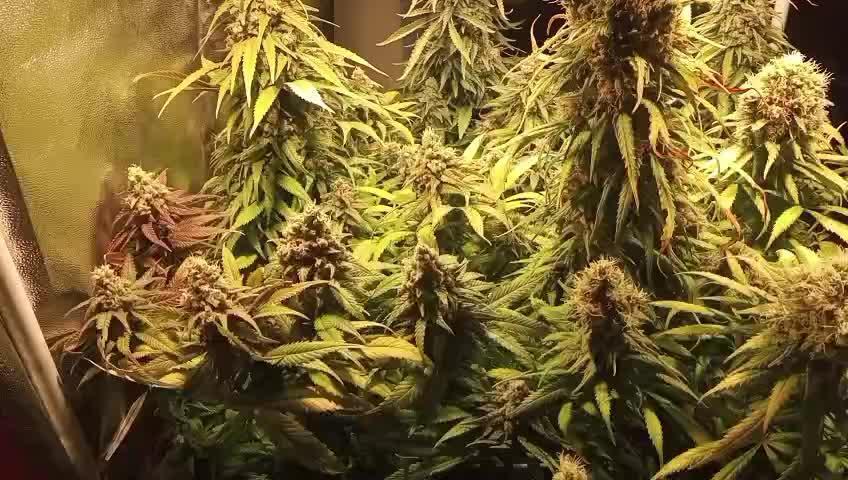
Hola, solo les estoy dando agua.
Hay una que viene un poco atrasada.
Seguramente la proxima semana haga el corte.
Saludos!



Likes
68
Share


@Ferenc
Follow
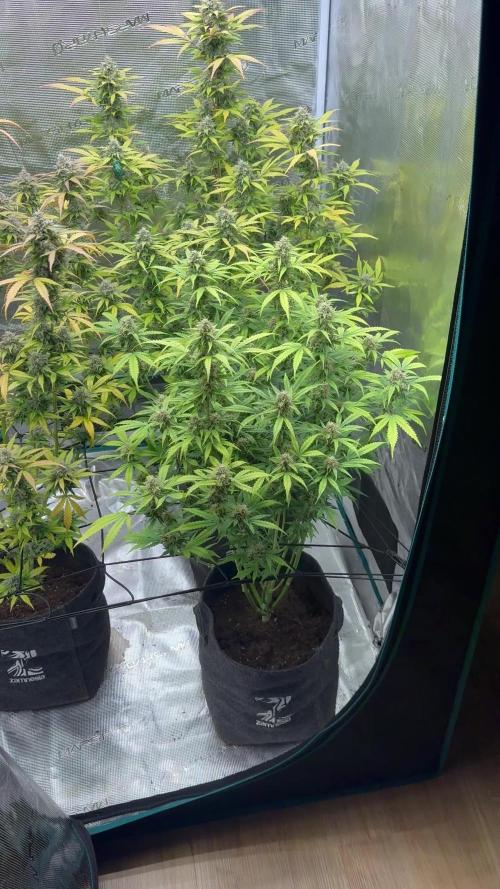
Day 57, 12th of November 2020:
Here we go she grew a lot nice plant added some more size :)
Seems to be okay pistils are coming.
Fertilization happens every 2nd day with the mix above and the rataio... :)
I set the lamp 15 minutes shorter to switch off earlier so she receives 11:45 of darkness. I would like to imitate the nature when longer nights come with time till the 4th week (when she will receive 13 hours darkness a day 15 minutes minus 4 times = 1hour) so every week 15 min longer darkness for 4 weeks and then back to 12/12 to have bigger buds from the 4th week....

Processing
Likes
4
Share


@Grow_of_Leisch
Follow
-Bagseed from Breeder (Friend)-
•Cherry Cream
Genetics:
•Ice Cream Man (mother)
x
•Cherry Wine (CBD) (father)
Ratio 1:1
Likes
146
Share


@EZgrower
Follow
Everything goes according to plan
22 oct 2019 - Day 19 - first small defoliation. cut 7-8 fan leaves.
23 oct - 20 day - 11 colas

Likes
28
Share


@m0use
Follow
*=UPDATED=*
looking about the same again, nothing much is changing other then the new flower growth has slowed and some of the trichomes are turning amber. the one plant has thick buds and the rest are average.
Harvest maybe next week or the one after if I get the time I need, I want to first take off all the extra fan leaves "half ass'd defoliation?" and let it sit in darkness for two-three days, help it breakdown some of the chlorophyll and should make the cure much nicer. first time trying this, may leave one plant in normal light and hang dry it to see if it makes a big difference.
Had a bit of powdery mildew on some of the lower bud sites and baby leaves on one plant, I believe this was because the fan in the case was broken and not replaced. Corrected it by spraying the area with a peroxide mix and increasing airflow.
*=UPDATE=* the one video I uploaded for this week was not working. So retrying it again today.

Likes
15
Share

@Mati_86
Follow
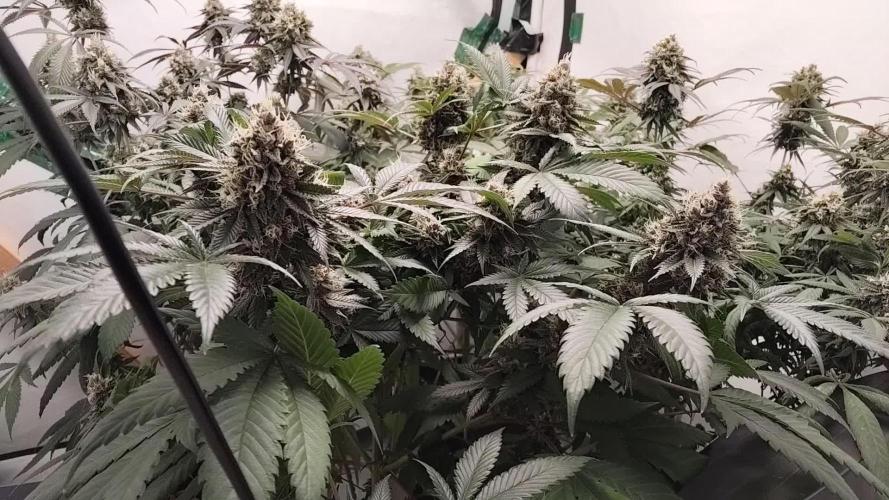
die buds schwellen an und ab jetzt gibt es keinen dünger mehr. ich hatte diese woche mal leicht gespült sodass ich ca 1 l drain hatte. der ec lag bei 2.0 ca.. werde kommende woche nochmal leicht spülen und wieder messen. zurzeit faden die oberen blätter aber die unteren sind mir etwas zu grün. habe noch 1.5 bis 2 wochen bis ich ernte. denke bis dahin wird das grün verschwinden. bin bis jetzt zufrieden und hoffe das die rlf sich senkt, denn es hat viel geregnet in der vergangenen woche und im zelt hatte ich gestern mittag 63% rlf😐.
ist aber bis zum abend auf 52 %runter..
heute hab ich 48% rlf im zelt.
die super boof und rainbow melon halte ich mir als mutti's 😁


Likes
86
Share


@Hawkbo
Follow
Day late on the update, pics/vids were taken on time tho just been a crazy week of harvests and trimming and keeping up with these. I linked up with Rain Science Grow Bags on Instagram and got them to offer all my followers and friends a discount of 10% off entire order from their site with the code ' bangdang ' so if anyone is in the market for a pot upgrade use that code. I got them in the mail 3 days after I ordered. Reason I went with Rain Science is because they offer identical air flow for rapid growth as the radicle bags, just using a different material and a tighter knit so water doesnt flood out the sides during feeds and when you pick these up when the coco is dry, it wont fly all over the tent like with the radicles. They're the optimal bag for autoflowers especially.
These 2 are doing great should get interesting in the next few weeks. I actually ran 3 of these in 1 gallon pots a few months ago and 2 atleast came out pretty good so the bus shots are from the 2nd pheno of those.


Likes
17
Share


@Kirsten
Follow
16.2.25:
I decided to check out the lower canopies of all plants to see if I need to get rid of any foliage.
I did get rid of a few small branches and leaves.
However, whilst I was doing this, I saw more garden pegs from my LST remaining.
There were about 6 or more in Pink Mist alone. Additionally, on Watermelon, there were some left in, too.
I'm so annoyed to see that because the plants are really stretching, and I could've potentially disrupted this by leaving the pegs in for all this time without realising it.
🤞 that I haven't compromised things too much. We'll see.
I watered today with 2ltrs of dechlorinated water PH'd to 6.3 containing the following nutrients;
♡ .8g Green Leaf Nutrients PK booster
♡ .5g Ecothrive Biosys
I ordered quite a few things for the garden. I got Greenleaf Nutrients Sea K(elp) and Mega Crop Parts A+B. To go with their PK Booster I got last month. I'm excited to try it all together. Next run, maybe just using these. We'll see how it goes.
18.2.25:
The plants are going crazy for water! Everything is getting used right up so fast!
Today, I decided to add some more Black Strap Molasses to add some carbs and other micronutrients. I'll add the jar with the label in the photos section above.
I watered a very small amount to each plant.
What I put in:
♡ Black strap molasses 150g
♡ 2g Sea K(elp) Greenleaf nutrients.
I dissolved everything in 4ltrs of dechlorinated water PH'd to 6.4.
19.2.25:
I received the majority of the garden purchases that I made. I'm still waiting for the Ecothrive Life Cycle. I wanted to top dress, but it's been delayed unfortunately.
I am using my Greenleaf nutrients products which I bought on Amazon. I got the Mega Crop 2 part system Part A and Part B. I have the Sea K(elp), and the bud explosion PK booster.
I really wanted to get some of their sweet candy asking read many positive reviews. Unfortunately, for me, this is unavailable to buy currently. So that's a little disappointing.
I needed to do a good watering so when my nutes were delivered today, I got excited 🤗
I watered 2ltrs of dechlorinated water per plant, PH'd to 6.4, containing the following nutrients:
♡ 1g Mega Crop Part A
♡ 1g Mega Crop Part B
♡ .5g Sea K(elp).
The plants drank this up within a few hours.
I'm going to try and hold off on watering in hopes that my Ecothrive Life Cycle will arrive so I can top dress and water it in then.
20.2.25:
My Ecothrive Life Cycle arrived yesterday, and the plants are ready for their top dress and a good watering in.
I have some Biobizz Light Mix, Canna Coco,and perlite. I'm going to use this as a base to mix my amendments in.
I'm going to fill my 5 gallon bucket with about 4.5 gallons of my top dress mix. I will distribute this across 6, 4-5 gallon pots. Then I will water in well with Greenleaf nutrients Mega Crop Parts A+B and Sea K(elp).
I've made a crude attempt to video mixing my top dress. Don't listen to the audio. lol, my YouTube didn't stop playing whilst I recorded this 😂
So anyway, I added the following amendments to the above base mix of 4.5 gallons;
♡ 3 TBSP Ecothrive Life Cycle
♡ 3 TBSP Vitalink Bat Guano
♡ 3 TBSP Ecothrive Charge
♡ 1 TBSP RHS Mycorrhizal Fungi granules
♡ 6 TBSP Ground Cinnamon.

Likes
16
Share


@Max1973
Follow
7 days exactly... 3 of the seeds made it.... all 3 look good....
just seed raising soil mixed with perlite, inside jiffy pots that break down in 2-6 weeks...
just normal tap water atm, and i'll water them less now, let them dry out abit...
Day 8 - pics/vid.... Had a look under the jiffy's, all 3 had 1-3 cm roots poking out, they went straight thru the jiffy like it was not even there..... (pic - Day 8 - Root straight thru all 3 pots.).... so, went into emergency repotting day... lol.......
i don't want the roots restricted or damaged in any way,
so, got what pots and soil i had, and put em in, (2 x 13.5 lt pot, and 1 x 7.7 lt).
Day 9 - some pics, bought a new tent (wait delivery), just got em under afew 6400k led's atm .... they seem happy..... 👍
😎
Likes
28
Share


@PrairieFrostGrow
Follow
*
***************** Week 3 of Growth From Seed, April 25 to May 1, 2020 - Days 15 to 21 from germination **********************
*
Started the head scratching more this week and wondering what is going on with the slower growth she has experienced the last 4 days or so. She is looking good and not dark....environment is good.....what the heck is the pH so high when been given feed well inline and below 6.0......why runoff numbers in low 7's so early in the run?? A number of heavy feedings this week so that I can read the runoff numbers for her. Going to keep staying the course with feeding but lower the pH because she is still progressing and its still pretty early in the run........not much veg time for an auto though so I need to get this figured out pretty soon.
Gave her some Epsom salts this week as well as I have been battling Magnesium deficiency the last run or two. Always just used CalMag but I don't think the girls always want as much Calcium as they are given this way though. Fed at a rate of 1tsp/gal in a two litre feed early on in the week.
Little more Detail...........
Apr 25/20, Day 15
- 500ml feed - VitaThrive and Dual Fuel @ 1.5ml
- 700ppm and 6.0pH
- small feed of base nute to try and perk her up.
- noticed the lower leaves are droopy while the upper leaves are perky still.
- Still working on dialing the light for these girls as they are happier at 30" away from canopy.
Apr 26/20 - Day 16
- 500ml feed - AN Sensi Cal @ 1.5ml, Sensyzime @ 2ml, Epsom Salt @ 1tsp/gal
- 700ppm and 6.0pH
- The Epsom Salt alone shot the ppm to 500
- Only have the veg switch on for the UnitFarm light.
- feeling some of the other girls are showing some magnesium deficiency with the yellowing perimeter of the leaves.
Apr 27/20 - Day 17
- dry out day
- Cut slits in the bottom of the bag today to let more water out, more quickly when feeding.
- Wondering if the root zone is staying too wet and therefore causing some stunted growth.
- She has been falling a sleep too early in the day so either too much light or getting root bound?
Apr 28/20 - Day 18
- needing some runoff numbers to see what the hell is going on
- fed 3L - Piranha @ 1ml, VooDoo @ 2ml, Dual Fuel @ 1ml
- going in was 575ppm and 5.3pH
- runoff numbers were 1450ppm and 6.9pH
- WTF......bring it down......next feed at only 500ppm and 5.0pH to lower her??
- leaf colour is perfect. Stems are a little immature yet, but side branching is coming out stronger.
Apr 29/20 - Day 19
- 8L feed - Dual Fuel @ 1.5ml = 325ppm and 5.0pH
- runoff after the watering was 500ppm and 7.0pH
- WTF.....expected it to be more in the 6.5pH range and not that high still?
- KK looked worse off, still droopy, after this than the other girls did. Lack of oxygen in root zone with so much water? Its coco though shouldn't be for too long.
Apr 30/20 - Day 20
- dry out day
- KK likes it a little dryer in her medium.....she perked up more today and looking a lot better.
- She has had more vertical growth the last day and she is spacing out some of her nodes.
- Her stem is thicker and she is getting stronger.
- Still a week behind though in my opinion and they should have been this size a week ago.
Apr 31/20 - Day 21
- dry out day
- she has done very well the last two days and going to keep riding that wave, didn't water today.
- She has certainly gotten taller and wider.......getting her back on track?
That will wrap up this puzzling week........pH is not staying low after being brought down......shoots back up over 7 in only 24 hours idea. Working on it Growmies. Have a great week and thanks for checking out the girls🙏👌

Likes
8
Share

@Nftgrower
Follow
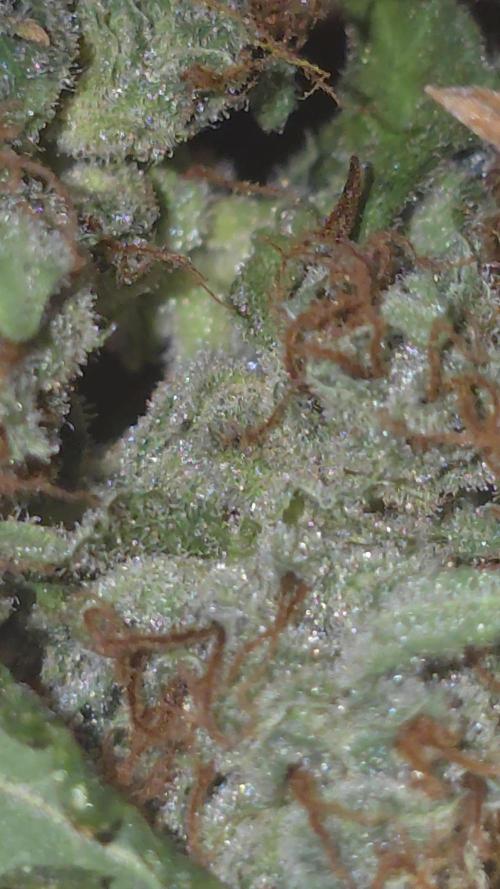
Had to do a partial harvest as some of them looked ready and some didnt.
Likes
13
Share


@GrowerGaz
Follow
Just been rolling along this week feed by the autopots , did give them half a litre of Iguana juice each and another foliar KNF spray. They seem to be developing fast, I don't think I have had frost production from day 12 .
So far so impressed with the Attis 300 w


Likes
18
Share


@AlienScrOG
Follow
I dont now if ... The last 3-4 week of have do a very light feeding ... I see Yellow in top of the plant .... I have wrong so much do ... In bloom fase ... I think the First week of Bloom the root deat for so much H2O2 ...and the root grow again to the top of the plant ... Is not good ... I have use h2o2 for Paint to pytium... Only now at 1 month ti finish plant grow bud

Likes
6
Share

@Grow_for_Happiness
Follow
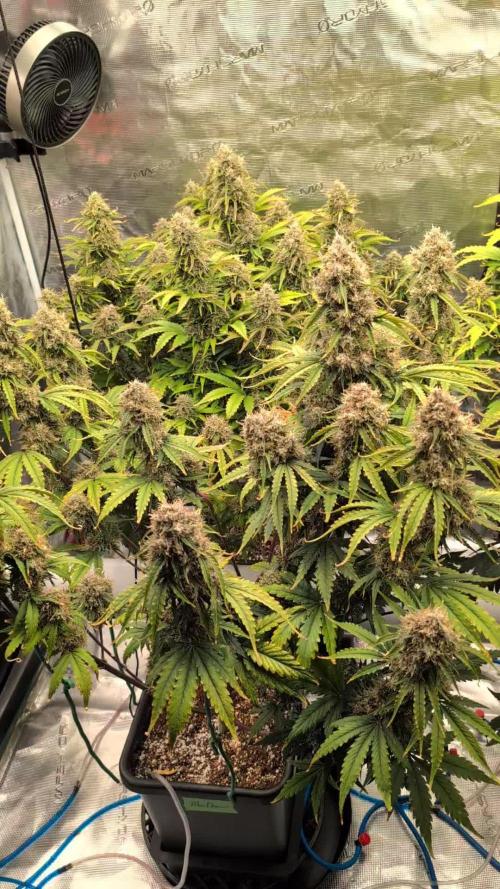
Another hands off week with the Christmas festivities taking up most of my time, shouting praise to the Autopots and automated controls for keeping the girls happy and fed while I was on and off away over the week. Nice to settle down for a week of vacation, and to start it by opening the tent to see big ol' shiny buds staring back at me!
They seem to just keep swelling and packing on the trichomes. Smell in the tent is strong sweet berry with skunk.
Did switch up the nutrients a bit, ran out of B52 and Bud Candy so am supplementing with some Nutes Nutrients Microbooster. Very similar composition and so far the plants don't seem to be complaining. Just cruising these girls to the finish line, will break out the magnifier this week and take a good look at the trichomes to try and guestimate a timeline.
Likes
7
Share


@nectarinepasta
Follow
New leaves still discolored but growing apparently correctly. Possible reasons:
- genetics (?)
- heavy fertilized soil - Batmix from Plagron was used (?)

Likes
12
Share


@AllieO
Follow
2/2: Some of the huge fan leaves had to go. Not even the strongest of tucking would control them. Flowering is officially starting! Trying to rotate to get as much light to bud sites as possible. Excited to see where things go with this one.
2/5: determined that there was a bit of a light burn situation. Decided to pull her from the tens for a good flushing and then rearranged the tent a bit to keep her off to the side a bit.
2/7: she's a big girl. I have her flying solo in the tent for now..