Likes
Comments
Share
@ChiTaN
Follow
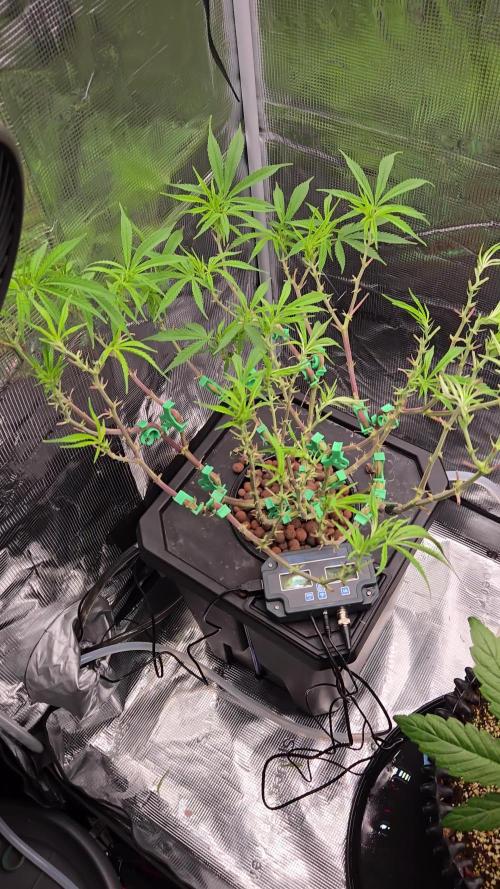
The girls are developing properly, frosting is beginning to be clearly visible.Also the smell has become clear and very intense.White Widow X Big Bud is the most noticeable.From today, the girls are switching to a different spectrum of light, UV light will be added.
Likes
10
Share
@Weedbadk
Follow
Día :1 iniciamos este seguimiento de estas variedades toda germinaron en 3 días Día 5 desde puesta en sustrato Solo pulverizó 1 no sobrevivió pero las 2 salieron sin problemas
Processing
Likes
20
Share
Started doing some light defoliation a bit each day on the very low level offshoots and any big leafs blocking main bud sights. Looking back I should have done a bit more earlier on as these are very heavy and leafy plants. At the start of the week my light was at 55%, on 13 Nov I put it to 100% to see how they react. I will monitor to see if they are ready for it but they really took off this last week. My one plant in the back left always appears droopy compared to the others because the leafs on it are so big it weighs down the whole plant. The plant in the back right was always janky and I considered not even growing it. The seed came through a few days later than the rest and I almost wrote it off. Figured I would use it as an experiment and try and learn from it instead.
Likes
17
Share
So had some problems. I took to long to raise my lights and i paid the price i flushed and 6.14 on the runoff so i think my meter is broken im also adding calmag too because from what ive been reading i should have used it sooner. You live and you learn though Some crunchy leaves but not as bad as my other plant The bud sites are doing awesome though still growing and the leaves are gaining more and more thc. She seems like shes still taking water and maturing so im not too worried. If anyone can give any advice to help me fix this it would be greatly appreciated
Likes
7
Share
01/19 - Tied her down completely (HST) - full light coverage - running in 2x2 until clones in 3x3 are complete then transplanting into 3x3 - offsetting clean water and nute feeds.
Likes
50
Share
@Igrowneil
Follow
Hey growers Day 35 This run is sponsored by VIPRASPECTRA LEDS XS4000 480W AND P2000 X2 400W TOTAL POWER RUNNING 880WATTS Hey guys and girls this week hasn't been the best I overwatered , underwatered and then underwatered again , shit these girls express some amount of water , I literally flooded there plants to get a somewhat of a recovery response which isn't going the quickest either , some roots where exposed ( small amount ) wow they look healty white and fuzzy looking with plenty of hairs which indicates the bio roots worked extremely well even the terra aquatica TRI PART as this is synthetic it has charge ions the plant will uptake (N) continuously if overdone I've held back on as I don't want to damage the root zone with a build up of salts as we will ruin any microbial life with salts locking out important nutrients uptake also Noticed the fade on some bottom leaves losing colour but I've been holding bk on (N) as some looked dark !! What to do next I'll take step by step and observe the situation for a while before acting to fast .seedbanks involved ZAMNESIA, E.T.S , RQS ZAMNESIA GORILLA GLUE AUTO This girl is growing pretty well with a good vigour even through this.bad week , staying pretty compact with an abundance of pistle formation indicates this is going to be decent size dense nugs and hopfully keep good airflow around these girls . The outsider gorilla glue over with the newer plants is hitting a good rebound, nothing special but not a total waste anyways which shows strong resistance overall which is a good incentive when picking which genicitis you would run in smaller space this is definitely the square ⬛ 10liter S.O.G / ScrOG method with these plants being smaller and Bushier GIRLS SCOUT COOKIE'S AUTO Growing the most compact with very big pistle formation 🙌 explosive pistle formation , I think using buddy from early flower in lower dosage has increase the amount of flower sites with abundance of pistles as this is starting to happen on all plants growing but these girls are taken that to the extreme and would also suit the 10liter square pot method RUNTZ AUTO girls are growing big and formation of lots of tops and lateral branching is great 👍 pistle formation isn't as quick bhy these girls didn't flip as quickly to flower , they did take the underwatering pretty bad plus some leaves being remove cause some more shock , lol its been a shit week but nothing we won't be able to fix over the next few days I need to start getting watering correct ROYAL QUEEN SEEDS DO SI DO AUTO . the girls aren't doing to bad and looking better after being dryer than normal when I underwatered them , needless to say there coming bk to life and branching out continues to go on forming lots of viable tops and plenty of flower sites , might be a slow starter but never let that full you EMERALD TRIANGLE SEEDS BLUEBERRY AUTO yes this girl is doing well , the other sister looks like a basil plant and nothing much will come of her . I can't wait to try this girl out and most of the seeds I had 4 blueberry I only got one viable seed , disappointed but the one that's growing is doing well so the taste is what will sway my decision HEADLIGHT KUSH AUTO doing well and getting to a good size and keeping on par with the ZAMNESIA seeds this is a good strain LEMON HAZE AUTO hopfully I'll contain any stretching untill the girls reach SCROG height So hopfully the girls will do better from today and I can update with these girls praying 🙏 again , going to set DLI to 45 , temps to 23oC and water upto 0.33 liter a day this week day 36 onwards
Likes
5
Share
I feel sorry about myself for not being able to give her the shape I wanted in the time I had settle of vegetative stage, the smell is absolutely gorgeous for a sativa plant, if you smell her you could think she's a pure blueberry strain, very very sweet and floral aroma, hope to keep working with her in many more runs, indoors and outdoors as well!! 💯 Let's see how this beautiful haze keeps developing those flowers! 💛❤️💚👨‍🌾
Likes
14
Share
@b_deal
Follow
This week was amazing guys. I literally watched the buds getting fat day by day. I am still feeding with a similar program and adding Aptus Regulator once per week to boost silica and some other minerals like molybdenum and boron. I'm flowering my plants in a hot environment with CO2 boost. PPFD is high to support these settings and thankfully my the pots aren't getting hot. No fungus gnats or any other pests, no root rot and bad smell. Everything is perfectly neat and buds are exploding. My expectations from this harvest is really high and I'll keep adding CO2 for another week. Some fellow growers asked for CO2 and PPFD measurements. I am sharing these information on this week's pictures. I got my CO2 meter fixed and I tested the CO2 PPM in different places of the canopy. Typical value for this grow tent with this CO2 setup is around 1100-1350. Temperature is fluctuating between 28-31 and the average PPFD on the bud sites is 1100 micro moles. I'm sharing CO2 measurements right under the fan, where you expect it to show the lowest value. Then I'll also share the CO2 PPM value coming out from the air pipe, which is normally attached to the grill of the fan. Direct output is now around 5500PPM and in the first two days, the meter shows 10000PPM which is the max value that it can reads. This bucket yeast CO2 reactor lasts for four days and I'm refreshing the mixture twice a week. This is huge CO2 with a fairly low cost compared to propane burners or CO2 tubes. Edit: I refreshed the CO2 bucket today and got you guys a video of the direct output. The system is outputting more than 10000PPM of CO2 and the meter can't measure it for the first two days. This CO2 method is a killer one for tent grows. Very low cost for very high CO2 concentrations. Hope these information helps. Happy growing 💪
Likes
2
Share
I did not top this girl, yet. Her top lowers started catching up to the top so I didn’t want to stop her yet lol. But all in all she’s looking healthy.
Likes
2
Share
Mais 2 semanas para a colheita,ela está gorda e cheirosa,vou começar a fazer o flush ,Super Moby Dick --LATITUD SUR SEEDS.
Likes
1
Share
@420Baddie
Follow
She really had a growth spurt! She seems very happy! Hope things keep going smoothly.
Likes
41
Share
Started the week with a NFTG Mid flower feed. She's looking healthy and I shaved her legs a bit ;) definitely flowering and still stretching! almost 40 " or so as of right now =) Added a video of how I mix my NFTG solution Day 71-NFTG mid flower feed /Mammoth P/ Recharge @ 6.5 ph Day 72-73 No watering Day 74- Recharge/Cal-Mag/Mammoth P/ Bloom Khaos Feed @6.5ph Day 75- No water
Likes
13
Share
She's really absorbing a lot of nutrients, I can't keep up! But I made extra space for her, hopefully she'll get nice and fat.
Likes
2
Share
The nighttime VPD does not need to mirror the daytime VPD. Daytime VPD dictates the pull of water and nutrients, while nighttime VPD acts mostly as a prevention tool. A high nighttime VPD increases the risk of the leaf temperature dropping below the dew point, which can trigger bud rot and powdery mildew. Switched down to 12's hours of light mid-week, changed spectrum, increased light intensity from 840umol up to 1150umol at current height. Overnight from 800ppm to 1500ppm, morning compensation point (microorganisms) 46-47 days from germination, she fills the canopy herself, once the apical dominance is broken. Measuring a plant's overnight CO2 emissions provides an accurate estimate of its dark respiration rate. Because photosynthesis stops in the dark, you are isolating the respiration process, which allows you to gauge how much stored energy (glucose) the plant has consumed and estimate the scale of oxidative phosphorylation. Oxidative phosphorylation is the final stage of respiration that generates the bulk of the plant's ATP (90%) and relies directly on the oxidation of these respiratory substrates NADH and FADH2 along with the consumption of oxygen. From a thermodynamic standpoint. Growth is an energy-capturing process, and the rate of that growth is bound by the available free energy (Gibbs free energy) and the First Law of Thermodynamics. While the ceiling or upper limit is dictated by free energy (such as photosynthetically active radiation), the actual amount of growth relies on how the plant balances that energy with other limiting factors. These are often described as the nine cardinal parameters of plant growth. 4 Above, 5 Below. If any one of the 9 becomes bottlenecked, the entire plant's cycle is restricted. Operating an 80F+ environment at night to force rapid carbon conversion comes with major drawbacks, as the biochemical processes work differently than the deductive logic suggests. While raising nighttime temperatures to 80F indeed accelerates respiration and speeds up the conversion of captured sugars (sink activity), doing so also radically increases the plant's overall metabolic baseline. If the plant's metabolic rate is artificially forced too high via heat, it can actually "burn" through more energy than it managed to assimilate during the day. This leads to carbohydrate starvation, stretching, and a net loss in final biomass yield. 400 ppm is near the standard ambient level; the plant's stomatal intake is the primary limiting factor, not the dark-reaction enzymes. To push 45 DLI without burning out the plant. Trying to force the conversion of a massive daylight DLI in a compressed time frame (12 hours) becomes highly inefficient because the Rubisco enzyme simply hits a saturation limit. To successfully convert a 45 DLI into dense, productive mass, the ambient CO2 generally needs to be elevated to the 1000 to 1200ppm range. This creates a steeper concentration gradient, driving the stomata to inhale CO2 fast enough to match the high photon energy. It's not all about the amount of light, but the ratio too, as this will dictate growth through the ratio of phytohormones. In order for correct bud development, there needs to be a correct ratio of RGB. Different wavelengths have different penetration depths. When one grows using top-down lighting, only the entire canopy is limited to 2-3 layers of leaf, meaning there will only be correct bud development in those layers, regardless of getting 45DLI. The biomass potential of a plant is linked to root mass. Generally, when a plant reaches its maximum biomass, you can help to chop off parts of the plant that are in less than efficient areas of the plant (low light) so that it can create new biomass growing towards the light. Strength is the maximum potential, and power is the rate of conversion. You can have the biggest veg period of 18 weeks, and it means nothing, as soon as you start flowering, the chronological clock starts ticking, the only metric that matters to bud size is how much energy you convert each cycle, not by how long it took you to build the framework, it helps a lot nonetheless. Not saying anyone should not defoliate for a reason, only that you should have one, and at the right time. Don't defoliate 30+% on autoflowers or 4 weeks into the flower period and expect an increase in yields; it doesn't work like that. There is room for dictating growth patterns and clearing out overcrowded nodes, but it needs to be done in veg because once that timer starts and buds start growing, it's all just energy conversion. One barely needs to defoliate at all in a 4x4 because with side lighting, turning a 2d canopy penetration into a 3d, even lower buds are 90% the quality and density of top ones. The rate of photosynthesis and the ultimate density of lower buds aren't just about the sheer number of photons PPFD. The specific ratio of R:G:B dictates canopy penetration and drives different photochemical reactions. The Electron Transport Rate (ETR) measures the speed at which electrons are driven through Photosystem II (PSII) during photosynthesis. The ratio of Red, Green, and Blue (RGB) light heavily dictates this rate. Plant leaves continuously perform cellular respiration regardless of the time of day, using energy and oxygen to fuel essential metabolic maintenance. If you over-defoliate, the remaining canopy may be unable to produce enough net sugars during the day to offset the constant respiratory demands of the plant. Must balance fixation with assimilation; there's no point in capturing 45 DLI if you only convert 20% every cycle due to an extreme lack of respiratory capacity to perform cellular oxidative phosphorylation. You can have a 4x4 canopy or a 4x4x4 canopy, yes, we know that side lights are not as effective at absorption from the sides or underneath, but it's not about DLI, it's never been just about efficiency, it's about the penetration ratios of RGB that drive ETR of/photosynthesis and trigger correct bud development. The size of each bud is its own ability to perform the ETR required for its own personal growth, and bud development is dictated by the ratio of RGB. It drives localised growth and acts as a regulatory switch for that development. Turgor pressure is another very important factor in understanding if you want big buds, for it is the "steam engine" that dictates the rate of bud expansion. Simply, a lot harder to achieve metabolically at ambient 75F than at say 86F Because buds have less chlorophyll, they do not suffer from the same photosynthetic shutdown that over-exposed, light-stressed leaves do. They can soak up direct light energy to swell in density and size. Their tolerance to intense light is heavily limited by the temperature and humidity, but if you can control those temps and keep the rot away, buds have a much, much higher tolerance to high light than leaves. Beneficial to hammer with high light before trichomes appear. Balancing this with trichome maturity is key for rich terpene and flavonoid profiles, want it just right, somewhere in the middle, not too much, not too little. Find cannabis plants can defoliate themselves come harvest, given the right signals. Every last ounce of potential is recycled into buds by the plant itself (senseceance), given you can keep the level of conversion high enough to prompt a need to do so. Get the canopy @ optimal PPFD range, 45-55DLI, then let the plant "stretch" the stems into a "PPFD range much higher, one that leaves don't like to grow in, but buds thrive in. What is optimal for a bud is different from what is optimal for a leaf photosynthetically. Genes provide the blueprint, but the environment dictates how, when, and if those genes are expressed. Must first signal the condition to increase the expression you want to exist through stress and response, cause and effect. A well-buffered CEC medium prevents extreme nutrient swings, allowing plants to maximise their dedicated genetic expression. A plant is either genetically expressing "growing" or "recycling" genes based on its nutrient starvation level in the medium. Constantly toggling between "growing" and "recycling" hormonal states creates a futile cycle that wastes valuable metabolic energy. Plants rely on sophisticated biochemical switches to manage this trade-off and prevent rapid fluctuations that disrupt that balance. This energy inefficiency is a recognised biological challenge. Plants avoid this costly "flip-flopping" by using hierarchical master regulators (like the TOR and SnRK1 protein kinases) that act as strict molecular switches. These networks enforce cellular commitment to either growth or survival, preventing mixed signals. This is something that was missing from previous grows. Under nutrient-rich conditions, TOR promotes protein synthesis, cell division, and structural expansion. Under starvation, TOR is inhibited, and SnRK1 is activated. This triggers autophagy—where the plant breaks down old macromolecules and organelles to scavenge and reallocate essential nutrients to critical sinks. "What's the point in flushing?" The core idea behind a PK booster is to deliver a massive, concentrated surge of P&K exactly when buds are swelling in conjunction with a N starvation. Because these are short, targeted windows, the nutrients must be highly bioavailable so the plant can process them immediately. As soon as you go "organic," that's out the window. Much slower release, uncontrolled, very difficult to "spike". to cause the ratio that will initiate a response. High-volume PK spikes rely strictly on the immediate uptake capabilities of mineral fertilisers. Making it far less efficient in organic/living soil setups. When you use organic nutrients, it changes the dynamic with which the plant delivers and trades its nutrients; organic is always releasing new nutrients into the immediate EC. This prevents a lot of autophagic responses from occurring due to a constant stream of new nutrients into the immediate medium's EC. This can prevent nutrient starvation from being signalled. PK boost is essentially just N starvation, triggering an autophagic response. Concentrated ratio of P&K while tapering off the Nitrogen base. To the plant, the sudden drop in Nitrogen registers as a severe environmental stressor—essentially, the beginning of starvation protocols. She aggressively strips nutrients and proteins from older leaves and vegetative structures and shuttles them directly to the developing flowers and fruit. Ta daaa. Call it a PK booster and sell it. Nothing to do with the P and K itself, it's the ratio immediately available in the medium triggering a nutrient recycling mechanism within the plant itself; all the "booster" sells is the trigger to the signal. PK BOOST with 50% ammoniacal N signals floral maturation. PK BOOST with N starvation signals nutrient recycling/sinking. Very difficult to initiate a response when organic nutes are doing their thing. It takes 4x5x more water significantly to leach or wash ammonia out than it does nitrates. This can prevent triggering N starvation from having its normal impact. Manipulating the C:N ratio in the medium. One autophagic response has multiple potential signal triggers. Nutrient starvation is not an option.
Likes
3
Share
@PatronEl
Follow
I found a humidifyer the same day, that somehow arrived the next day! I use rubberbands to manipulate the canopy into being more flat and then I waited how it looks. I think I should bend it a bit more, but I am scared to hurt her .. I also silicone for the sealing, to be bit more sure, because it didnt look good enough for me. I am still not satisfied and will remove everything and start from scratch after this lady. I want the sealing to be absolutely perfect! But she looks really good to me. I like how it works, and it feels way easier than imagined! since I stayed with the all mix when the soil arrived, I dont think I need to feed it until bloom, since I heard, that the all mix has nutritens for 4 weeks
Likes
36
Share
@OGTrauma
Follow
Most of santa bilbo are showing an advanced nutrient deficency as i cant deal properly with the previous nute burn may caused a block too. Therefore, at this stage i would prefer wash the root during the end. Smell is orgasmic even when they are not complex they excel as specimen through, and i hope you fellows can use this shit as reference tho, big gaz leakz