





Likes
19
Share


@Chubbs
Follow
420Fastbuds
TrainWreckAuto
Week 5
What up grow fam. Hopefully everyone had a great 420. These 2 beautiful ladies are growing amazing. Started there transition into flower this past week. So where starting to get some great growth and all in all the plants look super healthy. Happy Growing

Likes
63
Share


@AsNoriu
Follow
Day 36. New round of training, girls started to strech, so i can form them and by "them" - i mean Gorillas ;)))
Cookies are sad song, in control garden Strawberry Cough is out, so i keep my dirty mouth shut till results will come up.
Hope best to come, my 8 week veg plan extented to 9 at least ...
Plan to feed them Silica Acid and CalMag next round, so increased numbers of nutes will be used only next week, need to do pure water runs aswel ;)
One lovely thing - half of Bunny Gorilla gives 3 shots from one nod, other half grows normaly, lovely mutation.
Day 38. Yesterday girls got water with CalMag, so they started to look better, deficencies where showing up on all plants, so had to feed them up a bit.
Cookies long way to healthyness, but at last two off them started to grow.
So next water will be with silica acid.
Tomorrow should do some heavy lst, girls started to strech, can lower them again ,think it will be last mass lowering, next i will try to form as many tops from all that mass on Gorilla side and i really put many work to make Cookies look better.
Control garden is ok, all 4 beans showed up. Think to veg them for 2-3 weeks only, but my main target was to see will last Cookie show unhealthy grow in new run compaired to other strains or i should blame too ritch worm casting, cant find any other reason for so many grow issues.
Think any other gardener would chuck that crap and started new grow, but two cookies woke up, maybe two others will at least heal up by switch time...
Lets see...
Day 39. Heavy LST , HST , defoliation and new position, think they will stay that way till the end.
Some girls get theirs form, Bunny Gorilla looks amazing, plan to veg them 3 more weeks from today, so day 55 they will get darkness and light rythm will change.


Likes
42
Share


@Ultraviolet
Follow
Thank you. Gave her a cocktail to help with stress. Added 1st net for lateral support, not so much now, but for later. Blue light is absorbed by photoreceptor proteins called phototropins, which trigger a hormonal response that causes cells on the shaded side to elongate, making the plant bend toward the light. Try and fill this side a little. She is quite big already, just needs to find her stride again after the undue torture.
5 apex stems with 20-30 mini cola, let them develop a little, with the apical dominance shattered, all those 20-30 will all compete with each other as soon as that stretch is initiated. Key to a good stretch is making sure the plant is cycling efficiently, with large ATP conversions occurring lights out.
For now, I'm keeping light intensity high. A plant will slow its vertical growth in very high light intensities, leading to a more compact form with thicker stems and leaves. This response is a protective mechanism against light stress, which can damage the photosynthetic apparatus and lead to symptoms like leaf scorching, yellowing, and brittleness. Instead of growing taller, the plant invests its energy into creating a more robust, stress-tolerant structure.
Providing plants with necessary antioxidants helps protect the photosynthetic apparatus by scavenging reactive oxygen species (ROS) that cause damage from excess light.
UV light exposure can impact the xanthophyll cycle by either enhancing its photoprotective role or causing damage, depending on the intensity and type of UV radiation. UV exposure can trigger the synthesis of more xanthophyll cycle pigments to increase the plant's capacity to dissipate excess energy, but it can also cause direct damage, particularly to Photosystem II, and may lead to a decrease in the de-epoxidation state (DEPS ratio) which indicates a reduced capacity to dissipate excess energy.
Plants can respond to UV stress by increasing the synthesis of xanthophyll cycle pigments, such as violaxanthin and zeaxanthin, to improve their photoprotective capacity. UV-induced changes in xanthophyll cycle pigments can be linked to a plant's overall tolerance to high radiation stress. The xanthophyll cycle helps protect against photoinhibition, which is especially important when the plant is exposed to high levels of both UV and visible light. High doses of UV radiation can directly damage photosynthetic components, including the proteins, lipids, and pigments in the thylakoid membranes. Exposure to UV radiation can have a mixed effect on the de-epoxidation state (DEPS ratio) of the xanthophyll cycle pigments. In some cases, UV can inhibit the conversion of violaxanthin to zeaxanthin, resulting in a lower DEPS ratio and a reduced capacity for energy dissipation. However, the total pool of xanthophyll cycle pigments may increase, and this enhanced pool size could provide a greater potential for photoprotection despite a lower DEPS ratio.
The xanthophyll cycle works alongside other mechanisms, such as the accumulation of flavonoids (UV screens), to protect the plant from UV-induced damage.
Blue light repairs 100% UV-induced damage in plants through a process called photoreactivation, which uses a light-dependent enzyme called photolyase. This enzyme uses energy from blue and UV-A light to directly reverse the damaging pyrimidine dimers in the DNA caused by UV-B radiation, a key mechanism for maintaining the plant's genetic integrity.
After carbon, light, water, temperature, and nutrients, the limiting factor of a plant's growth is often its own internal factors or the amount of a key ingredient. Chlorophyll concentration is one such factor, as the amount of this pigment limits how much light can be captured for photosynthesis. Other factors include chloroplast number, respiration rate, and the concentration of carbon dioxide in the atmosphere, as plants are often in a CO2-deficient condition.
60x60x18=64800seconds x 700 = 45,360,000moles. 45DLI
Exposure to 165 µW/cm² of ultraviolet-B (UV-B) light for 3600 seconds = 1 hour, a extremely high, acute dose triggering stress responses and protective mechanisms.
.
The plant's photoreceptor protein, UVR8, senses the UV-B radiation. This triggers a signaling cascade that activates specific genes to protect the plant from damage. In response to the UV-B signal, the plant ramps up the biosynthesis of protective compounds like flavonoids, phenolic acids, and anthocyanins. These compounds absorb UV radiation and accumulate in the epidermal layers of leaves to shield inner photosynthetic tissues. The plant may increase leaf thickness or deposit more cuticular wax, creating a physical barrier to the radiation. The plant will produce more enzymatic and non-enzymatic antioxidants to neutralize the reactive oxygen species (ROS) produced by the UV-B radiation. The plant activates enzymes, including photolyases, to repair DNA damage caused by the UV-B. These repair mechanisms are critical for preventing permanent genetic mutations.
While protective measures are activated, a high dose delivered over a short period can cause stress that overwhelms the plant's defenses.
Photosynthesis is highly sensitive to UV-B. A high dose can inactivate Photosystem II (PSII), damage thylakoid membranes within the chloroplasts, and reduce chlorophyll content, which lowers the plant's overall photosynthetic capacity. Despite repair mechanisms, high UV-B doses can inflict persistent damage on the plant's DNA. One study found that acute, high-dose UV-B had a greater effect on genome stability than chronic, low-dose exposure. The overproduction of reactive oxygen species can cause oxidative stress, leading to the oxidation of lipids and proteins and disrupting cellular function.


Likes
1
Share


@Ogchemst
Follow
First day in Flower! It's been... very interesting 2 weeks.. now that I survived tha, im having some lockout due to being unable to take care of my plants for the past 5 days and someone having no idea had to do the job, I'm not afraid of showing these mistakes I'm always looking forward to the outcome so I'm still having some hopes for this og kush, not everything here went as planned and that's why I want to focus on finishing up the grow and starting new ones, better ones as soon as possible, I will definitely never grow autos again as I'm just not a fan of them having to be on 18/6 schedule and I like having co trolley over my plants as sometimes things can go wrong.
Og kush had a lockout after flush it grew beautiful but still ate up some of the upper leaves.
Runtz.. yeah I like him he is a beautiful little bonsai he didn't get lockout too much but also did I'm looking forward to seeting the stretch on him if it so happens.
Cherry gusher, a tiny pheno I got this time I'm looking forward to growing 4 next time and hunt down a pheno.
They say outdoors you have to play with God and indoor you try to play God.. we are not perfect and that's why I'm looking forward to the finish line.
Will i scrog? I have the net setup but I'm not sure if I will get enough stretch.
Day 3 I noticed some light white spots on bottom leaves of the plant after a flush I did recently, I diagnose this as magnese or magnesium deficiency, I'm going to up the cal mag to 8 ml and a+b to 10ml per 5 L of water along with additives extra 0.5 ml just as a touch up. Also I noticed we are at 47cm at the tallest branch after topping and lst and this thing is an absolute bush.. I could probably hide behind it if I was a kid playing hide and seek!.

Processing
Likes
10
Share


@Barcelona_Farmers710
Follow
Pasamos a segunda de flora a pesar del calor que hace empieza oler un poco y esto... enseguida ya llega nuevo equipo para ver si mejora un poco todo esto. Espero que os guste Farmers!🍁
Likes
Comments
Share

@Elguacho420
Follow
Buenas a tod@s... Otra semanita más para las niñas, se supone q es la anteúltima semana pero siempre queda algún día más seguro... Está semana se quitaron y agregaron nutrientes nuevos para esta etapa de la floración, de momento todo en orden, este rmario salió muchísimo mejor a comparación a otros diarios, eso desde mi punto de vista. Tanbm le quité varias hojas, haciéndole hueco para que entre más luz x debajo, ya había aquitado pero tenía bastantes otra vez. De momento todo en orden... La semana q viene ya vemos q tal van... Un saludo y buenos humos para tod@s... 💨💨💨🙌🏻👍🏻
😎💀🇦🇷🤝🏻🇪🇦

Likes
3
Share


@coolesrat
Follow
Both strains are in full bloom. I’ve been watering with more pro-silicate but I’m going to back it off a little and switch back to organic mixtures . Today’s watering was a mixture of Humic and Fluvic acid plus Molasses and bacteria. I’ll post photos of this soon !! Enjoy

Likes
21
Share


@DogterB
Follow
Week 14
Day 92 (10/16)
Checked her trichomes and she's just starting to show some amber. She may need watered tonight, probably will add in some Mammoth P and molasses too.
Day 93 (10/17)
I've been slacking on updates and pics, but there's just not too much to say or document. She's still doing her thing, really looking more frosty than the first partial harvest. Thinking I should have waited a bit longer for the first cut, but oh well, it still gets the job done. I have held off on watering as her pot is still pretty heavy. It was lighter this morning so maybe this afternoon I will water her. I'm keeping an eye on her trichomes as I want there to be more amber for the final harvest.
Day 94 (10/18)
Everything from the partial harvest has been dried and I finally weighed it all. Came out to around 48.5g (including the 4-5g we've been smoking on). There's still plenty more on her. Everything has been jarred up for a few days and I've got Boveda packs in the jars too.
Day 98 (10/22)
Checked the trichomes this morning and I think I might put her in the dark for 48 hours starting tomorrow night. She's turning into a fuggin 100 day auto.
Day 99 (10/23)
Well, I made the executive decision to prep her for harvest. When her lights went off last night, I unplugged it from the timer so she'll have her 48 hours of dark. I also added some ice cubes around her base. I've read about the dark helping and the ice simulating a frost, but I've never done this so we'll see. Shouldn't hurt right? So I'll be harvesting her Saturday night or Sunday. And hopefully popping another over the weekend 😃
Day 100 (10/24)
Well she's been in the dark almost her 48 hours. I have family in town tonight, so she may have to wait until tomorrow to get cut. Or I might just stay up half the night and get her down tonight lol. We'll see.
Day 101 (10/25)
Technically week 15, but who's counting. Cut her down today. Got her cleaned up and into paper bags to dry. Will get a weight and post the harvest once she's dry. Getting another one ready to go 😉

Likes
11
Share


@AntonioBanderas
Follow
W9- Light 20/4
I will apply nutrient for last time. After this week I’ll start flushing. 1-2 weeks to harvest. They smells good same as i bought from my dealer😂 🍀🍀🍀


Likes
4
Share


@420Paddy
Follow
Wedding cake was a failure, will still produce something but definitely not worth the run. Shit happens. Coming down in a few days.
Others are thriving and look to have another week or 2 left in them if not longer.


Likes
12
Share
@BettyFlores
Follow
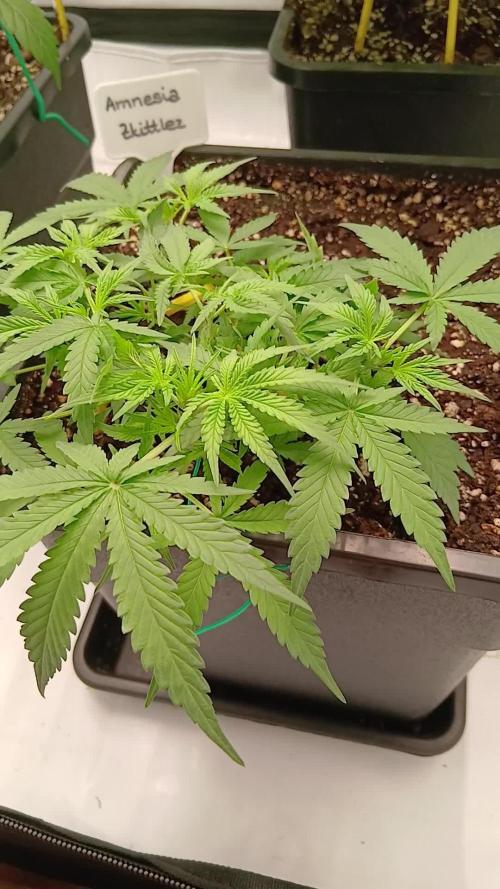
15.08.2025 They started flowering some days ago. They are splendid 🌸
Super-Cropped the Original Afghan Kush for achieving an even canopé, not mentioning the tiny version of Amnesia Zkittlez, which will never reach the canopé of the others.
16.08.2025 Yesterday evening I cropped the main cola of the O. A. K. and this morning 5 am she totally recovered the stem and is standing as before the cropping. Oh, Lord 😅


Processing
Likes
5
Share


@Mr_nugs_lover_David
Follow
She's looking gorgeous on her 3rd week of life in this crazy world. Love this pheno and love how she's developing, let's see what we can do!

Likes
16
Share


@HowtoBubatz
Follow
Today marks the beginning of the last week of flowering for my cannabis plant. After months of care and patience, I can finally see the first amber trichomes starting to form.
It's a sign that the plant is nearing the perfect time for harvest. The buds are dense and frosty, and the shift in trichome color is telling me that the plant is at its peak potency.
In a couple of days, I'll move the plant out of the tent and into complete darkness for 48 hours.
This process is supposed to help boost resin production and make the final buds even better.
After that, it’ll be time to cut her down. It's exciting to be so close to the end, and I can't wait to see how the final product turns out!🌱🌱


Likes
56
Share


@Master_weeda
Follow
Bonjour à tous les padawans et les maîtres jedis
Pour cette semaine 3 au jour 19 ma plante fais 21 centimètres et son septième noeud apparaît je décide donc de pratiquer un LST sur ma plante.
Pour ce j'utilise du fil de fer galvanisé que je plante directement dans le substrat en faisant attention de ne pas endommagé les racines car n'oublions pas que ce qui pousse dessus pousse aussi dessous.
Jour 17 je pulvérise du une solution composé d'une cuillère à café de savon noir mou (marque briochin) dilué dans un demi litre d'eau en prévention d'éventuels nuisibles.
Pourquoi le savon noir mou ?
Savon noir : quelle utilisation pour le jardin ?
Le savon noir est un produit naturel dont les propriétés nettoyantes sont connues depuis l'Antiquité. Utilisé pour l'entretien de la maison et pour les soins corporels, ses vertus antibactériennes et insecticides en font un allié précieux pour le jardinier bio.
Le savon noir est fabriqué à partir de potasse et d'un corps gras de type huils végétale comme l'huile d'olive, de lin ou de maïs.
Produit naturel et biodégradable (s'il ne contient pas d'additifs, comme cela peut-être parfois le cas), c'est un très bon produit nettoyant, pour les sols, la cuisine, la vaisselle, le linge, etc... Très polyvalent, il est également économique, comparé aux multiples détergents classiques du commerce.
Le savon noir se trouve sous forme de pâte molle et brune ou sous forme liquide, dilué avec de l'eau. C'est du savon noir liquide dont on se sert généralement au jardin, car son utilisation est plus simple. Il s'achète dans les magasins bio ainsi qu'en grandes surfaces ou jardineries.
Attention : la recette du savon noir de ménage et celle du savon noir utilisé en cosmétique ne sont pas forcément les mêmes ; les savons noir de ménage (multi-usages) peuvent contenir davantage de potasse afin d'améliorer le pouvoir dégraissant (irritant ou desséchant pour la peau), voire même certains additifs chimiques.
Au jardin, ce sont en priorité les propriétés antiseptiques et insecticides du savon noir qui sont utilisées.
Le savon noir liquide est utilisé pour lutter contre les pucerons, les cochenilles, les araignées rouges, les aleurodes, les psylles et autres thrips. C'est un insecticide de contact ; il tue les larves et nettoie le miellat qui englue les feuilles.
La recette de l'insecticide à base de savon noir (mou pour ma par marque briochin) est simple à réaliser : une ou deux cuillères à café de savon noir mou (briochin) diluées dans 1 demi litre d'eau tiède (dilution à 5 %) ; une fois la préparation refroidie, pulvérisez-la sur les plantes atteintes, en prenant soin de ne pas oublier l'envers des feuilles. À renouveler 1 à 2 fois si nécessaire, pour être totalement débarrassé des indésirables.
Comme il est de mise pour la plupart des traitements, ne pulvérisez pas la solution à base de savon noir en pleine journée, sous le soleil (ni sous la pluie !) ; procédez le matin de bonne heure ou patientez jusqu'à la fin de journée, lorsque les températures sont en dessous de 20°C.
Jour 18 Je corrige mon LST suivant la pousse de ma plante ...
Pour ma par c'est la manière dont je procède mais petit rappel de la technique du LST
Quand commencer à appliquer la technique LST ?
De nombreux cultivateurs commencent la manipulation dés que les plantes possèdent entre 3 et 6 nœuds ou une paire de feuilles. Durant cette première étape de la croissance, le tronc encore flexible est pliable sans risque qu’il ne se casse, même si au fur et à mesure du développement de la plante il sera de plus en plus difficile de le plier. Nous pouvons continuer à guider la croissance des branches durant toute la culture, même durant la floraison, ce qui pour cette étape représente un grand avantage face à la taille, qui n’est pas du tout recommandé une fois que la formation des têtes commence, cela stressera en effet la plante, ce qui aura pour effet de retarder la récolte.
Comment appliquer la technique de guidage LST
Si nous sommes prudents, la flexibilité naturelle des fibres du cannabis permet de plier leur tronc et branches avec une relative facilitée, même durant la floraison des plantes.
En utilisant une corde fine, nous pouvons accrocher la pointe de la plante à la base du pot par exemple ou à un tuteur que nous aurons planté dans le substrat. Nous plierons le tronc avec précaution et nous le fixerons avec la corde, à partir de là, nous pouvons augmenter progressivement la tension de la corde, chaque jour un peu plus, jusqu’à obtenir la position souhaitée. Soyez attentif à la réaction de la plante, essayez de ne pas appliquer trop de pression sur la corde et rappelez-vous que la flexibilité des branches peut varier d’une plante à l’autre.
Pour obtenir de meilleurs résultats, il suffit de suivre quelques règles simples. Pour commencer, nous devons choisir une corde fine mais pas trop pour ne pas blesser les troncs au fur et à mesure qu’ils grandissent et qu’ils deviennent plus gros.
Nous pouvons utiliser des crochets en plastique souple ou de n’importe quelle autre matière flexible pour éviter d’endommager les plantes. Spécialement en intérieur, utiliser des cordons en plastique de couleur (voir les diaries de @Silky) est très pratique pour voir facilement les accroches et faciliter le travail au milieu du réseau formés par les cordes, les tuteurs, les mailles ou les supports que nous aurons dans la culture. Bien entendu, en culture extérieure et surtout en guerilla nous ferons juste le contraire et nous utiliserons des matériaux de couleur qui n’attirent pas l’attention pour que notre jardin reste discret.
Pour stresser les plantes au minimum, la mieux est de réaliser ces manipulations le soir ou juste après que les lampes en intérieur s’éteignent, ce qui leur permettra de se remettre durant la nuit. Normalement, le jour suivant nous pourrons observer comme les pointes des branches que nous avons pliées se dressent de nouveau vers le haut à la recherche d’une source de lumière.
Que la force soit avec vous💪

Likes
19
Share


@EeyoreTheHomie
Follow
This strain was a pain in the ass honestly. I will never grow bagseeds again, when real genetics are so cheap.
This plant hermmed so I have a metric fuckton of seeds that I have no idea what to do with.
But for a first grow, this plant was really good at letting me know when I was doing something wrong. My other runs suffered the same treatment, but their strong genetics didn't mind as much. But this plant, this plant bitched and moaned about everything. Its leaves faded like 2 weeks early. It had all these weird mutations. When she was a babe (Weeks 1-4), I literally thought that she died from how she didn't grow much at all. Every other plant I've popped since, has been a dream compared to this one. But now I know how to diagnose all these things. I feel like I got 10 grows worth of wisdom in one. So for that, I am thankful.
RIP Big Bertha. You may be gone but, with the amount of seeds you've given me, your lineage will never die.
Likes
37
Share


@AUTOBUDDHA
Follow
Patiently waiting for these girls to begin their final descent! Gonna be some monster plants! Momster buds!!!
Steady on my nutrient schedule this week and she made some big gains!!!